
The Monetary Policy of India is an important economic tool used by the Reserve Bank of India (RBI) to regulate money supply, control inflation and support economic growth. It determines how much money circulates in the economy and influences interest rates, credit availability and overall financial stability.
In India, the RBI implements this policy through various instruments such as quantitative tools and qualitative tools. While quantitative tools control the overall supply of money and credit, qualitative tools regulate the direction and purpose of credit flow. For UPSC and APSC aspirants, understanding these tools is important for both prelims and mains.
This article explains the meaning, objectives and functions of Monetary Policy. It also covers RBI’s major instruments, including quantitative tools and qualitative tools, with examples relevant for UPSC and APSC examinations.
What Is Monetary Policy?
It refers to the policy adopted by the central bank to manage money supply, credit availability and interest rates in an economy.
In India, the RBI is responsible for formulating and implementing monetary policy. The RBI uses different instruments to maintain economic balance.
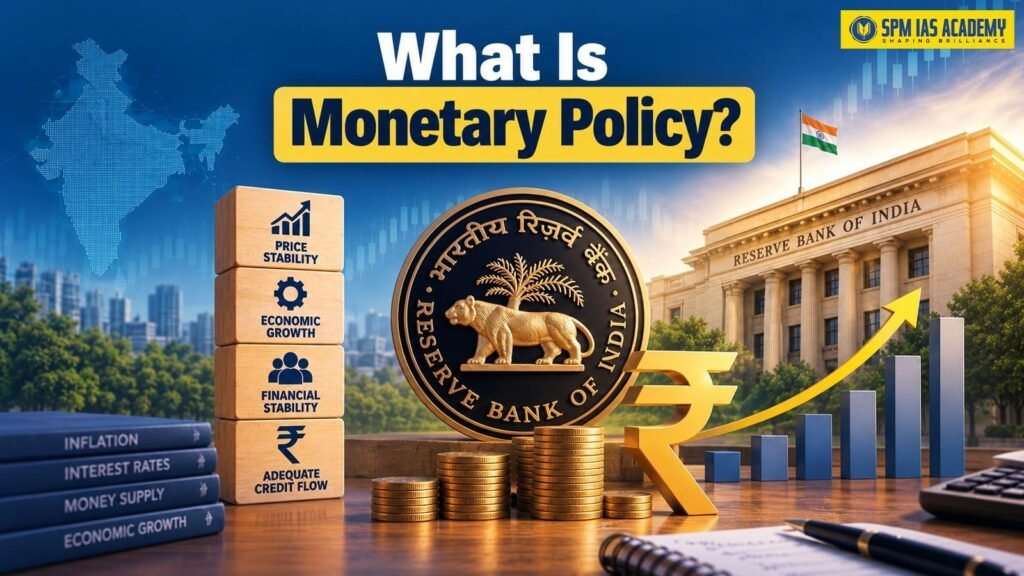
The main purpose of monetary policy is to control inflation, Maintain price stability. Moreover, it also supports economic growth, regulates credit availability and ensures financial stability. Therefore, it acts as a bridge between economic growth and inflation management.
Who Formulates Monetary Policy in India?
- The Reserve Bank of India manages India’s monetary policy framework. The Monetary Policy Committee (MPC) plays a key role in deciding the policy interest rate, especially the repo rate.
- The MPC consists of six members. Three members from the RBI and three external members appointed by the Government of India.
- The committee meets regularly to review economic conditions and decide monetary policy measures.
- The primary objective of the MPC is to maintain price stability while keeping economic growth in mind.
What are the primary Objectives of Monetary Policy in India?
The RBI uses monetary policy to achieve several economic objectives.
- Maintaining Price Stability:
- Firstly, controlling inflation remains the primary objective of monetary policy.
- High inflation reduces purchasing power and affects economic stability. Therefore, the RBI adjusts interest rates and credit conditions to control inflation.
- Promoting Economic Growth:
- Moreover, monetary policy supports economic growth by ensuring adequate availability of credit.
- Lower interest rates can encourage businesses and individuals to borrow and invest.
- Regulating Money Supply:
- The RBI manages the amount of money circulating in the economy.
- Excess money supply can increase inflation, while insufficient money supply can slow economic activity.
- Maintaining Financial Stability:
- Furthermore, monetary policy helps maintain confidence in the banking and financial system.
What Are Quantitative Tools of Monetary Policy?
Quantitative tools are broad-based instruments used by the RBI to control the overall volume of money and credit in the economy.
These tools affect the entire banking system.
- Repo Rate: The repo rate is the rate at which the RBI lends money to commercial banks. When the RBI increases the repo rate then borrowing becomes expensive. Banks reduce lending. Consequently, money supply decreases. Therefore, higher repo rates help control inflation.
- Reverse Repo Rate: The reverse repo rate is the rate at which the RBI borrows money from commercial banks. By increasing the reverse repo rate, the RBI encourages banks to deposit excess funds with it.
- Cash Reserve Ratio (CRR): CRR refers to the percentage of deposits that banks must maintain with the RBI as cash reserves. When the RBI increases CRR, banks have fewer funds for lending. Moreover, credit creation decreases and money supply reduces.
- Statutory Liquidity Ratio (SLR): SLR requires banks to maintain a certain portion of deposits in liquid assets such as government securities. It helps regulate bank lending capacity.
- Open Market Operations (OMO): Through OMO, the RBI buys or sells government securities. While buying securities increases money supply, on the other hand, selling securities reduces money supply.
What Are Qualitative Tools of Monetary Policy?
Qualitative tools are selective credit control measures used by the RBI to regulate the direction of credit. Unlike quantitative tools, these instruments focus on specific sectors or activities. The major qualitative tools include:
- Margin Requirement: The RBI changes the margin requirement between the value of security and the loan amount. Higher margins reduce excessive borrowing against securities.
- Credit Rationing: Through credit rationing, the RBI limits the availability of loans for specific purposes. This prevents misuse of credit and encourages productive lending.
- Moral Suasion: Moral suasion refers to the RBI persuading banks to follow responsible lending practices. The RBI uses guidelines and discussions to influence banking behaviour.
- Direct Action: The RBI can take regulatory action against banks that do not follow its instructions. Moreover, it may impose penalties or restrict certain banking activities.
- Selective Credit Control: Selective credit control allows the RBI to regulate lending towards specific commodities or sectors. It helps control speculative activities and inflationary pressures.
Difference Between Quantitative Tools and Qualitative Tools
| Quantitative Tools | Qualitative Tools |
| Control overall credit supply | Control credit direction |
| Affect the entire economy | Target specific sectors |
| Include repo rate, CRR and SLR | Include credit rationing and moral suasion |
| Used mainly for inflation control | Used for selective regulation |
Both tools work together to make Monetary Policy effective.
Why is Monetary Policy Important for India?
A strong monetary policy framework helps India manage economic challenges.
- Firstly, it helps control inflation and maintain purchasing power.
- Moreover, it supports sustainable economic growth.
- It improves financial stability.
- Furthermore, it regulates credit flow in the economy.
- Overall, it strengthens confidence in the banking system.
Therefore, its effective implementation plays an important role in India’s economic development.
Conclusion
The Monetary Policy framework allows the RBI to manage inflation, regulate credit and support economic growth. Through quantitative tools and qualitative tools, the central bank maintains balance between liquidity management and financial stability.
For UPSC and APSC aspirants, understanding RBI’s monetary policy instruments provides a strong foundation for analysing India’s economic challenges and policy decisions.
Read More:
Source:
Frequently Asked Question
1. What is Monetary Policy in India?
It refers to the RBI’s approach to managing money supply, credit availability and interest rates. It primarily aims to maintain price stability while supporting economic growth. Therefore, the RBI uses various monetary policy instruments to manage inflation and financial stability.
2. What are the quantitative tools of Monetary Policy?
Quantitative tools control the overall volume of money and credit in the economy. The major instruments include the repo rate, reverse repo rate, CRR, SLR and Open Market Operations (OMO). These tools affect the entire banking system and help the RBI manage liquidity and inflation.
3. What are the qualitative tools of Monetary Policy?
Qualitative tools regulate the direction and purpose of credit rather than its overall volume. These include margin requirements, credit rationing, moral suasion, direct action and selective credit control. Thus, the RBI can use them to influence lending towards specific sectors or activities.

Behind every article at SPM IAS Academy is a team of skilled content writers and subject experts committed to making preparation easier for aspirants. From answering common doubts to breaking down complex issues and current affairs, we create content that is accurate, easy to understand, and directly useful for UPSC, APSC, and other competitive exams.