
Why in the News?
Recently, US President Donald Trump shared a new map of America on social media in which Greenland, Canada, and Venezuela were depicted as part of US territory. The topic got global attention after former US President Donald Trump shared a social media post showing Greenland, Canada, and Venezuela as part of US territory. The post went viral and sparked international debate. Soon after, the phrase “Greenland US Territory Est 2026” began trending online, prompting renewed questions about why the US wants Greenland. The incident has highlighted wider concerns around Arctic geopolitics, national sovereignty, and international norms.
Therefore, this article examines why the US wants Greenland in a comprehensive and exam-oriented manner by analysing its historical background, strategic motivations, Greenland’s geopolitical importance, Denmark’s position, international law dimensions, Arctic geopolitics, global reactions, and implications for India.
For aspirants of UPSC, APSC, and State PCS examinations, this issue is highly relevant as it intersects international relations, geopolitics, climate change, resource security, and ethics in global governance.
Why does the US Want Greenland?
The renewed debate over why the US wants Greenland highlights a major shift in global geopolitics, especially in the Arctic region. In simple terms, Greenland has become strategically important due to its location, natural resources, and growing relevance in a warming world. As climate change opens new sea routes and intensifies competition among major powers, the United States sees Greenland as crucial for security, energy, and influence. Therefore, this issue goes beyond territory and reflects deeper questions of power, sovereignty, and global governance in the 21st century.
What is the Historical Background of US Interests on Greenland?
The idea of the United States acquiring Greenland dates back to the 19th century. In 1867, after purchasing Alaska, the US explored the possibility of buying Greenland. Later, in 1946, the US formally offered Denmark $100 million in gold to buy Greenland, which Denmark rejected.
In recent years, the issue resurfaced prominently when political leaders in the United States openly discussed the strategic advantages of Greenland. Although Denmark and Greenland firmly rejected the proposal, the renewed interest highlighted deeper geopolitical calculations rather than a mere real estate transaction.
Where Is Greenland and Why Does It Matter?
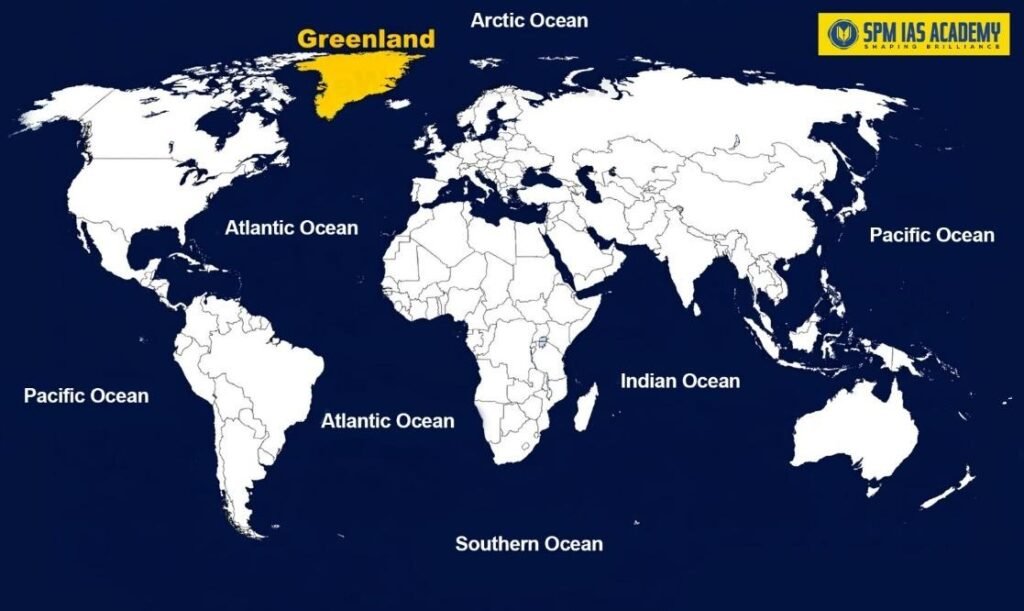
Why is Greenland Geographically Significant?
- Greenland is the world’s largest island, located between the Arctic and Atlantic Oceans.
- It lies strategically between North America and Europe. It makes Greenland critical for trans-Atlantic security.
- Greenland controls key Arctic Sea routes that are becoming increasingly accessible due to climate change.
What is the Political Status of Greenland?
- Greenland is an autonomous territory of the Kingdom of Denmark.
- It has its own parliament and government, while Denmark manages defence and foreign affairs.
- Importantly, Greenlanders possess the right to self-determination, a crucial factor in international law.
What are the Strategic Factors Behind the US Call for Acquiring Greenland?
1. Arctic Militarisation and Security:
The Arctic is rapidly emerging as a new theatre of strategic competition.
- Firstly, melting ice has opened new navigation routes such as the Northern Sea Route.
- The US views Greenland as vital for early warning systems and missile defence.
- The Thule Air Base (now Pituffik Space Base) already hosts critical US military infrastructure.
Therefore, the US sees Greenland as essential to protect its northern flank.
2. Countering Russia and China:
- Russia has expanded military bases across the Arctic.
- China has declared itself a “near-Arctic state” and invested heavily in Arctic research and infrastructure.
- Consequently, the US fears strategic encirclement if it fails to secure Arctic influence.
Thus, Greenland becomes a geopolitical buffer against rival powers.
3. Natural Resources and Energy Security:
- Greenland holds vast untapped resources. Its resource deposits include rare earth elements, uranium, oil and natural gas and critical minerals essential for green technologies.
- As global supply chains face uncertainty, the US seeks resource diversification away from China, making Greenland strategically valuable.
4. Climate Change and New Economic Routes:
Climate change has transformed the Arctic from a frozen frontier into an economic corridor.
- Shorter shipping routes reduce transit time between Asia, Europe, and North America.
- Control over Arctic infrastructure will lead to long-term economic and strategic advantages.
Denmark and Greenland’s Response:
Denmark’s Position:
Denmark unequivocally rejected the idea of selling Greenland. Danish leadership stated that Greenland is not for sale. Moreover, Denmark reaffirmed its commitment to Greenland’s autonomy and welfare. The issue also strengthened Denmark’s resolve to invest more in Arctic security.
Greenland’s Perspective:
Greenland’s leaders strongly opposed any acquisition proposal. They emphasised self-determination and indigenous rights. Moreover, Greenland seeks greater international engagement without compromising sovereignty. The episode intensified Greenland’s internal debate on eventual independence.
International Law and Ethical Dimensions:
Sovereignty and Self-Determination:
Under the UN Charter, territories cannot be transferred without the consent of their people.
- Greenlanders have the right to decide their political future.
- Any acquisition without the consent of its citizens would violate international norms.
Ethical Concerns:
The proposal raised ethical questions like “can powerful states treat territories as commodities?” Or “does strategic interest override democratic choice?” For GS Paper IV (Ethics), this issue highlights tensions between realpolitik and moral responsibility.
Arctic Governance and Multilateral Institutions:
Role of the Arctic Council:
- The Arctic Council is an intergovernmental forum. It aims to promote cooperation, coordination and interaction among Arctic states, Arctic indigenous people and other Arctic inhabitants on common Arctic issues.
- Established in 1996, it focuses on environmental protection and sustainable development.
- While the US is a member of this council, its unilateral actions threaten cooperative Arctic governance.
NATO Dimension:
- Denmark, as a member of NATO, strongly criticised the intention of the United States to acquire Greenland. Moreover, it warned that any attempt to take Greenland by force would amount to a violation of NATO’s principles of collective security.
- In addition, Greenland already plays an important role in NATO’s security architecture through existing defence arrangements. Therefore, acquiring Greenland is not necessary for strategic or security cooperation within the NATO framework.
Global Reactions and Diplomatic Impact:
Several European nations criticised the transactional approach adopted by the United States. Moreover, China closely monitored the developments because of its growing ambitions in the Arctic region. At the same time, smaller states viewed the proposal as a dangerous precedent for great-power coercion. As a result, the issue temporarily strained diplomatic relations between the United States and Europe.
Implications for India:
To begin with, although India is not an Arctic state, the issue holds indirect significance for the country. In this context, India participates as an observer in the Arctic Council. It keeps it engaged in Arctic governance discussions. Moreover, stability in the Arctic region influences global climate systems, including the Indian monsoon. In addition, Arctic mineral geopolitics can affect global supply chains that are crucial for India’s green energy transition. Therefore, India consistently supports a rule-based, cooperative, and multilateral approach to Arctic governance.
Way Forward:
Instead of acquisition, experts suggest:
- Strengthening diplomatic engagement with Greenland.
- Investing in joint research and climate studies.
- Respecting indigenous rights and autonomy.
- Promoting multilateral Arctic governance.
Such an approach ensures security without undermining international norms.
Conclusion:
In conclusion, when we look at why the US wants Greenland, it becomes clear that the interest is driven by concerns over security, resources, and a changing Arctic environment. However, understanding why the US wants Greenland also reminds us that global power politics must respect international law, ethics, and the wishes of people living on that land. Ultimately, Greenland’s firm rejection reinforces a simple truth – territories are not commodities, and people are not bargaining chips in geopolitical competition.
Source:
- https://www.aljazeera.com/news/2025/3/28/is-trumps-greenland-plan-part-of-a-scramble-for-the-arctic
- https://www.aljazeera.com/news/2025/12/23/trump-says-greenland-essential-for-security-could-he-take-it-by-force
Also read :
FAQ’s
To begin with, the US is interested in Greenland due to its strategic location in the Arctic, military importance, and access to critical minerals. Moreover, climate change has increased Greenland’s geopolitical and economic value.
Greenland is important because it lies between North America and Europe and controls emerging Arctic Sea routes. In addition, it plays a key role in Arctic security, missile defence, and trans-Atlantic strategic stability. That is why the US wants Greenland.
No, under international law and the UN Charter, Greenland cannot be transferred without the consent of its people. Therefore, any acquisition without public approval would violate the principle of self-determination.
Greenland is an autonomous territory of Denmark, which manages defence and foreign affairs. As a result, US acquisition proposals strained diplomatic relations, even though Denmark and the US remain NATO allies.
What does the Greenland issue reveal about modern geopolitics?
The issue highlights how climate change is reshaping global power politics. At the same time, it shows the tension between strategic interests and international law in global governance.