

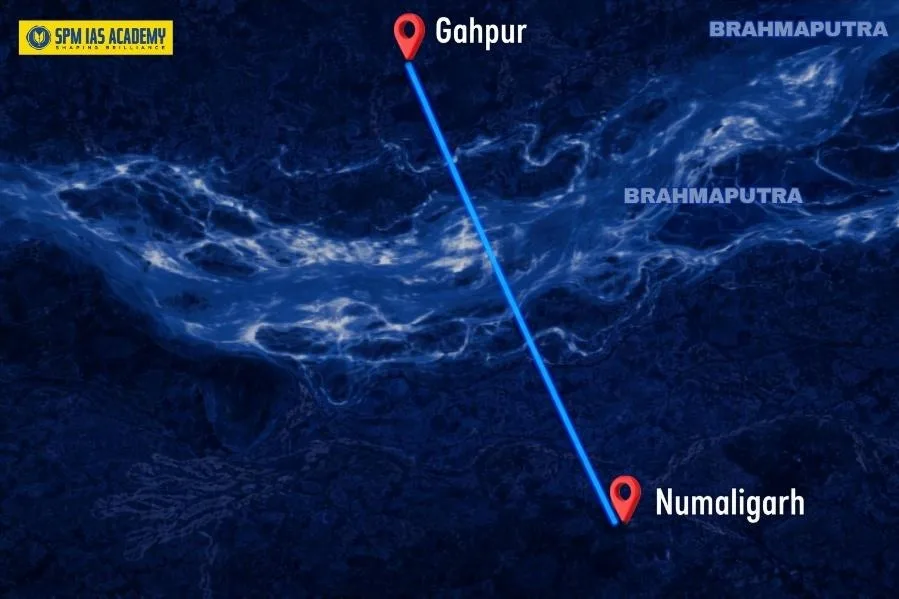
The Cabinet Committee on Economic Affairs (CCEA) has approved the construction of the Gohpur-Numaligarh tunnel under the Brahmaputra River in Assam at a total cost of ₹18,662 crore. This ambitious project will become India’s first and the world’s second rail-cum-road underwater tunnel. The 15.79 km long twin-tube tunnel will significantly improve connectivity between Gohpur and Numaligarh and strengthen infrastructure development in Northeast India.
What is the Gohpur-Numaligarh Tunnel Project?
The Gohpur-Numaligarh underwater tunnel is a 15.79 km long twin-tube tunnel that will run beneath the Brahmaputra River. It will form part of a 33.7 km long four-lane access-controlled greenfield connectivity corridor between Gohpur and Numaligarh.
Importantly, one of the twin tubes will include railway infrastructure, making it a rail-cum-road tunnel. The project will be constructed in Engineering Procurement Construction (EPC) mode and is expected to be completed within five years.
Thus, this project marks a historic milestone in India’s infrastructure development.
What are the Key Features of the Gohpur-Numaligarh Tunnel?
1. First Rail-Cum-Road Underwater Tunnel in India:
- Firstly, this project will become India’s first underwater rail-cum-road tunnel. Moreover, it will be only the second such tunnel in the world, marking a significant engineering milestone.
2. Reduced Travel Time:
- At present, the distance between Numaligarh (NH-715) and Gohpur (NH-15) is about 240 km, and commuters take nearly 6 hours via the Kaliabhomora Bridge.
- However, after completion of the project, travel time will reduce to just 20 minutes and the average speed will almost double, thereby significantly enhancing regional connectivity.
3. Strategic Location and Connectivity:
- Firstly, the tunnel alignment seamlessly integrates with key transport corridors such as National Highway 15 (NH-15), National Highway 715 (NH-715). Furthermore, it also aligns with the Rangia–Murkongselek Railway Section and the Furkating–Mariani loop line section. Therefore, it will strengthen surface and rail connectivity.
- Moreover, it strategically connects 11 economic nodes, 3 social nodes, 2 tourist nodes and 8 logistics nodes. In addition, it connects 4 major railway stations, 2 airports, and 2 inland waterways, thereby significantly enhancing multi-modal integration across Northeast India.
Why is the Gohpur-Numaligarh Tunnel Important?
The Gohpur-Numaligarh tunnel under Brahmaputra has multiple strategic, economic, and developmental implications.
1. Boost to Regional Economic Growth:
- Firstly, the project will improve freight movement efficiency and reduce logistics costs.
- Moreover, it will encourage industrial development and strengthen trade opportunities. As a result, it will accelerate socio-economic growth in Assam and neighbouring states.
2. Benefit to Northeast States:
- Moreover, the project will significantly benefit Assam, Arunachal Pradesh, Nagaland, and other Northeastern states. Therefore, it will promote balanced and inclusive regional development across the region.
3. Strategic Importance:
- The tunnel enhances strategic mobility in border areas. Faster connectivity strengthens national security and improves disaster response capabilities. Thus, the project holds both economic and defense significance.
4. Employment Generation:
- Furthermore, the project is expected to generate approximately 80 lakh person-days of employment, creating both direct and indirect job opportunities.
- Hence, it will significantly contribute to livelihood generation and boost local economic growth.
Students from the region can access specialized mentorship and preparation resources through UPSC coaching in north east India
What are the challenges of Gohpur-Numaligarh Tunnel?
1. Engineering and Technical Challenges:
- Firstly, the Brahmaputra carries a high sediment load, which makes underwater construction highly complex.
- Moreover, the riverbed remains unstable and frequently shifts its channels.
- The region falls under Seismic Zone VI. Therefore, the region is highly prone to earthquake risks.
- In addition, heavy monsoon rainfall can disrupt construction timelines.
- Furthermore, advanced Tunnel Boring Machine (TBM) technology requires high precision and skilled expertise.
2. Environmental Challenges:
- The Brahmaputra ecosystem is ecologically sensitive and biodiversity-rich. Consequently, construction activities may disturb and threaten aquatic flora and fauna including Endangered Gangetic Dolphin.
- Moreover, safe disposal of excavated materials demands strict environmental planning.
- Additionally, climate change-induced floods increase long-term environmental vulnerability.
3. Financial and Fiscal Challenges:
- The project involves very high capital investment.
- In addition, technical complexities may lead to cost overruns.
- Therefore, strict fiscal discipline and continuous monitoring are essential.
4. Administrative and Coordination Challenges:
- Multiple agencies are involved in project execution. Therefore, maintaining smooth coordination among the departments are necessary.
5. Social and Rehabilitation Concerns:
- Local communities may express concerns regarding livelihoods.
- Furthermore, construction activities may disrupt river-based occupations.
- Hence, inclusive consultation and proper rehabilitation measures are required.
7. Maintenance and Long-Term Sustainability:
- Underwater tunnels require continuous monitoring and advanced safety systems.
- In addition, maintenance costs may remain high after completion.
- Therefore, strong disaster management preparedness is essential in this flood-prone and high seismic region.
Engineering and Construction Model:
The Gohpur-Numaligarh tunnel will be built in EPC (Engineering, Procurement and Construction) mode.
Under EPC mode:
- The contractor handles design, procurement, and construction.
- The government ensures project oversight.
- Moreover, under this model, implementation becomes time-bound and efficient.
Therefore, the project ensures faster and structured execution.
Long-Term Impact of the Project:
- Firstly, the Gohpur–Numaligarh tunnel will enhance multi-modal transportation by integrating road and rail connectivity.
- Secondly, it will strengthen the logistics network across the Northeast, thereby improving supply chain efficiency.
- Moreover, it will promote the development of industrial corridors and facilitate economic growth in the region.
- In addition, the project will boost tourism by improving accessibility to key destinations.
- Furthermore, it will improve connectivity to airports and inland waterways, thereby supporting seamless transport integration.
- Consequently, the tunnel will open new avenues for trade expansion and industrial development in the Northeast.
Conclusion: Gohpur-Numaligarh Tunnel and Northeast Development
In conclusion, the Gohpur-Numaligarh tunnel under Brahmaputra represents a transformative infrastructure project for Northeast India. As India’s first rail-cum-road underwater tunnel, it strengthens connectivity and reduces travel time. Moreover, it integrates highways, railways, airports, and waterways into a seamless transport network.
Furthermore, the project supports regional economic growth, enhances strategic mobility, reduces logistics costs, and generates large-scale employment. By strengthening Assam’s infrastructure and improving connectivity across the Northeast, the Brahmaputra underwater tunnel project will play a vital role in long-term development and national integration.
Thus, the Gohpur-Numaligarh tunnel stands as a landmark initiative in India’s modern infrastructure expansion.
Aspirants preparing for civil services can explore expert guidance through UPSC coaching in Assam for structured preparation.
APSC Mains Practice Question:
Q. The Gohpur-Numaligarh Tunnel under Brahmaputra is considered a transformative infrastructure project for Northeast India. Discuss its strategic, economic, and developmental significance, along with the key challenges in its implementation.
Source:
Frequently Asked Questions:
The Gohpur-Numaligarh Tunnel under Brahmaputra is a 15.79 km long twin-tube underwater tunnel in Assam. It will connect Gohpur and Numaligarh. It will be India’s first and world’s second rail-cum-road underwater tunnel.
The Gohpur-Numaligarh Tunnel will strengthen connectivity in Northeast India by reducing travel time from nearly 6 hours to about 20 minutes. It will improve logistics, promote industrial development, and enhance strategic mobility in border areas.
The Cabinet Committee on Economic Affairs approved the Gohpur-Numaligarh Tunnel project at a cost of ₹18,662 crore. The project will be constructed in EPC (Engineering, Procurement and Construction) mode and is expected to be completed within five years.
Currently, travellers cover around 240 km via Kaliabhomora Bridge between Numaligarh and Gohpur. After completion, the Brahmaputra underwater tunnel will reduce the travel time to approximately 20 minutes, significantly enhancing regional connectivity.
The Gohpur-Numaligarh Tunnel under Brahmaputra will boost multi-modal transportation, strengthen the Northeast logistics network. In addition, it will promote tourism, generate employment, and open new avenues for trade and industrial expansion in Assam and neighbouring states.