

On the eve of Good Governance Day, the Government of Arunachal Pradesh launched Good Governance Week (Sushasan Saptah) 2025 across all districts.
As part of this reform initiative, the Tawang district administration started a special campaign “Prashasan Gaon ki Ore” (Administration towards the Village). It aimed to strengthen grassroots administration and service delivery.
Through this campaign, the district administration aims to improve last-mile service delivery. Moreover, it will enhance public grievance redressal. Furthermore, it will promote citizen-centric and inclusive governance.
The campaign was observed from 19 December to 25 December 2025. It focused on administrative outreach, transparency, and accountability at the village level. This topic is highly relevant for APPSC GS Paper I, II and Arunachal Pradesh current affairs for other competitive exams.
What is Prashasan Gaon ki Ore? Key Features:
- To begin with, Prashasan Gaon ki Ore is a governance initiative. This initiative focuses on taking administration directly to villages.
- Firstly, it promotes grassroots outreach by organising camps in villages. Through these, people can access essential government services at their doorstep.
- Secondly, the initiative gives special importance to grievance redressal. Through Jan Sunvai, officials listen to public complaints and aim for on-the-spot resolution.
- Moreover, the programme strengthens administrative responsiveness by stressing transparency, timely action, and accountability in service delivery.
- At the same time, it ensures inclusion by reaching remote, marginalised, and last-mile populations. These people often face barriers in accessing governance.
- Overall, the core objective of Prashasan Gaon ki Ore is to reduce procedural delays. It aims to improve trust in administration, and make governance people-centric and accessible at the village level.
What is Good Governance Day?
Good Governance Day is observed every year on 25 December. Notably, the day marks the birth anniversary of Atal Bihari Vajpayee, former Prime Minister of India. At its core, this day highlights the idea that governing process is not limited to routine administration. Instead, it serves as a means to improve the quality of life of citizens by promoting accountability, transparency, and inclusiveness in public administration.
Good Governance Index (GGI):
The index is a benchmarking tool developed by the Department of Administrative Reforms and Public Grievances (DARPG). It was launched on25 December 2019 with the objective of strengthening governance across India.
Primarily, the index aims to measure the adminstrative performance of States and Union Territories. At the same time, it seeks to promote evidence-based reforms and encourage healthy competition among states through the adoption of best practices.
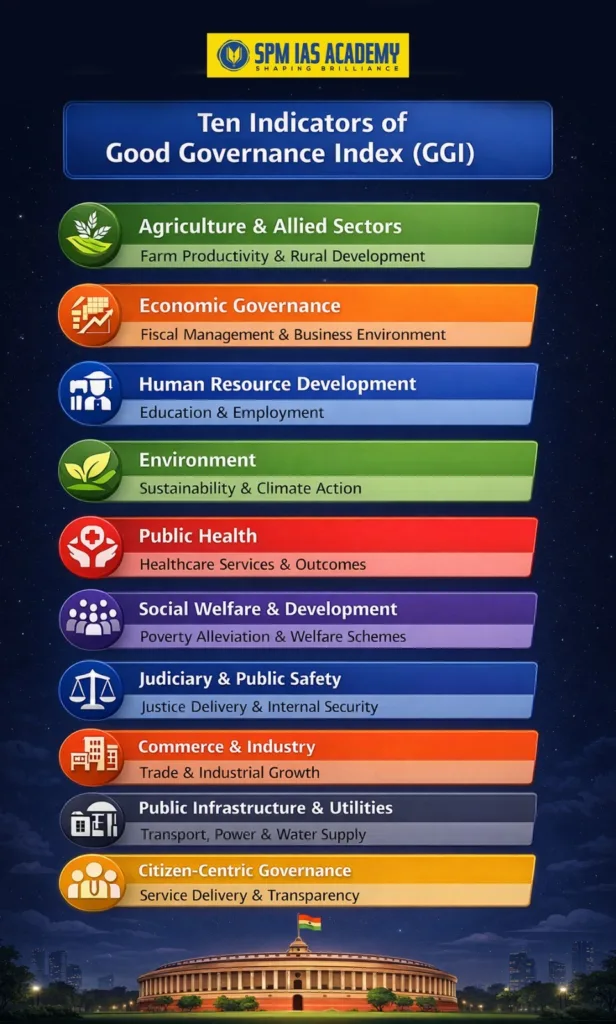
Importantly, the GGI is a composite index. It uses multiple indicators to assess administration in a comprehensive manner. As a result, it supports outcome-oriented andcitizen-centric governing system.
Overall, the Good Governance Index enables a comparative assessment across regions. It helps governments identify gaps, improve service delivery, and enhance transparency and accountability.
Ten Indicators of GGI:
What are the Significances of Good Governance Day?
The significance of this day lies in its focus on improving the quality of governing machinery in the country.
Firstly, it helps enhance state capacity and improve service delivery efficiency. It aims to ensure that public services reach citizens effectively.
Secondly, it works towards strengthening trust between citizens andthe administration by promoting transparency and accountability. Moreover, this day supports inclusive growth andbetter welfare outcomes, especially for marginalised sections.
In addition, it encourages cooperative and competitive federalism by motivating States and Union Territories to adopt best administrative practices. Finally, it aligns administrative processes with the Sustainable Development Goals (SDGs) and the constitutional values of justice, equality, and good administration.
Conclusion:
Overall, Good Governance Week (Sushasan Saptah) 2025 in Arunachal Pradesh reflects the government’s commitment to people-centric, transparent, and accountable administration. Initiatives like Prashasan Gaon ki Ore strengthen grassroots administration, last-mile service delivery make service delivery more accessible at the village level. For APPSC GS Paper II and Arunachal Pradesh current affairs, this development serves as a strong example of good administrative practices, cooperative federalism, and sustainable development-oriented administration.
Mains Practice Question:
“The Good Governance Index (GGI) has emerged as an important instrument for promoting outcome-oriented and citizen-centric administration in India.” Discuss the objectives, key features, and significance of the Good Governance Index. Also examine how the index helps in benchmarking administrative performance and encouraging evidence-based reforms among States and Union Territories.
Prelims Practice Question:
Q. Consider the following statements regarding the Good Governance Index (GGI):
- The Good Governance Index is a benchmarking tool developed by the Department of Administrative Reforms and Public Grievances (DARPG).
- The Good Governance Index was launched on 25 December 2019.
- The index aims to promote evidence-based governance reforms and healthy competition among States and Union Territories.
- The Good Governance Index evaluates governance performance using a single indicator focused only on economic growth.
Which of the statements given above are correct?
A) 1, 2 and 3 only
B) 1 and 4 only
C) 2 and 3 only
D) 1, 2, 3 and 4
Correct Answer: A
Source: Arunachal Times
Good Governance Week (Sushasan Saptah) is observed from 19 to 25 December to promote transparent, accountable, and citizen-centric administration. It concludes on Good Governance Day, which commemorates the birth anniversary of Atal Bihari Vajpayee. Moreover, it highlights administration as a means to improve citizens’ quality of life.
The GGI is a composite benchmarking index released by the Department of Administrative Reforms and Public Grievances (DARPG). It evaluates the governance performance of States and Union Territories across 10 sectors, promoting evidence-based reforms and competitive federalism.