
Why was the Legal Aid Clinic in Arunachal Pradesh in the news?
Recently, the Arunachal Pradesh State Legal Services Authority (APSLSA) launched a legal aid clinic at the Chimpu Police Station. Notably, the clinic was inaugurated by the Member Secretary of APSLSA, aiming to improve access to legal aid and justice at the grassroots level.
What is a Legal Aid Clinic?
A Legal Aid Clinic (LAC) is a grassroot institutional mechanism. It provides free legal assistance, awareness, and dispute resolution support to people who cannot afford legal services, especially in rural, tribal, and marginalized communities.
Moreover, it functions as a bridge between the justice delivery system and the common citizen. Thereby, it aims to ensure access to justice as a constitutional right. Legal Aid Clinics are usually located in Villages and Gram Panchayats, Urban slums, Law colleges and universities, Jails and juvenile homes and Remote and tribal areas.
What is the Constitutional Basis Behind Legal Aid Clinic?
The constitutional basis for Legal Aid Clinics lies in Article 39A of the Directive Principles of State Policy. Specifically, it directs the State to ensure equal justice and provide free legal aid. This constitutional provision aims to ensure that no citizen is denied access to justice due to economic or other disabilities.
Statutory Framework for Legal Aid Clinic:
The statutory framework for Legal Aid Clinics is provided under the Legal Services Authorities Act, 1987.
Under this Act, legal aid services are operationalised through a multi-tier institutional structure. At the national level, the National Legal Services Authority (NALSA) lays down policies and guidelines.
Subsequently, these services are implemented at the state level by State Legal Services Authorities (SLSAs). Further, District Legal Services Authorities (DLSAs) ensure delivery at the district level.
Finally, Taluk or Mandal Legal Services Committees extend legal aid services to the grassroots level, ensuring wider access to justice.
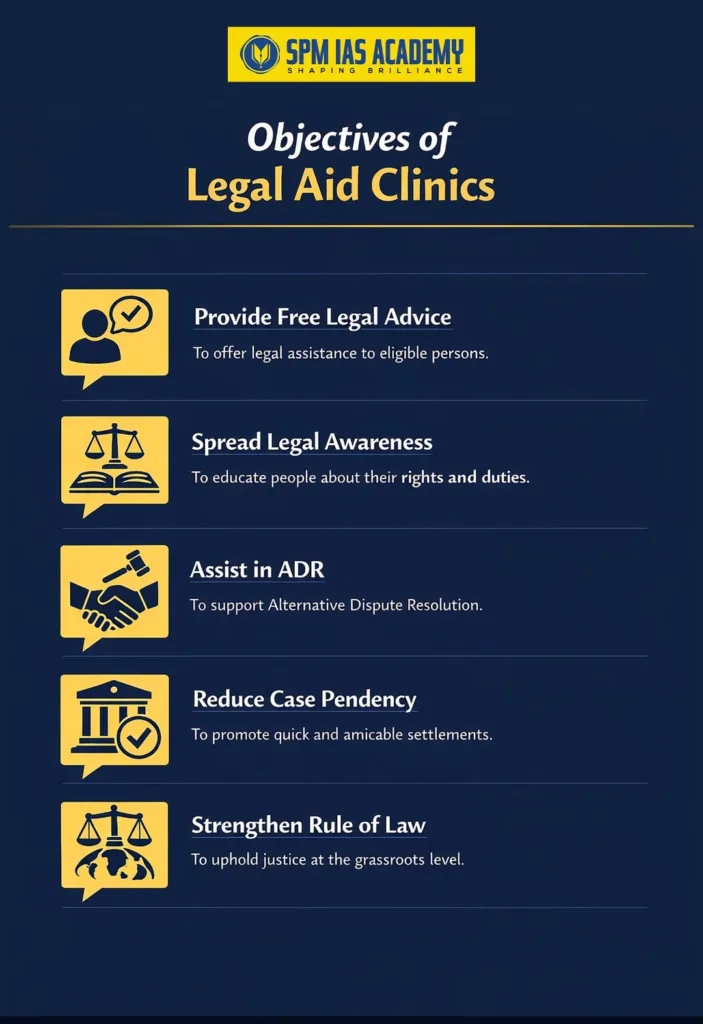
What are the Objectives of Legal Aid Clinics?
What are the Functions of Legal Aid Clinic:
- To begin with, Legal Aid Clinics provide legal counselling on issues such as family disputes, land matters, labour issues, domestic violence, and maintenance cases.
- Additionally, they play a key role in legal awareness and legal literacy. They educate people about the rights of women, SC/ST communities, children, senior citizens, workers, and minorities.
- Moreover, Legal Aid Clinics offer pre-litigation assistance. This includes drafting applications, notices, and petitions, as well as referring suitable cases to Lok Adalats.
- At the same time, they promote alternative dispute resolution (ADR) through mediation, conciliation, and compromise settlements. It helps to resolve disputes amicably.
- Finally, Legal Aid Clinics act as a link between beneficiaries and authorities, such as the police, courts, Legal Services Authorities, and welfare departments. Through this, it can ensure effective access to justice at the grassroots level.
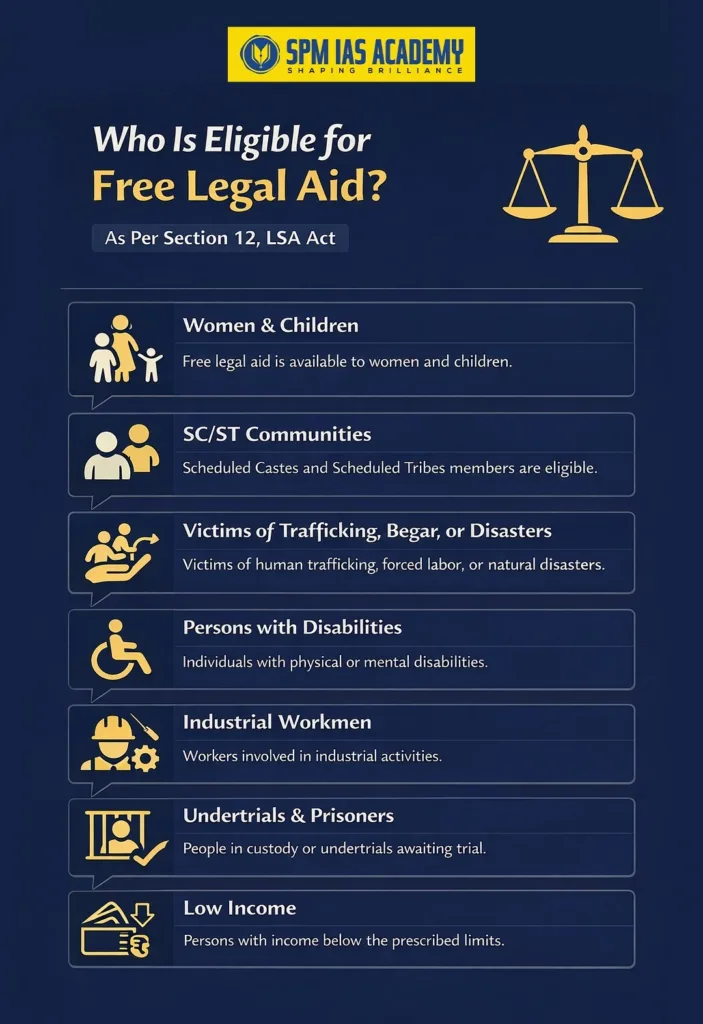
Who Is Eligible for Free Legal Aid?
As per Section 12, LSA Act, following are eligible for free legal aid:
What are the Importances of Legal Aid Clinics?
Legal Aid Clinics (LACs) are vital institutions for strengthening access to justice, social justice, and democratic governance in India. They transform the constitutional vision of justice into a practical, grassroots reality.
Key Importance of Legal Aid Clinics:
- Firstly, ensuring access to justice, Legal Aid Clinics make legal services accessible, affordable, and approachable. It especially helps the poor and vulnerable sections. As a result, they prevent the denial of justice due to economic, social, or educational disadvantages and give real meaning to Article 39A of the Constitution.
- Secondly, empowering marginalised sections, these clinics provide crucial legal support to women and children, SC/ST communities. Similarly, it also provides legal support to the migrant workers, prisoners and undertrials, and persons with disabilities. In doing so, they act as a protective shield against exploitation, discrimination, and injustice.
- Moreover, by promoting legal awareness and literacy, Legal Aid Clinics educate citizens about fundamental rights and duties, welfare laws, legal remedies, and procedures. Consequently, they reduce dependence on informal, unlawful, or coercive dispute-resolution mechanisms.
- In addition, strengthening the rule of law, these clinics encourage disputes to be resolved through legal and institutional channels. This, in turn, enhances public trust in judicial and administrative institutions. They also help in preventing vigilantism and arbitrary justice.
- Furthermore, reducing the burden on courts, Legal Aid Clinics promote pre-litigation settlements and Alternative Dispute Resolution (ADR). They also function as a feeder mechanism for Lok Adalats, thereby helping reduce case pendency and judicial backlog.
- At the same time, facilitating speedy and inexpensive justice, early legal intervention prevents prolonged litigation. As a result, it saves time and costs for both citizens and the judiciary. Therefore, it strengthens the right to speedy justice under Article 21.
- Additionally, promoting inclusive and good governance, Legal Aid Clinics ensure the participation of the weakest sections in governance processes. This improves institutional accountability.
- These clinics encourage a culture of mediation and ADR. They strengthen alternative justice mechanisms and complement formal judicial reforms aimed at efficiency.
- Finally, upholding constitutional morality and social justice, Legal Aid Clinics reinforce the core values of equality, dignity, and justice, while also supporting India’s commitment to social and economic democracy.
What are the Challenges Faced by Legal Aid Clinics in Arunachal Pradesh?
To begin with, low awareness among the vulnerable sections limits the effective use of legal aid services.
Additionally, inadequate infrastructure and limited funding affect the smooth functioning of Legal Aid Clinics, especially in remote areas.
Moreover, there is a shortage of trained legal professionals and support staff, which constrains service delivery.
At the same time, weak monitoring and accountability mechanisms reduce the overall effectiveness of these clinics.
Finally, language diversity and low literacy levels in rural and tribal areas create communication barriers. It strengthens the challenges of legal awareness and counselling.
What is the National Legal Services Authority (NALSA)?
The National Legal Services Authority (NALSA) is the apex statutory body responsible for implementing and monitoring free legal aid and legal services across India to ensure equal access to justice.
Constitutional & Legal Basis of NALSA:
- Article 39A (DPSP): Mandates free legal aid and equal justice.
- Legal Services Authorities Act, 1987: Provides the statutory framework for NALSA and the legal aid machinery.
Organisational Structure of NALSA:
- Chairperson: Chief Justice of India (ex-officio)
- Executive Chairman: Senior Judge of the Supreme Court
- Members: Judges, legal experts, and officials
Vertical Structure under NALSA:
- State Legal Services Authorities (SLSAs)
- District Legal Services Authorities (DLSAs)
- Taluk/Mandal Legal Services Committees
- Legal Aid Clinics & Para Legal Volunteers (PLVs)
Arunachal Pradesh State Legal Services Authority (APSLSA):
- Arunachal Pradesh State Legal Services Authority has been constituted by an Act of Parliament under “The Legal Services Authorities Act, 1987” as amended in 2002.
- It is to provide free and competent legal service to the weaker sections of the society.
- It aims to ensure that justice is not denied to any citizen by reason of economic or other disabilities.
- Furthermore, it also organizes Lok Adalats to secure equal opportunity to the operation of the legal system and justice.
Vision and Mission of APSLSA:
Vision:
- The Vision of APSLSA is to promote inclusive legal systems and ensure fair and meaningful justice to the marginalized and disadvantaged sections.
Mission:
- To legally empower the marginalized and excluded groups of the society by providing proper legal representation.
- To promote legal literacy and awareness and bridging the gap between the legally available benefits and the entitled beneficiaries.
- To strengthen the system of Lok Adalats and other Alternative Dispute Resolution mechanisms in order to provide for informal, quick, inexpensive and effective resolution of disputes.
Conclusion:
Overall, the launch of the Legal Aid Clinic in Arunachal Pradesh marks an important step towards strengthening access to justice at the grassroots level. By aligning with Article 39A of the Constitution and the Legal Services Authorities Act, 1987, Legal Aid Clinics play a crucial role in promoting free legal aid, social justice, and inclusive governance, especially for tribal, rural, and marginalized communities. For APPSC and other competitive exams, this topic holds high relevance under Prelims, GS I (Society), and GS II (Governance), as it effectively links constitutional values, legal empowerment, and people-centric administration.
Prelims Practice MCQ:
Q. With reference to the National Legal Services Authority (NALSA), consider the following statements:
- It is a statutory body established to provide free legal aid and legal services in India.
- It derives its constitutional mandate from Article 39A of the Indian Constitution.
- It was established under the Legal Services Authorities Act, 1987.
Which of the statements given above are correct?
(a) 1 and 2 only
(b) 2 and 3 only
(c) 1 and 3 only
(d) 1, 2 and 3
Correct Answer: (d) 1, 2 and 3
Mains Practice Question:
“Legal Aid Clinics play a crucial role in translating the constitutional mandate of access to justice into grassroots reality.” In this context, discuss their objectives and functions in strengthening access to justice, rule of law, and good governance.
Source: Arunachal Times
📘 You can also visit our APPSC Page for the latest updates, syllabus, and exam-related current affairs.
FAQ:
A Legal Aid Clinic (LAC) is a grassroots institution that provides free legal advice, legal awareness, and ADR services to poor and marginalized sections. Established under the Legal Services Authorities Act, 1987, it implements Article 39A by ensuring access to justice, especially in rural and tribal areas.
The National Legal Services Authority (NALSA) is the apex body that implements and monitors free legal aid in India under Article 39A. It works through SLSAs, DLSAs, Taluk Committees, and Legal Aid Clinics, and promotes Lok Adalats, ADR, legal literacy, and Para Legal Volunteers.