

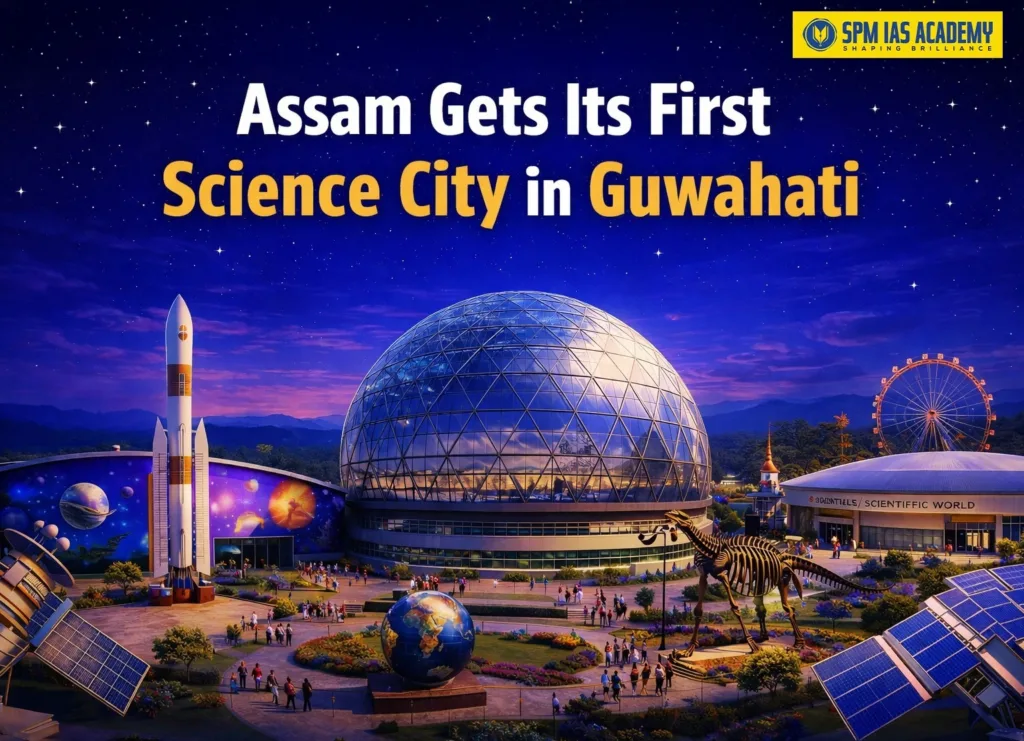
Assam inaugurated its first Science City – Science City Guwahati at Tepesia, Sonapur on March 11, 2026. Chief Minister Himanta Biswa Sarma inaugurated the facility. Built at a cost of ₹300 crore over nearly 250 bighas of land, it was developed under the Union government’s ‘Scheme for Promotion of Culture of Science’ by the Ministry of Culture, in partnership with the National Council of Science Museums (NCSM) and the Assam Science & Technology Department.
This is a landmark milestone for Assam in scientific education. Chief Minister Himanta Biswa Sarma inaugurated Science City Guwahati at Tepesia in Sonapur on March 10, 2026. This is the first science city in the entire Northeast India. The development is highly significant for UPSC Prelims, UPSC Mains GS Paper III (Science & Technology), APSC Mains, and other State PCS examinations. Aspirants must note both the factual details and the broader policy dimensions connected to this event.
Key Facts About Science City Guwahati: At a Glance:
- Firstly, the official name of the project is Science City Guwahati.
- The Science City Guwahati is at Tepesia, Sonapur in Kamrup (Metropolitan) District, Assam.
- Importantly, the Chief Minister of Assam inaugurated the Science City Guwahati on March 10, 2026.
- Earlier, the foundation stone was laid by former Chief Minister Sarbananda Sonowal on January 18, 2021.
- In terms of cost, the total project expenditure is approximately ₹300 crore. Out of this, the Central Government contributed ₹144 crore.
- Moreover, the project spans nearly 250 bighas of land.
- It has been developed under the ‘Scheme for Promotion of Culture of Science’ by the Ministry of Culture, Government of India.
- Furthermore, the implementing agencies include the National Council of Science Museums (NCSM) along with the Assam Science & Technology Department.
- Currently, the operational galleries include the Eureka Pavilion and Space Odyssey.
- In the upcoming phases, the project will add a Science Discovery Centre and a Science Park.
- Most significantly, Science City Guwahati is the first Science City in Assam and the entire Northeast India.
Five District-Level Science Centres Also Inaugurated:
Along with the inauguration of Science City Guwahati, Chief Minister Himanta Biswa Sarma also virtually inaugurated five district-level science centres on the same day. These centres aim to promote scientific awareness at the grassroots level across Assam.
- The newly inaugurated centres are located in Bongaigaon, Dadara, Kaliabor, Majuli, and Silchar.
- Furthermore, these district centres complement the state-level Science City and together form a structured three-tier model of science outreach in the state.
- This model includes Aryabhatta Science Centres at the block level, District Science Centres at the district level, and Science City Guwahati at the state level.
Therefore, this tiered approach is highly relevant for Mains answer writing, especially in topics related to science outreach, inclusive development, and governance.
What are the significance of Science City Guwahati?
1. Science & Technology Dimension (UPSC GS Paper III):
- Firstly, Science City Guwahati aligns with India’s broader policy of promoting scientific temper. The Scheme for Promotion of Culture of Science (SPoCS) of the Ministry of Culture aims to build scientific awareness.
- Moreover, the National Council of Science Museums (NCSM) implements this scheme nationwide. It aims to integrate Science City Guwahati into a national science communication network.
- Despite having premier institutions like IIT Guwahati, NIT, Assam’s representation in ISRO and DRDO remains limited. Therefore, Science City Guwahati can bridge the gap between institutional presence and student participation by improving science outreach, pedagogy, and awareness.
2. Governance & Cooperative Federalism Dimension (UPSC GS Paper II):
- Secondly, the project reflects cooperative federalism in action. The Central Government contributed ₹144 crore, while the Assam Government co-implemented it through its Science & Technology Department.
- Therefore, it serves as a model of Centre-State partnership in building educational and research infrastructure.
- Furthermore, the establishment of district-level science centres in Majuli and Silchar demonstrates inclusive governance and equitable regional development.
3. Northeast India Development Dimension:
- Importantly, Science City Guwahati is the first Science City in the entire Northeast region.
- Historically, the Northeast lagged behind in advanced science infrastructure despite its vast natural resources and research potential.
- Therefore, this initiative represents a shift toward a knowledge economy and human capital development in the region.
- Moreover, the project complements national initiatives like the Act East Policy and the Northeast Industrial Development Scheme.
- Consequently, it strengthens the integration of the Northeast into India’s broader scientific and economic progress.
4. Education & Scientific Temper Dimension (GS Paper II, IV & Essay):
- Notably, Article 51A(h) of the Indian Constitution mandates the development of scientific temper as a Fundamental Duty.
- Accordingly, Science City Guwahati directly contributes to fulfilling this constitutional obligation.
- Additionally, it promotes rational thinking, innovation and inquiry-based learning among students.
- Therefore, aspirants can use this example in GS Paper IV (Ethics) and Essay answers on scientific temper, humanism and evidence-based governance.
5. Human Capital & Demographic Dividend Dimension:
- Furthermore, the project strengthens human capital formation by encouraging STEM education among youth especially girls.
- In the long run, it can improve employability, research participation and entrepreneurship in Assam.
- Therefore, it will contribute to harnessing India’s demographic dividend, especially in the Northeast region.
6. Innovation & Startup Ecosystem Dimension:
- Moreover, innovation hubs and science parks under the project can stimulate local startups and research-based enterprises.
- Consequently, this aligns with national programmes like Startup India and Atmanirbhar Bharat.
7. Tourism & Economic Dimension:
- In addition, Science City Guwahati can boost educational tourism and attract visitors from across the Northeast.
- Therefore, it contributes to the service sector and strengthens Assam’s urban economy.
8. Environmental Awareness & Sustainable Development Dimension:
- Significantly, science cities promote awareness about climate change, biodiversity, renewable energy, and sustainability.
- As a result, they support India’s commitments under global environmental conventions.
9. Social Inclusion & Grassroots Outreach Dimension:
- Finally, the three-tier model i.e. Aryabhatta Science Centres (block level), District Science Centres, and Science City Guwahati (state level) will ensure promotion of scientific awareness at the grassroots.
- Consequently, it reduces the urban-rural knowledge gap. Moreover, it will promote inclusive education in remote areas of Assam.
Science City Guwahati is not merely an infrastructure project. Rather, it represents a multidimensional initiative connecting science and technology, cooperative federalism, Northeast development, scientific temper, and human capital formation.
Major Scientific and Research Institutions in the Northeast: A Ready Reference
Chief Minister Sarma highlighted several key institutions in the region during the inauguration. Aspirants must remember these for Prelims and Mains:
- IIT Guwahati – Indian Institute of Technology, Guwahati, Assam
- NFSU Guwahati – National Forensic Sciences University Campus, Guwahati
- Institute for Plasma Research (IPR) – Premier nuclear/plasma research body with a centre in Guwahati
- IIM Shillong – Indian Institute of Management, Shillong, Meghalaya
- Rain Forest Research Institute (RFRI) – Jorhat, Assam; under ICFRE, Ministry of Environment
- Regional Science Centre Guwahati – Operated by NCSM
- Aryabhatta Science Centres – Established at development block level across Assam
What is the Scheme for Promotion of Culture of Science?
The Scheme for Promotion of Culture of Science (SPoCS) is a flagship initiative of the Ministry of Culture, Government of India.
- Firstly, it aims to foster scientific temper and promote scientific awareness among the general public, especially students.
- Moreover, the scheme supports the establishment of Science Cities, Science Centres, Innovation Hubs, and Digital Planetariums across different regions of the country.
- Importantly, the National Council of Science Museums (NCSM), an autonomous body under the Ministry of Culture, functions as the nodal agency responsible for implementing the scheme.
- As of July 2025, a total of 27 Science Centres have been established across India under SPoCS.
- Furthermore, these centres have significantly enhanced informal science education through hands-on exhibits, innovation hubs, digital planetariums and outreach programmes.
- Notably, during FY 2024-25, these institutions recorded a cumulative footfall of over 15 lakh visitors. This reflects strong public engagement, particularly among students and educators.
- Additionally, regular activities such as science workshops, mobile exhibitions and interactive demonstrations have helped popularise science and encourage curiosity among the youth.
- Therefore, this scheme plays a vital role in nurturing scientific temper and promoting a culture of innovation aligned with national educational and developmental priorities.
- As per the scheme criteria, Science Centres and Digital Planetariums (Category-III) are established in areas with a population of less than 5 lakh to ensure wider regional coverage.
- Significantly, to promote inclusion, several Science Centres have already been set up in the North-East region, including:
- Shillong Science Centre (Meghalaya)
- Nagaland Science Centre (Dimapur)
- Sikkim Science Centre (Gangtok)
- Mizoram Science Centre (Aizawl)
- Arunachal Pradesh Science Centre (Itanagar)
- Manipur Science Centre (Imphal)
- Importantly, these centres in the North-East have received 90% project funding from the Ministry of Culture, thereby ensuring balanced regional development and scientific outreach.
What is the National Council of Science Museums (NCSM)?
The National Council of Science Museums (NCSM) is an autonomous body under the Ministry of Culture, Government of India. It operates the largest network of science centres and museums in the world. NCSM manages over 25 science museums and centres across India. It designs and implements exhibits, science parks, and outreach programmes to promote science communication among the general public, especially students. In the context of Science City Guwahati, NCSM served as the primary technical and knowledge partner.
Conclusion: Why Science City Guwahati Matters for UPSC, APSC, and State PCS 2025-26
Science City Guwahati at Sonapur is not merely a current affairs fact. It is a multi-dimensional topic that connects Science & Technology policy, governance, Northeast India development, cooperative federalism, and constitutional values. Every UPSC 2026 aspirant, APSC 2025 aspirant from Assam must thoroughly understand this topic.
Source:
FAQ:
Science City Guwahati is located at Tepesia, Sonapur in Kamrup (Metropolitan) District, Assam. It is the first Science City in Assam and the entire Northeast India.
Science City Guwahati was inaugurated on March 10, 2026, by Assam Chief Minister Himanta Biswa Sarma. The foundation stone was laid on January 18, 2021, by former Chief Minister Sarbananda Sonowal.
The total cost of Science City Guwahati is ₹300 crore. The project was developed under the Union Government’s “Scheme for Promotion of Culture of Science (SPoCS)” by the Ministry of Culture, with ₹144 crore contributed by the Central Government.
Science City Guwahati is important for UPSC and APSC exams because it connects to topics such as Science & Technology (GS Paper III), Cooperative Federalism (GS Paper II), Northeast Development, Scientific Temper (Article 51A), and Inclusive Governance. It is a relevant current affairs topic for Prelims and Mains answer writing.
The Scheme for Promotion of Culture of Science (SPoCS) is a flagship initiative of the Ministry of Culture, Government of India. It aims at promoting scientific temper and awareness. Moreover, it supports the establishment of Science Cities, Science Centres, Innovation Hubs and Digital Planetariums across India and is implemented by the National Council of Science Museums (NCSM).