

Graduation marks the end of one chapter. It also signifies the exciting beginning of another. The modern job market is evolving rapidly. Technology and data are driving new opportunities. Choosing the right career path requires balancing your passion with market demand. Hence, it is important to understand the career paths after Graduation. Moreover, it is important to consider future growth potential as well. Making decisions about a career after graduation can be daunting with the many opportunities available.
In this article, we have compiled the top 10 career paths to choose after graduation. This will help you understand the job industry better and which are the best career options for you.
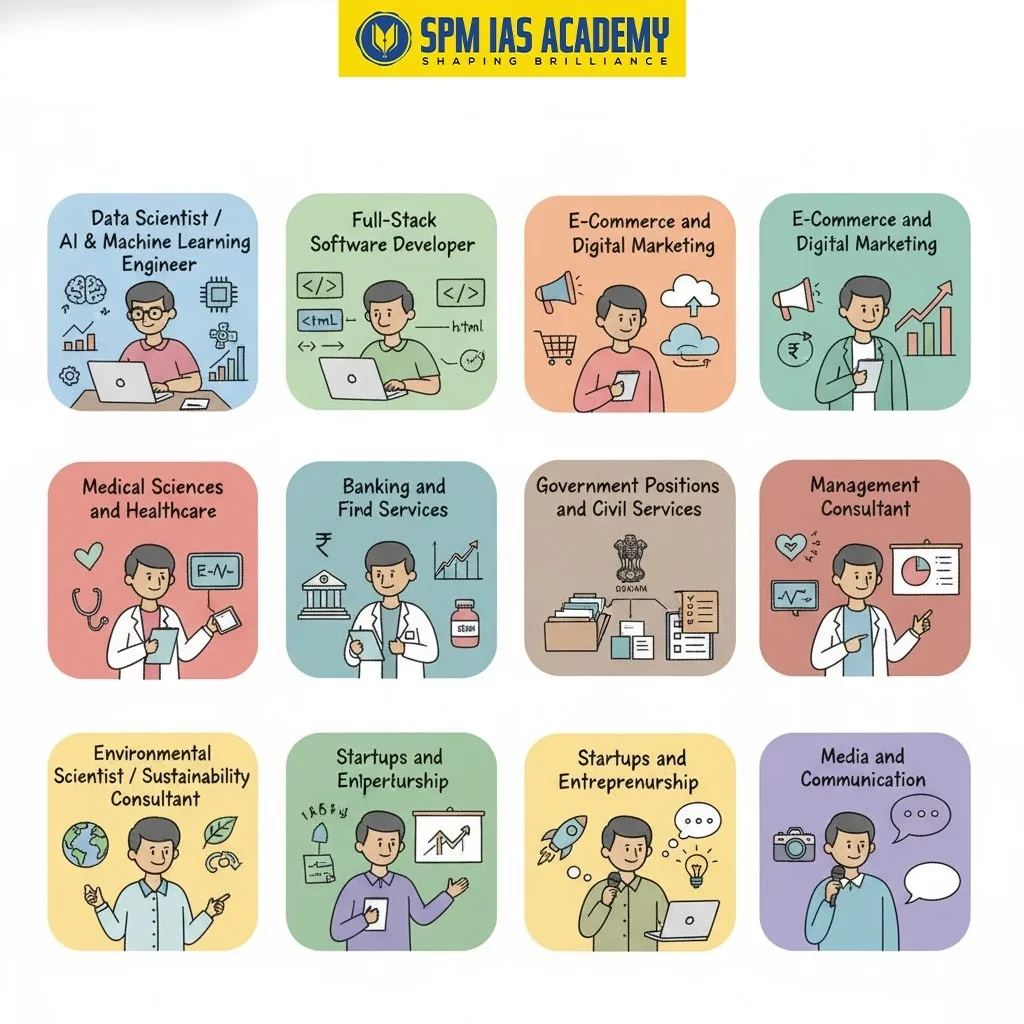
1. Data Scientist / AI & Machine Learning Engineer
Data scientist is one of the best career options after Graduation. Professionals use statistics, programming, and advanced models such as AI and machine learning to extract meaningful insights. Moreover, they create intelligent systems and drive critical decision-making across all industries.
- Best for Graduates in: Computer Science, Mathematics, Statistics, and Engineering.
- Key Skills: Python/R, SQL, Machine Learning Algorithms, Data Visualisation.
2. Full-Stack Software Developer
The backbone of the digital world is the Full-Stack Developer. Hence, this is one of the best career paths after Graduation. They are proficient in both front-end and back-end development. The front-end is what the user sees, while the back-end includes the server and database. This versatility makes Full-Stack Developers invaluable for both startups and established tech firms.
- Best for Graduates in: Computer Science, Information Technology, or self-taught coders with a strong portfolio.
- Key Skills: HTML, CSS, JavaScript (React/Angular/Vue), Node.js, Databases (MongoDB, PostgreSQL).
3. E-Commerce and Digital Marketing
Online platforms dominate the retail landscape. These roles focus on the entire digital business lifecycle. This includes driving traffic through Digital Marketing. It also involves optimising the online store experience. Additionally, it requires managing inventory. Finally, analysing sales funnels is crucial in E-Commerce.
- Best for Graduates in: Marketing, Business Administration, Communications, or anyone with strong quantitative skills and business acumen.
- Key Skills: SEO/SEM, Content Strategy, Social Media Ads, E-commerce Platforms (Shopify, Magento), Data Analytics (Google Analytics).
4. Banking and Financial Services
While exploring the career paths after graduation, you can also explore banking and financial services. These roles are central to the finance world. Financial Analysts evaluate a company’s financial performance and value. Investment Bankers advise on mergers, acquisitions, and capital raising. These positions are demanding, but they offer very high earning potential.
- Best for Graduates in: Finance, Accounting, Economics, or Commerce (CFA certification is a major plus).
- Key Skills: Financial Modelling, Valuation, Data Analysis, Risk Assessment, Attention to Detail.
5. Medical Sciences and Healthcare
The healthcare industry offers incredible stability and personal fulfilment. The ageing population contributes to this demand. Additionally, technological advancements in biotech play a significant role. As a result, the need for qualified medical and allied health professionals remains consistently high.
- Best for Graduates in: Medicine (MBBS), Nursing, Pharmacy, and other specialised health sciences.
- Key Skills: Clinical Knowledge, Empathy, Critical Thinking, Resilience.
6. Government Positions and Civil Services
A commitment to public service offers stability and competitive benefits. Due to its high demand and various perks, the civil services have emerged as one of the sought-after career paths after graduation. It also provides the opportunity to contribute directly to national development and public welfare. Roles in public service range from policy formulation and administration to law enforcement and defence.
- Best for Graduates in: Public Administration, Political Science, Economics, Law, History, or any field (requires clearing specific national/state-level competitive examinations).
- Key Skills: General Knowledge, Policy Analysis, Ethical Judgment, Administrative Skills, Communication.
Explore the highest rewarding government careers by checking these top High Paying Government Jobs in India after graduation.
7. Environmental Scientist / Sustainability Consultant
As climate change and ESG (Environmental, Social, and Governance) become central to business and policy, the demand for professionals who can develop and implement sustainable solutions is increasing. Many organisations are seeking individuals with expertise in this area. Sustainable practices are becoming essential for success in various industries.
- Best for Graduates in: Environmental Science, Civil/Chemical Engineering, or Business/Policy with a focus on sustainability.
- Key Skills: Environmental Policy Knowledge, Data Analysis, Project Management, Renewable Energy Expertise.
8. Management Consultant
Consultants are hired to solve a company’s most complex problems. These problems can range from restructuring to market entry strategy. This role offers rapid learning and high-level exposure. Additionally, it provides excellent compensation.
- Best for Graduates in: Economics, Business, Engineering, or any rigorous discipline (an MBA or Master’s degree is highly beneficial for progression).
- Key Skills: Analytical Thinking, Problem-Solving, Excellent Communication, PowerPoint/Excel Proficiency.
9. Startups and Entrepreneurship
Instead of joining an established company, this path involves building a new one (a startup) or becoming a key early employee. It offers unmatched learning, autonomy, and the potential for massive impact and financial upside, though it involves high risk.
- Best for Graduates in: Any field, combined with exceptional leadership, resilience, and business acumen.
- Key Skills: Adaptability, Sales and Pitching, Financial Management, Strategic Planning, Project Management.
10. Media and Communication
This diverse field covers traditional media, digital platforms, and corporate relations. The roles focus on creating and disseminating information. They also involve managing public perception and engaging audiences. This field is essential for brand building and public discourse.
- Best for Graduates in: Journalism, Mass Communication, Public Relations, English, Film/Media Studies.
- Key Skills: Storytelling, Content Creation (Writing, Video, Audio), Crisis Management, Public Relations (PR), Digital Engagement.
Points to Take into Consideration While Choosing Career Paths After Graduation
1. Personal Interests and Aptitude: Match job decisions to actual interests and natural aptitudes for long-term fulfilment.
2. Demand from Markets: Investigate employment opportunities in selected sectors and industry trends.
3. Skill Needed: Evaluate present strengths and pinpoint areas requiring improvement.
4. Harmonious Work-Life Balance: Think about how various professions affect general well-being and personal life.
5. Money Issues: Review long-term earning capacity, growth potential, and beginning salaries.
SPM IAS Academy offers expert guidance for both UPSC and APSC aspirants, with experienced faculty, detailed study plans, and mentorship that simplifies the complexities of civil services preparation.
Learn how to strategically Prepare for UPSC During Graduation with proven study methods and expert planning tips.
Conclusion
The career paths after Graduation offer different possibilities in both conventional and innovative industries. In any chosen field, success depends on constant learning, careful preparation, and fit with personal goals and market needs.
Many people effectively move between disciplines over their careers. Each experience adds insightful knowledge and perspective. The secret is to remain open to future opportunities. It’s important to begin from a path that fits your current interests and abilities.
Start your civil services journey with expert-led UPSC Coaching in Guwahati for effective, structured preparation.
Frequently Asked Questions
Generally, careers in Investment Banking, Management Consulting, and high-level Data Science/AI Engineering roles offer the highest starting salaries due to the specialised quantitative skills and demanding work hours required. However, these fields are often highly competitive and may require advanced degrees or extensive internships for entry.
Yes, absolutely! Many successful developers and data scientists come from non-CS backgrounds like Mathematics, Physics, or Engineering. The key is demonstrating practical skills through projects, online courses (like those for Python/SQL), and relevant certifications. Focus on building a strong portfolio rather than relying solely on your degree title.
The biggest risk is financial instability and a high failure rate. Most startups do not succeed, meaning high commitment of time and personal capital for little or no short-term return. This path requires extreme resilience, adaptability, and the ability to tolerate ambiguity compared to stable corporate or government jobs.
While not always mandatory for entry-level positions, an MBA or specialised master’s degree often becomes a significant advantage, or even a requirement, for career progression, especially in Management Consulting and Product Manager roles at large firms. It helps secure higher starting salaries and accelerates promotion timelines.
Start by evaluating the intersection of three factors:
Your Aptitude (what you’re good at)
Your Interests (what you enjoy)
Market Demand (where the jobs and growth are).
Don’t limit yourself; try internships or shadow experiences in different fields to test which culture and type of work fit you best.