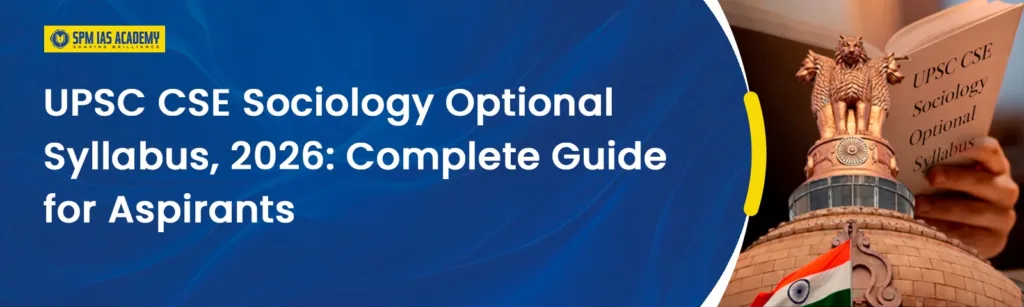
The UPSC Civil Services Examination allows candidates to choose one optional subject. Sociology remains one of the most popular choices. Many aspirants pick Sociology because the syllabus is short and easy to understand. The subject also overlaps with General Studies, Essay, and Ethics papers. Moreover, Sociology helps candidates understand society and human behaviour. Therefore, it becomes a scoring and strategic optional subject.
This article provides a complete guide on the UPSC CSE Sociology Optional Syllabus.
Why Choose Sociology Optional for UPSC CSE, 2026?
Sociology has clear advantages over other optional subjects. The syllabus is well-defined and easy to complete. The concepts are simple and therefore, beginners can also score well. Moreover, the subject improves answer-writing skills. It encourages clarity, structure, and logical explanation.
Additionally, the subject overlaps with General Studies Paper I, Paper II, and sometimes GS Paper IV. It also supports essay writing. Many successful candidates mention its scoring potential. As a result, Sociology remains a top choice among UPSC aspirants.
Before choosing an optional subject, aspirants should clearly understand the UPSC CSE 2026 age limit attempts eligibility explained.
Structure of the Sociology Optional Syllabus
UPSC offers two papers for Sociology. Each paper carries 250 marks. Paper – I covers the fundamentals of Sociology. Paper II discusses Indian society in detail. Both papers require conceptual clarity and strong examples.
UPSC Sociology Optional Syllabus: Paper I
The sociology optional Paper I focuses on Sociological Theories, Thinkers, and Methods. The syllabus covers classical theories, modern perspectives, and research methods. It builds the foundation needed for Paper II.
A detailed breakdown of the syllabus of Sociology Optional Paper – I is given below:
Fundamentals of Sociology:
- Sociology – The Discipline:
- Modernity and social changes in Europe and emergence of Sociology.
- Scope of the subject and comparison with other social sciences.
- Sociology and common sense.
- Sociology as Science:
- Science, scientific method and critique.
- Major theoretical strands of research methodology.
- Positivism and its critique.
- Fact value and objectivity.
- Non-positivist methodologies.
- Research Methods and Analysis:
- Qualitative and quantitative methods.
- Techniques of data collection.
- Variables, sampling, hypothesis, reliability and validity.
- Sociological Thinkers:
- Karl Marx – Historical materialism, mode of production, alienation, class struggle.
- Emile Durkhteim – Division of labour, social fact, suicide, religion and society.
- Max Weber – Social action, ideal types, authority, bureaucracy, protestant ethic and the spirit of capitalism.
- Talcolt Parsons – Social system, pattern variables.
- Robert K. Merton – Latent and manifest functions, conformity and deviance, reference groups.
- Mead – Self and identity.
- Stratification and Mobility:
- Concepts – equality, inequality, hierarchy, exclusion, poverty and deprivation.
- Theories of social stratification – Structural functionalist theory, Marxist theory, Weberian theory.
- Dimensions – Social stratification of class, status groups, gender, ethnicity and race.
- Social mobility – open and closed systems, types of mobility, sources and causes of mobility.
- Works and Economic Life:
- Social organization of work in different types of society – slave society, feudal society, industrial capitalist society.
- Formal and informal organization of work.
- Labour and society.
- Politics and Society:
- Sociological theories of power.
- Power elite, bureaucracy, pressure groups and political parties.
- Nation, state, citizenship, democracy, civil society, ideology.
- Protest, agitation, social movements, collective action, revolution.
- Religion and Society:
- Sociological theories of religion.
- Types of religious practices: animism, monism, pluralism, sects, cults.
- Religion in modern society: religion and science, secularization, religious revivalism, fundamentalism.
- Systems of Kinship:
- Family, household, marriage
- Types and forms of family.
- Lineage and descent.
- Patriarchy and sexual division of labour.
- Contemporary trends.
- Social Change in Modern Society:
- Sociological theories of social change.
- Development and dependency.
- Agents of social change.
- Education and social change.
- Science, technology and social change.
UPSC Sociology Optional Syllabus: Paper II
Sociology Optional Paper II deals with Indian Society. It applies theories from Paper – I to Indian realities. The syllabus covers social structure, institutions, change, and development.
A detailed breakdown of the syllabus of Sociology Optional Paper – II is given below:
Indian Society: Structure and Change:
Introducing Indian Society:
- Perspectives on the Study of Indian Society:
- Indology (G.S. Ghure).
- Structural functionalism (M. N. Srinivas).
- Marxist sociology (A. R. Desai).
- Impact of colonial rule on Indian society:
- Social background of Indian nationalism.
- Modernization of Indian tradition.
- Protests and movements during the colonial period.
- Social reforms.
Social Structure:
- Rural and Agrarian Social Structure:
- The idea of Indian village and village studies.
- Agrarian social structure— evolution of land tenure system, land reforms.
- Caste System:
- Perspectives on the study of caste systems: G. S. Ghurye, M. N. Srinivas, Louis Dumont, Andre Beteille.
- Features of caste system.
- Untouchability-forms and perspectives
- Tribal Communities in India:
- Definitional problems.
- Geographical spread.
- Colonial policies and tribes.
- Issues of integration and autonomy.
- Social Classes in India:
- Agrarian class structure.
- Industrial class structure.
- Middle classes in India.
- Systems of Kinship in India:
- Lineage and descent in India.
- Types of kinship systems.
- Family and marriage in India.
- Household dimensions of the family.
- Patriarchy, entitlements and sexual division of labour.
- Religion and Society:
- Religious communities in India.
- Problems of religious minorities.
Social Changes in India:
- Visions of Social Change in India:
- Idea of development planning and mixed economy.
- Constitution, law and social change.
- Education and social change.
- Rural and Agrarian Transformation in India:
- Programmes of rural development, Community Development Programme, cooperatives, poverty alleviation schemes.
- Green revolution and social change.
- Changing modes of production in Indian agriculture.
- Problems of rural labour, bondage, migration.
- Industrialization and Urbanisation in India:
- Evolution of modern industry in India.
- Growth of urban settlements in India.
- Working class: structure, growth, class mobilization.
- Informal sector, child labour.
- Slums and deprivation in urban areas.
- Politics and Society:
- Nation, democracy and citizenship.
- Political parties, pressure groups, social and political elite.
- Regionalism and decentralization of power.
- Secularization.
- Social Movements in Modern India:
- Peasants and farmers movements.
- Women’s movement.
- Backward classes & Dalit movements.
- Environmental movements.
- Ethnicity and Identity movements.
- Population Dynamics:
- Population size, growth, composition and distribution.
- Components of population growth: birth, death, migration.
- Population Policy and family planning.
- Emerging issues: ageing, sex ratios, child and infant mortality, reproductive health.
- Challenges of Social Transformation:
- Crisis of development: displacement, environmental problems and sustainability.
- Poverty, deprivation and inequalities.
- Violence against women.
- Caste conflicts.
- Ethnic conflicts, communalism, religious revivalism.
- Illiteracy and disparities in education.
Students from Northeast India often prefer reputed institutes like guwahati ias academy for focused UPSC preparation.
Conclusion:
The UPSC Sociology Optional Syllabus offers a balanced mix of theory and applied content. The syllabus is short and manageable. It helps in GS papers, essay writing, and interview discussions. However, you must study it strategically. Use examples, thinkers, and current issues. Maintain clarity and structure in answers. With consistent practice, Sociology can become a high-scoring optional subject.
Many aspirants also explore best online upsc coaching for beginners to build strong conceptual clarity and structured preparation.
Sources:
Frequently Asked Questions:
The UPSC Sociology Optional syllabus is divided into two papers. Paper I covers sociological theories, thinkers, and research methods. Paper II focuses on Indian society, social structure, institutions, and social change.
Yes. Sociology is considered a scoring optional because the syllabus is compact, easy to understand, and overlaps with GS, Essay, and Ethics. Clear concepts and structured answers help improve marks.
Most candidates can complete the Sociology Optional syllabus in 3–4 months with disciplined study. Revision and answer writing need additional time.
No. Sociology is beginner-friendly. The concepts are simple, relatable, and do not require an academic background in the subject. Many first-timers score well with proper guidance.
Focus on conceptual clarity, link thinkers to answers, use current examples, and practice regular answer writing. Integrate Paper I theories with Paper II topics for maximum marks.