
Are you thinking of UPSC in your regional language? Many UPSC aspirants have the misconception that they must prepare only in English to clear the Civil Services Examination. However, this is not true. UPSC preparation in a regional language is possible. You can prepare in a regional language and still build a strong foundation for Prelims, Mains, and the Interview stage. UPSC allows candidates to write the Civil Services Mains examination in English or in any language listed in the Eighth Schedule of the Constitution.
Moreover Subjects like History, Polity, Geography, Ethics, and Society become clearer when aspirants learn them in a language they are comfortable with. This also helps them express ideas naturally during answer writing. In this article, we will discuss the regional papers, challenges and benefits of preparing from regional languages, etc.
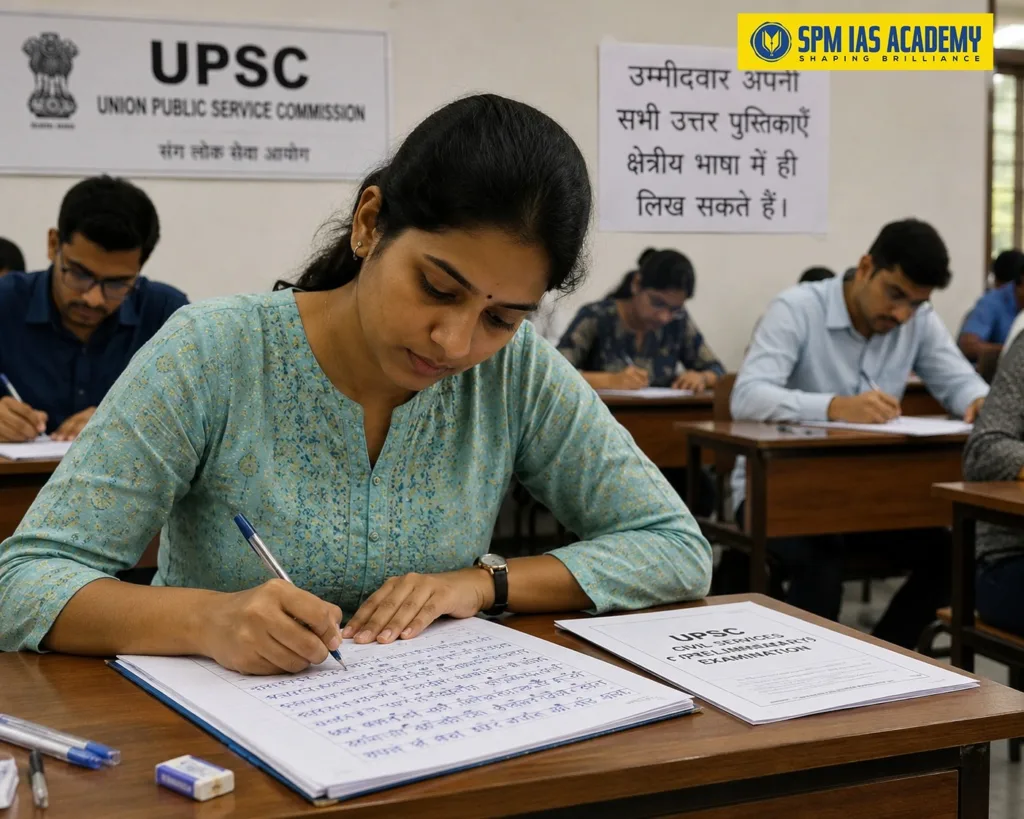
Which Languages Are Allowed in the UPSC Exam?
UPSC allows candidates to give the Mains exam in English or any Indian language listed in the Eighth Schedule of the Constitution. Writing mains in English or appearing for an interview in English is not compulsory. Aspirants who are comfortable and can express ideas better in a regional language can choose that language. The only condition is that it must be included in the 8th Schedule of the Indian Constitution. This is why UPSC Preparation in Regional languages has become an important option for aspirants who are more comfortable studying and writing in their mother tongue.” There are a total of 22 language UPSC language option. These are
- Assamese
- Bengali
- Bodo
- Dogri
- Gujarati,
- Hindi,
- Kannada,
- Kashmiri,
- Konkani,
- Maithili,
- Malayalam,
- Manipuri,
- Marathi,
- Nepali
- Odia
- Punjabi
- Sanskrit
- Santali
- Sindhi
- Tamil
- Telugu
- Urdu
However, you should remember one important point. The selected language must be used properly in answer writing. The script should match UPSC rules. For example, Hindi uses the Devanagari script, Assamese uses the Assamese script, and Bengali uses the Bengali script. Therefore, aspirants should become comfortable with UPSC-level vocabulary, answer structure, and subject terminology in their chosen language
Is Regional Language Allowed in UPSC Mains?
Yes, candidates can write UPSC Mains in the regional language if the selected language is included in the Eighth Schedule of the Indian Constitution. UPSC gives candidates the option to choose the medium of examination for the Civil Services (Main) Examination.UPSC asks candidates to specifically pick their medium of language in the GS, Optional, and compulsory Indian Language papers. One thing you must note is that once you select the medium of examination, it cannot be changed later.
This indicates that you must not necessarily write your Mains examination only in the English language. For such students, UPSC Preparation in Regional languages can improve confidence, answer clarity, and overall understanding of GS and Optional subjects. It gives a huge advantage to the aspirants who understand concepts better in their regional language and can express their ideas better in their regional language.
Moreover, once you select the medium of your paper, you should prepare all the concepts, practice answers writing, and make notes in that language itself. You should make sure that good static, current affairs, and tests are available in the language you have selected.
Can I Give the UPSC Interview in Regional Language?
Yes, candidates can appear in the UPSC interview in a regional language. The UPSC specifies that the candidate can choose English, Hindi, or any other language included in the 8th Schedule of the Constitution for the personality test.
However, choosing a regional language in the UPSC interview must be well thought out. The UPSC Interview is not a language test. It is rather a tests your awareness, decision-making ability, honesty, communication skills, emotional balance, and suitability for public service. The main criteria should be- if you can freely express your ideas in your regional language, then you can go for it confidently
One major advantage of using a regional language is the flow natural expression. Many aspirants can explain social issues, local governance problems, etc., more deeply in their mother tongue. This can make the answers look more natural. For example, if an aspirant from Assam talks about flood management, tea garden communities, and border issues in Assamese, their expression may become more connected and confident.
Benefits of Preparing for UPSC in the Mother Tongue
For many aspirants, preparing for UPSC in regional language helps them connect difficult topics with familiar words, examples, and local understanding. For example, subjects such as History, Polity, Geography, Society, Ethics, and Governance often become easier when students can connect ideas with familiar words and examples.
One major advantage of UPSC Preparation in Regional languages is that aspirants can understand difficult topics in simple words instead of mentally translating every concept from English. When aspirants study in their mother tongue, they donot have to translate key ideas in mind. By this, they can save a sufficient amount of time and focus on understanding the topics.
The main answer writing is all about expressing your ideas. Students comfortable in their mother tongue can come up with better explanations of the idea. This can make their answer more natural and maintain a good flow of ideas.
Moreover, there is a myth that one must be perfect in English to clear the UPSC exam. But this is not the case. An aspirant giving papers in a regional language can perform much better. The only constants that matter are- Discipline, Hardwork, Conceptual clarity, and regular practice in the regional language.
Challenges Faced by Regional Language UPSC Aspirants
UPSC Preparation in a regional language is possible, but there are some practical challenges to it. The biggest challenge is the limited availability of quality study material. The study materials for English and Hindi are easily available in markets. But there are very few UPSC-specific study materials in the Regional Languages. The study materials are the basis of your preparation. Without proper study materials, there can be a preparation gap between the regional language aspirants and aspirants from Hindi and English medium
Another challenge is the Current Affairs part. The UPSC demands a high analytical understanding of national and international issues. However, many government reports, policy documents, editorials, and expert opinions are mainly available in English. This creates a major problem for the preparation of Current affairs. Regional aspirants invest crucial time in translating important points.
In addition, regional language aspirants may face difficulty in finding good mentors and answer evaluators. Proper feedback is very important for Mains preparation. Without regular evaluation, students may not understand whether their answers meet UPSC standards or not. Peer group support can also be limited. Many regional language students may not find enough serious aspirants preparing in the same medium. This can make discussion, answer review, and resource sharing harder.
UPSC Preparation in Hindi Medium
UPSC preparation in Hindi medium is a good option for aspirants who understand and express ideas better in Hindi. Over the years, Hindi Medium has produced many UPSC toppers. Though the trend is on a declining path, there are still many aspirants preparing for UPSC in Hindi Medium. Students primarily from a Hindi background feel more comfortable studying subjects like History, Polity, Geography, Ethics, Society, and Governance in Hindi. This comfort helps them build strong conceptual clarity and reduces the fear that UPSC can only be cleared through the English medium.
Answer writing is very important for Hindi medium UPSC aspirants. Students should practice writing answers in Hindi from the beginning and focus on simple language, clear structure, proper keywords, examples, and balanced conclusions. You can prepare current affairs from popular Hindi newspapers like Dainik Jagaran and reliable magazines such as Yojana and Kurukshetra.
For subjects like Polity, you should first thoroughly read the NCERTs and complement them with standard books such as M. Laxmikanth’s Bharatiya Rajvyavastha. For topics like economy, international relations, science and technology, and government policies, they can use simple English sources and make short Hindi notes. Most importantly, Hindi medium aspirants should not feel inferior, because UPSC checks knowledge, clarity, analytical thinking, and presentation, not the language medium.
Best Strategy for UPSC Preparation in Regional Languages
Let us discuss the section on UPSC Preparation in regional language in detail. It will give you a proper idea. To make UPSC Preparation in Regional languages effective, aspirants should follow a balanced approach of limited resources, regular answer writing, and current affairs notes. Aspirants should not think that the regional language is a weakness. It automatically signals a negative message in the brain. In fact, it can become a strength if they use it properly for concept clarity, answer writing, and revision. The ultimate goal for any answers should be a clear expression of ideas, facts, and knowledge.
Initially, choose limited but reliable study material. You should not run behind too many resources. Start with NCERTs, standard UPSC books, and good regional-language resources wherever available. If some topics are not explained well in your language. Then use simple English sources for reference, and then prepare your own notes in your regional language.
Secondly, build a strong vocabulary of UPSC-related terms. Subjects like Polity, Economy, Ethics, Governance, Environment, and International Relations use many keywords. Aspirants should maintain a small glossary of important terms in both English and their regional language. This will help in Prelims understanding, Mains answer writing, and Interview preparation.
Moreover, practising answer writing in your regional language is very important. Many students read in one language but struggle to write in another. So, start writing short answers, 10-mark answers, and 15-mark answers in your chosen medium. Focus on structure, keywords, examples, and a clear conclusion.
For current affairs, use a good newspaper that is available in your regional language. You can also translate key topics from English or Hindi newspapers. There are fewer sources of Current affairs for regional languages, but using AI to translate ideas and facts can be a way to tackle this problem.
Even though you are preparing in your Regional Language, knowing basic English is essential. Basic English terms are useful for government reports, schemes, judgments, and current affairs. A balanced bilingual approach can make your UPSC preparation stronger, more confident, and more exam-ready.
Conclusion
UPSC Preparation in regional language is completely possible if the aspirant follows a smart and right strategy. The UPSC exam is not about language checking. It is about how an aspirant can remain consistent for a longer period of time during preparation. It test mental strength of the aspirant. It tests the Knowledge, conceptual clarity, analytical thinking, answer-writing ability, and overall personality of the aspirant
Writing papers in a regional language can be a big advantage for aspirants who understand concepts better in the regional language. The main point of the Mains examination is – How clearly can you express your ideas while understanding the demand of the question? So one who understands concepts well can express ideas in a better way.
In simple words, success in UPSC does not depend on English or any single language. It depends on discipline, consistency, clarity, revision, and the ability to present ideas effectively. So, if you are comfortable in your regional language, you can confidently prepare for UPSC and work toward your civil services dream.
Frequently Asked Questions (FAQs)
No, English is not compulsory for clearing UPSC. Many aspirants prepare and write the exam in Hindi or other regional languages. UPSC checks your knowledge, clarity, analytical ability, answer presentation, and personality. However, basic English understanding can help you read government reports, schemes, judgments, and current affairs material.
Yes, UPSC Preparation in Regional languages is possible.UPSC allows candidates to write the Mains exam in English or any Indian language included in the Eighth Schedule of the Constitution. However, you should make sure that proper study material, current affairs sources, answer-writing practice, and mentorship are available in your chosen language.

SPM IAS Academy is a leading APSC & UPSC coaching institute based in Guwahati, Assam, dedicated to helping aspirants achieve success in civil services examinations. The academy provides expert mentorship, comprehensive study materials, current affairs guidance, test series, and personalized preparation strategies for APSC, UPSC, and other competitive exams. With a strong focus on quality education, discipline, and result-oriented learning, SPM IAS Academy has become a trusted name among civil service aspirants across Assam and Northeast India.