Udasin Bhakats are celibate Vaishnavite monks associated with Assam’s Sattra system. Recently, the Assam government launched a monthly financial assistance scheme of ₹1,500 for Udasin Bhakats. Through Direct Benefits Transfer (DBT), this scheme will ensure social security, preserve Sattriya culture, and address challenges like declining donations and Sattra land encroachment. This topic is highly relevant for UPSC, APSC, and State PCS exams.
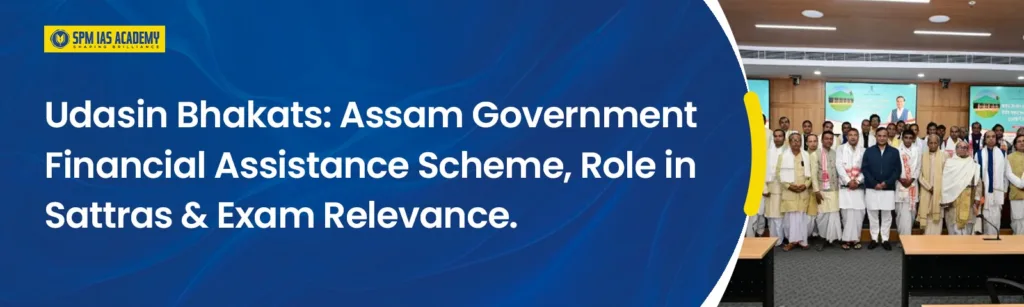
Udasin Bhakats play a crucial role in preserving Assam’s spiritual, cultural, and social heritage. Recognising their contribution, the Assam government recently launched a financial assistance scheme for Udasin Bhakats. The scheme was formally announced by the Chief Minister of Assam at a programme held at Janata Bhawan, Guwahati.
This initiative has gained importance for UPSC, APSC, and other competitive exams. It links GS 1, GS2 and APSC GS 5 syllabus topics such as culture, governance, social welfare, culture of Assam and heritage preservation.
Who Are Udasin Bhakats?
Meaning and Origin of Udasin Bhakats:
Udasin Bhakats are a distinct group of Vaishnavite devotees associated with the Sattra system of Assam, which was established by Srimanta Sankardeva. The term ‘Udasin’ means detached or ascetic, reflecting their renunciatory way of life.
Key Features of Udasin Bhakats:
- Firstly, they are celibate monks (non-householders).
- Secondly, they dedicate their lives to full-time spiritual service.
- Notably, they live inside Sattra premises and do not engage in economic or household activities.
- They traditionally depend on public donations and Sattra land support.
Role of Udasin Bhakats in Sattras:
Udasin Bhakats act as the spiritual backbone of the Sattra system.
Religious and Cultural Responsibilities:
They assist the Sattradhikar (head of the Sattra) in:
- Daily religious rituals such as Naam-Prasanga and Kirtan
- Teaching sacred texts like Kirtan-Ghoxa and Bhagavata
- Preserving Neo-Vaishnavite traditions
Custodians of Sattriya Heritage:
Moreover, Udasin Bhakats play an important role in safeguarding Sattriya music and dance, ancient manuscripts. Moreover, they also play a crucial role in the preservation of religious customs and oral traditions. As a result, they play a vital role in protecting Assam’s intangible cultural heritage.
What are the Differences Between Udasin Bhakats and Grihasthi Bhakats?
In the Sattra system of Assam, devotees are broadly classified into Udasin Bhakats and Grihasthi Bhakats based on their lifestyle, religious commitment, and social roles. Understanding the difference between Udasin Bhakats and Grihasthi Bhakats is essential to comprehend the structure of Neo-Vaishnavite traditions introduced by Srimanta Sankardeva. This topic holds high relevance for APSC Prelims and Mains, especially under Assam Art and Culture, Society, and Heritage studies. The following table shows the differences between the Udasin Bhakats and Grihasthi Bhakats.
| Udasin Bhakats | Grihasthi Bhakats |
| Celibate monks | Married household devotees |
| Full-time religious service | Part-time religious involvement |
| Live in Sattras | Live in villages |
| Lead a renunciatory life | Follow a householder’s life |
This distinction is important for APSC Prelims and Mains questions related to Assam’s culture.
Why Are Udasin Bhakats in the News?
Udasin Bhakats have faced growing financial insecurity due to:
- A steady decline in public donations.
- Encroachment on Sattra land, which reduced traditional income sources.
Therefore, many Sattras struggle to sustain daily religious and cultural activities.
For guided preparation, explore Best APSC & UPSC Coaching in Guwahati for expert mentorship and test series.
What is the Assam Government Financial Assistance Scheme for Udasin Bhakats?
The Assam government introduced a monthly financial assistance scheme to support Udasin Bhakats.
Key Features of Assam Government Financial Assistance Scheme for Udasin Bhakats:
- The beneficiaries of this scheme are Udasin Bhakats of Sattras in Assam.
- The amount of financial assistance is ₹1,500 per month.
- Moreover, the mode of transfer is Direct Benefit Transfer (DBT).
This scheme ensures regular and predictable income support.
What are the Objectives of the Assam Government Financial Assistance for Udasin Bhakats Scheme?
The Assam Government Financial Assistance Scheme for Udasin Bhakats has been designed with clear social, cultural, and governance objectives.
- Firstly, the scheme seeks to formally recognise the spiritual, cultural, and social contributions of Udasin Bhakats. They have played a central role in sustaining the Sattra system and Neo-Vaishnavite traditions of Assam for centuries.
- Secondly, the scheme aims to provide social security and financial stability to Udasin Bhakats and Sattradhikars. Many of them face economic hardship due to declining donations and loss of traditional income sources. By ensuring regular monthly assistance, the government helps safeguard their basic welfare and dignity.
- Thirdly, the initiative supports the continuity and uninterrupted functioning of Sattra traditions. It enables Bhakats to focus fully on religious practices, teaching, and cultural preservation without financial anxiety.
- Finally, the scheme strengthens cultural preservation through welfare-based governance. It demonstrates how targeted social support can protect Assam’s intangible heritage while promoting inclusive and people-centric administration.
Implementation Mechanism of this scheme:
To ensure transparency, accountability, and effective delivery, the Assam Government has put in place a structured implementation mechanism for the financial assistance scheme.
- Firstly, the beneficiary lists are prepared by the offices of the respective Deputy Commissioners, based on verified records of Udasin Bhakats in each district.
- Secondly, these lists undergo strict verification by the District Commissioner or the Additional District Commissioner to prevent errors, duplication, or misuse.
- Thereafter, the verified beneficiary details are uploaded district-wise on the DIDS portal, ensuring digital record-keeping and monitoring.
- Finally, the Directorate of Cultural Affairs acts as the nodal department. It will oversee the overall implementation, coordination, and timely disbursal of funds, thereby maintaining institutional accountability and governance integrity.
What are the Coverage Details of the Scheme?
The Assam Government Financial Assistance Scheme for Udasin Bhakats covers multiple districts to ensure wide and inclusive coverage. At present, the scheme benefits a total of 620 Udasin Bhakats spread across the state.
District-wise distribution shows a higher concentration of beneficiaries in traditional Sattra hubs. Barpeta has the highest number with 100 beneficiaries, followed by Majuli with 74 and Jorhat with 54. It reflects their strong association with the Sattra tradition.
Other districts covered under the scheme include Lakhimpur (22) and Kamrup (14). In addition, Dhubri and Goalpara have 8 beneficiaries each, while Golaghat, Nalbari, and Sivasagar have 6 beneficiaries each. Sonitpur and Udalguri currently have 3 beneficiaries each.
Overall, the district-wise spread highlights the government’s effort to ensure equitable regional coverage while prioritising areas with a significant presence of Sattras and Udasin Bhakats.
What are the Associated Issues?
Sattra Land Encroachment:
One of the major challenges affecting Sattras in Assam is the widespread problem of Sattra land encroachment. Over time, illegal occupation of Sattra land has significantly reduced traditional sources of income, thereby placing many Sattras under severe financial stress.
Key Data Highlights:
- As per Assam State Land Revenue & Monitoring Commission, nearly 15,288 bighas of Sattra land encroached across Assam.
- Barpeta district alone accounts for about 7,137 bighas of encroached Sattra land, making it the most affected district.
As a result, this issue has affected the financial sustainability of Sattras and the welfare of Udasin Bhakats. Therefore, it highlights the need for effective land protection measures and institutional intervention.
Related Government Measures: Assam Satra Commission
To address challenges faced by Sattras, especially financial stress and land encroachment, the Assam government has constituted the Assam Satra Commission as a dedicated institutional mechanism. The Commission plays a crucial role in safeguarding the religious, cultural, and economic interests of Sattras across the state.
Key Functions of the Assam Satra Commission:
- Firstly, the Commission is empowered to provide financial grants to Sattras. It will ensure support for their day-to-day functioning and cultural activities.
- Secondly, it is responsible for identifying cases of illegal encroachment on Sattra land and recommending appropriate corrective action.
- Finally, the Commission has the authority to permit eviction proceedings under the Assam State Land Revenue and Monitoring laws. Therefore, it will strengthen legal protection for Sattra properties.
Through these measures, the Assam Satra Commission aims to restore institutional stability, protect heritage assets, and reinforce good governance in the management of Sattras.
Conclusion:
Udasin Bhakats are central to Assam’s Vaishnavite spiritual tradition and Sattriya cultural heritage. Through the financial assistance scheme for Udasin Bhakats, the Assam government has taken a significant step toward social security, cultural preservation, and inclusive governance. At the same time, measures like the Assam Satra Commission aim to address long-standing issues such as Sattra land encroachment. For UPSC, APSC, and other competitive exam aspirants, this topic offers an excellent blend of culture, welfare policy, and governance, making it a high-value current affairs subject.
Download the UPSC current affairs pdf for concise, exam-ready updates and quick revision before prelims.
Source:
FAQ:
Udasin Bhakats are celibate Vaishnavite monks associated with the Sattra system of Assam. They live inside Sattras, dedicate themselves to full-time spiritual service, and lead a renunciatory life. They play a key role in performing religious rituals, teaching scriptures, and preserving Sattriya culture and Neo-Vaishnavite traditions.
The Assam Government launched the financial assistance scheme for Udasin Bhakats. It aims to address their growing financial insecurity caused by declining public donations and Sattra land encroachment. The scheme aims to provide social security, ensure the continuity of Sattra traditions, and support cultural preservation through welfare-based governance.
Under this scheme, Udasin Bhakats of Sattras in Assam receive ₹1,500 per month as financial assistance. The amount is transferred through Direct Benefit Transfer (DBT) to their bank accounts. The scheme ensures regular income support and is implemented with proper verification and digital monitoring.
Udasin Bhakats are important for UPSC, APSC, and State PCS exams because the topic integrates Assam art and culture, welfare schemes, governance, and heritage preservation. It is relevant for UPSC GS Paper 1 (Culture), GS Paper 2 (Social welfare and governance), and APSC GS-5, making it a high-value current affairs topic for both prelims and mains.

Behind every article at SPM IAS Academy is a team of skilled content writers and subject experts committed to making preparation easier for aspirants. From answering common doubts to breaking down complex issues and current affairs, we create content that is accurate, easy to understand, and directly useful for UPSC, APSC, and other competitive exams.