
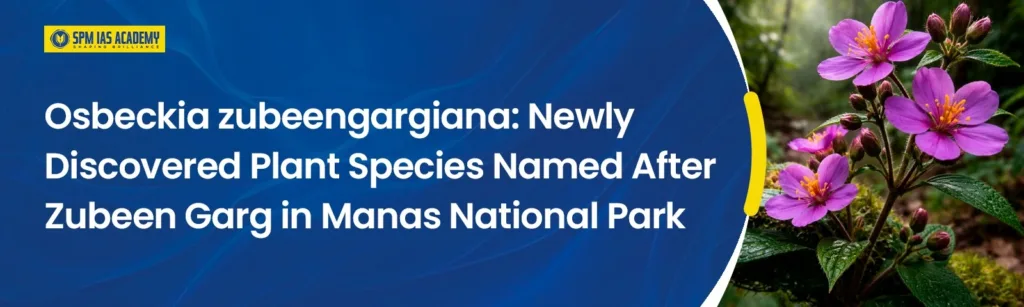
Researchers have discovered a new plant species in Manas National Park. They named it Osbeckia zubeengargiana in memory of Assam’s music icon, Zubeen Garg.
This discovery adds a new chapter to Assam’s biodiversity research. It also highlights the ecological richness of Northeast India.
The finding is important for UPSC, APSC, and State PCS exams under biodiversity, taxonomy, and environmental conservation.
Discovery of Osbeckia zubeengargiana in Manas National Park
Scientists discovered the new plant species during a field survey in Manas National Park. The plant grows in grasslands with mixed vegetation.
Researchers noticed unusual morphological features. Initially, it resembled other Osbeckia species. However, careful observation revealed clear differences.
They conducted detailed taxonomic comparisons. Finally, they confirmed it as a new species.
The discovery was officially published on March 13 in the international journal Phytotaxa.
Who Discovered Osbeckia zubeengargiana?
The research team included:
- Barnali Das, Research Scholar, Department of Botany, Gauhati University
- Prof. Namita Nath, Department of Botany, Gauhati University
- Dr. Prashob Pulpra, NSS College, Manjeri, Kerala
They collaborated to identify and classify the species scientifically.
What are the Botanical Features of Osbeckia zubeengargiana?
Family and Genus:
The plant belongs to the genus Osbeckia under the family Melastomataceae.
Melastomataceae is one of the largest angiosperm families worldwide. Members are mostly shrubs or small trees.
Key Morphological Characteristics of Osbeckia zubeengargiana:
The newly identified species displays several distinct botanical features. These characteristics clearly differentiate it from other species within the genus Osbeckia:
- Firstly, it has linear lanceolate leaves with three prominent nerves.
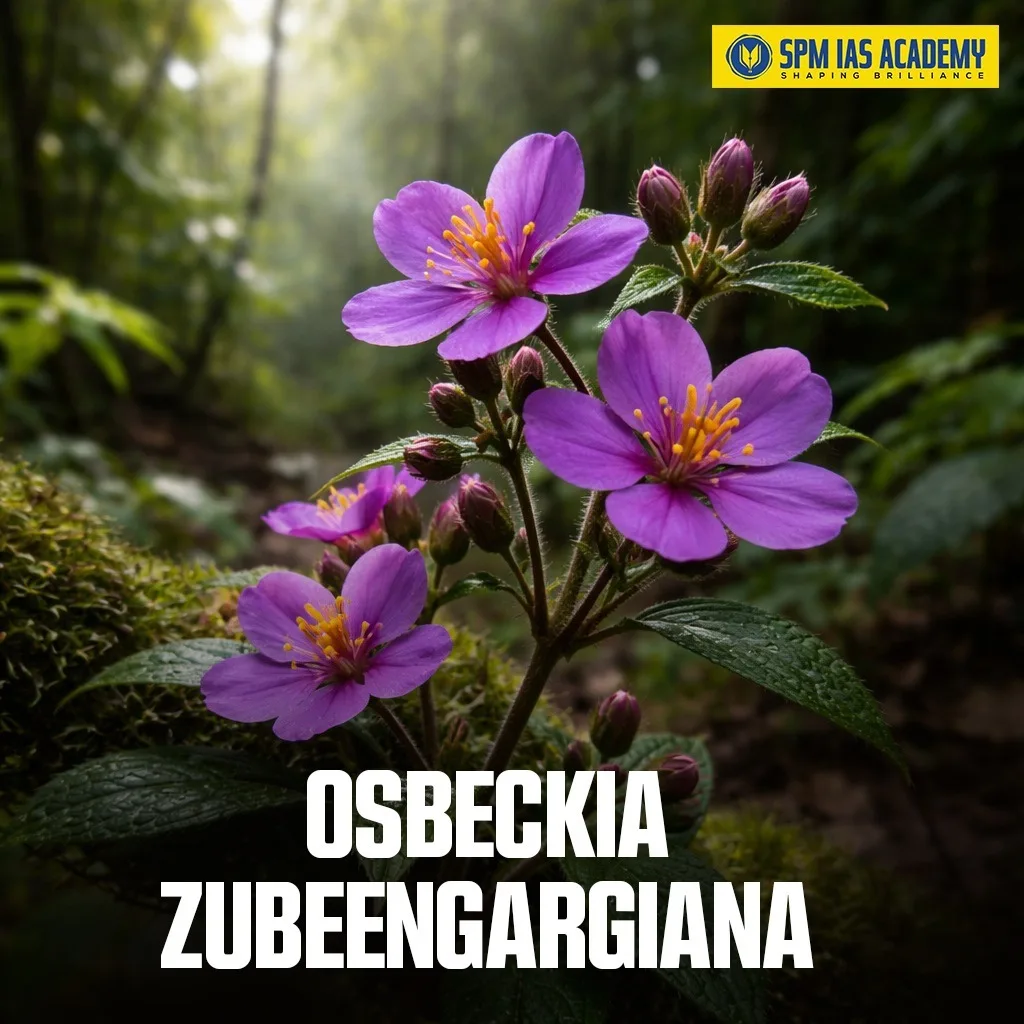
- Secondly, the plant bears tetramerous flowers, meaning the floral parts occur in multiples of four.
- Additionally, it possesses a hypanthium with intersepalar emergences.
- Moreover, the species shows a pubescent style base, which is covered with fine hairs.
Together, these defining features distinguish Osbeckia zubeengargiana from other known Osbeckia species.
Ecological Importance of the Melastomataceae Family
The newly discovered species belongs to the family Melastomataceae Juss. It is one of the largest angiospermic families in the world.
- Notably, members of this family are usually shrubs or small trees. Moreover, they typically have opposite leaves with distinctive parallel veins.
- In addition, these plants produce showy flowers with prominent stamens, which make them easily identifiable.
- Therefore, the structural features of this family play an important role in plant taxonomy and identification.
- Plants of this family produce bright purple or pink flowers. They play an important ecological role in tropical ecosystems.
- They support pollinators and help maintain biodiversity. Therefore, discovering a new species strengthens conservation efforts.
- Currently, scientists recognize 43 accepted species under the genus Osbeckia. Most species occur in Southeast Asia.
Why Was the Species Named After Zubeen Garg?
Researchers dedicated the species to the memory of Assam’s heartthrob Zubeen Garg. He was a cultural legend of Assam.
He contributed to music, cinema, and cultural identity. He also supported environmental awareness.
Therefore, the naming honours his lasting influence on Assam’s society and culture.
Importance for Assam’s Biodiversity
This discovery highlights the floristic richness of Assam. It also shows the importance of field-based botanical surveys.
Manas National Park is already a UNESCO World Heritage Site. Now, it adds another scientific achievement to its record.
Such discoveries strengthen conservation awareness in Northeast India.
Conclusion: Osbeckia zubeengargiana and Assam’s Biodiversity Milestone
The discovery of Osbeckia zubeengargiana marks a major milestone in Assam biodiversity research. Scientists identified the species in Manas National Park and published it in Phytotaxa.
This botanical discovery strengthens India’s plant taxonomy records. It also highlights the ecological richness of Northeast India.
For UPSC and APSC aspirants, Osbeckia zubeengargiana, Manas National Park biodiversity, and new plant species discovery remain important current affairs topics.
Source:
FAQ:
Osbeckia zubeengargiana is a newly discovered plant species found in Manas National Park, Assam. Researchers named it after Assam’s music icon Zubeen Garg to honour his cultural contribution.
Scientists discovered Osbeckia zubeengargiana in the grasslands of Manas National Park in Assam. The discovery was officially published in the international journal Phytotaxa.
Osbeckia zubeengargiana strengthens Assam’s biodiversity records. Moreover, it highlights the ecological richness of Northeast India and supports plant taxonomy research.
The species has linear lanceolate leaves with three nerves. Additionally, it bears tetramerous flowers, a hypanthium with intersepalar emergences and a pubescent style base, which distinguish it from other Osbeckia species.
This discovery is relevant under biodiversity, plant taxonomy, and environmental conservation. Therefore, UPSC and APSC aspirants should remember its link to Manas National Park and the Melastomataceae family.

SPM IAS Academy is a leading APSC & UPSC coaching institute based in Guwahati, Assam, dedicated to helping aspirants achieve success in civil services examinations. The academy provides expert mentorship, comprehensive study materials, current affairs guidance, test series, and personalized preparation strategies for APSC, UPSC, and other competitive exams. With a strong focus on quality education, discipline, and result-oriented learning, SPM IAS Academy has become a trusted name among civil service aspirants across Assam and Northeast India.