
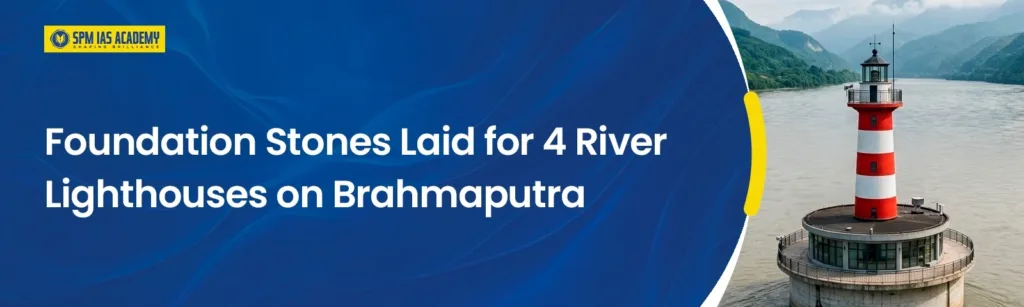
Union Minister of Ports, Shipping and Waterways, Sarbananda Sonowal, has laid the foundation stones for four river lighthouses along the Brahmaputra River. Notably, for the first time, India is developing lighthouse infrastructure on an inland waterway. The government has taken this step to enhance navigation safety, improve cargo movement and promote tourism along National Waterway-2 (NW-2). Furthermore, this initiative marks a significant new phase in the development of inland waterways in Assam and the wider Northeast region.
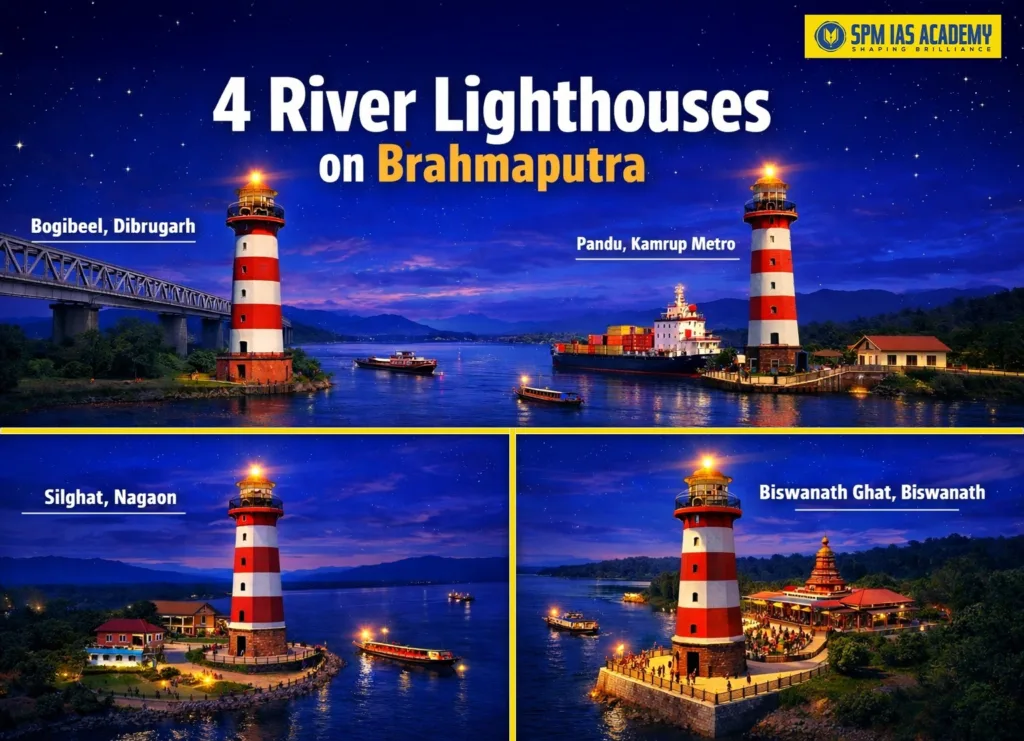
First River Lighthouses on an Inland Waterway in India
For the first time in the country, river lighthouses are being constructed on an inland waterway. These lighthouses will be developed along the Brahmaputra River, which is designated as National Waterway-2 (NW-2).
The four selected locations are:
- Bogibeel in Dibrugarh district
- Pandu in Kamrup (Metro)
- Silghat in Nagaon district
- Biswanath Ghat in Biswanath district
Three of these sites are located on the south bank of the Brahmaputra, while Biswanath Ghat lies on the north bank. All four locations are strategically positioned along NW-2, which is one of India’s most important inland cargo and passenger corridors.
Project Cost and Key Features of the River Lighthouses
The combined project outlay for all four river lighthouses stands at approximately Rs 84 crore.
Each lighthouse will have the following features:
- A height of 20 metres
- A geographical range of 14 nautical miles
- A luminous range of 8-10 nautical miles
- Complete solar power operation
The use of solar energy makes the project environmentally sustainable. In addition, each lighthouse will be equipped with weather observation sensors. These sensors will improve navigation safety and support efficient river traffic management.
Therefore, the project combines modern navigation infrastructure with renewable energy solutions.
Enhancing 24×7 Safe Navigation on National Waterway-2
The commissioning of these river lighthouses directly responds to the rapid growth in cargo movement on the Brahmaputra. According to the Inland Waterways Authority of India (IWAI), cargo movement on NW-2 recorded a 53 percent surge in FY 2024-25.
The Brahmaputra corridor now plays a vital role in transporting Assam’s tea, Coal, Fertilizers, Passenger and tourism traffic.
As traffic increases, safe navigation becomes more important. Night navigation has been one of the biggest challenges for inland waterways. The new “Deep-stambh” lighthouses will remove this barrier by enabling round-the-clock operations.
Thus, the project will ensure reliable and safe navigation throughout the day and night.
River Lighthouses as Tourism and Public Spaces
In addition to their primary navigation functions, the proposed river lighthouses will also serve as vibrant tourism and public spaces. Each lighthouse site will include modern facilities such as a museum, an amphitheatre, a cafeteria, a children’s play area, a souvenir shop, and well-designed landscaped public spaces.
As a result, these lighthouses will evolve beyond mere maritime infrastructure and emerge as major tourism landmarks. Visitors will not only observe functional river navigation systems but will also enjoy cultural, educational, and recreational experiences at the same location.
Consequently, the project is expected to significantly promote river tourism in Assam. Moreover, it will generate local employment opportunities in sectors such as hospitality, tourism services, and small businesses, thereby contributing to regional economic growth.
Inland Waterways as a Force Multiplier for the Economy
Inland waterways are emerging as powerful drivers of economic growth. They are not merely alternatives to road and rail transport. Instead, they act as force multipliers for the economy.
Transporting one tonne of freight by inland waterway costs:
- Roughly one-third of road transport
- About half of rail transport
Moreover, waterways generate significantly lower carbon emissions. They reduce congestion on highways and decrease road accidents.
For Northeast India, this shift is crucial. Road infrastructure in the region faces constant pressure due to terrain and weather conditions. Therefore, activating the Brahmaputra as a full-scale freight corridor is a practical necessity.
Environmental and Supply Chain Benefits
As traffic on NW-2 grows, the benefits multiply.
Firstly, fewer trucks on highways mean lower carbon emissions. Secondly, road maintenance costs decline due to reduced heavy vehicle movement. Thirdly, accident risks decrease significantly.
Furthermore, waterways create a more resilient supply chain. This resilience is essential for Assam’s tea, coal, fertilizer, and tourism sectors.
Thus, the environmental and economic advantages of inland waterways reinforce the importance of this project.
Institutional Framework and Implementation
The project originated from an initiative by the Minister’s Office to explore the feasibility of river lighthouses in the Northeast.
On April 8, 2025, a Memorandum of Understanding (MoU) was signed between:
- Inland Waterways Authority of India (IWAI)
- Directorate General of Lighthouses and Lightships (DGLL)
The MoU covers all four sites along the Brahmaputra. This collaboration ensures technical expertise, coordinated execution and timely implementation.
Strategic Importance of National Waterway-2
National Waterway-2 runs along the Brahmaputra River from Sadiya to Dhubri. It is one of India’s most strategically important inland waterways.
The corridor supports both domestic cargo movement and cross-border trade with Bangladesh. It strengthens regional connectivity and enhances access to international markets.
Therefore, improved infrastructure on NW-2 directly contributes to Assam’s long-term economic growth and integration with national logistics networks.
Conclusion:
The foundation stones for four river lighthouses on the Brahmaputra represent a historic milestone in India’s inland waterways development. The project strengthens navigation safety, enables 24×7 operations, and supports the growing cargo traffic on National Waterway-2.
By combining solar-powered technology with tourism infrastructure, the initiative promotes both economic development and sustainability. Inland waterways offer clear cost advantages, lower emissions and reduced congestion compared to road transport.
As the Brahmaputra evolves into a full-scale freight and passenger corridor, these river lighthouses stand as a strong statement that India’s rivers are open for business around the clock.
Source:
FAQ:
The Government of India is constructing four river lighthouses along the Brahmaputra under National Waterway-2 (NW-2). Notably, this is the first time lighthouse infrastructure is being developed on an inland waterway in India.
The four river lighthouses are being built at Bogibeel (Dibrugarh), Pandu (Kamrup Metro), Silghat (Nagaon), and Biswanath Ghat (Biswanath district). These locations lie along the strategically important National Waterway-2.
The river lighthouses will enable 24×7 safe navigation by supporting night-time vessel movement. Additionally, they will include weather sensors and solar-powered systems to enhance river traffic safety.
The project will strengthen cargo movement on NW-2, reduce transport costs, and promote river tourism. Consequently, it will create employment opportunities and support Assam’s tea, coal, fertilizer, and tourism sectors.
National Waterway-2 runs from Sadiya to Dhubri along the Brahmaputra River. It supports domestic cargo, cross-border trade with Bangladesh, and regional connectivity. Therefore, improved infrastructure on NW-2 enhances Assam’s economic growth and logistics network.

SPM IAS Academy is a leading APSC & UPSC coaching institute based in Guwahati, Assam, dedicated to helping aspirants achieve success in civil services examinations. The academy provides expert mentorship, comprehensive study materials, current affairs guidance, test series, and personalized preparation strategies for APSC, UPSC, and other competitive exams. With a strong focus on quality education, discipline, and result-oriented learning, SPM IAS Academy has become a trusted name among civil service aspirants across Assam and Northeast India.