
Gitchak Nakana: New Underground Fish Species Discovered in Assam
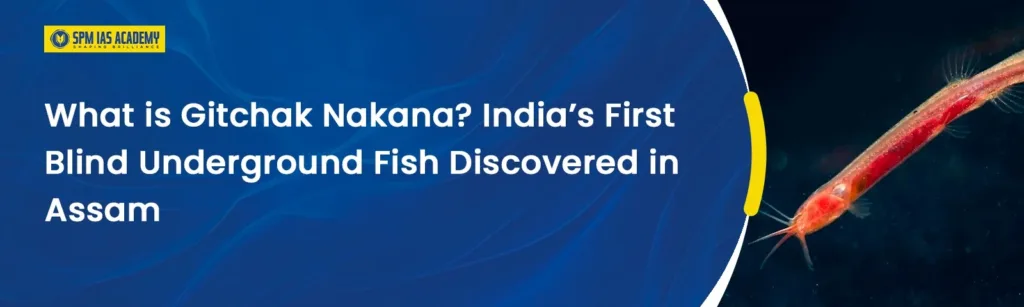
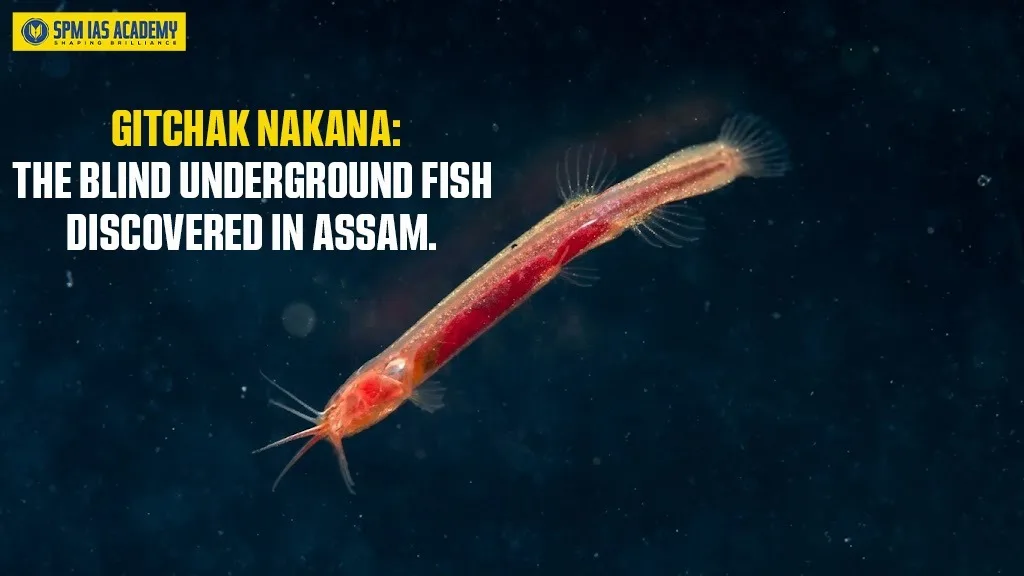
Scientists have recently discovered a new fish species in Assam. This fish, named Gitchak nakana, lives underground in a well. It is a tiny fish with a blood-red body and no eyes, which helps it survive in complete darkness. Moreover, it is the first groundwater-dwelling fish ever found in Northeast India. Researchers discovered this unique species in a dug-out well in the Goalpara district. Therefore, this discovery is very important for understanding biodiversity and ecology. In addition, it is also useful for students preparing for competitive exams like UPSC, APSC, and other State PCS exams.
What Is Gitchak Nakana? Key Facts
Gitchak nakana is a miniature, blind loach fish. Scientists formally described it in February 2026. The research paper appeared in the journal Scientific Reports by Nature Portfolio. Let us look at its key facts quickly.
| Feature | Details |
| Scientific Name | Gitchak nakana |
| Common Name | Underground Blind Loach / Red Underground Fish |
| Family | Cobitidae (Loach family) |
| Size | About 20 millimetres (less than 1 inch) |
| Body Colour | Vivid red (due to visible blood vessels) |
| Eyes | Completely absent (blind) |
| Body Pigment | Absent — body is translucent |
| Skull Roof | Absent — brain covered only by skin |
| Habitat | Underground aquifer (subterranean water) |
| Location Found | Dug-out well, Goalpara district, Assam |
| Published In | Scientific Reports, Nature Portfolio |
| First Recorded In | Northeast India (first such species in the region) |
Where Was Gitchak Nakana Found? Location and Habitat
- Researchers discovered this unique fish in a small village in the Goalpara district. The well is located near the foothills of the Shillong Plateau. It is a concrete-ringed dug-out well and is nearly seven metres deep. The fish lives in a lateritic aquifer beneath the well.
- An aquifer is a layer of rock or soil that stores groundwater. In this case, the aquifer lies under a laterite rock formation. Laterite is a common type of soil found in many parts of Northeast India. As a result, the fish lives in complete darkness and never sees sunlight.
- Interestingly, the discovery happened by accident. Local villagers pumped water out of the well, and the fish came up along with the water. Researchers then noticed this unusual creature and started studying it carefully.
Unique Features of Gitchak Nakana: Why It Looks Alien
This fish looks very different from ordinary fish. It has adapted to life in total darkness underground. These adaptations are called troglomorphies. Here are its most striking features.
- No Eyes: The fish has completely lost its eyes. Eyes are useless in total darkness.
- No Pigment: The body has no colour pigment. It is translucent like glass.
- Blood-Red Appearance: You can see blood vessels through the skin. This gives it a vivid red colour.
- No Skull Roof: Most fish have a bony skull. This fish has no bones on top of its skull. The brain is covered only by skin. This is extremely rare.
- Miniature Size: It is only about 20 mm long. This makes it a miniature species.
- Subterranean Spine: It has a bifurcated subocular spine. This is a structural feature of the loach family.
Scientific Significance of the Discovery
This discovery is groundbreaking for many reasons. It opens a new chapter in India’s biodiversity story. Furthermore, it changes what scientists know about underground life in Northeast India.
- First in Northeast India: No groundwater-dwelling fish had ever been recorded in Northeast India before this.
- First aquifer fish in the region: Gitchak nakana is phreatobitic. It lives in aquifers. This is very rare globally.
- New Genus and Species: Scientists created a completely new genus called Gitchak for this fish. It belongs to no known existing genus.
- Ancient Lineage: Genetic studies show this species separated from its closest relatives between 21 and 45 million years ago. This makes it an evolutionarily ancient creature.
- Global Rarity: Only about 300 subterranean fish species exist worldwide. Fewer than 10 percent of them live in aquifers. Gitchak nakana is among this tiny group.
What Does the Name Gitchak Nakana Mean?
The name comes from the Garo language.
- Gitchak means red in Garo. Scientists chose this name because of the fish’s striking red body colour.
- Nakana comes from two Garo words — na-tok (fish) and kana (blind). Together, they mean blind fish.
- So Gitchak nakana literally means red blind fish in the Garo language.
This naming reflects the local cultural connection to the discovery. Moreover, it honours the indigenous knowledge of the Garo community.
Who Discovered Gitchak Nakana? The Research Team
An international team of researchers worked together on this discovery. The team included scientists from several institutions.
| Institution | Country |
| Senckenberg Naturhistorische Sammlungen Dresden | Germany |
| Assam Don Bosco University, Guwahati | India (Assam) |
| Dhanamanjuri University, Imphal | India (Manipur) |
| Kerala University of Fisheries and Ocean Studies (KUFOS) | India (Kerala) |
| Naturhistorisches Museum Bern | Switzerland |
| University of Bern | Switzerland |
Conclusion:
In conclusion, the discovery of Gitchak nakana, the blind underground fish in Assam, highlights the rich and hidden biodiversity of Northeast India. This unique species shows how life can adapt to extreme conditions like total darkness and underground habitats. Moreover, it helps scientists better understand groundwater ecosystems and rare evolutionary traits.
Therefore, this discovery is not only important for biodiversity and ecology but also highly relevant for UPSC, APSC, and State PCS exams. In addition, students should remember key facts about this new fish species discovered in Assam for current affairs preparation. Overall, Gitchak nakana reminds us that many unknown species still exist, and we must protect these fragile ecosystems for the future.
Source:
FAQ:
Gitchak nakana is a newly discovered blind underground fish species in Assam. It lives in groundwater and has unique features like no eyes, transparent skin, and a blood-red appearance.
Researchers discovered Gitchak nakana in a dug-out well in the Goalpara district. Moreover, the well is located near the foothills of the Shillong Plateau, where the fish live in an underground aquifer.
The discovery of this new fish species in Assam is important because it improves our understanding of biodiversity, groundwater ecosystems, and evolution. In addition, it is highly relevant for UPSC, APSC, and State PCS current affairs.
Gitchak Nakana has several unusual features. For example, it has no eyes, no pigment, and a transparent body. Furthermore, it has a rare skull structure and a very small size, which helps it survive in complete darkness.
Gitchak nakana survives without eyes because it lives in total darkness underground. Therefore, it uses other senses like touch and vibration to move and find food in its environment.

Behind every article at SPM IAS Academy is a team of skilled content writers and subject experts committed to making preparation easier for aspirants. From answering common doubts to breaking down complex issues and current affairs, we create content that is accurate, easy to understand, and directly useful for UPSC, APSC, and other competitive exams.