What Is the Best Way to Read The Hindu for UPSC Preparation?
Reading The Hindu for UPSC is not about reading every word on every page. It is about reading the right sections, in the right order, with the right mindset. The Hindu is one of the most trusted sources for current affairs for UPSC Civil Services Exam preparation. It covers national and international news, editorials, government policies, science, economy, and much more. All of which appear directly in the UPSC Prelims and Mains question papers.
In this article, you will learn exactly how to read The Hindu daily, which sections matter most, how to take notes effectively, and how to build a powerful daily routine around this newspaper. Whether you are preparing for UPSC CSE, APSC, or any State PCS exam, this step-by-step guide will save you time and sharpen your preparation.
Pro Tip: Most UPSC toppers spend 60 to 90 minutes daily on The Hindu. Quality reading always beats quantity.
Why The Hindu Is the Best Newspaper for UPSC Aspirants
Every year, thousands of UPSC aspirants ask the same question – which newspaper should I read? The answer from most UPSC toppers and experts is clear: The Hindu. Here is why it stands out above all other newspapers for UPSC preparation.
1. Editorial Quality:
The Hindu publishes in-depth, well-researched editorials. These editorials help you build analytical thinking, which is essential for UPSC Mains answer writing. Moreover, the language used in editorials improves your vocabulary and expression.
2. Policy and Governance Coverage:
UPSC loves questions on government schemes, policy decisions, and constitutional developments. The Hindu covers all of these in detail. You will find topics like new legislative bills, Supreme Court judgements, and Cabinet decisions reported regularly.
3. International Affairs:
The Hindu gives excellent coverage to India’s foreign policy, bilateral relations, international organisations, and global events. These topics appear frequently in both Prelims and Mains.
4. Science and Technology:
The Science page of The Hindu is a goldmine for UPSC Science & Technology topics. Discoveries, ISRO missions, new policies in health and technology — all of these appear here regularly.
Remember: UPSC does not just test what you know. It tests how deeply you understand current affairs and how you connect them to your static syllabus.
Serious aspirants can also explore UPSC coaching in Assam to strengthen current affairs understanding and structured preparation strategies.
Which Sections of The Hindu Should You Read for UPSC?
Do not try to read the entire newspaper. Instead, focus on the sections that are most relevant to the UPSC syllabus. Here is a section-by-section breakdown to guide your daily reading.
1. Front Page – Must Read
The front page carries the most important national and international news of the day. You should read every headline carefully. Whenever a story connects to your syllabus – such as a new policy, a major court verdict, or a diplomatic development – you must read the full article.
2. National News – Must Read
The National section covers Parliament sessions, state governance, new laws, social issues, and major domestic events. This section directly maps to General Studies Paper 2 (Polity & Governance). Pay close attention to any news about constitutional amendments, new government schemes, or major court rulings.
3. International News – Must Read
India’s foreign policy, geopolitics and international organisations are key UPSC topics. Furthermore, events in neighbouring countries such as developments in Pakistan, China, Bangladesh and Sri Lanka appear repeatedly in UPSC questions. Read this section with a focus on India’s role and response.
4. Editorial & Opinion Pages – Most Important
The Editorial and Op-Ed pages are the heart of The Hindu for UPSC preparation. Read the editorials carefully which are important from the perspective of UPSC syllabus. After reading, ask yourself: What is the main argument? What are the key facts? How does this topic relate to my syllabus? Then write a short 5-line summary in your notes.
The Editorial page builds your answer-writing ability. If you read and summarise one editorial every day, your Mains answers will improve dramatically within 3 months.
5. Economy and Business – Read Selectively
You do not need to read all business news. However, you must track topics like GDP data, inflation trends, RBI policy decisions, government budget highlights, and major economic reforms. These directly cover GS Paper 3 topics.
6. Science & Technology – Read on Science Page Days
The Hindu publishes a dedicated Science page on Tuesdays. Additionally, science and technology news appear throughout the week. Focus on space missions, health and medicine, environment and climate, and emerging technologies like AI, quantum computing, and biotechnology.
7. Environment and Ecology – Read Carefully
Climate change, biodiversity, environmental laws, and government environment policies are important UPSC topics. The Hindu covers these topics in dedicated articles and in its science sections. Link these stories to your Environment syllabus.
8. Skip These Sections
You can safely skip sports news (unless a major Indian sporting policy is announced), celebrity news, entertainment news, detailed financial market data, and regional local news that has no national or policy significance.
How to Read The Hindu Daily — A Step-by-Step Morning Routine
Most successful UPSC aspirants follow a structured daily routine for newspaper reading. Here is a proven daily routine that works for UPSC, APSC, and State PCS preparation.
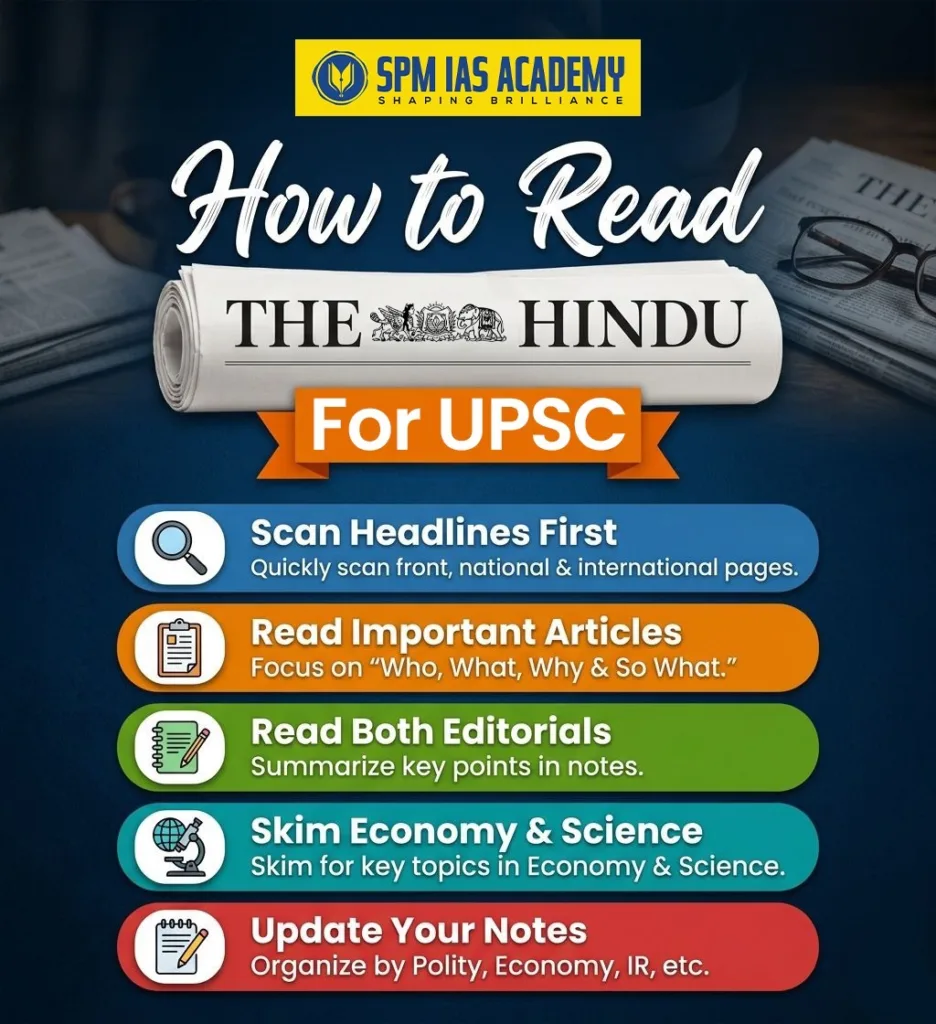
Step 1: Scan All Headlines First (10 Minutes)
Start your reading by scanning all the headlines on the front page, national page and international page. Do not read full articles yet. This gives you a quick overview of the day’s major news. Mark the stories that you need to read in detail.
Step 2: Read Marked Articles in Full (20-25 Minutes)
Now go back and read the articles you marked. While reading, focus on the Who, What, Why, and So What of each story. The ‘So What’ is the most important question – it pushes you to think about the implications and connect the news to your syllabus.
Step 3: Read Both Editorials (15-20 Minutes)
Read both editorials slowly and carefully. Underline key arguments, important facts, and any government or legal terms you encounter. After finishing, write a 5-line summary of each editorial in your notes. This practice improves both your understanding and your answer-writing speed.
Step 4: Skim Economy, Science, and Environment Sections (10 Minutes)
Quickly skim these sections for relevant UPSC topics. If a story is directly connected to your syllabus such as a new RBI policy, a new species discovery or a court ruling on the environment — read it fully and note it down.
Step 5: Update Your Notes File (10 Minutes)
Finally, update your daily current affairs notes. Organise your notes by subject: Polity, Economy, International Relations, Environment, Science & Technology, and Social Issues. Tag each note with the relevant GS Paper so that you can revise it easily later.
Total daily time: 60 to 90 minutes. Consistency beats perfection. Reading regularly for 60 minutes every day is far better than reading for 3 hours occasionally.
How to Make Notes from The Hindu for UPSC
Note-making is the skill that separates average aspirants from toppers. Good notes help you revise quickly in the last month before the exam. Here is how to make effective notes from The Hindu.
Use a Subject-Wise Format
Do not write notes in a diary or day-by-day format. Instead, organise your notes by subject. Create separate sections for Polity & Governance, International Relations, Economy, Environment & Ecology, Science & Technology, and Social Issues. Whenever you read a relevant article, add the key points under the correct subject heading.
Follow the 5-Point Summary Method
For every important article or editorial, write exactly 5 key points. No more, no less. This forces you to identify what truly matters. Additionally, add a line connecting the news to your static syllabus. For example: ‘New bill on data protection links to GS2: Governance, Transparency, and Accountability.’
Highlight Government Schemes and Policies
Whenever The Hindu mentions a new or existing government scheme, note down its name, the ministry behind it, the objective, and the target group. UPSC asks about these schemes both in Prelims (factual) and Mains (analytical) papers.
Use Digital Tools if Convenient
Many aspirants use tools like Notion, OneNote, or Google Docs for note-making. These tools allow you to search your notes quickly. However, if you prefer pen and paper, a good notebook with tabs works just as well. The format matters less than the habit of making notes every day.
Common Mistakes UPSC Aspirants Make While Reading The Hindu
Many aspirants spend a lot of time with The Hindu but still fail to benefit from it. Here are the most common mistakes and how to avoid them.
Mistake 1: Reading Too Much, Retaining Too Little
Reading 3 hours of news without taking any notes is wasted effort. Your brain cannot retain all that information without the aid of structured notes. Always pair reading with note-making.
Mistake 2: Reading Every Section
You do not need to read the entire newspaper. Trying to read everything leads to information overload and wastes precious study time. Stick to the important sections listed in this guide.
Mistake 3: Not Connecting News to the Syllabus
Current affairs are only useful when you connect them to the UPSC syllabus. Every time you read a news story, ask yourself: which GS paper does this connect to? Which topic in the syllabus does it belong to? This habit transforms passive reading into active preparation.
Mistake 4: Skipping Editorials
Many aspirants skip the editorial pages because they find them difficult to understand at first. However, editorials are the most important part of The Hindu for UPSC Mains preparation. Start slowly. Read one editorial per day. Over time, you will find them easier and more rewarding.
Mistake 5: Reading Only The Hindu and Skipping Monthly Magazines
The Hindu gives you daily current affairs, but you also need monthly current affairs magazines for quick revision. Combine The Hindu with a trusted monthly current affairs source to cover everything comprehensively.
Conclusion:
Reading The Hindu for UPSC preparation is not about spending long hours with the newspaper. Rather, it is about reading strategically and consistently. When you focus on the right sections, connect articles to the UPSC syllabus, and make structured subject-wise notes, you transform daily news into powerful exam content. Moreover, regular editorial reading sharpens your analytical skills and improves your answer-writing ability for Mains.
Therefore, build a disciplined 60-90 minutes daily routine, stay consistent, and revise your notes weekly. Over time, this strategy will strengthen your current affairs preparation for UPSC, APSC and State PCS exams. Ultimately, smart newspaper reading can become one of your biggest advantages in cracking the civil services examination.
Many aspirants preparing in the region prefer UPSC coaching in north east India for guided mentorship and exam-focused preparation.
Start today. Read one editorial. Write 5 key points. Connect it to your syllabus. Repeat every day. That is how toppers use The Hindu and that is how you will too.
For more expert guidance on UPSC preparation, daily current affairs notes, comprehensive test series, and personalised mentorship, explore the specialised programs of SPM IAS Academy. We are committed to supporting every serious aspirant – from Guwahati to Gujarat – with structured resources and strategic guidance to help you crack your dream civil services examination.
Source:
Frequently Asked Questions:
60 to 90 minutes daily is the ideal time. Spend about 10 minutes scanning headlines, 25 minutes reading important articles, 20 minutes on editorials and 15 minutes on notes. This routine covers everything you need without taking up too much of your study time.
Yes. Start reading The Hindu from day one of your preparation. Even if you do not understand everything at first, your comprehension will improve rapidly. The earlier you start, the stronger your current affairs base will be by the time you sit for the exam
Yes. The Hindu’s e-paper is equally good and often more convenient. You can highlight text, search for topics, and access old editions easily. Many aspirants prefer the e-paper because it saves time and allows easy note integration with digital tools.
Absolutely. The Hindu is just as essential for APSC (Assam Public Service Commission) and other State PCS exams as it is for UPSC. Additionally, APSC aspirants should supplement their reading with Assam-specific newspapers like Assam Tribune to cover state-level governance and issues.
The best way to remember what you read is to write it down immediately after reading. Use the 5-point summary method. Revise your notes at the end of each week. Also, try to discuss one news topic with a fellow aspirant each day — teaching is the most powerful form of revision.

Behind every article at SPM IAS Academy is a team of skilled content writers and subject experts committed to making preparation easier for aspirants. From answering common doubts to breaking down complex issues and current affairs, we create content that is accurate, easy to understand, and directly useful for UPSC, APSC, and other competitive exams.