
Every year, over 10 lakh aspirants register for the UPSC Civil Services Examination. However, fewer than 1,000 make it to the final list. The difference between those who clear it and those who rarely come down to raw intelligence. Instead, it comes down to planning. A well-structured UPSC study plan for 1 year provides you with a roadmap. This roadmap outlines what to study, when to study it, and how to measure your progress. This guide serves as that roadmap.
Many aspirants also explore best online upsc coaching for beginners to build a strong preparation foundation.
Whether you are a fresh graduate or a working professional, this step-by-step guide is designed for you. It will walk you through every phase, from building your foundation to cracking the final interview.
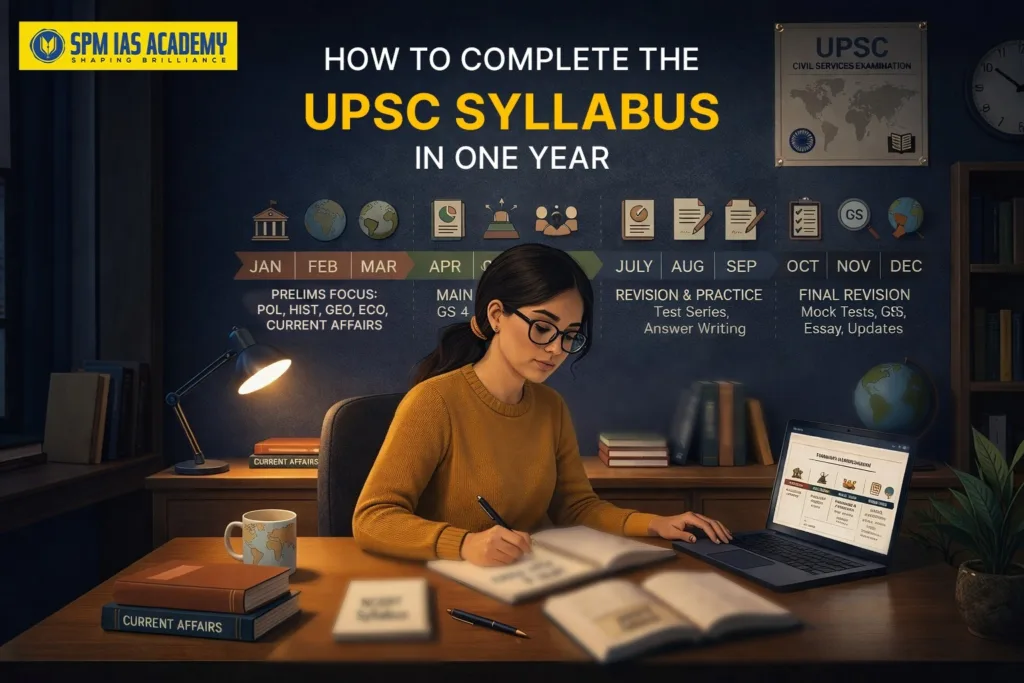
Phase 1: The Foundation (Months 1-3)
One of the most common mistakes beginners make is diving into books before understanding the battlefield. Your first two weeks should be devoted entirely to understanding:
- The three stages: Prelims, Mains, and the Personality Test (Interview)
- The UPSC syllabus for both GS and Optional
- The pattern of Prelims (GS Paper 1 + CSAT) and Mains (9 papers)
Download the official UPSC notification and read the syllabus word by word. Print it out. This document is your Bible for the next 12 months.
1. Analyze Previous Year Questions (PYQs)
Before reading a single chapter of any book, spend at least 7-10 days analyzing PYQs from the past 10 years. PYQ analysis will show you:
- Which topics repeat most frequently
- The depth of knowledge UPSC actually demands
- How do Prelims and Mains questions from the same topic differ in nature
This is your most underrated tool for UPSC 2026 preparation strategy, and most toppers swear by it.
2. The Role of NCERT for UPSC
Months 1-3 are your NCERT months. These textbooks are non-negotiable as the base layer of your preparation. NCERT for UPSC covers History, Geography, Polity, Economy, Science, and Environment in a language that is simple, accurate, and UPSC-aligned.
Below is the NCERT Reading Priority List:
| Subject | Classes to Cover |
| History | 6th to 12th (Old + New NCERT) |
| Geography | 6th to 12th |
| Polity | 11th & 12th (Political Science) |
| Economy | 11th & 12th (Indian Economic Development) |
| Science & Environment | 6th to 10th |
Do not annotate heavily or take long notes in this phase. Read for comprehension, not memorization.
Phase 2: Core Subject Mastery (Months 4-8)
1. General Studies: Deep Dive
This is the longest and most intensive phase of your UPSC study plan for 1 year. With your NCERT foundation in place, you now move to standard reference books and subject-specific resources. Tackle one subject at a time to build conceptual depth.
Below is a demo monthly breakdown:
- Month 4: Indian Polity + Governance
- Month 5: Modern History + Art & Culture
- Month 6: Indian & World Geography
- Month 7: Indian Economy + Social Issues
- Month 8: Environment, Science & Technology, Internal Security
Alongside each subject, immediately revise the relevant PYQs. This cements your understanding and begins training your mind to think like a UPSC examiner.
2. Selecting and Starting Your Optional Subject
Your optional subject contributes 500 marks to your Mains score more than any single GS paper. Choose wisely based on:
Students from the region can also consider UPSC coaching in north east India for structured preparation support.
- Genuine interest (you’ll spend 400+ hours on it)
- Availability of good study material and mentors
- Overlap with GS syllabus (e.g., PSIR, History, Geography, Sociology)
Begin optional preparation no later than Month 6 and dedicate 2 hours daily to it alongside your GS study. This is a key pillar of any serious UPSC strategy for beginners.
Phase 3: Integration & Answer Writing (Months 9-10)
1. Bridging Prelims and Mains
By Month 9, your conceptual coverage should be largely complete. The focus now shifts from learning to applying. This phase is critical in any IAS syllabus completion guide because it’s where many aspirants lose momentum.
Start writing at least one Mains-style answer daily. Use the following structure:
- Introduction: Context or definition (2-3 lines)
- Body: Multi-dimensional analysis with subheadings, bullet points, and data
- Conclusion: Forward-looking or solution-oriented (2-3 lines)
Join a test series or an answer-writing group for peer feedback. UPSC Mains answer writing practice is a skill, and like all skills, it demands deliberate, regular effort.
You can also follow this UPSC Mains Preparation Strategy: 3-Month Plan for Success for focused revision before Mains.
2. Mastering Ethics (GS Paper 4)
Ethics is one paper that many aspirants underestimate. Yet GS Paper 4 can be a game-changer; toppers have scored 130+ here, while others barely cross 90. Focus on:
- Foundational thinkers: Aristotle, Kant, Gandhiji, Kautilya
- Case studies: Practice writing nuanced, multi-stakeholder answers
- Integrity in public service: Connect theory to real governance situations
Ethics cannot be crammed into the last month. Build it steadily through Months 9 and 10.
Phase 4: Final Revision & Mock Tests (Months 11-12)
This phase is where toppers separate themselves from the rest. Your target for Months 11 and 12:
- 50+ full-length Prelims mock tests
- Weekly Mains answer writing (full papers under timed conditions)
- Daily 1-hour current affairs revision
Analyze every mock test deeply. Don’t chase scores, chase error patterns. A single recurring mistake, if fixed, can add 5–10 marks on the actual exam.
1. CSAT: Don’t Neglect It
CSAT (Civil Services Aptitude Test) is qualifying in nature, but failing it disqualifies your GS score entirely. Dedicate 30-45 minutes daily to:
- Reading comprehension passages
- Basic arithmetic and data interpretation
- Logical reasoning
If you have a non-science background, start CSAT practice from Month 10 rather than Month 11.
2. Current Affairs Consolidation
Compile your current affairs notes by themes, not by date. UPSC connects current events to the static syllabus, so your revision should map news stories to GS topics like Polity, Economy, or Environment. Revise this consolidated document at least three times before Prelims.
Important Resource List for UPSC Preparation
Below are some important resources for your UPSC study plan for 1 year:
| Subject | Standard Book/Resource |
| Indian Polity | M. Laxmikanth – Indian Polity |
| Modern History | Rajiv Ahir (Spectrum) – A Brief History of Modern India |
| Ancient & Medieval History | R.S. Sharma, Satish Chandra (Old NCERTs) |
| Indian Geography | G.C. Leong + NCERT |
| Indian Economy | Ramesh Singh – Indian Economy |
| Environment | SPM IAS Environment |
| Art & Culture | Nitin Singhania |
| Ethics | Lexicon for Ethics (Chronicle), G. Subba Rao |
| Current Affairs | The Hindu / Indian Express + SPM IAS Monthly C.A. |
| CSAT | SPM IAS CSAT |
Conclusion: Your Journey Starts Today
In conclusion, the UPSC examination is long, demanding, and deeply rewarding. A structured UPSC study plan for 1 year doesn’t just help you cover the syllabus; it builds the discipline, clarity, and confidence that define a future civil servant.
The best time to begin your preparation was yesterday. The second-best time is right now.
Pick up your syllabus. Open your first NCERT. Write your first answer. The path to IAS in 2026 begins with a single, deliberate step, and you’re already on it.
Frequently Asked Questions:
Yes, for most candidates, a disciplined UPSC study plan for 1 year is sufficient for a first serious attempt. Many toppers cleared Prelims in their first year with 10–12 months of structured preparation. The key is consistency over intensity: a steady 8–10 hours daily beats sporadic 14-hour sessions.
Aim for 8 to 10 hours of focused study per day. More important than the number is the quality. Eliminate distractions, take scheduled breaks (use the Pomodoro technique), and track what you study each day in a simple journal. Avoid comparing your hours with others on social media.
Absolutely. Many IAS officers cleared the exam through self-study alone. Knowing how to clear UPSC in first attempt through self-study requires three things: a structured plan, honest self-assessment, and disciplined execution. Coaching is helpful but not mandatory, especially with the quality of free resources and test series available today.
Start no later than Month 9, though introducing 2–3 answers per week from Month 7 is even better. Many aspirants wait until the last two months, which is insufficient to develop fluency and depth. Think of the Mains answer writing as a muscle, build it gradually.

Behind every article at SPM IAS Academy is a team of skilled content writers and subject experts committed to making preparation easier for aspirants. From answering common doubts to breaking down complex issues and current affairs, we create content that is accurate, easy to understand, and directly useful for UPSC, APSC, and other competitive exams.