Who Was Mamoni Raisom Goswami?
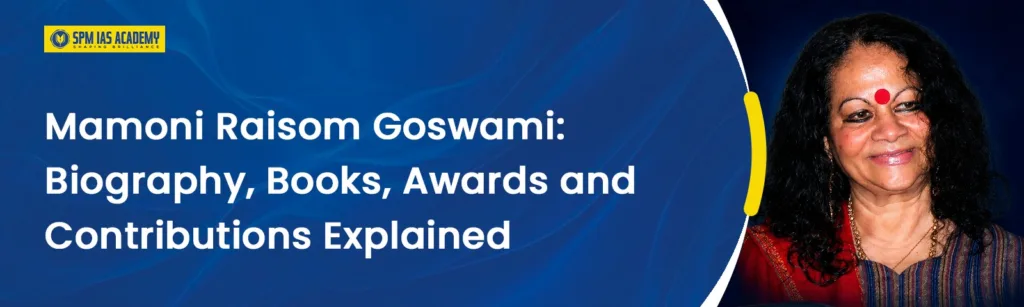
Mamoni Raisom Goswami was a famous Assamese writer, scholar, novelist, and Jnanpith Award winner from Assam. She was one of the most influential writers in Indian literature and Assamese literature. Born on 14 November 1942 in Guwahati, her real name was Indira Goswami. Later, became widely famous by her pen name, Mamoni Raisom Goswami, and the affectionate title “Mamoni Baideo.” She is best known for her novels on social issues, women’s struggles, and Assamese society.
She is best known for books like Datal Hatir Uye Khowa and Neelkanthi Braja. Moreover, her writings focused on women’s issues, social injustice, poverty, and Assamese society. She received the prestigious Jnanpith Award in 2000 for her tremendous literary contributions. Her writings reflected social realities, human suffering, women’s issues, and cultural traditions. Therefore, the biography, books, awards, and contributions of Mamoni Raisom Goswami are highly important for APSC, UPSC, and Assam GK preparation.
Quality UPSC coaching in north east India helps aspirants strengthen Assam history, literature, and current affairs preparation.
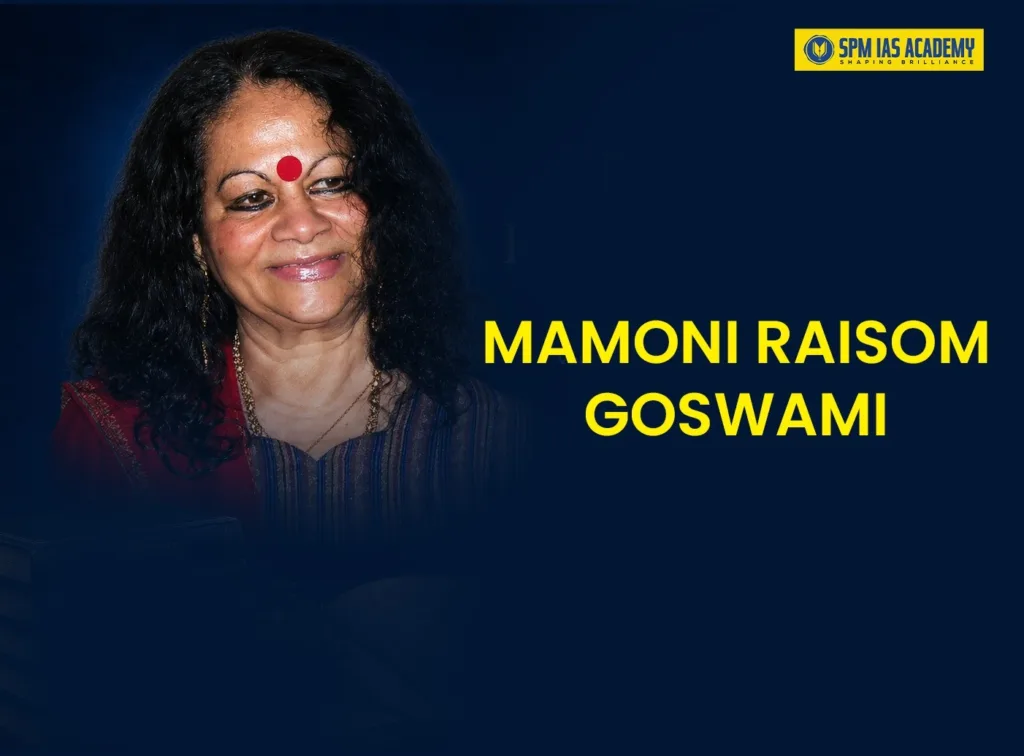
Biography of Mamoni Raisom Goswami:
Early Life and Family
- Mamoni Raisom Goswami was born into a Vaishnavite Brahmin family. Her father was Umakanta Goswami, and her mother was Ambika Devi.
- Her family had deep connections with the Sattra tradition of Ekasarana Dharma.
- She studied at Latashil Primary School in Guwahati and Pine Mount School in Shillong.
- Later, she studied at Tarini Chaudhury Girls’ School in Guwahati. She completed her Intermediate Arts from Handique Girls College, Guwahati.
- Mamoni Raisom Goswami earned her Bachelor’s degree from Cotton College, Guwahati. She majored in Assamese literature. Then, she completed her Master’s degree from Gauhati University in the same subject. She was a brilliant student from a young age.
When Did Mamoni Raisom Goswami Start Writing?
- Mamoni Raisom Goswami started writing at a very young age. When she was in Class VIII, she wrote her first short stories. Editor Kirti Nath Hazarika published these stories in a literary journal. This was a great achievement for a thirteen-year-old girl.
- In 1962, she published her first collection of short stories called Chinaki Morom. She was still a college student at that time. Her writing career spanned from 1956 to 2011.
Life and Career of Mamoni Raisom Goswami: Personal Struggles and Strength
The life and career of Mamoni Raisom Goswami were full of personal hardships. She has suffered from depression since childhood. She married Madhaven Raisom Ayengar, an engineer from Karnataka. Sadly, her husband died in a car accident in Kashmir. This happened after only eighteen months of marriage. This tragedy deeply affected her.
After her husband’s death, she returned to Assam. She joined Sainik School in Goalpara as a teacher. Writing became her way of healing. She said that she wrote just to keep herself alive. Her personal pain gave depth and feeling to her literary work. Later, she went to Vrindavan in Uttar Pradesh for research. She lived there for several years. Her experiences there later became the basis for one of her most celebrated novels.
Mamoni Raisom Goswami later joined the University of Delhi as a Professor of Assamese. She worked in the Modern Indian Languages and Literary Studies Department. During her time at Delhi University, she wrote her greatest works.
What are the famous books of Mamoni Raisom Goswami?
First Novel of Mamoni Raisom Goswami and Major Literary Works
- The first novel of Mamoni Raisom Goswami on the subject of widows in Vrindavan was Neelkanthi Braja (The Blue Necked Braja) published in 1976. She wrote this novel during her stay in Vrindavan. This novel talked about the difficult lives of young widows in Vrindavan. Moreover, the novel highlights the harsh lives of Radha Swamis in Vrindavan, who suffered from poverty, social neglect, and sexual exploitation.
- This novel was autobiographical in nature. The pain of the main character, Saudamini, reflected the author’s own grief after losing her husband. This novel was the first of its kind in Indian literature on this subject.
Some of her most important books:
- Pages Stained with Blood – about the pain of Sikhs during the 1984 anti-Sikh riots in Delhi.
- The Man from Chinnamata – a bold critique of the practice of animal sacrifice at the Kamakhya temple in Assam.
- Ahiron – based on her experiences in Kashmir.
- The Chehnab’s Current – based on her experiences in Madhya Pradesh.
- Dasharathir Khoj (Dasharathi’s Steps), 1998 – the novel focused on social issues, human emotions, lives of marginalized sections like widows.
- Adha Lekha Dastavez (1988) – Her autobiography and personal life story.
- Furthermore, Hridoy, Nangoth Sohor, and Borofor Rani are some of her well-known short stories that reflect human emotions and social realities.
- Datal Hatir Uye Khowa (The Moth-Eaten Howdah of a Tusker), 1986: In this novel, she portrayed the struggles of Assamese Brahmin widows living in Satras. Later, filmmakers adapted the novel into the award-winning film Adajya (1996), which received several national and international awards.
- Tej Aru Dhulire Dhusarita Prishtha (Pages Stained with Blood), 2001: Through this work, she described the suffering of Sikhs during the 1984 anti-Sikh riots that followed the assassination of Indira Gandhi.
- The Man from Chinnamasta (Chinnamastar Manuhto) 2005: In this novel, she strongly criticised the traditional practice of animal sacrifice at the famous Kamakhya Temple in Assam.
- Mamore Dhora Toruwal, 1980 (The Rusted Sword): This novel revolves around a long labour strike by workers of a construction company involved in building an aqueduct over the Sai River in Raebareli district during the 1990s. Moreover, the novel reflects labour struggles and social injustice in India.
Mamoni Raisom Goswami Books: Research and Scholarship
- Mamoni Raisom Goswami also wrote important research works. She was a renowned scholar of Ramayani literature. Her book Ramayana from Ganga to Brahmaputra is a comparative study. It compares the Ramayana of Tulsidas with the fourteenth-century Assamese Ramayana written by Madhava Kandali. This was a major contribution to Indian literary scholarship. She studied these texts deeply during her time in Vrindavan. For this work, she was conferred with the International Tulsi Award by Florida University.
Poems and Short Stories of Mamoni Raisom Goswami
- Apart from novels, Mamoni Raisom Goswami wrote several short stories and poems. Her short story collection Chinaki Morom was her first published work.
- Some of her well-known short stories include Beasts, Parasu’s Well, The Journey, Pakistan, Ode to a Whore, and Pain and Flesh. These stories dealt with the lives of ordinary people, the poor, and the marginalised.
- She wrote about women, widows, riot victims, and the dispossessed. Her poems and prose deeply reflected the social issues of her time.
Why did Mamoni Raisom Goswami win the Jnanpith award?
A common question often asked in APSC and other competitive exams is “for which book did Mamoni Raisom Goswami receive the Jnanpith Award?” Notably, the Jnanpith Award is the highest literary honour in India. Mamoni Raisom Goswami received the Jnanpith Award in 2000. She received the award for her overall contribution to Assamese literature. However, her novels, like The Moth-Eaten Howdah of the Tusker and The Man from Chinnamasta, were very influential works at that time.
While Birendra Kumar Bhattacharya was the first recipient of Jnanpith award from Assam, Mamoni Raisom Goswami was the second literary figure to receive the Jnanpith Award. This was a proud moment for Assam and all of Northeast India. The award recognised her decades of dedication to Assamese literature and social causes.
Which awards did Mamoni Raisom Goswami win?
Awards and Honours Received by Mamoni Raisom Goswami
Throughout her career, Mamoni Raisom Goswami received many prestigious awards and honours. Here is a list of her major awards:
- Sahitya Akademi Award (1983) – given by India’s national academy of letters for her contribution to Assamese literature.
- Jnanpith Award (2000) – India’s highest literary award for her overall contribution to Assamese literature.
- Padma Shri (2002) – one of India’s highest civilian honours, awarded by the Government of India.
- Principal Prince Claus Laureate Award (2008) – an international award from the Netherlands for her contributions to culture and development.
- Asom Ratna – She was conferred with the prestigious Asom Ratna Award for the year 2012 posthumously for her contribution in the field of literature and promoting peace and brotherhood.
- Asom Sahitya Sabha Award and International Tulsi Award from Florida University for her book – ‘Ramayana – Ganga to Brahmaputra’.
These awards reflect the wide recognition that Mamoni Raisom Goswami earned. She was celebrated not just in India but also internationally. Her work reached readers across many countries.
Mamoni Raisom Goswami as a Social Activist and Peace Mediator
- Mamoni Raisom Goswami was not just a writer. She was also a brave social activist. She mediated the peace talks between the armed militant group ULFA (United Liberation Front of Asom) and the Government of India.
- She helped to form the People’s Consultative Group, a peace committee. She called herself an observer rather than a mediator in this process.
- Mamoni Raisom Goswami also fought against social evils through her writing. Her novel “The Man from Chinnamasta” challenged the age-old practice of animal sacrifice at the Kamakhya temple. She argued that the Mother Goddess should be worshipped with flowers, not blood. She used religious scriptures to support her argument. She even received death threats for writing this book. However, she did not stop. Later, this novel became one of the bestsellers in her career.
Films and Other Media Based on Her Works
Many of the works of Mamoni Raisom Goswami were adapted into films and television series. These adaptations helped spread her message to a wider audience.
- Adajya (1996) – a film based on The Moth-Eaten Howdah of the Tusker. It won several national and international film festival awards.
- The Moth-Eaten Howdah of the Tusker was also adapted into two television mini-series. Nandita Das played the lead role of Giribala in one of them.
- Words from the Mist – a biographical film on the life of Mamoni Raisom Goswami, directed by Jahnu Barua.
Death of Mamoni Raisom Goswami and Her Lasting Legacy
Mamoni Raisom Goswami passed away on 29 November 2011 at Gauhati Medical College Hospital. She was 69 years old. Her death was a great loss not only for Assamese literature but also for the whole literary community in India. People across Assam and India mourned her passing. However, her work continues to inspire readers and writers today.
Her novel The Moth-Eaten Howdah of the Tusker was included in The Masterpieces of Indian Literature. Many of her works have been translated into English and other languages. Her autobiography – Adha Lekha Dastabez, an Unfinished Autobiography, remains a deeply personal and important literary document.
Mamoni Raisom Goswami also tried to establish a Srimanta Sankardev Chair at Delhi University. She worked with the Chief Minister of Assam and other officials for this purpose. Although she could not see this dream fulfilled, her efforts were recognised after her death.
Mamoni Raisom Goswami – Notes for APSC
- Mamoni Raisom Goswami was the pen name of Indira Goswami, one of the most famous writers in Assamese literature and Indian literature.
- She was born on 14 November 1942 in Guwahati. Moreover, she became widely popular as “Mamoni Baideo” in Assam.
- She passed away on 29 November 2011 at Gauhati Medical College and Hospital.
- Furthermore, she received the prestigious Jnanpith Award in 2000 for her outstanding contribution to Assamese literature. She became the second Jnanpith Award winner from Assam.
- She also won several major literary honours, including the Sahitya Akademi Award in 1983, the Padma Shri in 2002, and the Prince Claus Award in 2008.
- Moreover, she served as Professor of Assamese at the University of Delhi and contributed significantly to academic research and Assamese studies.
- She also played an important role in peace talks between the United Liberation Front of Asom and the Government of India.
- Her literary works mainly focused on social injustice, poverty, women’s struggles, and the lives of marginalized communities in Assamese society.
- In addition, her first short story collection was Chinaki Morom, published in 1962.
Therefore, the life, books, awards, and contributions of Mamoni Raisom Goswami are highly important for APSC, UPSC, Assam GK, and other State PCS examinations.
Students preparing Assam GK and civil services can join trusted APSC & UPSC coaching in Assam for expert guidance.
Conclusion:
In conclusion, Mamoni Raisom Goswami remains one of the greatest figures in Assamese literature and Indian literature. Through her novels, short stories, poems, and social activism, she highlighted women’s struggles, poverty, social injustice, and human suffering in society. Moreover, her famous books such as Datal Hatir Uye Khowa and Neelkanthi Braja continue to inspire readers across India. Her Jnanpith Award, Sahitya Akademi Award, and Padma Shri recognised her tremendous contribution to Assamese literature and Indian literary culture. Therefore, the biography, books, awards, and contributions of Mamoni Raisom Goswami are highly important for APSC, UPSC, Assam GK, and other State PCS examinations.
Beginners confused about preparation strategy can read How to start your UPSC exam preparation for proper study planning guidance.
Source:
Frequently Asked Questions:
Mamoni Raisom Goswami was a famous Assamese writer, novelist, scholar, professor, and social activist from Assam. Her real name was Indira Goswami, although people widely knew her as “Mamoni Baideo.” Moreover, she became one of the most influential figures in Assamese literature and Indian literature through her novels, short stories, and social writings.
Mamoni Raisom Goswami received the prestigious Jnanpith Award in 2000 for her outstanding contribution to Assamese literature. Furthermore, her novels such as Datal Hatir Uye Khowa and The Man from Chinnamasta made a major impact on Indian literary culture and social thought.
Some of the most famous books of Mamoni Raisom Goswami include Neelkanthi Braja, Datal Hatir Uye Khowa, Pages Stained with Blood, The Man from Chinnamasta, and Adha Lekha Dastabez. Moreover, her literary works mainly focused on women’s issues, poverty, social injustice, and Assamese society.
The real name of Mamoni Raisom Goswami was Indira Goswami. However, she became widely popular by her pen name “Mamoni Raisom Goswami” and the affectionate title “Mamoni Baideo” in Assam.

Behind every article at SPM IAS Academy is a team of skilled content writers and subject experts committed to making preparation easier for aspirants. From answering common doubts to breaking down complex issues and current affairs, we create content that is accurate, easy to understand, and directly useful for UPSC, APSC, and other competitive exams.