
Can you really clear APSC in 2 months? The answer is yes, but only with the right, smart, and focused strategy. The exam is about a proper balance of hard work, smart world and the right strategy.
The APSC Prelims is becoming highly competitive year on year, and it demands the right balance of static subjects, current affairs, and Assam-specific topics. Around 30% of the questions come from Assam specific topic, which makes the topic a game-changer
Understanding APSC Prelims Exam Pattern
Understanding the APSC Prelims exam pattern is the most important step toward the right preparation. The exam is conducted by the Assam Public Service Commission and serves as a screening test for the Mains stage. It consists of two objective-type papers: General Studies Paper I and General Studies Paper II (CSAT).
General Studies Paper I focuses on subjects such as History, Geography, Polity, Economy, Environment, Science & Technology, and Current Affairs, with a strong emphasis on Assam-specific topics. Around 30% of the questions are usually related to Assam, making it a game-changer in the preparation. This paper carries 200 marks, each question contributing 2 marks, and has a negative marking scheme of 0.25 per wrong answer
General Studies Paper II (CSAT) includes comprehension, logical reasoning, basic numeracy, and decision-making questions. Situation and administrative-based decision-making questions constitute a significant number of questions in the CSAT paper. It is qualifying in nature; the candidates need to secure at least 33% marks (i.e, 66.66) to qualify in the CSAT paper. Each question carries 2.5 marks, and each wrong answer deducts 0.50 marks.
Students seeking reliable APSC coaching in guwahati prefer structured mentorship, mock tests, and Assam-focused preparation guidance.
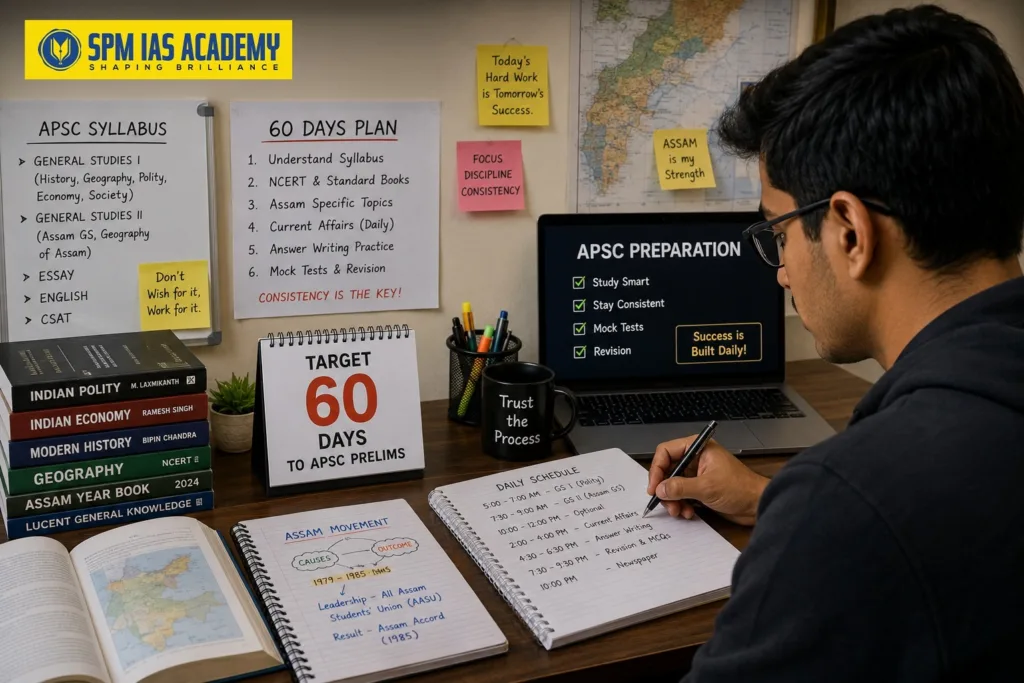
60-Day Preparation Strategy (Phase-wise Plan)
Phase 1 (Day 1–20)
You should focus on building a strong foundation. Begin with covering basic NCERT concepts across core subjects like history, geography, Polity, Economy, and Science. At the same time, start reading monthly or yearly compilations of current affairs to develop awareness of recent events.
Since Assam-related questions form a significant portion of the exam, gradually begin Assam-specific topics alongside your core preparation. This phase is about clarity, so avoid rushing and focus on understanding concepts properly.
Phase 2 (Day 21–45)
You should be revising and strengthening what you studied in the first phase. Start with a thorough revision of high-yielding topics, ensuring that key concepts, facts, and frequently asked areas are clear and well-retained. It is the stage where revision becomes more important than grasping new concepts, so focus on consolidating your previously read topics rather than adding too many new sources.
Alongside revision, regularly solve PYQs from both APSC and UPSC Prelims to deepen your understanding of question patterns and difficulty levels. Precisily you should focus on UPSC PYQs of the last ten years and APSC PYQs from 2022-2024
Phase 3 (Day 46–60)
This phase focuses on final consolidation and an exam-centric mindset. You shouldn’t worry if some topics are left for fresh reading, but trust in the knowledge gained through whatever you have studied. At this stage, you should shift your full focus to attempting full-length mock tests regularly under exam-like circumstances. This will help you improve time management, accuracy, and confidence. After each test, spend sufficient time analyzing your performance—identify mistakes, understand gaps, and avoid repeating them.
Quality APSC coaching in north east India helps aspirants strengthen concepts, revision strategy, and Assam-specific preparation effectively.
Subject-wise strategy
POLITY
Polity is one of the most important and scoring subjects in the APSC Prelims. At least 10 questions directly come from polity in the prelims examination every year. Your focus should be on building a clear understanding of the Indian Constitution and how it functions in practice.
Start with the basics, like the making of the Constitution and the significance of the Preamble, then gradually move toward detailed topics. Since many questions are conceptual and directly based on standard sources, clarity is of utmost importance rather than rote learning.
INDIAN HISTORY
It is a crucial part of the APSC Prelims, with a focus on Ancient and, more so, on Modern India. While questions from Ancient History come from topics like culture, Vedic period, religions, Modern History is more important from an exam perspective due to its direct link with the freedom struggle. The key is to understand timelines, causes, and impacts.
The role of Assam in the freedom struggle is extremely important—revise regional leaders, movements, and events thoroughly. Regular revision of timelines and solving PYQs will help you retain facts and improve accuracy in this topic
GEOGRAPHY
It is a high-scoring and conceptual subject for the APSC Prelims. The preparation should focus on both Physical Geography and Indian Geography. The questions are often a mix of conceptual understanding and map-based identification. Start by building strong fundamentals in topics like geomorphology, climatology, and oceanography.
Give special emphasis on Map based question related to India and the world. Practice world mapping regularly, including continents, oceans, important straits, rivers, mountains, and places in the news.
ECONOMY
Economy is a conceptual subject in the APSC Prelims, so your focus should be on building clear basics rather than memorizing definitions. Start with fundamental concepts. Questions come from topics that are often linked with current affairs, so try to relate static concepts with recent developments like government policies, economic surveys, and budget announcements.
Important areas to prioritize include inflation, budget, banking,monetory tools. Also focus on fiscal policy, national income accounting, including GDP, GNP, etc., and the sectors of the Indian economy(primary, secondary, and tertiary). Practice PYQs to understand how questions are framed and revise regularly to retain concepts.
SCIENCE AND TECHNOLOGY
Science and Technology in APSC Prelims is largely based on basic concepts and practical understanding, rather than deep technical knowledge. The focus should be on NCERT-level science, especially from classes 6–10, as many questions are directly or indirectly based on these fundamentals.
Give special attention to basic NCERT questions and everyday science, which includes real-life applications of scientific principles such as health, environment, technology, and common phenomena. Questions are often simple but require a clear understanding. Regular revision, solving PYQs, and linking concepts to daily life will help you improve accuracy and confidence in this section.
ASSAM HISTORY
Assam History plays a crucial role in APSC Prelims, with a significant weightage given to state-specific topics. Your preparation should focus on understanding Assam’s historical evolution, including key dynasties and the role of the state in India’s freedom struggle.
Special emphasis on the Ahom Dynasty, covering its administration, important rulers, and major battles like those associated with Lachit Borphukan. Another important topic is the freedom movement in Assam, which includes regional movements, contributions, and unique events
ASSAM GEOGRAPHY
Assam Geography is a high-priority area in APSC Prelims. Your preparation should focus on understanding both the physical features and location-based aspects of the state. Clarity in rivers, valleys, climate, and terrain will help you answer both conceptual and factual questions with ease.
Special attention to the Brahmaputra and Barak Valley systems, including their origin, course, tributaries, and importance in Assam’s economy and ecology.
ART & CULTURE
It is an important scoring area in APSC Prelims, especially with a focus on Assam’s rich cultural heritage. Preparation should be fact-oriented but also connected with understanding traditions and their significance. Questions are usually direct, so consistent revision is key to retaining information.
ASSAM ECONOMY
Assam Economy is a crucial section in APSC Prelims, with many questions directly linked to recent developments and government initiatives. Your preparation should focus on understanding the basic structure of the state economy, along with current updates. Since economic questions are often dynamic, integrating static concepts with current affairs is essential
Importance of Previous Year Questions(PYQs)
PYQs help to understand the question patterns. It guides through the important topics. They act as a mirror of the actual exam, helping you understand what the examiner expects from you. By regularly practicing PYQs, you get a clear idea of the question pattern, the level of difficulty, and the types of questions that are frequently asked. Solving at least 10 years of UPSC Prelims questions and the last 3 years of APSC prelims question can give you a huge advantage
Choosing the right APSC books simplifies preparation, improves revision quality, and strengthens conceptual clarity for APSC Prelims success.
Revision Strategy (make or break factor)
In the first phase, your focus should be on full syllabus coverage along with conceptual clarity. This is not just a light revision; it is a consolidation phase where you revisit everything you have studied and strengthen. Try to cover two subjects every day—one major subject like Polity, History, Geography, or Economy, and one minor subject such as Assam-specific topics, Environment, Science, or Current Affairs.
Since Assam-related questions contribute nearly 30% of the paper, you must give dedicated time to it daily. Instead of passively reading, use active recall—after finishing a topic, close your book and try to write or mentally recall the key points. Along with this, solve around 30–40 MCQs every day, especially previous year questions and Assam-based questions, to build application skills and identify gaps.
Conclusion: Final Advice
Clearing APSC Prelims in two months is absolutely achievable with a disciplined, structured, and revision-friendly approach. Success depends on balancing static subjects, current affairs, and especially Assam-specific topics.
Consistent practice of PYQs, regular revision, and smart time management are the key pillars of preparation. Instead of chasing too many sources, focusing on clarity, accuracy, and retention will maximize results. With the right strategy and mindset, even a short preparation window can lead to success.
Frequently Asked Questions:
Ideally, candidates should study 8–10 productive hours daily. Instead of only increasing study hours, focus more on consistency, revision, and solving MCQs regularly
Yes, Mock tests are essential for understanding the exam pattern, identifying the weak areas, and helping improve time management
PYQs are one of the most important aspects of APSC preparation. It helps understand frequently
asked topics, the difficulty level of the questions, important areas for reason and also boosts confidence level
Honest answer is yes. But it requires smart strategy, dedicated study hours and discipline in the preparation

Behind every article at SPM IAS Academy is a team of skilled content writers and subject experts committed to making preparation easier for aspirants. From answering common doubts to breaking down complex issues and current affairs, we create content that is accurate, easy to understand, and directly useful for UPSC, APSC, and other competitive exams.