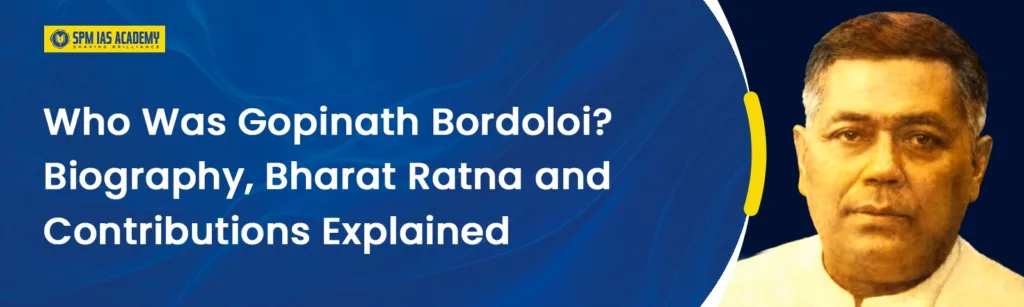
“Like Sardar Patel integrated princely states, Gopinath Bordoloi protected Assam’s territorial integrity.”
Who Was Gopinath Bordoloi?
Gopinath Bordoloi was the first Chief Minister of Assam, a freedom fighter, Bharat Ratna awardee, and the architect of modern Assam. He was a prominent freedom fighter, a close follower of Mahatma Gandhi, and one of the most respected political leaders of Assam. Moreover, Gopinath Bordoloi played a historic role in protecting Assam’s territorial integrity during the Partition of India in 1947 and ensured that Assam remained part of India. For his immense contributions to Assam and the Indian freedom movement, the Government of India posthumously honoured him with the prestigious Bharat Ratna in 1999.
Therefore, the life, contributions, and achievements of Gopinath Bordoloi are highly important for APSC, Assam GK, and other State PCS examinations.
Many aspirants prefer the best apsc upsc coaching centre in guwahati for structured preparation and quality study materials.
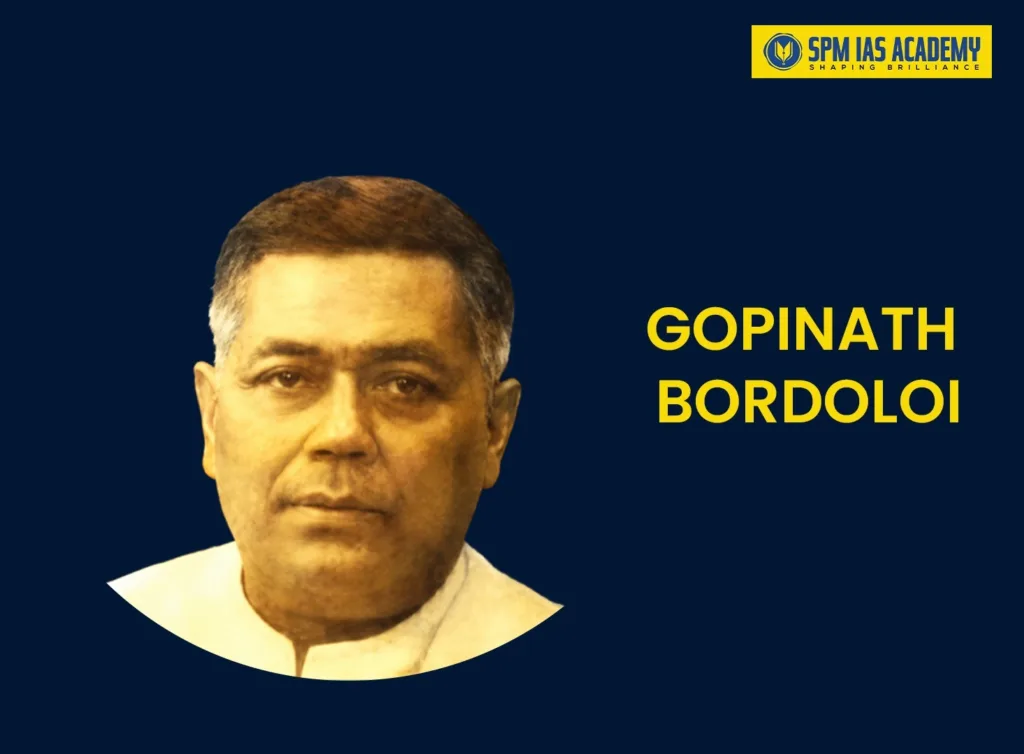
Gopinath Bordoloi Biography
- Gopinath Bordoloi was born on 6 June 1890 in Raha, Nagaon district, Assam. His father, Buddheswar Bordoloi, worked in the government’s medical service. His mother, Praneswari Devi, passed away when Gopinath was only 12 years old. After his mother’s death, his elder sister Shashikala Devi raised him. He came from the Daivajna Brahmin community with roots in Uttar Pradesh.
- Gopinath Bordoloi cleared his matriculation in 1907 and joined Cotton College in Guwahati. He later studied at the Scottish Church College in Calcutta and earned his MA degree from Calcutta University in 1914. He returned to Assam and worked briefly as a headmaster at Sonaram High School. He then pursued law and started his legal practice in Guwahati.
- In 1910, Gopinath Bordoloi married Surabala Devi of North Guwahati. He was deeply influenced by great Bengali personalities like Rabindranath Tagore, J.C. Bose, and Surendranath Banerjee during his student days in Calcutta.
Why Is Gopinath Bordoloi Famous?
- Gopinath Bordoloi is famous as the first Chief Minister of Assam after India’s independence and one of the greatest leaders in Assam’s history.
- Moreover, he played a historic role in protecting Assam during the Partition of India in 1947 and prevented the state from becoming part of East Pakistan.
- He was also a prominent freedom fighter who actively participated in the Indian freedom movement under the leadership of Mahatma Gandhi.
- Furthermore, he worked extensively for the development of education, healthcare, tribal welfare, and infrastructure in Assam. Under his leadership, Assam established important institutions such as Gauhati University and Assam Medical College.
- Sardar Vallabhbhai Patel admired his courage and leadership and honoured him with the title “Sher-i-Assam,” meaning the Lion of Assam.
- In recognition of his immense contribution to Assam and India, the Government of India posthumously awarded him the prestigious Bharat Ratna in 1999.
- Therefore, Gopinath Bordoloi remains famous for his patriotism, visionary leadership, and role in shaping modern Assam.
Gopinath Bordoloi and India’s Freedom Struggle
Gopinath Bordoloi joined the Indian National Congress in 1921. He gave up his law practice to join the Non-Cooperation Movement led by Mahatma Gandhi. He was arrested in 1922 for his active participation in the movement. He spent one year in jail. After the movement was suspended following the Chauri Chaura incident, he returned to legal practice.
From 1930 to 1933, Gopinath Bordoloi stepped back from active politics. During this period, he served on the Guwahati Municipal Board and Local Board. He used this time to work for the social welfare of the people. He strongly demanded a separate University and High Court for Assam during these years.
In December 1940, Gopinath Bordoloi was arrested again by the British. He was released before completing a year in jail due to ill health. When the Quit India Movement was launched in August 1942, British authorities arrested all Congress leaders. Gopinath Bordoloi was jailed twice more during this period. He was finally released in 1944. Throughout all these difficult years, Gopinath Bordoloi stayed committed to Gandhi’s principles of non-violence and truth.
Gopinath Bordoloi as Chief Minister of Assam
First Term: 1938 to 1940
- In 1936, Gopinath Bordoloi was elected as the leader of the opposition in the Assam Legislative Assembly. The Congress party had won 38 seats. However, a British law prevented them from forming the government. The Md. Sadulla Cabinet finally resigned in September 1938. The Governor then invited Gopinath Bordoloi to form the government. He took the oath of office on 21 September 1938.
- During his first term, Gopinath Bordoloi took several bold steps. He stopped the Land Tax that burdened ordinary people. He also protected the land rights of the indigenous Assamese people. He stopped the grant of land to migrant Muslims to preserve the rights of the local population.
- His government was the first provincial government in India to levy agricultural income tax on rich tea planters. This was a revolutionary decision that replaced the ‘Planter’s Raj’ with Swaraj for ordinary people.
- However, his first term did not last long. World War II broke out in 1939. Following Gandhi’s appeal, Gopinath Bordoloi’s Cabinet resigned in 1940.
Second Term: 1946 to 1950
In the 1946 elections, Gopinath Bordoloi was again elected as the Premier (Chief Minister) of Assam. He went on to become the first Chief Minister of independent Assam after India gained freedom on 15 August 1947. He held this position until his death on 5 August 1950.
Key Achievements During the Chief Ministership of Gopinath Bordoloi
- Established Gauhati University (1948): The first university in Northeast India
- Established the High Court of Assam
- Established Assam Medical College
- Established Assam Veterinary College
- Laid the foundation for sports, music, and performing arts in Assam
- Organised the rehabilitation of millions of Hindu refugees from East Pakistan after the partition
- Worked with Sardar Patel to safeguard Assam’s sovereignty against East Pakistan and China
- United all tribal groups, communities, and sections of Assamese society
Why is Gopinath Bordoloi called Lokapriya?
The then Governor of Assam, Jayram Das Doulatram, conferred this ‘Lokapriya’ title on Gopinath Bordoloi after his death. The term Lokapriya means ‘loved by all people’. This honour recognised his selfless service and deep connection with the common people of Assam.
Gopinath Bordoloi lived a simple and humble life despite being the Chief Minister. Following the Gandhian tradition, he always used to wear Khadi cloth. He was deeply influenced by the Bhagavad Gita and was also a gifted Vaishnava devotional singer. He led by example and never used his powerful position for personal gain.
Moreover, Gopinath Bordoloi had a warm and dignified personality. He connected with people from all communities and backgrounds. He worked for tribal people, farmers, refugees, students, and every section of Assamese society equally. This is why the title Lokapriya truly describes him. Even today, people in Assam remember him with great love and respect.
Gopinath Bordoloi and the Constituent Assembly of India
Gopinath Bordoloi was elected as a member of the Constituent Assembly from Assam. He played an important role in the debates that shaped India’s Constitution. He was the Chairman of the North-East Frontier Tribal Areas and Assam Excluded and Partially Excluded Areas Sub-Committee.
He also served as a member of the Committee on the Rules of Procedure. In the debates, he raised important points about tribal rights, representation of Assam in the Lok Sabha, and taxation. On 5 August 1949, he gave a detailed account of the financial difficulties faced by Assam. On 18 July 1947, he spoke about changes in Assam’s population due to migration. He proposed solutions to ensure Assam had adequate representation in Parliament.
Through his work in the Constituent Assembly, Gopinath Bordoloi ensured that the rights and interests of Assam and its tribal communities were protected in the Constitution of India.
How Did Gopinath Bordoloi Save Assam During Partition?
Opposition to the Grouping System
- During the Partition of India in 1947, the British introduced the Cabinet Mission Plan, which included the controversial “Grouping System.”
- Under this system, Assam was proposed to be grouped with Bengal in Group C. Moreover, the Muslim League wanted to use this arrangement to eventually include Assam in East Pakistan.
- However, Gopinath Bordoloi strongly opposed the Grouping System because he believed it threatened Assam’s identity, autonomy, and future within India.
Political Resistance and Public Mobilisation
- Gopinath Bordoloi organised political campaigns, protest movements, and public meetings across Assam against the plan to merge Assam with East Pakistan.
- Furthermore, he created awareness among the people of Assam regarding the dangers of the Grouping System and Partition politics.
Coordination with National Leaders
- He also worked closely with Sardar Vallabhbhai Patel and other national leaders to present Assam’s concerns before British authorities and the Constituent Assembly.
- Moreover, he strongly argued that Assam had a distinct cultural and political identity and should remain within the Indian Union.
Protection of Assam’s Territorial Integrity
- Through his strong leadership and diplomatic efforts, Gopinath Bordoloi successfully prevented Assam from becoming part of East Pakistan after Partition.
- In addition, he protected the interests of tribal communities and indigenous Assamese people during this politically sensitive period.
- Due to his fearless role in safeguarding Assam, Sardar Patel honoured Gopinath Bordoloi with the title “Sher-i-Assam,” meaning the Lion of Assam.
- Therefore, Gopinath Bordoloi is remembered as the architect of modern Assam and the leader who saved Assam during Partition.
Honours and Recognition Given to Gopinath Bordoloi
Gopinath Bordoloi passed away on 5 August 1950 in Guwahati while still serving as Chief Minister. He was 60 years old. His death was a great loss for Assam and India. However, the nation has recognised his extraordinary contributions in many ways.
- Bharat Ratna (1999): Awarded posthumously by Prime Minister Atal Bihari Vajpayee. He became the first and only person from Northeast India to receive this honour.
- Statue in Parliament: A life-size statue of Gopinath Bordoloi was unveiled at Parliament House in 2002 by President A.P.J. Abdul Kalam.
- Lok Kalyan Divas: The Assam Government observes his death anniversary, 5 August, as Lok Kalyan Divas every year.
- Lokapriya Gopinath Bordoloi International Airport: The main airport of Assam and Northeast India is named in his honour.
Why Did Gopinath Bordoloi Receive the Bharat Ratna?
- The Government of India posthumously awarded Gopinath Bordoloi the Bharat Ratna in 1999 for his extraordinary contribution to Assam and the Indian freedom movement.
- Moreover, he played a historic role in protecting Assam during the Partition of India in 1947 and ensured that Assam remained part of India instead of East Pakistan.
- He also made major contributions as the first Chief Minister of Assam after India’s independence. Furthermore, he worked for the development of education, healthcare, tribal welfare, and administration in Assam.
- Under his leadership, Assam established important institutions such as Gauhati University, Assam Medical College, and the High Court of Assam.
- In addition, Gopinath Bordoloi strongly supported the rights of tribal communities and represented Assam’s interests in the Constituent Assembly of India.
- Sardar Vallabhbhai Patel greatly admired his courage and leadership and gave him the title “Sher-i-Assam,” meaning the Lion of Assam.
- Therefore, the Bharat Ratna recognised the immense contribution of Gopinath Bordoloi to Assam, Indian democracy, national unity, and the freedom struggle.
Why Is Gopinath Bordoloi Called “Sher-i-Assam”?
- Gopinath Bordoloi received the title “Sher-i-Assam,” meaning “Lion of Assam,” because of his fearless leadership and courageous role in protecting Assam during the Partition of India in 1947.
- Moreover, he strongly opposed the plan to merge Assam with East Pakistan and worked tirelessly to safeguard Assam’s territorial integrity and identity.
- He also organised political movements, public campaigns, and discussions to defend the interests of the Assamese people during a critical period in Indian history.
- Furthermore, Sardar Vallabhbhai Patel greatly admired his bravery, leadership, and dedication toward Assam and the nation. Therefore, Patel honoured him with the title “Sher-i-Assam.”
- In addition, Gopinath Bordoloi worked for tribal welfare, education, refugee rehabilitation, and the development of Assam after independence.
- His selfless service, strong nationalism, and commitment to public welfare earned him immense respect among the people of Assam.
- Therefore, the title “Sher-i-Assam” symbolises the courage, leadership, and patriotic contribution of Gopinath Bordoloi to Assam and India.
What were the Contributions of Gopinath Bordoloi?
- Gopinath Bordoloi played a major role in India’s freedom struggle by actively participating in the Non-Cooperation Movement and Quit India Movement led by Mahatma Gandhi.
- Moreover, he protected Assam during the Partition of India in 1947 and ensured that Assam remained part of India instead of East Pakistan.
- He became the first Chief Minister of Assam after independence and laid the foundation for modern Assam through visionary leadership and development policies.
- Furthermore, he established important educational and healthcare institutions such as Gauhati University, Assam Medical College, and the High Court of Assam.
- He also worked extensively for the welfare and protection of tribal communities and indigenous people in Assam.
- In addition, he helped rehabilitate millions of Hindu refugees who migrated from East Pakistan after Partition.
- As a member of the Constituent Assembly of India, he strongly represented Assam’s interests and advocated for tribal rights and regional development.
- Gopinath Bordoloi also promoted Assamese culture, education, music, and social harmony across the state.
- Due to his courage and leadership, Sardar Vallabhbhai Patel honoured him with the title “Sher-i-Assam.”
- Therefore, Gopinath Bordoloi is remembered as the architect of modern Assam and one of the greatest leaders in Assam’s history.
Important Facts About Gopinath Bordoloi for APSC
Questions about Gopinath Bordoloi appear regularly in APSC Prelims, APSC Mains, UPSC GS papers, and state PCS examinations. The following facts are most important for exam preparation.
- He was the first Chief Minister of Assam after independence (1946–1950).
- He was the first Chief Minister of undivided Assam before independence (1938–1940).
- He was awarded the Bharat Ratna posthumously in 1999.
- He is the first and only person from Northeast India to receive the Bharat Ratna.
- He was a member of the Constituent Assembly from Assam.
- He chaired the Sub-Committee on North-East Frontier Tribal and Excluded Areas.
- He established Gauhati University, Assam Medical College, and the High Court of Assam.
- He stopped Assam from merging with East Pakistan during the 1947 Partition.
- Sardar Patel called him ‘Sher-i-Assam’ (Lion of Assam).
- Governor Jayram Das Doulatram gave him the title ‘Lokapriya’ (loved by all).
- His death anniversary (5 August) is observed as Lok Kalyan Divas in Assam.
- His life-size statue stands in the Parliament House of India.
Students preparing for civil services can join the trusted ias coaching institute assam for expert guidance and mentorship.
Conclusion
Gopinath Bordoloi was truly the architect of modern Assam. Through his courage during India’s freedom struggle, his visionary leadership as the first Chief Minister of Assam, his role in the Constituent Assembly, and his selfless service to the people, Gopinath Bordoloi shaped the destiny of Assam and Northeast India. His title Lokapriya, shows the love and respect the people of Assam have for him. The Lokapriya Gopinath Bordoloi International Airport carries his name and his legacy forward for all time.
Source:
Frequently Asked Questions:
Gopinath Bordoloi was the first Chief Minister of Assam after India’s independence and one of the most influential freedom fighters from Northeast India. Moreover, he played a major role in protecting Assam during the Partition of India and contributed significantly to education, tribal welfare, and state development. Therefore, he is widely remembered as the architect of modern Assam.
Gopinath Bordoloi is famous for saving Assam from becoming part of East Pakistan during the Partition of India in 1947. Furthermore, he established important institutions such as Gauhati University and Assam Medical College. He also served as the first Chief Minister of Assam and strongly supported India’s freedom movement.
Gopinath Bordoloi received the title “Lokapriya,” which means “loved by all people,” because of his humble personality and selfless service to Assam. Moreover, he worked for farmers, tribal communities, refugees, students, and ordinary citizens without discrimination. Therefore, the people of Assam deeply respected and admired him.
During the Partition of India, Gopinath Bordoloi strongly opposed the British Cabinet Mission’s Grouping System, which threatened to include Assam in East Pakistan. Furthermore, he organised political campaigns and worked closely with Sardar Vallabhbhai Patel to protect Assam’s territorial integrity. As a result, Assam remained part of India after independence.
During the Partition of India in 1947, Gopinath Bordoloi played a historic role in safeguarding Assam from political merger with East Pakistan. Moreover, he defended the interests of indigenous Assamese people and tribal communities during a politically sensitive period. His leadership helped preserve Assam’s identity, sovereignty, and future within independent India.
The Government of India posthumously awarded Gopinath Bordoloi the prestigious Bharat Ratna in 1999. Moreover, the award recognised his extraordinary contribution to Assam, India’s freedom struggle, and national unity.

Behind every article at SPM IAS Academy is a team of skilled content writers and subject experts committed to making preparation easier for aspirants. From answering common doubts to breaking down complex issues and current affairs, we create content that is accurate, easy to understand, and directly useful for UPSC, APSC, and other competitive exams.