
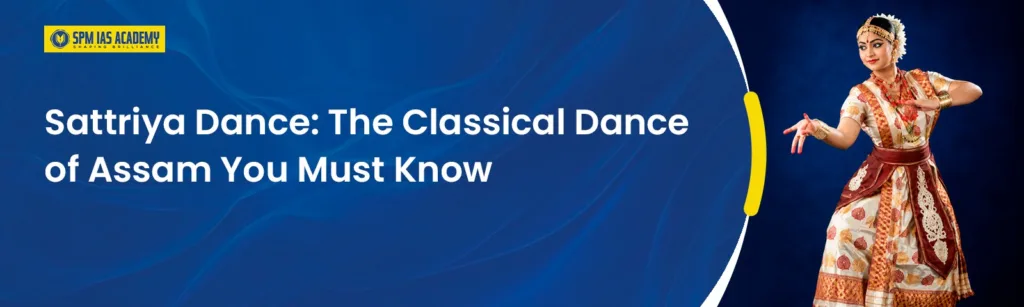
Sattriya dance is the classical dance of Assam. It is one of the eight major classical dances of India. The Sangeet Natak Akademi recognised Sattriya dance as an official Indian classical dance on 15 November 2000. This dance form carries a history of over 500 years. It is deeply connected to the Vaishnavite bhakti movement of Assam propagated by Mahapurush Srimanta Sankardeva. Students preparing for UPSC, APSC, and other State PCS exams must know Sattriya dance well.
What Is Sattriya Dance? – The Classical Dance of Assam
- Sattriya dance, also called Sattriya Nritya, is the classical dance of Assam. It originated in the 15th to 16th century.
- The great saint-scholar Sankaradeva created this dance form. He used it as a powerful tool to spread the message of devotion to Lord Krishna.
- Sattriya dance grew inside Sattras, which are Vaishnavite Hindu monasteries in Assam. The word “Sattriya” itself comes from the word “Sattra,” meaning a monastery.
- In the early days, only male monks performed Sattriya dance. Today, both male and female dancers perform it.
- The dance moved from monasteries to public and global stages in the 20th century. Sattriya dance now represents Assam’s cultural identity on the world stage.
Is Sattriya a Classical Dance of India?
Among the eight classical dances of India, Sattriya dance is one among them. The Sangeet Natak Akademi of India gave it official recognition in the year 2000. Before this, it was mainly known within Assam’s Sattra communities. After recognition, Sattriya dance gained national and international attention. It joined the list of India’s great classical dance forms, including Bharatanatyam, Kathak, Odissi, Kathakali, Kuchipudi, Manipuri, Mohiniyattam, and Chhau. If you want to know more on the classical dances of India, read this!
Sattriya dance has its roots in the ancient text Natya Shastra, written by Bharata Muni. This text is the oldest guide to Indian performing arts. It covers the theory of dance, expressions, gestures, basic steps, and standing postures. All Indian classical dances, including Sattriya dance, follow the principles laid down in the Natya Shastra.
Origin and History of Sattriya Dance of Assam
- The history of Sattriya dance of Assam goes back to ancient times. Copper plate inscriptions and sculptures from Assam show evidence of dance traditions linked to Shaivism and Shaktism.
- However, the modern form of Sattriya dance belongs to the 15th and 16th century. The Neo-Vaishnavite Saint Sankaradeva systematised this dance form. He created it as a community religious art to promote devotion to Lord Vishnu.
- Sankaradeva originally created Sattriya dance as part of Bhaona, which are performances of Ankiya Nat or one-act plays. These plays featured stories from the Mahabharata, Ramayana, and the Bhagavata Purana.
- Sankaradeva’s principal disciple, Madhavadeva, also contributed greatly to these dance-dramas. Together, they shaped the rich tradition of Sattriya dance in Assam.
Role of Sattras in the Development of Sattriya Dance of Assam
- Sattras are Vaishnavite monasteries established by Sankaradeva in Assam. They became the home of Sattriya dance.
- The monks inside these monasteries practised and preserved the Sattriya dance tradition for centuries.
- One special feature of Sattriya dance inside Sattras is that it is not performed before any idol. Instead, dancers perform it before a copy of the Bhagavata Purana placed in the eastern corner of the hall, called the Manikut.
What are the Key Features of Sattriya Dance – Classical Dance of Assam
Sattriya dance has many unique and important features. These features make it stand out among all Indian classical dances.
- Firstly, Sattriya dance follows the three-part repertoire: Nritta (pure dance), Nritya (expressive dance), and Natya (dramatic group play).
- Secondly, the themes of Sattriya dance are mostly based on stories of Lord Krishna and other avatars of Vishnu.
- Sattriya dance uses Ankiya Nat plays as its base.
- The dance follows the principles of Natya Shastra, Abhinaya Darpana, and Sangita Ratnakara.
- Moreover, traditional costumes include silk garments, specific jewellery, and masks used during performances.
- Similarly, musical instruments like the khol (drum) and flute accompany the Sattriya dance performance.
- Earlier only men performed Sattriya dance, but today women also perform and teach it widely.
Which Is the Classical Dance of Assam?
The answer is simple: Sattriya dance is the classical dance of Assam. This is one of the most asked questions in UPSC, APSC, and State PCS exams. Candidates must also remember that Sattriya dance received its official status from the Sangeet Natak Akademi in the year 2000. It became the 8th classical dance of India at that time. Furthermore, it belongs to the Ekasarana Dharma tradition started by Sankaradeva.
In addition, Sattriya dance is performed before the Bhagavata Purana and not before an idol. This is a unique and important feature. Remember this fact for your objective questions in competitive exams.
Students preparing Art and Culture topics can join apsc upsc coaching in guwahati for expert guidance.
Spiritual and Cultural Significance of Sattriya Dance
- Sattriya Dance is not only a classical dance form but also a spiritual practice deeply connected with Neo-Vaishnavite traditions in Assam.
- Moreover, Srimanta Sankardeva believed that dance, music, drama, and religious values should work together to spread devotion and moral teachings.
- He also encouraged every Sattra leader to compose at least one religious play during their lifetime. Therefore, Sattriya Dance developed a strong ethical and philosophical foundation.
- Furthermore, Sattriya Dance spreads values such as truthfulness, devotion, discipline, compassion, and non-violence through performances and Bhaona traditions.
- The dance played a major role in the Neo-Vaishnavite Bhakti movement in Assam by helping Srimanta Sankardeva connect common people with spiritual teachings and devotional culture.
- Moreover, the dance-drama tradition of Bhaona strengthened community participation and preserved Assamese religious and cultural heritage.
- Even today, Sattriya Dance remains an important part of social, cultural, and religious life in Assam.
Learn Assam culture and important exam topics through professional APSC coaching in guwahati with experienced faculty support.
Sattriya Dance and Assamese Identity
- Sattriya Dance represents Assamese cultural pride and heritage through music, storytelling, poetry, costume, and devotional expression.
- Moreover, the dance uses Assamese language, literature, and traditional artistic styles to preserve regional identity and cultural continuity.
- Furthermore, the recognition of Sattriya Dance as an Indian classical dance form gave Assam a prominent place on India’s cultural map.
Therefore, Sattriya Dance continues to strengthen Assamese identity while promoting India’s rich cultural diversity.
Conclusion
In conclusion, Sattriya dance is not just the classical dance of Assam; it is a living symbol of Assam’s spiritual, cultural, and artistic heritage. Srimanta Sankaradeva developed this dance form to spread devotion, moral values, and community participation through music, drama, and storytelling. Moreover, the Sattras preserved Sattriya for centuries and helped it grow as a disciplined classical tradition. Today, after its recognition by the Sangeet Natak Akademi in 2000, Sattriya dance holds an important place among India’s classical dance forms. Therefore, students preparing for UPSC, APSC, and State PCS exams must understand Sattriya dance as an important topic in Indian art and culture.
Students preferring Assamese language learning can benefit from APSC coaching in guwahati for complete preparation support.
Source:
Frequently Asked Questions:
Sattriya dance is the classical dance of Assam. It developed inside Vaishnavite monasteries called Sattras and became a major cultural expression of devotion, music, drama, and storytelling. Moreover, it represents Assam’s spiritual and artistic heritage.
Mahapurush Srimanta Sankaradeva created and systematised Sattriya dance in the 15th–16th century. He used this dance form to spread devotion to Lord Krishna and promote moral values through performance traditions like Bhaona and Ankiya Nat.
Sattriya is one of the classical dances of India. The Sangeet Natak Akademi officially recognised Sattriya dance as an Indian classical dance on 15 November 2000. Therefore, it holds an important place in Indian art and culture.
Sattriya dance is associated with Assam. It grew within the Sattra tradition of Assam and reflects the state’s Neo-Vaishnavite culture, Assamese identity, religious values, and classical performance heritage.
Sattriya dance is important for UPSC, APSC, and State PCS exams because it is the classical dance of Assam and one of India’s recognised classical dance forms. Moreover, questions often focus on its founder, origin, features, link with Sattras, and recognition by Sangeet Natak Akademi.
Sattriya dance is the classical dance of Assam. It developed in the Vaishnavite Sattras of Assam and was systematised by Mahapurush Srimanta Sankaradeva. Moreover, the Sangeet Natak Akademi recognised Sattriya as an official classical dance of India in 2000. Therefore, Sattriya dance is important for UPSC, APSC, and other competitive exams.

Behind every article at SPM IAS Academy is a team of skilled content writers and subject experts committed to making preparation easier for aspirants. From answering common doubts to breaking down complex issues and current affairs, we create content that is accurate, easy to understand, and directly useful for UPSC, APSC, and other competitive exams.