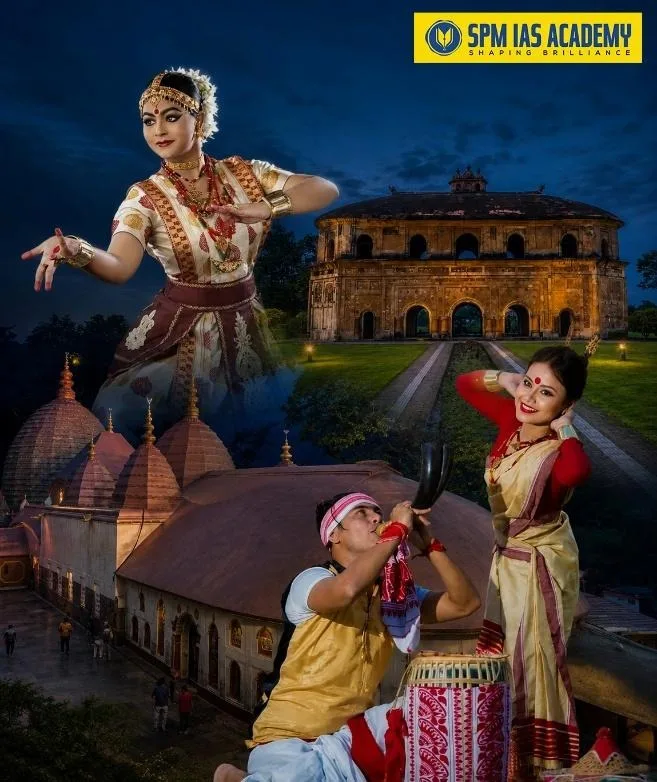
Assam culture and heritage is one of the most important topics for APSC and other Assam government competitive exams. It covers Assam’s festivals, classical dance, folk dances, literature, Sattras, monuments, tribal traditions, handloom, music, language, and historical personalities. For APSC, this topic becomes especially important because Assam-specific questions often test a candidate’s understanding of the state’s identity, history, society, and cultural continuity. Moreover, APSC Mains GS-I and GS-5 include Indian culture, art forms, literature, and architecture and Assam specific topics which makes Assam’s cultural heritage highly relevant for answer writing.
Assam is the most populous state in Northeast India and lies in the Brahmaputra and Barak river valleys. Its location, river systems, tribal diversity, Vaishnavite traditions, and historical kingdoms shaped a rich cultural identity. Therefore, aspirants must study Assam culture not as a separate subject but as a part of history, society, geography, economy, and current affairs.
Why is Assam Culture and Heritage Important for APSC?
Assam culture and heritage is important for APSC because it connects static knowledge with Assam-specific current affairs. Questions may come from festivals, dances, literature, monuments, tribes, GI tags, traditional crafts, Sattras, and famous personalities.
Moreover, this topic helps in both Prelims and Mains. In APSC Prelims, 30% to 35% questions will be based on the Assam specific topics. And within Assam specific topics, Assam culture and heritage form an important area of study. In APSC Mains, General Studies (GS) Paper-5 specifically deal with Assam specific topics. Along with GS-5, GS Paper-I also asks questions based on Assam specific topics under the topics of Indian art and Culture and Indian society. For example, in APSC CCE 2024 Mains, there was a question in GS Paper-I on Manuscript Painting in Assam. The question was –
“Write an essay on the tradition of manuscript painting in Assam?”
Similarly, in APSC CCE 2020 Mains, in GS Paper 1, there was a question on Sattriya dance.
“Write a note on the origins, evolution, salient features of the Sattriya Dance of Assam?”
Visit SPM IAS Academy, a leading apsc coaching centre in assam for expert guidance, Assam-specific notes, and complete APSC preparation.
What Are the Important Topics in Assam Culture and Heritage?
The most important Assam culture and heritage topics for APSC include Sattriya dance, Bihu, Sattras, Neo-Vaishnavism, Ahom monuments, Assamese literature, tribal festivals, folk music, handloom, and cultural current affairs.
Most Important Topics for APSC
- Sattriya dance
- Bihu festival
- Sattra and Namghar tradition
- Srimanta Sankaradeva and Madhavadeva
- Bhaona and Ankiya Nat
- Ahom architecture
- Charaideo Maidams
- Kamakhya Temple
- Assamese language and literature
- Bodo, Mising, Karbi, Dimasa, Rabha, and Tiwa culture
- Muga silk, Eri silk, and traditional weaving
- Folk songs and instruments
- GI tags of Assam
- Cultural festivals in news
These topics regularly appear in Assam-oriented exam discussions and preparation materials. Assam art and culture resources also classify topics into folk dances, music, instruments, handicrafts, architecture, literature, language, festivals, Neo-Vaishnavite movement, and traditional occupations.
Sattriya Dance: Classical Dance of Assam
Sattriya is the classical dance of Assam. Srimanta Sankaradeva developed it as part of the Neo-Vaishnavite movement. It evolved inside Sattras, which are Vaishnavite monasteries of Assam.
Sattriya combines dance, drama, devotion, music, and storytelling. It uses themes from Lord Krishna’s life, Bhagavata Purana, and Vaishnavite traditions. Moreover, it became one of India’s recognised classical dance forms. Therefore, Sattriya dance is a must-study topic for APSC art and culture.
Bihu: Cultural Identity of Assam
Bihu is the most popular festival of Assam. It reflects Assam’s agrarian life, seasonal cycle, music, dance, and community bonding.
Three Types of Bihu
| Bihu | Time | Significance |
| Rongali Bihu | April | Assamese New Year and spring festival |
| Kongali Bihu | October | Period of scarcity and prayer |
| Bhogali Bihu | January | Harvest festival and community feasting |
Rongali Bihu has strong cultural importance because it includes Bihu dance, Bihu songs, dhol, pepa, gogona, and traditional dress. Assam also created a Guinness World Record in 2023 for the largest Bihu dance performance in a single venue with 11,304 dancers and drummers.
Therefore, Bihu is important for both cultural facts and current affairs.
Sattra and Namghar: Core of Assamese Vaishnavite Culture
Sattras and Namghars are key institutions of Assam’s cultural and religious life. Srimanta Sankaradeva and his followers developed these institutions to spread Neo-Vaishnavism.
Difference Between Sattra and Namghar
| Basis | Sattra | Namghar |
| Meaning | Vaishnavite monastery | Community prayer hall |
| Role | Religious, cultural, and educational centre | Social and devotional gathering place |
| Link | Monastic tradition | Village community life |
Sattras preserved Sattriya dance, Bhaona, devotional songs, manuscripts, masks, and traditional knowledge. Therefore, they are essential for APSC culture preparation.
Srimanta Sankaradeva and Neo-Vaishnavite Movement
Srimanta Sankaradeva shaped the cultural and spiritual identity of Assam. He introduced Neo-Vaishnavism, promoted devotion to Lord Krishna, and used art as a tool of social reform.
Contributions of Sankaradeva
- Srimanta Sankardeva spread the philosophy of Ekasarana Naam Dharma across Assam through devotion to Lord Krishna.
- Moreover, he composed devotional Borgeet that became an important part of Assamese spiritual and musical traditions.
- Furthermore, Srimanta Sankardeva created Ankiya Nat plays to spread religious teachings through drama and storytelling.
- He also promoted Bhaona performances to connect common people with Neo-Vaishnavite culture and values.
- In addition, Srimanta Sankardeva developed Sattriya Dance as a devotional dance tradition in Assam.
- Moreover, he built a strong community-based religious system through Sattras and Namghars across Assam.
Therefore, Srimanta Sankardeva greatly strengthened Assamese literature, culture, music, theatre, and social unity. Moreover, Madhavadeva carried forward his legacy through devotional literature and cultural work. Therefore, Sankaradeva and Madhavadeva are highly important for APSC.
Bhaona and Ankiya Nat:
Bhaona is a traditional religious theatre form of Assam. Sankaradeva used it to spread moral, spiritual, and devotional messages. On the other hand, Ankiya Nat refers to one-act plays composed by Sankaradeva and Madhavadeva. These plays use music, dialogue, costume, masks, and dramatic performance. Srimanta Sankardeva created Ankiya Nat plays to spread religious messages through drama and storytelling. He also promoted Bhaona performances to strengthen Neo-Vaishnavite culture in Assam.
Ahom Architecture and Historical Monuments of Assam
Ahom architecture forms an important part of the culture, history, and heritage of Assam. Moreover, the Ahom dynasty ruled Assam for nearly 600 years and developed remarkable architectural traditions.
- Rang Ghar: Rang Ghar is popularly known as the first amphitheatre or first pavilion of Asia. Ahom king Swargadeo Rudra Singha first constructed it in 1696, and the structure was inaugurated during the Bhogali Bihu celebrations in 1714. However, the original structure used bamboo and wood, so it gradually deteriorated over time. Therefore, Swargadeo Pramatta Singha rebuilt the monument in 1744. The two-storeyed structure has an octagonal base and a roof shaped like an inverted Ahom royal boat. Moreover, the Ahom royal family used Rang Ghar to watch sports, cultural programmes, and traditional recreational activities.
- Talatal Ghar: Talatal Ghar is the largest surviving Tai-Ahom monument in Assam. Ahom king Swargadeo Rajeswar Singha built it in 1765. The palace complex contains seven storeys, including three underground levels and four above-ground levels. Moreover, the Ahom rulers used the structure as a royal court, administrative office, and strategic military headquarters. The monument also reflects the advanced architectural and military planning of the Ahom kingdom.
- Kareng Ghar: Kareng Ghar, also known as the Garhgaon Palace, is one of the finest examples of Ahom architecture in Assam. The palace served as the central administrative building of the Ahom capital at Garhgaon. Initially, the Ahoms built the structure mainly with wood until the reign of Swargadeo Pramatta Singha in 1751. However, Swargadeo Rajeswar Singha constructed the present permanent brick structure in 1752. Moreover, the palace originally had seven storeys built with bricks and stone boulders.
- Shiva Doul: Shiva Doul was built in 1734 by Queen Ambika alias Madambika, the wife of Swargadeo Siva Singha. It remains one of the tallest Shiva temples in India.
- Joysagar Tank: Joysagar Tank was constructed in 1707 A.D. by Ahom king Rudra Singha in memory of his mother Joymoti. It was completed within 45 days. It is one of the largest man-made tanks in India.
- Charaideo Maidam: Charaideo Maidams were developed from the 13th century onwards after the establishment of Ahom rule in Assam by Sukapha in 1228. These burial mounds represent the royal funerary traditions of the Ahom kings and nobles. Moreover, people also refer to these burial mounds as the ‘Pyramid of Assam’. To Know More, Read This!
Kamakhya Temple and Religious Heritage of Assam
Kamakhya Temple is one of the most important Shakti Peethas in India and a major centre of Tantric worship. The temple is located on the Nilachal Hills in Guwahati. Historians believe that the original temple existed before the 8th century. However, Koch king Naranarayana and his brother Chilarai rebuilt the present structure in 1565 after earlier destruction. The temple is dedicated to Goddess Kamakhya, who represents feminine power and fertility in Hindu belief. Moreover, devotees believe that the yoni of Goddess Sati fell at this sacred site. The famous Ambubachi Mela, held every year, attracts thousands of pilgrims and Tantric practitioners from across India.
These topics form an important part of Assam History. If you want to know more about Assam History for APSC CCE Prelim, kindly CLICK ON THE LINK!
Assamese Literature and Language for APSC
Assamese literature forms an important part of the culture and heritage of Assam. It developed through devotional writings, folk traditions, modern literature, and nationalist movements. Moreover, Assamese literary works greatly influenced the social, cultural, and religious life of Assam. APSC and Assam GK examinations frequently include questions on Assamese literary texts, writers, and cultural movements. Therefore, aspirants must revise important literary works, authors, and their contributions carefully.
Important Topics of Assamese Literature for APSC
- Various stages of development of Assamese literature: Assamese literature developed through several important historical stages. The earliest stage began with Charyapada and other early religious writings. Later, the Bhakti movement led by Srimanta Sankardeva and Madhavdeva greatly enriched Assamese literature through devotional songs, dramas, and religious texts. Furthermore, modern Assamese literature developed during the 19th and 20th centuries with contributions from writers like Lakshminath Bezbaroa and Hemchandra Barua. Assamese literature later expanded into novels, poetry, drama, journalism, and nationalist writings. Therefore, Assamese literature reflects the social, cultural, and spiritual evolution of Assam.
- Charyapada: Charyapada is one of the earliest examples of Assamese and Eastern Indian literary traditions. Buddhist Siddhacharyas composed these mystical verses between the 8th and 12th centuries. Moreover, the verses contain spiritual teachings and reflect the early development of regional languages in Eastern India.
- Borgeet: Borgeet are devotional songs composed mainly by Srimanta Sankardeva and Madhavdeva. These songs form an important part of Neo-Vaishnavite culture in Assam. Furthermore, Borgeet promotes devotion, spirituality, and moral values through music.
- Ankiya Nat: Ankiya Nat are devotional one-act plays created by Srimanta Sankardeva. These plays use drama, dance, music, and storytelling to spread the teachings of Neo-Vaishnavism. Moreover, Ankiya Nat greatly influenced Assamese theatre and Bhaona traditions.
- Kirtan Ghosa: Kirtan Ghosa is an important religious text written by Srimanta Sankardeva. The book contains devotional songs and narratives based on Lord Krishna. Furthermore, it plays a major role in Assamese Vaishnavite religious practices and Namghar traditions.
- Namghosa: Namghosa is a major devotional text composed by Madhavdeva. The text focuses on devotion to Lord Krishna through prayers and spiritual teachings. Moreover, Assamese people regularly recite Namghosa in Namghars and religious gatherings across Assam.
- Contributions of missionaries: Christian missionaries made major contributions to the development of modern Assamese literature during the 19th century. Moreover, Nathan Brown promoted Assamese language and published educational books. Miles Bronson prepared Assamese dictionaries and supported education, while Oliver Thomas Cutter developed printing facilities in Assam. Furthermore, the missionaries published Orunodoi in 1846, which greatly influenced Assamese prose, journalism, and modern literature. Therefore, missionary activities played an important role in strengthening Assamese language and education.
Important Assamese Literary Personalities and their contributions for APSC
- Lakshminath Bezbaroa: Lakshminath Bezbaroa was a leading figure of modern Assamese literature and the Jonaki era. Moreover, he wrote poems, dramas, essays, and short stories that strengthened Assamese language and cultural identity. His literary works greatly influenced Assamese nationalism and social awareness.
- Hemchandra Barua: Hemchandra Barua was an important Assamese scholar, writer, and social reformer. Furthermore, he wrote the famous Assamese dictionary Hemkosh, which became a milestone in Assamese language development. He also criticised social evils through his writings.
- Jyoti Prasad Agarwala: Jyoti Prasad Agarwala was a famous poet, playwright, filmmaker, and cultural leader of Assam. Moreover, he directed Joymoti, the first Assamese film, in 1935. His contributions greatly influenced Assamese cinema, music, and literature.
- Bishnu Prasad Rabha: Bishnu Prasad Rabha was a renowned artist, singer, writer, dancer, and social reformer. Furthermore, people lovingly called him “Kalaguru” because of his contribution to Assamese culture, music, theatre, and literature. His works promoted social equality and Assamese identity.
- Birendra Kumar Bhattacharya: Birendra Kumar Bhattacharya was a distinguished Assamese novelist and editor. Moreover, he became the first Assamese writer to receive the Jnanpith Award for his novel Mrityunjay in 1979. His writings reflected social and political realities of Assam.
- Mamoni Raisom Goswami: Mamoni Raisom Goswami, also known as Indira Goswami, was a famous Assamese novelist, scholar, and social activist. Furthermore, she received the Jnanpith Award in 2000 for her outstanding literary contribution. Her writings highlighted social injustice, women’s issues, and human suffering. She was best known as scholar of Ramayani literature.
Apart from major literary texts and personalities, APSC examinations also focus on several other important topics related to Assamese literature. Moreover, aspirants should study the Jonaki Era, Orunodoi Era, Assamese journalism, folk literature, and Vaishnavite literature. Important literary organisations such as Assam Sahitya Sabha and important magazines like Orunodoi and Jonaki are also highly relevant for exams. Furthermore, candidates should revise important Assamese novels, dramas, dictionaries, biographies, and literary awards such as the Jnanpith Award. Therefore, a proper understanding of Assamese literary history and cultural movements is essential for APSC and Assam GK preparation.
Important Folk Dances and Folk Music of Assam for APSC
Assam’s folk dances and music show the diversity of its communities. These traditions reflect agriculture, festivals, worship, love, nature, and community life.
Important Folk Dances
- Bihu dance
- Bagurumba
- Jhumoir
- Sattriya
- Deodhani
- Gumrag
- Karbi dance
- Dimasa dance
Bagurumba, the traditional folk dance of the Bodo community, recently gained major current affairs importance in Assam. Moreover, Assam successfully organised a mega Bagurumba dance performance featuring more than 10,000 performers from different districts of the state. The event highlighted Bodo cultural heritage and promoted Assam’s rich tribal traditions at the national level. Furthermore, the mega showcase followed earlier large-scale performances of Bihu Dance and Jhumoir organised in Assam.
Important Tribes and Cultural Diversity of Assam for APSC
Assam’s tribal communities enrich the state’s cultural identity. Each community has its own festivals, dress, language, food, music, and social customs. APSC frequently asks questions on different tribes and their cultural, social and demographic features.
Important Tribes and Communities for APSC
- Bodo
- Mising
- Karbi
- Dimasa
- Rabha
- Tiwa
- Deori
- Sonowal Kachari
- Tea tribes
- Moran and Motok
Important Tribal and Ethnic Festivals
- Baishagu
- Ali-Ai-Ligang
- Rongker
- Bushu Dima
- Me-Dam-Me-Phi
- Karam Puja
Moreover, tribal culture can be linked with identity, autonomy movements, Sixth Schedule areas, local governance, and inclusive development.
Handloom, Handicrafts and GI Tags of Assam for APSC
Assam has a rich handloom and handicraft tradition. Muga silk, Eri silk, Pat silk, bamboo crafts, cane crafts, mask-making, bell metal, brass work, and pottery form an important part of Assam’s cultural economy.
Important Topics
- Muga silk
- Eri silk
- Pat silk
- Jaapi
- Gamosa
- Bell metal craft of Sarthebari
- Majuli mask-making
- Bamboo and cane craft
Cultural museums and educational institutions are also preserving Assam’s heritage. For example, Gargaon College launched a cultural museum in Sivasagar in 2025 to showcase traditional attire, weaving tools, musical instruments, and indigenous farming and fishing tools.
Therefore, aspirants should connect handloom and crafts with livelihood, heritage tourism, GI tags, and women’s participation.
Assam Culture and Heritage Current Affairs Topics for APSC
Assam culture and heritage current affairs have become highly important for APSC preparation in recent years. Moreover, APSC frequently asks questions on topics such as Charaideo Maidams, GI tags of Assam, Sattriya dance, tribal festivals, cultural museums, manuscript painting, heritage conservation, and major cultural events. Aspirants should regularly connect static culture topics with recent developments and government initiatives in Assam. Furthermore, current affairs related to Assamese literature, folk dances, handloom, and tribal identity often appear in both Prelims and Mains examinations in GS 5 Assam Specific paper. Therefore, proper preparation of Assam culture and heritage current affairs is essential for scoring well in APSC GS papers and interviews. For this section, one of the best sources is Axom Bikhekh (Assam Specific Weekly Current Affairs) of SPM IAS Academy by Abhishek Lahkar Sir.
Students searching for quality APSC coaching in north east India can explore SPM IAS Academy Guwahati UPSC Coaching for structured mentorship and comprehensive preparation support.
Conclusion
Assam culture and heritage form one of the most important sections of APSC and Assam GK preparation. Moreover, topics such as Sattriya dance, Bihu, Neo-Vaishnavism, Ahom architecture, Assamese literature, tribal traditions, and handloom reflect the rich cultural identity of Assam. Therefore, aspirants should study these topics with proper historical, social, and current affairs connections. A strong understanding of Assam’s culture and heritage not only helps in Prelims and Mains but also improves answer writing and interview performance for APSC and other state competitive examinations.
Source:
Frequently Asked Questions:
Assam culture and heritage is highly important for APSC because the examination frequently asks Assam-specific questions in both Prelims and Mains. Moreover, topics such as Sattriya dance, Bihu, Assamese literature, Ahom architecture, tribal festivals, GI tags, and Neo-Vaishnavism regularly appear in GS Paper-I and GS Paper-V. Therefore, aspirants must prepare Assam culture and heritage thoroughly for better scoring in APSC.
The most important Assam culture and heritage topics for APSC include Sattriya Dance, Bihu, Sattra and Namghar traditions, Ahom Architecture and Monuments, Assamese literature, tribal festivals, GI tags, folk dances, and handloom traditions. Furthermore, current affairs related to heritage conservation and cultural events are also important for APSC preparation.
Many aspirants consider “Axom Bikhekh” by Abhishek Lahkar Sir of SPM IAS Academy one of the best sources for Assam culture and heritage current affairs. Moreover, it weeky covers important Assam-specific current affairs topics relevant for APSC Prelims, APSC Mains and interviews.

Behind every article at SPM IAS Academy is a team of skilled content writers and subject experts committed to making preparation easier for aspirants. From answering common doubts to breaking down complex issues and current affairs, we create content that is accurate, easy to understand, and directly useful for UPSC, APSC, and other competitive exams.