
Assam’s biodiversity and wildlife is one of the most important environmental topics for both APSC Prelims and APSC Mains. Assam lies in the Eastern Himalayan biodiversity region and supports rich forests, wetlands, grasslands, rivers, and wildlife habitats. The state is famous for the one-horned rhinoceros, Bengal tiger, Asian elephant, wild water buffalo, Gangetic river dolphin, pygmy hog, golden langur, and hoolock gibbon. Moreover, Assam has globally important protected areas like Kaziranga National Park, Manas National Park, Nameri National Park, Orang National Park, Dibru-Saikhowa National Park, Raimona National Park, and Dehing Patkai National Park. Therefore, aspirants must study Assam biodiversity with national parks, wildlife sanctuaries, Ramsar sites, Biodiversity Heritage Sites, conservation challenges, and current affairs.
Why is Assam’s Biodiversity and Wildlife Important for APSC?
Assam’s biodiversity and wildlife is important for APSC because it connects environment, geography, ecology, disaster management, tourism, economy, and current affairs. APSC often tests state-specific knowledge on biodiversity and wildlife conservation in both Prelims and Mains. Therefore, candidates must know Assam’s key species, protected areas, wetlands, forest types, and environmental issues.
Moreover, Assam’s biodiversity helps in APSC Mains answer writing for GS-3 and GS-5. Aspirants can use examples from Kaziranga, Manas, Deepor Beel, Brahmaputra wetlands, and Assam’s elephant corridors.
APSC aspirants should focus on:
- National parks of Assam
- Wildlife sanctuaries of Assam
- Tiger reserves and elephant reserves
- Ramsar site of Assam
- Biodiversity Heritage Sites
- Endangered species of Assam
- Human-wildlife conflict
- Floods and wildlife conservation
- Poaching and illegal wildlife trade
- Assam biodiversity current affairs
Many aspirants prefer trusted apsc coaching online in assam for structured preparation, notes, and current affairs guidance.
What Makes Assam a Biodiversity Hotspot?
Assam forms part of the Eastern Himalaya and Indo-Burma biodiversity regions. Its unique location supports high species richness. The Brahmaputra and Barak river systems also create wetlands, floodplains, grasslands, and riverine forests.
The Assam government notes that the state has many wetlands, including Deepor Beel, Chandubi, Son Beel, and several other important beels and hoars. These wetlands support fish, birds, reptiles, mammals, and local livelihoods.
Major reasons behind Assam’s biodiversity richness:
- Firstly, Assam has tropical forests, grasslands, wetlands, and river ecosystems.
- Secondly, the Brahmaputra floodplain supports fertile and diverse habitats.
- Moreover, the state lies near the Eastern Himalayan biodiversity region.
- Furthermore, it provides habitat for many endangered and endemic species.
- Notably, it acts as a wildlife corridor between India, Bhutan, Arunachal Pradesh, and other Northeast regions.
Therefore, Assam’s biodiversity has both ecological and exam importance.
National Parks of Assam for APSC
National parks of Assam are among the most important environmental topics for APSC. At present, there are 8 National Parks and around 17 Wildlife Sanctuaries in Assam. Aspirants should know their location, key species, and special features.
Important National Parks of Assam
| National Park | Important Features |
| Kaziranga National Park | One-horned rhinoceros, tiger reserve, UNESCO World Heritage Site |
| Manas National Park | UNESCO World Heritage Site, tiger reserve, elephant reserve, biosphere reserve |
| Nameri National Park | Tiger reserve landscape, bird diversity, Jia Bhoroli river |
| Orang National Park | One-horned rhinoceros, tiger habitat, Brahmaputra floodplain |
| Dibru-Saikhowa National Park | Riverine ecosystem, feral horses, wetlands |
| Raimona National Park | Part of Bodoland region, golden langur landscape |
| Dehing Patkai National Park | Rainforest ecosystem, rich biodiversity |
| Sikhna Jwhwlao National Park | Part of Manas Biosphere reserves, along Indo-Bhutan border, 3rd national park in BTR and 8th national park in Assam. |
Assam’s Environment and Forest Department lists Kaziranga, Manas, and Nameri as tiger reserves. It also lists Kaziranga and Manas as World Heritage Sites and Deepor Beel as the state’s only Ramsar site.
Kaziranga National Park: Assam’s Global Wildlife Identity
Kaziranga National Park is Assam’s most famous wildlife area. It is a UNESCO World Heritage Site and one of the best examples of successful wildlife conservation in India.
UNESCO states that Kaziranga has the world’s largest population of one-horned rhinoceroses. It also supports tigers, elephants, panthers, bears, and thousands of birds.
Key facts for APSC:
- Kaziranga is famous for the Indian one-horned rhinoceros.
- It is a UNESCO World Heritage Site.
- It is also a tiger reserve.
- It supports the “Big Five” of Kaziranga.
- The Big Five include rhino, tiger, elephant, wild water buffalo, and swamp deer.
- Floods, poaching, invasive plants, and habitat pressure affect the park.
Moreover, Kaziranga appears regularly in current affairs due to rhino conservation, floods, anti-poaching efforts, and tourism.
Manas National Park: Biodiversity and Conservation Importance
Manas National Park is another globally important protected area of Assam. It is a UNESCO World Heritage Site and a major conservation landscape near the Bhutan border.
Why Manas is important:
- Manas National Park received recognition as a UNESCO World Heritage Site in 1985 because of its outstanding biodiversity and ecological importance.
- Moreover, the park functions as an important tiger reserve under India’s wildlife conservation programme.
- Furthermore, Manas also serves as an elephant reserve and supports the protection of Asian elephants in Northeast India.
- In addition, the park holds the status of a biosphere reserve due to its rich ecosystem and diverse habitats.
- The reserve protects several rare and endangered species, including the golden langur, pygmy hog, Royal Bengal tiger, Asian elephant, and wild buffalo.
- Moreover, Manas strengthens transboundary biodiversity conservation because it shares ecological connectivity with Bhutan.
Deepor Beel: Assam’s Ramsar Site
Deepor Beel is Assam’s only Ramsar site. It is a freshwater lake located in the south-western part of Guwahati. The Assam government states that Deepor Beel was listed under the Ramsar Convention in November 2002 because of its biological and environmental importance. Moreover, it is an important habitat for local and migratory birds. As of early January, 2026, the latest bird count revealed that there are around 17,700 birds of 165 bird species.
Important points for APSC:
- Deepor Beel is located near Guwahati.
- Notably, it is Assam’s only Ramsar site.
- It supports birds, fish, wetland plants, and local livelihoods.
- Moreover, it helps in flood control and groundwater recharge.
- Furthermore, it faces threats from encroachment, pollution, waste dumping, and urban pressure.
Recently, concerns over tree felling and ecological stress near Deepor Beel again brought the wetland into the news. The forest department promised to plant ten times the number of felled trees near Deepor Beel.
Important Wildlife Species of Assam
Assam has many important wildlife species. Some are endangered, while others are iconic symbols of the state.
Which are the Key Species on which APSC frequently ask questions?
The most important key species on which APSC frequently asks questions are as follow:
- One-horned rhinoceros
- Royal Bengal tiger
- Ganges Softshell Turtle
- Asian elephant
- Wild water buffalo
- Eastern swamp deer
- Gangetic river dolphin
- Pygmy hog
- Golden langur
- Western hoolock gibbon
- Greater adjutant stork
- Bengal florican
- White-winged wood duck
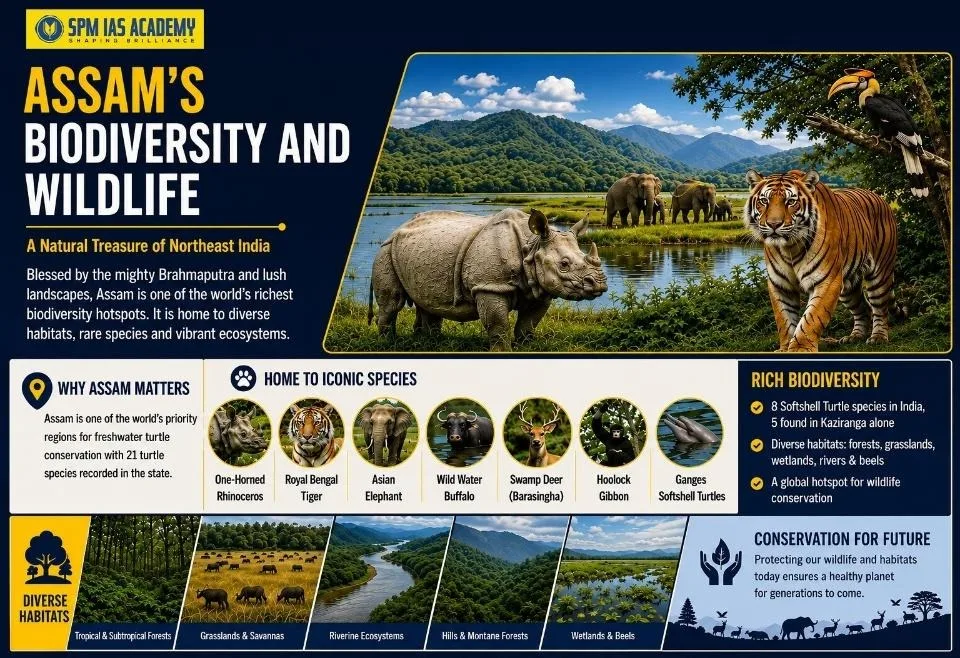
The Assam State Biodiversity Board notes that Assam has around 950 bird species, which represents 53.5% of bird species found in the Indian subcontinent. Moreover, out of 8 species of Gangetic Softshell turtle, 5 are found in Kaziranga national park.
Therefore, Assam is highly important for avian biodiversity and wetland conservation.
One-Horned Rhinoceros in Assam
The one-horned rhinoceros is Assam’s most iconic wildlife species. Kaziranga is the main stronghold of this species. As per the recent data, Kaziranga has 2,613 greater one-horned rhinoceroses. It also supports elephants, wild water buffaloes, swamp deer, and other wildlife. Moreover, Pobitora Wildlife Sanctuary holds the highest density of Greater one Horned Rhinoceros in the country.
Threats to rhinos:
- Poaching for horn
- Flood-related deaths
- Habitat loss
- Disease risk
- Human-wildlife conflict
However, strong anti-poaching efforts have helped improve rhino protection.
Endangered Species in Assam for APSC
Endangered species in Assam are important for Prelims, Mains, and current affairs.
Important endangered and threatened species:
- Pygmy Hog: Found in tall grassland habitats.
- Golden Langur: Found near the Assam-Bhutan landscape.
- Western Hoolock Gibbon: India’s only ape.
- Bengal Florican: A critically endangered grassland bird.
- Gangetic River Dolphin: Found in Brahmaputra river system.
- Ganges Softshell Turtle: Important freshwater turtle species.
Moreover, Assam recently achieved a conservation milestone by releasing India’s first satellite-tagged Ganges softshell turtle in the Brahmaputra at Kaziranga. This shows the growing use of technology in wildlife conservation.
Assam’s Wetlands and River Ecosystems
Assam’s wetlands play a major role in biodiversity conservation. The Brahmaputra and Barak river systems create several wetlands, beels, oxbow lakes, marshes, and floodplain ecosystems. Notably, Deepor Beel is the only Ramsar site in Assam.
Importance of wetlands:
- Firstly, they support fish diversity.
- Secondly, they provide habitat for migratory birds.
- Thirdly, they reduce flood impact.
- Moreover, they support local communities.
- Furthermore, they recharge groundwater and act as carbon sinks.
However, wetlands face threats from encroachment, siltation, pollution, overfishing, and urban expansion.
What are the major threats to Assam’s Biodiversity and Wildlife?
Assam’s biodiversity faces several serious threats. Aspirants should prepare this section for Mains answers specifically for GS-5.
Key threats:
- Habitat loss: Roads, mining, settlements, and agriculture reduce wildlife habitats.
- Floods: Annual floods affect Kaziranga and other floodplain habitats.
- Poaching: Illegal wildlife trade targets rhinos, turtles, birds, and other animals.
- Human-wildlife conflict: Elephants, leopards, and other animals often enter human settlements.
- Wetland degradation: Pollution and encroachment damage Deepor Beel and other wetlands.
- Climate change: Changing rainfall and flood patterns affect ecosystems.
- Invasive species: Alien plants reduce native grasslands and wetlands.
In May 2026, Golaghat Police launched anti-poaching operations in six critical areas to protect wildlife and counter illegal wildlife trade networks.
Assam Floods and Wildlife Conservation
Floods are natural to Assam’s riverine ecosystem. However, extreme floods can harm wildlife.
Kaziranga faces floods almost every year. Floods help renew grasslands, but severe floods can kill animals and force them to move towards highlands and roads. In 2024, floods in Assam killed many animals, including one-horned rhinos, at Kaziranga.
Conservation measures during floods:
- Build and protect highlands.
- Control vehicle speed near animal corridors.
- Use rescue teams.
- Monitor animal movement.
- Strengthen community support.
- Protect forest corridors.
Therefore, flood management is also wildlife management in Assam.
Human-Wildlife Conflict in Assam
Human-wildlife conflict is a major environmental issue in Assam. Elephants, leopards, wild boars, rhinos, and other animals often move into villages and farms.
Causes of conflict:
- Shrinking forest cover has forced many wild animals to move out of their natural habitats in search of food and shelter.
- Furthermore, blocked elephant corridors and habitat fragmentation have disrupted the traditional movement routes of elephants and other wildlife species.
- In addition, the rapid expansion of human settlements near forests has increased encounters between humans and wild animals.
- Seasonal floods in Assam also push animals out of forests and protected areas into nearby villages and agricultural lands.
Therefore, human-wildlife conflict remains an important topic for APSC and UPSC preparation under environment, biodiversity, and conservation issues.
Solutions:
- Authorities should restore and protect wildlife corridors to ensure the safe movement of animals between forest areas.
- Moreover, the government should use early warning systems to alert nearby villages about animal movement.
- Furthermore, officials must provide quick and fair compensation to people affected by crop loss, livestock damage, or property destruction.
- In addition, conservation agencies should promote community awareness programmes about wildlife behaviour and conflict management.
- Farmers should reduce the cultivation of crops that strongly attract elephants and other wild animals near forest boundaries.
- Authorities should also use solar fencing carefully and legally to minimise human-wildlife conflict without harming animals.
Conservation Laws and Institutions for Assam Biodiversity
Aspirants should link Assam biodiversity with national environmental laws.
Important laws and institutions:
- Wildlife Protection Act, 1972
- Forest Conservation Act, 1980
- Environment Protection Act, 1986
- Biological Diversity Act, 2002
- Assam State Biodiversity Board
- National Biodiversity Authority
- Biodiversity Management Committees
- People’s Biodiversity Registers
The Assam State Biodiversity Board works under the Environment, Forest and Climate Change Department of Assam and deals with biodiversity conservation, awareness, documentation, and sustainable use.
Assam Biodiversity Current Affairs for APSC
APSC aspirants must connect biodiversity topics with current affairs. Many questions come from recent wildlife events, conservation projects, and government initiatives.
Current affairs areas to follow:
- Rhino population updates
- Kaziranga floods
- Anti-poaching operations
- Deepor Beel conservation
- New species discoveries
- Biodiversity Heritage Sites
- Turtle conservation
- Elephant corridor issues
- Assam State Biodiversity Board updates
- Wildlife tourism and eco-tourism
Moreover, aspirants should add Assam-specific examples in Mains answers. This improves answer quality.
To prepare for Assam Specific Current Affairs, you can follow ‘Axom Bikhekh’ (Assam Specific Weekly Current Affairs) by Abhishek Lahkar Sir of SPM IAS Academy.
Students seeking expert mentorship often choose a reputed apsc coaching institute in guwahati for Assam-specific exam preparation.
Conclusion
Assam’s biodiversity and wildlife represent one of the richest ecological systems in India and remain highly important for APSC preparation. Moreover, topics such as Kaziranga, Manas, Deepor Beel, endangered species, floods, wetlands, and human-wildlife conflict frequently appear in both APSC Prelims and Mains examinations. Therefore, aspirants should prepare Assam biodiversity by linking static environment topics with current affairs, conservation policies, and Assam-specific examples. A proper understanding of Assam’s wildlife and environmental challenges also improves answer writing for GS-3 and GS-5 papers. For Assam-specific current affairs preparation, many aspirants consider “Axom Bikhekh” by Abhishek Lahkar Sir of SPM IAS Academy as the best source for regular updates and analysis.
Recent success stories in APSC Mains Result 2026 Out reflect the importance of consistent Assam-specific current affairs preparation.
Source:
Frequently Asked Questions:
Assam’s biodiversity is important for APSC because it connects environment, ecology, geography, current affairs, and Assam-specific knowledge. Moreover, it helps in both Prelims and Mains answers.
Deepor Beel is the only Ramsar site in Assam. It is a freshwater wetland located near Guwahati and supports birds, fish, plants, and local livelihoods.
Kaziranga National Park is famous for the Indian one-horned rhinoceros. UNESCO states that Kaziranga has the world’s largest population of one-horned rhinoceroses.
Assam’s biodiversity and wildlife is highly important for APSC because the examination frequently asks questions on national parks, endangered species, wetlands, floods, and conservation issues. Moreover, topics such as Kaziranga National Park, Manas National Park, human-wildlife conflict, and Assam biodiversity current affairs regularly appear in both Prelims and Mains. Therefore, aspirants must prepare Assam wildlife topics thoroughly for GS-3 and GS-5 papers.
Assam’s biodiversity faces major threats from habitat loss, floods, poaching, wetland degradation, climate change, and human-wildlife conflict. Furthermore, blocked elephant corridors, illegal wildlife trade, and rapid urban expansion have increased pressure on wildlife habitats across Assam. Therefore, conservation planning, anti-poaching measures, wetland protection, and corridor restoration have become highly important for biodiversity conservation in Assam.

Behind every article at SPM IAS Academy is a team of skilled content writers and subject experts committed to making preparation easier for aspirants. From answering common doubts to breaking down complex issues and current affairs, we create content that is accurate, easy to understand, and directly useful for UPSC, APSC, and other competitive exams.