

UPSC Mains answer writing is one of the most important skills for Civil Services preparation. Many aspirants know the syllabus and current affairs. However, only a few know how to present answers effectively. A high quality UPSC Mains answer should remain clear, structured, analytical, and relevant to the demand of the question. Therefore, aspirants must learn the correct UPSC answer writing structure, introduction techniques, body presentation, and conclusion methods.
This article explains how to write a perfect UPSC Mains answer with examples, structure, and practical strategies for better marks.
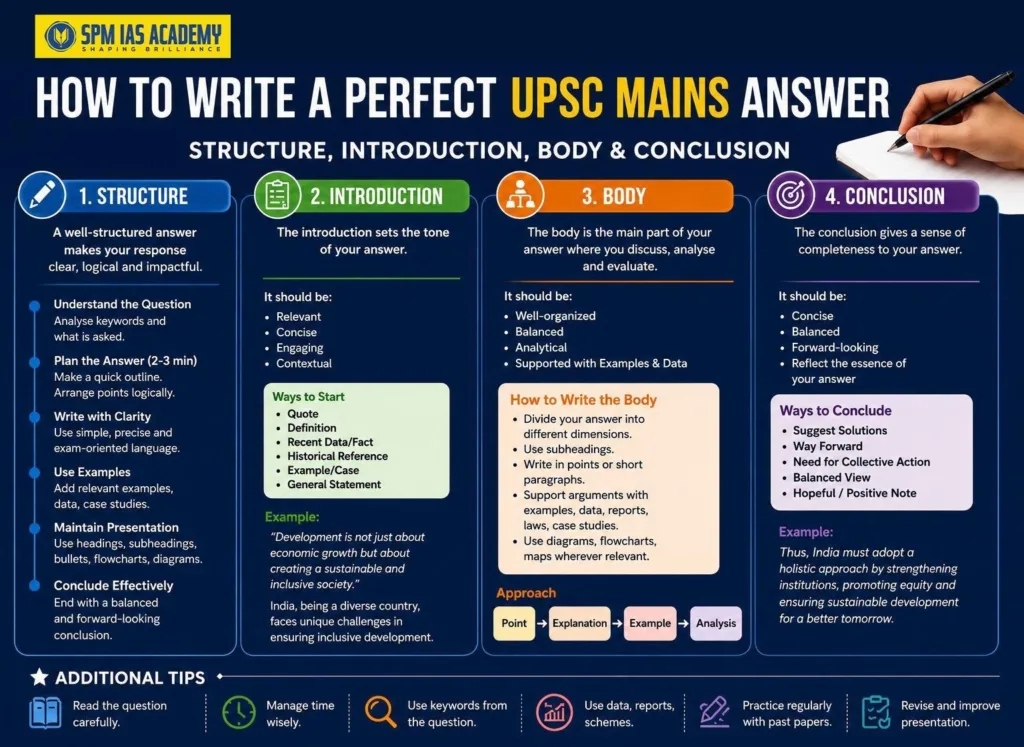
What is the Ideal Structure of a good quality UPSC Mains Answer?
A perfect UPSC Mains answer should follow a clear and well-organised structure. This structure improves clarity, readability, and presentation quality. Moreover, it helps the examiner understand the argument and core idea quickly.
Main Parts of a UPSC Mains Answer
- Introduction – Introduce the topic and address the core demand of the question.
- Body – Explain the main arguments, analysis, examples, and solutions in a structured manner.
- Conclusion – Summarise the answer and provide a balanced or solution-oriented ending.
Therefore, aspirants should maintain this structure to write clear, analytical, and high-scoring UPSC Mains answers.
Why is UPSC Mains Answer Writing Important?
UPSC Mains is not a memory-based examination. Instead, it tests:
- Analytical ability
- Conceptual clarity
- Decision-making skills
- Balanced thinking
- Time management
- Presentation skills
Moreover, UPSC rewards the quality, clarity, and relevance of answers instead of lengthy information. Therefore, regular answer writing practice becomes essential for UPSC GS Papers, Essay Paper, Ethics Paper, and Optional Subjects. Furthermore, consistent practice improves analytical thinking, presentation skills, and time management.
Students seeking expert guidance can explore upsc coaching in guwahati for structured Civil Services preparation support.
How to Write Introduction in UPSC Mains Answers?
The introduction creates the first impression. Therefore, aspirants should keep it short, relevant, and direct.
What is the Ideal Length of Introduction?
An introduction of UPSC Mains answer can be written in 2 to 4 lines with around 20 to 30 words. This length can be an ideal length as it will help to introduce the core theme and manage time at the same time.
Objectives of Introduction
- It introduces the topic on which the question is asked.
- Secondly, it defines the keyword and sets the context for the body.
- Overall, it addresses the core demand of the question.
What are the Best Ways to Start a UPSC Mains Answer?
1. Definition-Based Introduction
Use a simple definition for conceptual topics. It makes it easy for the examiner to understand that you understood the concept and core demand of the question.
Example:
“Federalism refers to the division of powers between the Centre and States.”
2. Data or Report-Based Introduction
Use recent reports, surveys, or statistics.
Example:
“According to the IPCC report, climate change is increasing extreme weather events globally.”
3. Constitutional Article-Based Introduction
Use Articles for polity questions.
Example:
“Article 21 guarantees the Right to Life and Personal Liberty.”
4. Current Affairs-Based Introduction
Use recent events for dynamic questions.
Example:
“The recent floods in Assam highlighted the challenges of disaster management and urban planning.”
5. Quote-Based Introduction
Use only relevant and authentic quotes.
Example:
“Dr. B.R. Ambedkar called constitutional morality the foundation of democracy.”
What are the Common Mistakes one should avoid in UPSC Mains Answer Introductions?
Many aspirants lose marks because of weak and poorly structured introductions in UPSC Mains answers. Therefore, candidates should keep introductions short, relevant, and precise. Moreover, a good introduction should directly address the core demand of the question.
Common Mistakes to Avoid
- Writing very long introductions wastes time and reduces answer efficiency.
- Giving unnecessary background information makes the answer less focused.
- Moreover, using irrelevant quotes weakens the quality and relevance of the introduction.
- Repeating the question directly creates a poor impression on the examiner.
- Writing vague or unclear statements reduces clarity and analytical depth.
Therefore, aspirants should maintain clarity, precision, and relevance while writing UPSC Mains answer introductions.
How to Write the Body of a UPSC Mains Answer?
The body forms the most important part of the answer. It should directly address the demand of the question.
What are the Ideal Features of the Body of a UPSC Mains Answer?
- A good UPSC Mains answer should maintain a logical and structured flow of ideas.
- Moreover, aspirants should use proper headings and subheadings to improve readability.
- Point-wise presentation makes answers clear, concise, and easy to understand.
- Furthermore, balanced arguments help present multiple dimensions of an issue.
- Relevant examples and case studies strengthen the quality and credibility of answers.
- Aspirants should also use diagrams or flowcharts wherever necessary to improve presentation and save time.
Therefore, a well-structured body improves clarity, analytical depth, and overall answer quality in UPSC Mains.
How to Understand the Demand of the Question?
Understanding the demand of the question is one of the most important parts of UPSC Mains answer writing. Therefore, aspirants should carefully identify the directive keywords before writing the answer. These keywords help candidates understand the approach, structure, and analytical depth required in the answer.
Important Directive Keywords in UPSC Mains
- Discuss
- Analyse
- Examine
- Critically evaluate
- Explain
- Comment
Moreover, each directive keyword changes the structure and presentation of the answer.
Example of Question Demand
If the question uses the term “Critically Analyse,” then aspirants should:
- Explain the positive aspects of the issue.
- Furthermore, discuss the negative aspects or limitations.
- Finally, provide a balanced and logical judgement in the conclusion.
Therefore, understanding directive keywords helps aspirants write relevant, structured, and high-scoring UPSC Mains answers.
What is the Best Structure for the Body of UPSC Mains Answers?
A well-structured body improves the clarity, presentation, and analytical depth of UPSC Mains answers. Therefore, aspirants should organise the body in a logical and easy-to-read format. Moreover, a structured answer helps the examiner quickly understand the main arguments and analysis.
Use Headings and Subheadings
Aspirants should use proper headings and subheadings to improve readability and structure. Furthermore, headings help organise ideas in a systematic manner.
Common Headings Used in UPSC Answers
- Causes
- Impacts
- Challenges
- Solutions
Use Point-Wise Presentation
Point-wise presentation makes answers concise and effective. Moreover, short points save time and improve overall answer presentation.
Use Relevant Examples
Examples increase the quality, credibility, and analytical value of answers. Therefore, aspirants should use current and relevant examples wherever possible.
Examples for Climate Change Answers
- Kerala floods
- Assam erosion
- Heatwaves in India
Use Government Reports and Data
Government reports strengthen arguments and make answers more factual. Furthermore, reports improve the authenticity and analytical depth of UPSC Mains answers.
Important Sources for UPSC Answers
- NITI Aayog
- NFHS
- NCRB
- IPCC
- SDG Reports
- Economic Survey
Use Diagrams and Flowcharts
Simple diagrams and flowcharts improve retention and visual presentation. Moreover, diagrams help aspirants explain complex topics in less time.
Useful Diagram Types
- Mind maps
- Flowcharts
- India maps
- Cycles and pyramids
Therefore, aspirants should use structured presentation, examples, reports, and diagrams to write effective UPSC Mains answers.
How to Make UPSC Answers More Analytical?
UPSC prefers analytical answers instead of purely descriptive writing. Therefore, aspirants should focus on explaining issues from multiple dimensions. Moreover, analytical answers demonstrate conceptual clarity, critical thinking, and balanced judgement.
Methods to Improve Analytical Writing
- Explain the causes and effects of the issue clearly.
- Moreover, compare different viewpoints to present balanced analysis.
- Connect current affairs with static syllabus topics to improve relevance.
- Furthermore, suggest practical and realistic solutions wherever necessary.
- Mention long-term implications to show deeper understanding of the topic.
Example of Analytical Writing
Instead of writing:
“Urbanisation increases pollution.”
Aspirants should write:
“Unplanned urbanisation increases pollution because cities lack sustainable transport and waste management systems.”
Therefore, aspirants should focus on reasoning, balanced arguments, and cause-effect relationships to make UPSC Mains answers more analytical.
Importance of Examples in UPSC Mains Answers
Examples play an important role in improving the quality and credibility of UPSC Mains answers. Moreover, relevant examples support arguments and make answers more analytical and practical. UPSC examiners prefer answers that connect theory with real-world developments. Therefore, aspirants should regularly use current and relevant examples in their answers.
Types of Examples Used in UPSC Mains Answers
- Government schemes improve factual depth and policy understanding.
- Supreme Court judgments strengthen constitutional and legal arguments.
- Current affairs examples make answers dynamic and relevant.
- International examples help present comparative analysis and global perspectives.
- Local governance models improve practical understanding of governance issues.
Examples:
- Self Help Groups in Kerala
- Beti Bachao Beti Padhao Scheme
- Women-led biodiversity conservation through the Hargila Army in Assam
Therefore, aspirants should use balanced, updated, and issue-specific examples to improve the analytical quality of UPSC Mains answers.
How to Write Conclusion in UPSC Mains Answers?
A good conclusion should end the UPSC Mains answer in a positive, balanced, and logical manner. Therefore, aspirants should keep conclusions short, relevant, and solution-oriented. Moreover, a strong conclusion leaves a positive impression on the examiner and improves overall answer quality.
Ideal Length of Conclusion
- A UPSC Mains conclusion should usually contain 2 to 3 lines.
- Moreover, the ideal length remains around 20 to 30 words.
Objectives of a Good Conclusion
- Summarise the main idea of the answer clearly.
- Furthermore, provide a balanced and logical ending.
- Suggest a practical way forward or future solution wherever necessary.
Therefore, aspirants should write concise and meaningful conclusions to improve the effectiveness of UPSC Mains answers.
Best Types of UPSC Conclusions
Aspirants should use different types of conclusions based on the demand of the UPSC Mains question. Moreover, a strong conclusion improves balance, presentation, and analytical depth. Therefore, candidates should choose conclusions that logically connect with the core theme of the answer.
Solution-Oriented Conclusion
A solution-oriented conclusion suggests practical measures to address the issue discussed in the answer. Furthermore, it reflects problem-solving ability and policy-oriented thinking.
Example:
“India should strengthen climate resilience through sustainable urban planning and renewable energy expansion.”
Constitutional Conclusion
A constitutional conclusion connects the answer with constitutional values, principles, or democratic ideals. Moreover, it works effectively in polity, governance, and ethics answers.
Example:
“Cooperative federalism can strengthen India’s democratic structure.”
SDG-Based Conclusion
An SDG-based conclusion links the answer with Sustainable Development Goals and inclusive development. Therefore, it adds global relevance and developmental perspective.
Example:
“Inclusive development is essential for achieving Sustainable Development Goals.”
Vision-Based Conclusion
A vision-based conclusion presents a positive future outlook and long-term reforms. Furthermore, it highlights innovation, governance, and sustainable growth.
Example:
“Technology and governance reforms can help India achieve inclusive growth.”
Many aspirants prefer UPSC coaching in north east India for personalised mentorship and strong answer writing preparation.
Common Mistakes in UPSC Mains Answers
Many aspirants lose marks in UPSC Mains because of common answer writing mistakes. Candidates often write irrelevant information and ignore the directive keyword of the question. Moreover, poor handwriting, weak structure, and excessive paragraph writing reduce readability. Many answers also lack examples, data, and analytical depth. Furthermore, very lengthy answers and weak conclusions affect overall presentation and time management. Therefore, aspirants should focus on clarity, relevance, balanced structure, and precise presentation in UPSC Mains answers.
Best Tips to Improve UPSC Mains Answer Writing
Daily Practices for UPSC Mains Answer Writing
Consistent practice plays an important role in improving UPSC Mains answer writing skills. Therefore, aspirants should write answers daily to improve speed, clarity, and analytical thinking. Moreover, solving previous year questions helps candidates understand the pattern and demand of UPSC questions. Aspirants should also read topper copies and analyse model answers to learn effective presentation techniques. Furthermore, regular practice improves time management and answer structuring skills.
Important Strategies to Improve UPSC Mains Answers
Aspirants should use simple and easy-to-understand language in UPSC Mains answers. Moreover, short sentences improve readability and clarity. Candidates should underline important keywords to highlight key points for the examiner. Furthermore, smart use of diagrams and flowcharts improves presentation and saves time. Aspirants should also practise writing answers within the prescribed word limit to maintain discipline and complete the paper on time.
Importance of Revision in UPSC Answer Writing
Regular revision strengthens conceptual clarity and improves retention. Therefore, aspirants should frequently revise notes, examples, reports, and current affairs. Moreover, revision helps candidates present balanced, relevant, and analytical answers in the UPSC Civil Services Examination.
Role of Current Affairs in UPSC Mains Answers
Current affairs make UPSC Mains answers more dynamic, relevant, and analytical. Therefore, aspirants should regularly integrate government schemes, important reports and indices, international developments, Supreme Court judgments, Budget highlights, and Economic Survey data into their answers. Moreover, contemporary topics like AI governance, climate change, the India-Middle East-Europe Corridor, and the Semiconductor Mission help connect static concepts with real-world developments.
How Many Questions Should Aspirants Practise Daily?
Beginners should practise 2 to 3 UPSC Mains answers daily to build consistency and improve basic answer writing skills. Moreover, regular practice helps improve clarity and time management. Advanced aspirants should practise 8 to 10 answers regularly to strengthen analytical thinking and writing speed. Furthermore, candidates should simulate real exam conditions before UPSC Mains to improve accuracy, presentation, and time management skills.
Importance of Maintaining Word Limit in UPSC CSE Mains Answer Writing
Maintaining the word limit is extremely important in UPSC CSE Mains answer writing because it reflects clarity, discipline, and time management skills. UPSC expects aspirants to present maximum value within limited words.
Therefore, candidates should avoid unnecessary explanations and focus only on relevant points. In UPSC Mains, 10-mark questions usually require answers within 150 words, while 15-mark questions generally require around 250 words.
Moreover, maintaining the prescribed word limit helps aspirants complete the paper on time and improves answer presentation. Furthermore, concise answers with proper structure, examples, and balanced arguments often score better than lengthy and repetitive answers.
The 7-5-3 Rule for UPSC Mains 2026 helps aspirants improve structure, speed, and answer presentation effectively.
Conclusion
UPSC Mains answer writing requires clarity, structure, analysis, and consistent practice. Aspirants should focus on writing strong introductions, analytical body sections, and balanced conclusions. Moreover, they should use examples, reports, diagrams, and current affairs to improve answer quality. A perfect UPSC Mains answer does not require complex language. Instead, it requires relevance, precision, and proper presentation. Therefore, regular UPSC answer writing practice can significantly improve Mains scores and overall rank in the Civil Services Examination.
Source:
Frequently Asked Questions:
A good UPSC Mains answer should follow a clear structure consisting of an introduction, body, and conclusion. Moreover, aspirants should use headings, subheadings, examples, and balanced arguments to improve clarity, analytical depth, and answer presentation in the UPSC Civil Services Examination.
In UPSC CSE Mains, 10-mark questions usually require answers within 150 words, while 15-mark questions require around 250 words. Therefore, aspirants should maintain the prescribed word limit to improve time management, clarity, and overall answer quality in UPSC Mains answer writing.
Aspirants can improve UPSC Mains answer writing through regular practice, previous year questions, topper copies, and current affairs integration. Moreover, using diagrams, government reports, examples, and structured presentation helps improve analytical thinking and scoring potential in UPSC Mains examination.

Behind every article at SPM IAS Academy is a team of skilled content writers and subject experts committed to making preparation easier for aspirants. From answering common doubts to breaking down complex issues and current affairs, we create content that is accurate, easy to understand, and directly useful for UPSC, APSC, and other competitive exams.