
Did you know that India has also started a major project to counter China in the realm of hydropower sector? This is the Upper Siang Multipurpose Project (SUMP). The Siang Upper Multipurpose Project (SUMP) is a large-scale dam project on the Siang River in Arunachal Pradesh. The SUMP aims to generate around 11,000 MW of hydropower, control floods, and protect India’s water security against China’s upstream dam activities.
This article covers all key aspects of the Siang Upper Multipurpose Project and its significance in the field of India’s water diplomacy.
What is the Siang Upper Multipurpose Project (SUMP)?
The Siang Upper Multipurpose Project (SUMP) is India’s most ambitious river infrastructure project in Arunachal Pradesh. It sits on the Siang River in the Upper Siang district of Arunachal Pradesh. Notably, the National Hydroelectric Power Corporation (NHPC) is developing this project. Importantly, this project aims to generate hydropower capacity of 11,000 MW. This makes it one of the largest hydropower projects in India.
The SUMP is not a simple power plant. It is a multi-purpose dam aiming to serve three critical national goals at once. These goals include energy generation, flood moderation, and strategic water security.
The Siang River: Origin, Geography, and Importance
In this section, let’s know about the Siang River.
- The Siang River originates in the Tibetan Plateau in China. In Tibet, it is called the Yarlung Tsangpo. After entering India through Arunachal Pradesh, it takes the name Siang.
- Secondly, it later joins the Lohit and Dibang rivers and becomes the mighty Brahmaputra. The Brahmaputra finally flows through Assam as the lifeline of the state and Bangladesh as Jamuna before reaching the Bay of Bengal.
- The Siang River carries immense amounts of water and sediment. Its steep gradient makes it ideal for hydropower generation. However, this same force also causes severe floods in Assam every monsoon season. This is exactly why the SUMP is so critical for India.
Why is the Siang River Strategically Important?
- China is constructing a 60,000 MW mega dam at the Great Bend of the Yarlung Tsangpo in Motuo county. This location sits just a few kilometres before the river enters Indian territory.
- Therefore, China can control water flow into India at any time. Consequently, this raises serious concerns about India’s water security and national safety. The SUMP directly addresses this strategic threat.
Key Objectives of the Siang Upper Multipurpose Project
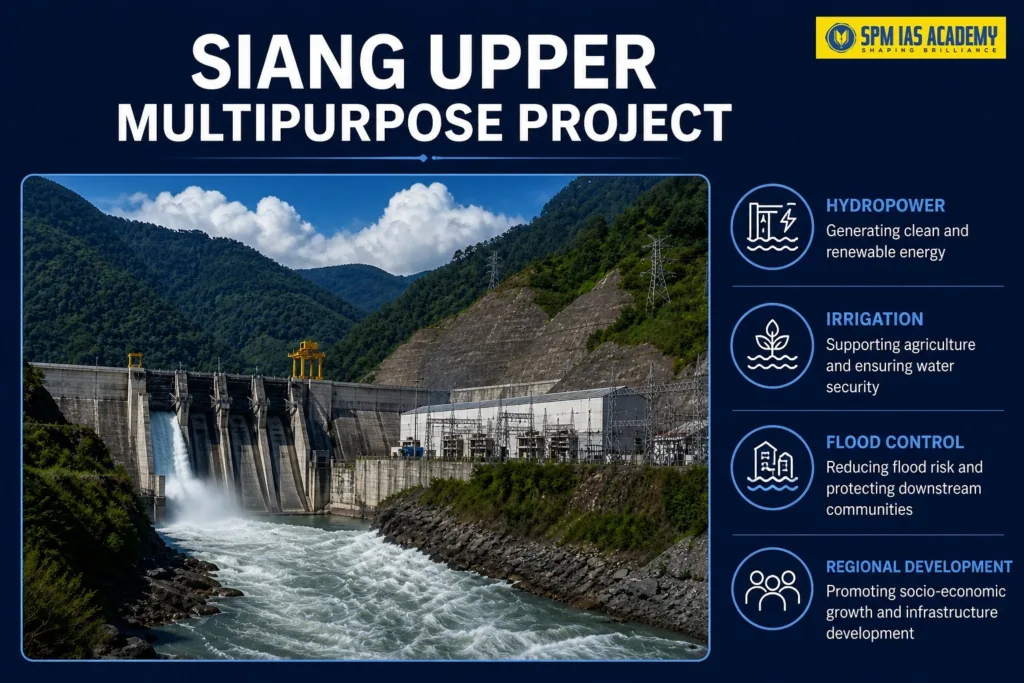
The SUMP will serve multiple purposes. These include:
- Firstly, the project will generate over 11,000 MW of clean and renewable hydropower.
- Moreover, it will control floods in Assam and downstream Brahmaputra regions.
- Additionally, the project will store large volumes of water. Therefore, it will help counter sudden upstream water releases by China.
- Furthermore, it will strengthen India’s strategic position in the Eastern Himalayas.
- In addition, the project will support regional development and create employment opportunities in Arunachal Pradesh.
- Finally, it will contribute to India’s clean energy goals and climate commitments.
Siang Upper Multipurpose Project as a Renewable Energy Source
Arunachal Pradesh holds one of the largest untapped hydropower reserves in India. The state holds around 58,160 MW of hydropower potentials. It constitutes 40% of India’s total hydropower potential and around 9% of India’s small hydropower potential. Its steep rivers and high rainfall make it perfect for generating clean electricity. The SUMP plans to harness this potential on a massive scale.
With around 11,000 MW power capacity, this project can supply electricity to millions of homes and industries. This will help India reduce its dependence on coal and fossil fuels thus meeting its Nationally Determined Contributions (NDCS). Moreover, SUMP supports India’s target of reaching 500 GW of renewable energy capacity by 2030. Thus, the SUMP becomes a key tool in India’s fight against climate change.
Flood Moderation Role of the Siang Upper Multipurpose Project
Assam faces devastating floods almost every year during the monsoon season. The Siang and Brahmaputra rivers overflow their banks. Consequently, this causes massive loss of life, crops, and property. This project can act as a flood buffer. It will store excess water during heavy rainfall and release it in a controlled manner.
This flood moderation function makes the SUMP different from ordinary run-of-the-river dams. It adds a powerful disaster risk reduction (DRR) component. By controlling peak flood discharge, SUMP protects millions of people living in the plains below.
The China Threat and Water Security Concerns
China’s mega dam on the Yarlung Tsangpo can store billions of cubic metres of water. Moreover, China can suddenly release this stored water into the Siang River. Such a sudden release can cause catastrophic floods in the downstream Indian states such as Arunachal Pradesh and Assam. India currently has no large storage dam on the Siang to absorb such a shock.
The SUMP would create a large reservoir in India. This reservoir can absorb sudden water releases from upstream China. Hence, SUMP is India’s most important strategic counter-measure against water-based coercion. It acts as both a physical shield and a strategic deterrent.
Strategic and National Security Significance of SUMP
The Siang River basin shares a sensitive international border with China. Therefore, the Siang Upper Multipurpose Project carries deep national security value. It allows India to monitor river flow data in real time. India can respond quickly to sudden changes in upstream water levels.
In addition, SUMP builds permanent infrastructure in a strategically important border region. This strengthens India’s physical presence in Arunachal Pradesh. Furthermore, the project supports better connectivity and logistical access to remote areas. These factors make this project a national security asset.
Environmental and Ecological Challenges of the Siang Upper Multipurpose Project
The Eastern Himalayas are a globally recognised biodiversity hotspot. Building a large dam in this region raises serious environmental questions. The Siang Upper Multipurpose Project faces criticism from ecologists and local communities alike. Key environmental concerns include the following:
- Firstly, the project may disrupt aquatic habitats and fish migration patterns in the Siang River.
- Moreover, it may alter the natural flow of sediments. As a result, it can affect downstream ecosystems.
- Additionally, the project may submerge forests and wildlife habitats. Therefore, it can threaten biodiversity.
- Furthermore, it may trigger reservoir-induced seismicity in this earthquake-prone region. This area lies in a high seismic zone.
- Finally, the project may have long-term impacts on the fragile Himalayan river ecology.
Therefore, a thorough Environmental Impact Assessment (EIA) is essential before work begins. The SUMP must follow strict environmental clearance procedures.
Seismic and Geological Risks in the Siang River Valley
The entire Siang River basin falls in one of India’s highest seismic risk zones i.e. Seismic Zone VI. Large dams built in such areas can trigger earthquakes known as reservoir-induced seismicity. The sheer weight of stored water puts enormous pressure on underlying rock formations.
As a result, the Siang Upper Multipurpose Project requires world-class engineering standards. Authorities must set up continuous seismic monitoring systems. Regular safety audits and structural inspections are also non-negotiable requirements for such a large dam.
Social Impact and Community Concerns Related to SUMP
The Adi tribe and other indigenous communities have lived along the Siang River for centuries. Their culture, livelihood, and identity are deeply connected to this river. Large-scale dam construction threatens their way of life. Displacement and loss of farmland are major concerns among local populations.
Therefore, meaningful community consultation is essential for the Siang Upper Multipurpose Project. The government must ensure fair compensation and rehabilitation for affected families. Social impact assessments must happen alongside environmental ones. This approach ensures inclusive development and upholds principles of social justice.
Conclusion
The Siang Upper Multipurpose Project is far more than a dam. It is India’s answer to energy needs, flood disasters, and geopolitical threats on the Siang River. SUMP represents a bold step in integrated river basin management and strategic infrastructure building. The project connects vital national interests including clean energy, disaster management, water security, and border safety.
For students preparing for UPSC, Arunachal Pradesh Public Service Commission, and other State PCS exams, understanding the significance of the Siang Upper Multipurpose Project is essential.
India must balance development with ecology and security with sustainability. Success of the Siang Upper Multipurpose Project depends on scientific planning, transparent governance, and genuine community partnership. If executed responsibly, SUMP will become a landmark example of multi-purpose river management in India.
Source:
Government of Arunachal Pradesh
FAQs on
The Siang Upper Multipurpose Project (SUMP) is a large dam project in Arunachal Pradesh. Moreover, it aims to generate 11,000 MW hydropower, control floods, and ensure water security.
SUMP is important because it strengthens India’s energy security, flood management, and strategic position. Therefore, it also helps counter China’s upstream dam activities.
The Siang Upper Multipurpose Project is located on the Siang River in Arunachal Pradesh. Additionally, this river originates from the Yarlung Tsangpo in Tibet.
The project aims to generate clean energy, control floods, store water, and support regional development. Moreover, it contributes to India’s climate goals and renewable energy targets.
The project may affect aquatic ecosystems, forests, and biodiversity. Furthermore, it may cause seismic risks and ecological imbalance in the Himalayan region.

Behind every article at SPM IAS Academy is a team of skilled content writers and subject experts committed to making preparation easier for aspirants. From answering common doubts to breaking down complex issues and current affairs, we create content that is accurate, easy to understand, and directly useful for UPSC, APSC, and other competitive exams.