The NPSC New Pattern has created one common question among aspirants: Is the NPSC exam now like UPSC? The simple answer is that NPSC has moved closer to the UPSC-style structure, but it is not the same. The new pattern brings major changes in Prelims and Mains. Prelims now have 100 MCQs, 200 marks, 2 hours, and negative marking. At the same time, the Mains exam has also been expanded with more papers and a stronger focus on answer writing.
For aspirants, the NPSC New Pattern is important because it changes both stages of the exam. Prelims now demand accuracy. Mains now demands better answer writing.
Students seeking structured preparation can explore UPSC coaching in Assam for expert guidance.
Is NPSC Exam Now Like UPSC?
Yes, under the NPSC New Pattern, the exam is now much closer to the UPSC exam pattern than before. The new structure has been revised to make the exam more competitive and analytical. .
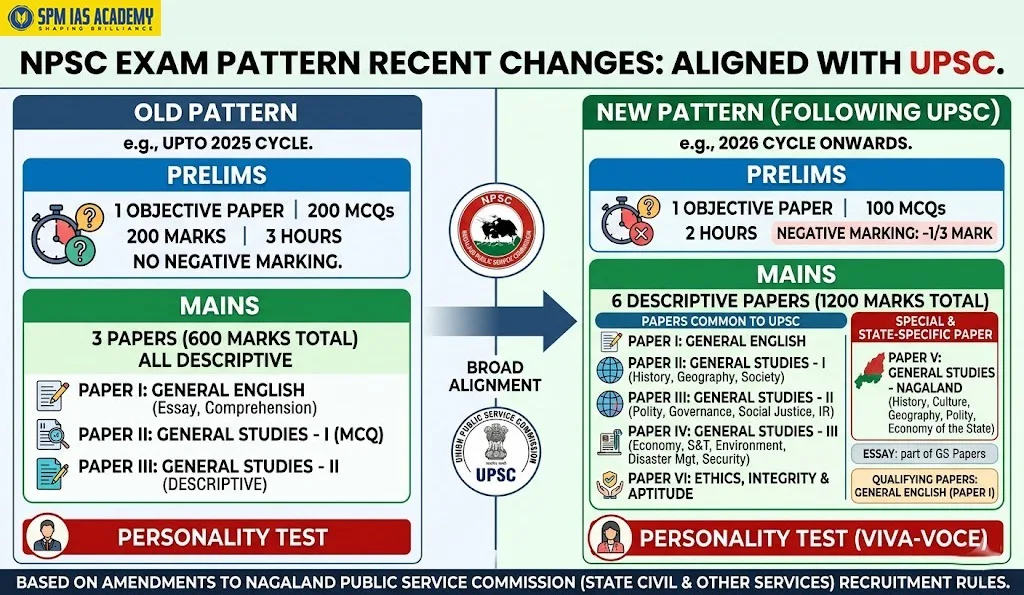
- Prelims: In the new NPSC Prelims pattern, there is one objective-type paper. It carries 200 marks and has 100 MCQs. The duration is 2 hours. Negative marking has also been introduced. This is close to UPSC Prelims because UPSC GS Paper I also has 100 MCQs for 200 marks with negative marking. So, the focus is now on accuracy and conceptual understanding. However, NPSC Prelims is not the same as UPSC Prelims. UPSC has two papers in Prelims. These are General Studies Paper I and CSAT. NPSC has only one Prelims paper.
- Mains: The NPSC Mains exam has also become more UPSC-style. Earlier, it was shorter. Now, it has been expanded into six papers carrying 1,200 marks. The papers include General Studies papers, English Comprehension and Essay, and a dedicated General Studies–Nagaland paper. This is closer to UPSC because UPSC Mains also focuses on descriptive answers. However, the biggest difference is the Nagaland-specific paper. NPSC now has a dedicated General Studies–Nagaland paper.
What Has Changed in the NPSC New Pattern?
The NPSC New Pattern has brought major changes in both Prelims and Mains. The exam is now closer to the UPSC-style structure. However, it still keeps Nagaland-specific areas in focus. Here are the key changes-
Quality UPSC coaching in north east India helps aspirants build strong conceptual foundations.
- Prelims will have 100 questions- The new Prelims paper will have 100 MCQs. Earlier, the paper had 200 MCQs.
- Each question will now carry 2 marks– Under the new pattern, each Prelims question carries 2 marks. Earlier, each question carried 1 mark. This makes every question more important than before
- Exam duration has been reduced to 2 hours- Candidates will now get 2 hours to complete the Prelims paper. Earlier, the duration was 3 hours. So, time management will remain important.
- Negative marking has been introduced– One-third of the marks allotted to a question will be deducted for every wrong answer. Since each question carries 2 marks, 0.66 marks will be deducted for one incorrect answer.
- Mains has been expanded to six papers– The Main Examination will now have six papers carrying a total of 1,200 marks. Earlier, Mains had three papers carrying 600 marks in total.
- General Studies papers are now more UPSC-style- The new Mains pattern includes wider General Studies areas like history, geography, polity, governance, economy, technology, environment, ethics, and aptitude. Earlier, the Mains was limited to General English, General Studies 1, and General Studies 2.
- General Studies–Nagaland paper has been added- Earlier, Nagaland-related topics were included within the general papers. Now, there is a separate paper for Nagaland. It will focus on the state’s history, culture, geography, economy, polity, governance, society and current affairs
NPSC Prelims New Pattern Explained
The NPSC Prelims New Pattern has changed the way candidates should look at the first stage of the exam. The paper is now shorter in terms of questions. But each question carries more marks. So, accuracy has become very important.
Read the detailed NPSC Prelims New Pattern guide for complete marks, syllabus, and negative marking updates.
Exam Pattern
One objective-type paper: NPSC Prelims will have one MCQ-based paper. The paper will be conceptual in nature and closer to the UPSC-style approach. Therefore, the NPSC New Pattern makes Prelims more accuracy-based than before. Candidates now need to attempt carefully instead of depending on random guesses.
100 MCQs: The paper will have 100 multiple-choice questions. Candidates have to select the correct answer from the given options.
Exam Duration: Candidates will get 2 hours to complete the paper. This makes time management important during the exam.
Negative marking: There will be negative marking for wrong answers. One-third of the marks allotted to a question will be deducted for every incorrect answer. Since each question carries 2 marks, 0.66 marks will be deducted for one wrong answer.
NPSC Prelims Syllabus
- General Science: General Appreciation and Understanding of the science, including matters of everyday observation and experience as may be expected of a well-educated person who has not made a special study of any scientific discipline.
- History: Broad general understanding of the subject in its social, economic, and political aspects, social and cultural heritage of India, emphasising unity in diversity.
- Nagaland: Political, economic, social, cultural, and heritage of its people
- Geography: Geography of India, including the physical, social, economic, geography and main features of Indian agricultural and natural resources.
- Indian Polity and Economy: Country’s political, Executive, Judicial System, Local Bodies, Rural and Community Development, and Economic Planning in India
- Indian National Movement: Nature and character of the Nineteenth century resurgence, growth of nationalism and attainment of independence
- General Mental Ability Test: Analysis of classified data, logical and behavioural reasoning, analogies, basic arithmetic, numerical ability and basic concepts of computers.
- Current Events: Latest development on all the fields detailed above, including science and technology and environmental awareness
NPSC Prelims vs UPSC Prelims: Key Similarities
| Point of Similarity | NPSC Prelims | UPSC Prelims GS Paper I |
| Nature of paper | Objective-type paper | Objective-type paper |
| Question type | MCQs | MCQs |
| Total questions | 100 questions | 100 questions |
| Total marks | 200 marks | 200 marks |
| Marks per question | 2 marks | 2 marks |
| Duration | 2 hours | 2 hours |
| Negative marking | 0.66 marks | 0.66 marks |
| Role of Prelims | Screening stage for Mains | Screening stage for Mains |
However, one difference must be clear. UPSC Prelims has two papers: GS Paper I and CSAT. NPSC Prelims has one paper only. So, NPSC is closer to UPSC in approach, but it is not exactly the same as UPSC.
Read the detailed NPSC Prelims New Pattern guide for complete marks, syllabus, and negative marking updates.
NPSC Mains Syllabus Explained
Under the NPSC New Pattern, the Mains exam has become more descriptive and analytical. It is now closer to the UPSC-style Mains structure. However, it still keeps Nagaland-specific areas in focus.
Exam Pattern
- Total number of papers: The NPSC Mains Examination will now have six papers. These are- GS1, GS2, GS3, GS-4, GS-5(Nagaland Specific), GS-6(English Comprehension and Essay)
- Total marks: The Mains exam will carry 1,200 marks in total. With each paper consisting of 200 marks
- Duration: All the GS papers will be 3 hours
- Question format: Each descriptive paper will contain 20 questions. Candidates will have to answer selected 10-mark and 20-mark questions.
- English paper format: The English paper will have comprehension and grammar for 100 marks (Objective type). It will also have two essay questions of 50 marks each. Each essay should not be more than 1,200 words.
This shows that the NPSC New Pattern has made Mains more descriptive and writing-focused. Candidates must now build strong content, structure their answers well and practise regularly.
Official Mains Syllabus
| Paper | Subject |
| Paper I | General Studies 1 – Indian Heritage and Culture, History and Geography of the World and Society |
| Paper II | General Studies 2 – Governance, Constitution, Polity, Social Justice, and International Relations |
| Paper III | General Studies 3 – Economic Development, Technology, Bio-diversity, Environment, Security, and Disaster Management |
| Paper IV | General Studies 4 – Ethics, Integrity and Aptitude |
| Paper V | General Studies – Nagaland |
| Paper VI | English Comprehension and Essay |
What is the new Nagaland- Specific Paper in NPSC Mains?
One of the most important changes under the NPSC New Pattern is the addition of Paper V: General Studies – Nagaland. This makes the exam more state-focused than before. Through this paper, NPSC will test a candidate’s understanding of Nagaland in a deeper way. The official syllabus for the General Studies – Nagaland paper is given below.
Paper V: General Studies- Nagaland: Nagaland in all aspects – History, Art and Culture, Geography, Economy, Polity & Governance, Society, and Current Affairs.
- The history of Nagaland will cover aspects from the 19th century onward till the attainment of statehood, including wars between the British and the Naga villages; Bengal Eastern Frontiers Regulation Act, 1873; the advent of Christianity in Naga Hills; Naga Club; Naga Nationalist movement and the various agreements signed; lead up to the formation of Nagaland as a State of the Indian Union.
- Art and Culture will include festivals and historical places; customary law including administration of Justice and tribal institutions like Morung, Clan system, Khel, Monarchical (Angh) system, Village Chieftain system and Village Council, etc.
- Economy (Rural and Urban): Agriculture system; land tenure system; Trends and challenges, including industry and commerce, infrastructure, start-up policy; schemes, etc.
- Geography, Environment and Biodiversity: physical geography; demographic trends; economic resources, including mineral resources and hydro projects; environmental conservation; biodiversity; infrastructure projects and their impact on the environment and ecology; community conservation practices, forest governance, and sustainable development in hill regions.
- Polity and Governance will include the role of the state legislature; Acts and Legislation; Special Provisions like Article 371 A; urban and rural governance, including ULBs, Village councils, VDBs; District Administration in all its aspects.
- Society will include aspects on vulnerable sections of society like women, children, gender issues, women’s empowerment; issue of drug menace.
- Nagaland Current Affairs, etc.
Conclusion
To sum up, the NPSC New Pattern clearly shows that the exam is slowly shifting towards a UPSC-style structure. Prelims has become more accuracy-based, while Mains now gives more importance to answer writing and General Studies. However, NPSC is not the same as UPSC. It still keeps Nagaland-specific topics at the centre. Therefore, aspirants must prepare for both national and state-focused areas seriously.
Frequently Asked Questions
Yes, the NPSC exam is now closer to the UPSC pattern, especially in Prelims and Mains structure. Prelims have 100 MCQs, 200 marks and negative marking. Mains has also become more descriptive. However, NPSC still has strong Nagaland-specific areas.
The biggest change is the shift towards a more UPSC-style structure. Prelims now has fewer questions but higher marks per question. Negative marking has also been introduced. In Mains, the number of papers has increased, and a separate General Studies–Nagaland paper has been added.

Behind every article at SPM IAS Academy is a team of skilled content writers and subject experts committed to making preparation easier for aspirants. From answering common doubts to breaking down complex issues and current affairs, we create content that is accurate, easy to understand, and directly useful for UPSC, APSC, and other competitive exams.