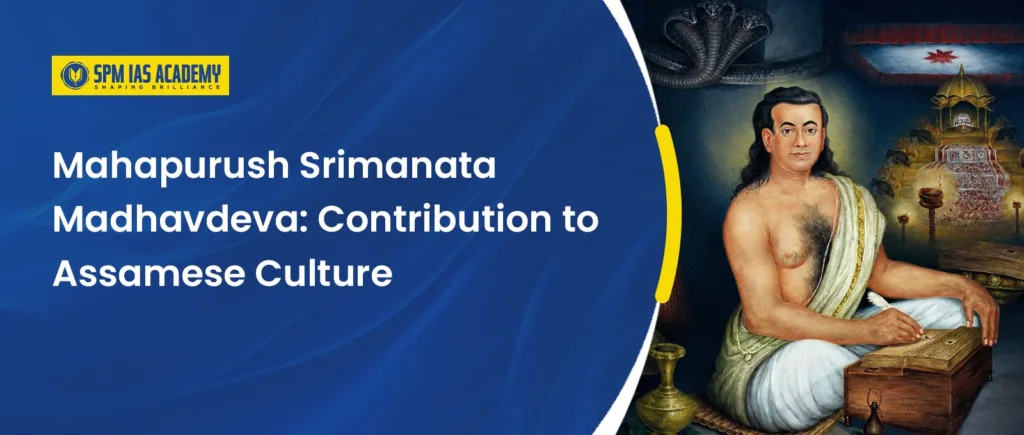
There are very few figures in the history of Assam whose influence extends across literature, music, theatre, social reform, and religious philosophy simultaneously. Srimanta Madhavdeva is one such extraordinary personality. A renowned poet, playwright, composer, social reformer, and the most devoted disciple of Srimanta Sankardeva, he played a pivotal role in the growth of the Ekasarana Naam Dharma movement. His contributions continue to shape Assamese culture through the Namghars established across the region, the Borgeets sung during prayers, the Ankia Naat performances at religious festivals, and the democratic traditions of the Sattras that he helped strengthen. Understanding the life and contributions of Srimanta Madhavdeva is essential for aspirants preparing through the best online coaching for APSC, as questions on Assamese history, culture, and the Neo-Vaishnavite movement are frequently asked in APSC and UPSC examinations.
This article goes deep into the life, work, and lasting contributions of Srimanta Madhavdeva, including several facts that are rarely discussed outside academic and religious circles.
Who Was Srimanata Madhavdeva and How Did He Find His Path?
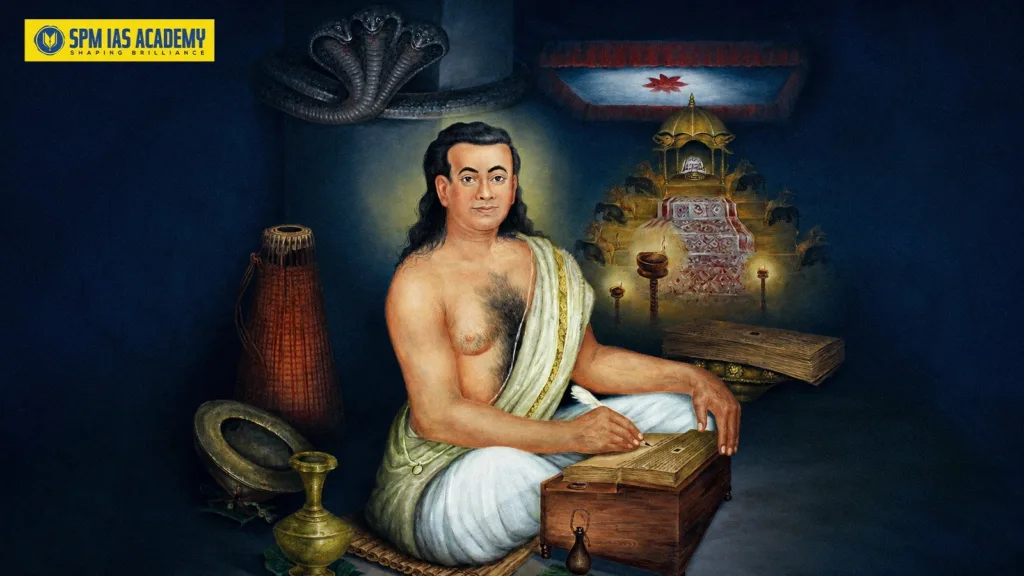
Before embracing Vaishnavism, Srimanta Madhavdeva was a respected Shakta scholar and a skilled warrior. He strongly supported animal sacrifice as an important religious practice and followed a ritual-based tradition of worship rooted in the Shakta faith. However, his encounter with Srimanta Sankardeva brought about a profound transformation in his beliefs, leading him to adopt the principles of Ekasarana Naam Dharma and become one of its greatest exponents. This transformation is an important topic for aspirants preparing to crack APSC exam online, as questions related to the Neo-Vaishnavite movement, Assamese culture, and prominent historical personalities are frequently asked in APSC and UPSC examinations.
- The Historic Turning Point (1522): In 1522, Madhavdeva was preparing to sacrifice a goat for his sick mother when he met Srimanta Sankardeva. Their 4.5-hour theological debate became one of the most significant events in Assamese history.
- The Manikanchan Sanyog: This meeting is remembered as Manikanchan Sanyog, meaning the “Confluence of Gold and Diamond.” During the debate, Sankardeva advocated pure devotion, while Madhavdeva defended animal sacrifice.
- A Complete Spiritual Transformation: By the end of the debate, Madhavdeva gave up animal sacrifice and accepted the Ekasarana path of unconditional devotion to Lord Krishna. He soon became Sankardeva’s closest disciple and spiritual successor.
- A Life Dedicated to Devotion: To serve the movement wholeheartedly, Madhavdeva took a lifelong vow of celibacy and even ended his own marriage betrothal. Deeply moved by his commitment, Srimanta Sankardeva honored him with the title “Prana Bandhaba”, meaning “friend of my soul.”
What Did Srimanta Madhavdeva Create and Why Does It Still Matter?
The literary legacy of Srimanta Madhavdeva is vast, and every work he composed served a distinct purpose in making philosophy, devotion, and the teachings of Ekasarana Naam Dharma accessible to ordinary people. Through his poetry, devotional songs, dramas, and religious writings, he played a significant role in enriching Assamese literature and preserving the region’s cultural heritage. Studying these contributions is important for aspirants preparing at SPM IAS Academy Guwahati, as topics related to Assamese literature, the Neo-Vaishnavite movement, and cultural history are frequently asked in APSC and UPSC examinations.
Naam Ghosa is his magnum opus. Also called the Hazari Ghosa because of its one thousand devotional verses, this text focuses entirely on surrender and complete devotion to Lord Krishna. It is not just a historical artifact, it is recited daily in Namghars across Assam, making it one of the most continuously used devotional texts in the region’s living religious practice.
Bhakti Ratnavali is a highly philosophical yet genuinely accessible compilation that serves as a guide to spiritual salvation. It draws from several classical sources and condenses complex theological ideas into a form that educated and uneducated devotees alike could engage with.
Janma Rahasya and Bhakti Pradip were specifically written to teach spiritual and theological ideas to the common population, people who had no access to Sanskrit learning and no exposure to the complex religious literature of the time.
Together, these texts gave ordinary Assamese people a complete framework for understanding faith, devotion, and the path to salvation, without requiring them to be scholars or come from privileged backgrounds.
How Did Srimanata Madhavdeva Revolutionize Assamese Music Through Borgeets?
The contribution of Madhavdeva to Assamese music runs deeper than most people realize, and it involves a story of loss, resilience, and creative genius.
According to historical accounts, a devastating fire destroyed a large portion of Srimanta Sankardeva’s original Borgeet compositions. Heartbroken by this loss, Sankardeva commanded Madhavdeva to revive the tradition. Madhavdeva took up the responsibility and composed over 150 unique Borgeets, keeping the entire musical movement alive through what would have otherwise been a permanent loss.
But Madhavdeva did not simply replicate what had existed. He brought his own distinct emotional texture to the Borgeet tradition. Where Sankardeva’s compositions tended to focus on the grand majesty and cosmic scale of the divine, Madhavdeva specialized in two deeply human emotional registers, Vatsalya Rasa, which is the emotion of parental love, and Dasya Rasa, the emotion of a devoted servant toward a beloved master. His lyrics look at the universe through the eyes of Mother Yashoda, a woman dealing with a crying, stubborn, mischievous toddler who also happens to be the lord of the cosmos. This intimacy made his Borgeets emotionally accessible in a way that formal theological poetry simply could not match.
Borgeets are not folk songs. They are a distinct school of Indian classical music. Srimanata Madhavdeva set his compositions to complex, specific Ragas, including Kalyan, Ahir, and Suhai, and specific rhythmic cycles called Talas. What makes the performance tradition even more distinctive is that Borgeets are sung entirely without stringed instruments. The only accompaniment is the Khol (drum), the Taal (cymbals), and the human voice. This creates a haunting, meditative sound that is unlike anything else in the Indian classical music tradition.
What were the Theatres that Srimanata Madhavdeva Created and Why Was It Radical?
Madhavdeva believed that ordinary people could not understand complex Sanskrit texts or theological debates. Instead, he used theatre to spread the message of devotion simply and engagingly.
- Created Powerful Religious Plays: Madhavdeva wrote and directed several Ankia Naats (one-act plays) and introduced the shorter and more lively Jumura format. His famous works include Chor Dhara, Arjuna Bhanjana, and Pimpora Goswa.
- Made Lord Krishna More Relatable: Instead of presenting Krishna as a distant divine ruler, Madhavdeva showed him as a playful child who stole butter, told small lies, got bitten by ants, and cried when scolded. This made devotion feel natural and closer to everyday life.
- Introduced Innovative Stagecraft: Madhavdeva brought large bamboo-and-clay masks into theatre to portray demons, animals, and supernatural characters. These colourful masks gave village performances a grand visual appeal and remain an important part of Assamese theatre today.
- Used a Language Everyone Could Understand: He wrote his plays in Brajabuli, a literary language blending Maithili, Assamese, and Braj Bhasha. This made his plays easy to understand across different regions and helped unite diverse audiences.
- Built a Lasting Performing Arts Tradition: During the same broad historical period when William Shakespeare was shaping theatre in Europe, Madhavdeva, along with Srimanta Sankardeva, was developing an equally rich tradition of drama, music, stagecraft, and philosophy in Assam.
How Did Srimanata Madhavdeva Reshape Assamese Society Through Culture?
The contributions of Madhavdeva were never just artistic, every cultural form he developed was also a tool for social engineering with a clear purpose.
The Namghar as a community parliament: Following Sankardeva’s death, Madhavdeva organized and expanded the entire Namghar network across Assam. He designed these prayer houses not just as religious spaces but as community centers, village parliaments where disputes were settled democratically, education happened for those excluded from formal learning, and community decisions were made outside the influence of feudal lords. For centuries, the Namghar functioned as a genuinely democratic civic institution.
Art as the weapon against caste: In 16th-century India, lower castes were formally barred from entering temples and accessing scripture. Madhavdeva bypassed this system entirely by staging Borgeet performances and Ankia Naats in open-air public spaces where people of all castes, including tribal communities and Muslims, sat together on the ground as equals. His most famous Muslim disciple, Chandsai, became a symbol of this radical inclusivity. Art, in his hands, became the most effective equalizer in a deeply unequal society.
The Sattra as an economic engine: Under Madhavdeva, the Sattras, the monastic institutions of the Ekasarana movement, became centres of economic self-reliance. He introduced and standardized crafts including woodcarving, manuscript writing, textile weaving, and mask-making, as institutional arts. This gave artists a dignified, self-sustaining economic identity rather than making them dependent on royal patronage. The Sattras effectively became cottage industry hubs that supported communities while maintaining their cultural and spiritual functions.
What Is the Story of the Dhekiakhowa Flame and Why Does It Matter?
One of the most remarkable unknown facts connected to Srimanata Madhavdeva is what happened in 1528. He established the historic Dhekiakhowa Bornaamghar in Jorhat, and at its consecration, he lit an earthen mustard-oil lamp, an Akhanda Pradip, which means the unbroken light. This flame has been kept burning continuously by generations of devotees ever since. It has not gone out in nearly five hundred years, making it one of the longest-burning continuous sacred flames in the history of South Asian religious practice.
This flame is not just symbolic. It represents the unbroken continuity of the devotional tradition that Madhavdeva helped establish, a living connection between the 16th century and the present day.
What Did Srimanata Madhavdeva Do on His Deathbed?
Even in his final moments, Madhavdeva demonstrated the philosophy he had lived by. When he was dying at Bhela Sattra in Cooch Behar, his distressed disciples asked him to name his spiritual successor so the movement would have clear leadership after his passing. His response was unexpected. He told them he found no single individual worthy of that entire burden and responsibility. Rather than appointing anyone, whether from his closest circle or from a bloodline, he instructed the community to democratically elect their own leaders over time.
In doing so, at the very end of his life, he planted the seeds of democratic governance within the monastic Satra system, a principle that was remarkably ahead of its time in 16th-century India.
Conclusion
The legacy of Srimanata Madhavdeva is not confined to the pages of history or the shelves of academic libraries. It lives in the Namghars that function as community centers across thousands of Assamese villages. It lives in the Borgeets sung before dawn without string instruments. It lives in the Ankia Naats performed on festival nights, where a child Krishna steals butter and gets caught. It lives in the Dhekiakhowa flame that has burned without interruption for nearly five hundred years. Madhavdeva was not simply a saint or a poet or a playwright or a social reformer. He was all of these things simultaneously, and the genius of his contribution was precisely that art, spirituality, social change, and community building were never separate for him. Every song he wrote was also a social statement. Every play was also an education. Every institution he built was also an assertion that every human being, regardless of caste, community, or background deserved equal access to the sacred.
That is the contribution of Madhavdeva to Assamese culture and five centuries later, it remains one of the most complete and enduring cultural legacies that any single individual has left in this region.
| Important Topics | Important Topics |
| BATADRAVA THAN REDEVELOPMENT PROJECT | Vrindavani Vastra: Assam’s Spiritual Heritage and Its Global Journey |
Frequently Asked Questions
Madhavdeva’s spiritual guru was Srimanta Sankardeva, the great saint, scholar, and social reformer of Assam. Their historic first meeting in 1522 led to a 4.5-hour theological debate, after which Madhavdeva underwent a profound transformation and became Sankardeva’s most trusted disciple. Sankardeva regarded him so highly that he called him Prana Bandhaba, the friend of his soul, rather than simply a follower.
His undisputed magnum opus is the Naam Ghosa, also known as the Hazari Ghosa because it contains one thousand devotional verses. Written in a deeply philosophical and moving style, this text is dedicated to absolute devotion to Lord Krishna and is recited daily in Namghars across Assam even today, making it one of the most continuously active devotional texts in the region.
Madhavdeva is credited with composing over 150 Borgeets, devotional classical songs set to specific Ragas and Talas. He took up this composition work after a fire destroyed a large portion of his guru Sankardeva’s original Borgeet compositions. By accepting this responsibility and reviving the tradition, he ensured that one of Assam’s most distinctive musical forms survived what could have been a permanent loss.

Behind every article at SPM IAS Academy is a team of skilled content writers and subject experts committed to making preparation easier for aspirants. From answering common doubts to breaking down complex issues and current affairs, we create content that is accurate, easy to understand, and directly useful for UPSC, APSC, and other competitive exams.