
Pradhan Mantri Krishi Sinchayee Yojana was launched in 2015 with the vision of “Har Khet Ko Pani” and “Per Drop More Crop.” The scheme aims to expand irrigation coverage, improve water-use efficiency and promote sustainable water management in agriculture. This is important because Indian agriculture still depends heavily on monsoon rainfall, while climate change is increasing the risk of droughts, floods and irregular rainfall.
PMKSY focuses on providing assured irrigation and reducing water wastage. Moreover, it tries to integrate water sources, distribution networks and farm-level water application into one comprehensive framework.
Objectives of PMKSY:
- Expand irrigation coverage: PMKSY aims to bring more cultivated area under assured irrigation through the vision of “Har Khet Ko Pani.”
- Improve water-use efficiency: The scheme promotes efficient use of water through micro-irrigation, field application systems and better water management.
- Promote farm-level water conservation: It encourages water harvesting, watershed development and sustainable use of available water resources.
- Increase agricultural productivity: Better irrigation helps farmers improve crop yield, crop intensity and income.
- Encourage convergence: PMKSY integrates irrigation-related activities of different ministries and departments for better planning and implementation.
Major components of PMKSY:
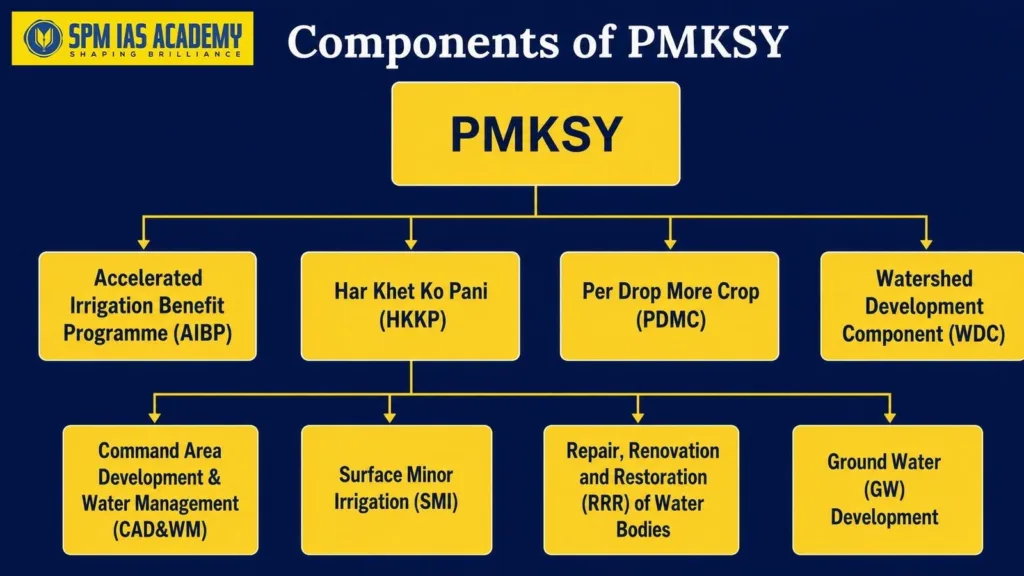
- Accelerated Irrigation Benefit Programme (AIBP): It focuses on completing major and medium irrigation projects to increase irrigation potential.
- Har Khet Ko Pani (HKKP): It aims to provide water to every farm through surface irrigation, groundwater development, repair of water bodies and command area development. It has four sub-components. These are:
- Command Area Development & Water Management (CAD&WM),
- Surface Minor Irrigation (SMI),
- Repair, Renovation and Restoration (RRR) of Water Bodies
- Ground Water (GW) Development
- Watershed Development Component: It promotes soil and water conservation, rainwater harvesting, afforestation and livelihood support in rainfed areas.
- Per Drop More Crop: It promotes micro-irrigation technologies like drip irrigation, sprinkler irrigation and precision water application at the farm level. PMKSY’s official framework highlights irrigation coverage expansion and water-use efficiency as core goals.
Per Drop More Crop and effective water utilisation:
- The concept of Per Drop More Crop means producing more output with less water. It shifts irrigation from flood-based water use to precision-based water use.
- Under this approach, farmers use drip and sprinkler systems to deliver water directly to the root zone of crops. As a result, it reduces water loss through evaporation, runoff and deep percolation.
- For example, drip irrigation is highly useful for horticulture crops, sugarcane, cotton and vegetables.
- Similarly, sprinkler irrigation helps in areas with uneven land and limited water availability.
- The government also promotes micro-irrigation under PMKSY because it improves water conveyance and precision water application.
Significance of Per Drop More Crop:
- It reduces water wastage at the farm level.
- It improves crop productivity and input efficiency.
- It lowers the cost of irrigation in the long run.
- It supports climate-resilient agriculture.
- It benefits water-stressed and rainfed regions.
- It promotes fertigation, where nutrients reach crops through irrigation water.
Conclusion:
PMKSY plays an important role in making Indian agriculture more productive, water-efficient and climate-resilient. However, its success depends on timely project completion, farmer awareness, affordable micro-irrigation systems and proper maintenance. Therefore, Per Drop More Crop should be promoted as a key strategy to achieve sustainable agriculture and effective water resource management in India.