
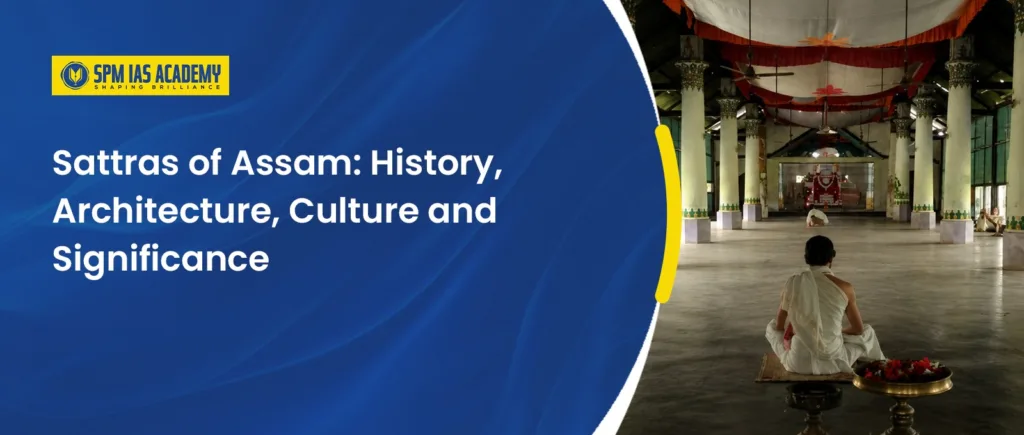
Assam carries within it one of the most unique monastic traditions in the world, the Sattra system. Built on a 15th-century spiritual and social revolution, the Sattras of Assam are far more than religious institutions. They are living centers of art, music, theatre, literature, social reform, and community governance that have shaped Assamese identity for over five hundred years. Today, between 862 and 900 active Satras spread across Assam and neighbouring regions, all operating under the umbrella organization called the Asam Satra Mahasabha.
This guide covers everything you need to know about the Sattra system—its origin and evolution, the four major sects, prominent individual Sattras, their distinctive architecture, and their cultural and social significance. It also explains why these institutions are regarded as some of India’s most important living heritage centres, preserving the rich legacy of the Neo-Vaishnavite movement. For aspirants seeking the best APSC coaching in Assam, this topic is highly relevant, as questions on Assamese history, culture, art, and heritage frequently appear in APSC and UPSC examinations.
Where Did the Sattras of Assam Originate?
The word Satra itself traces back to the Sanskrit term “sattra,” which appears in the Bhagavata Purana and refers to an assembly of devotees. In Assam, the institution took root through the work of Mahapurush Srimanta Sankardeva, the 15th-century saint-reformer, playwright, and social architect who founded the Ekasarana Dharma, a devotional movement centered on one God, one name, and one path. The very first Sattra of Assam was established at Bardowa (also known as Bordowa) in the Nagaon district around 1494 CE. Sankardeva founded it at his own birthplace as a primary community prayer space called a “Kirtanghar” or “Than.” This founding marks the beginning of the entire Neo-Vaishnavite movement in Assam.
During Srimanta Sankardeva’s lifetime, devotees gathered in open spaces and beneath trees for prayers and religious discourses. Although temporary prayer houses existed, the tradition of monks residing permanently within the campus had not yet emerged. The first formal reference to the Hati—the residential rows that became a defining feature of the Sattra layout—appears in the records of Patbausi Satra established by Damodardeva. Later, Srimanta Madhavdeva founded Barpeta Satra in 1583 CE, introducing a structured system of daily prayers and religious tithes that gave the institution greater stability and organization. Vamsigopaldev further expanded the Neo-Vaishnavite movement by establishing Sattras across eastern Assam, significantly extending its geographical reach. This topic is particularly important for aspirants enrolled in the UPSC Online Mentorship Program, Assam, as questions on Assamese history, culture, and the Neo-Vaishnavite movement are frequently asked in UPSC and APSC examinations.
How Did the Sattra System Evolve Through the Centuries?
The evolution of the Sattras of Assam spans five distinct historical phases, each of which transformed the institution’s reach, structure, and authority.
- In the 15th century, Sankardeva initiated the foundational model by setting up a basic community prayer space and expanding it as he and his followers traveled across Assam, spreading egalitarian socio-religious ideas.
- In the 16th century, after Sankardeva’s passing, Madhavdev expanded the movement. Simple prayer spaces transformed into multi-functional monastic centers with specific institutional roles, dedicated monks, and organized daily worship systems.
- Toward the end of the 16th century, ideological differences led to the Sattras of Assam dividing into four distinct sub-sects called Sanghatis. These four sects were firmly established by the early 17th century.
- In the 17th and 18th centuries, the Ahom kingdom initially resisted the Sattra movement but eventually fully endorsed it. King Jayadhwaj Singha officially patronized Auniati Satra in 1653 CE, turning Majuli Island into a powerful, land-owning epicenter of cultural and religious authority. During this period, 125 sattras were built in the 17th century and 85 more in the 18th century. However, the movement also suffered two major setbacks ,the Moamoria rebellion and the Burmese invasion of Assam.
Today, the primary historical and cultural centres of the Sattra tradition are concentrated in Majuli Island, Barpeta, and Nagaon. In addition, important Sattras are found across Dibrugarh, Kamrup, and even parts of West Bengal, reflecting the wide geographical spread of the Neo-Vaishnavite movement. This topic is highly relevant for aspirants preparing at an IAS Academy Guwahati, as questions on Assam’s cultural heritage, religious institutions, and history are frequently asked in UPSC and APSC examinations.
What Are the Four Sects of the Sattras of Assam?
The last quarter of the 16th century saw the Sattras of Assam divided into four sects known as Sanghatis. Each carried a distinct theological position and social approach.
Brahmasamhati
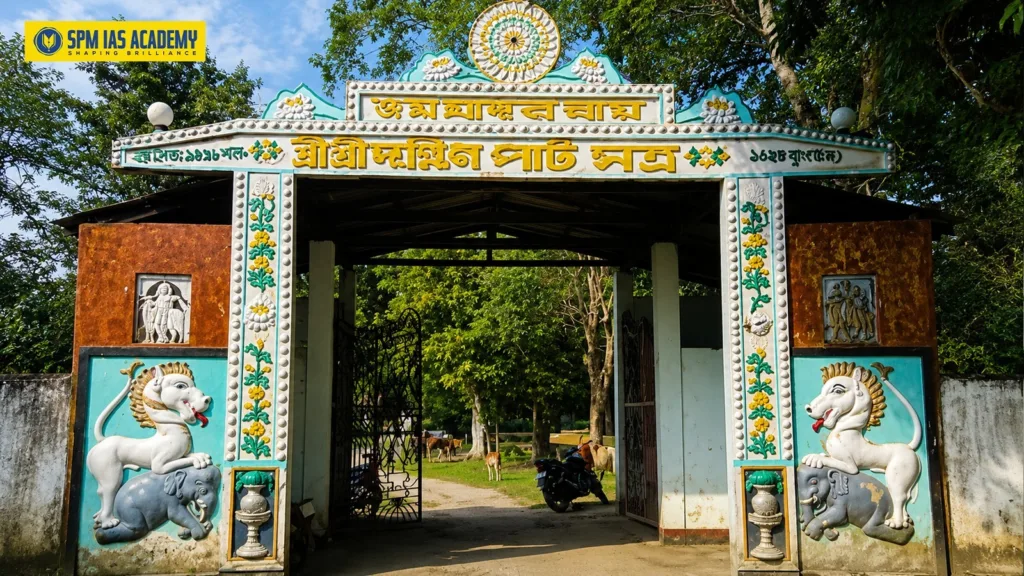
Damodaradeva, a Brahmin disciple of Sankardeva, formed this sect. It brought back the caste system to its original Brahmanical form while still following the namadharma teachings of Sankardeva. Followers called themselves Damodariyas, and the head of each Sattra, the Sattradhikar, was always chosen from a Brahmin family. The Koch king Nara Narayan was initiated into the Vaishnava order by Damodaradeva. Auniati Satra, Dakhinpat Satra, Garamur Satra, and Kurawabahi Satra became the most influential of this sect and received royal patronage from the Ahom kings.
Purusasamhati
Caturbhuja Thakur, a grandson of Sankardeva, headed this sect. It practices the original features of Sankardeva’s teachings and is therefore considered the closest to the core of the movement. The head priest was chosen from either a Kayastha or Gossain family. The term “Purusa” derives from the honorific title “Mahapurusa,” usually applied to Sankardeva himself. Bardowa Satra, founded by Sankardeva, remained the most important Sattra of this sect.
Nikasamhati
Mathuradasa and Padma Ata, both disciples of Madhavdeva, established this sect. It strictly followed Madhavdeva’s teachings and placed greater emphasis on asceticism compared to the other sects. Kamalabari Satra, Barpeta Satra, and Madhupur Satra serve as the three main centers of this sect.
Kalasamhati
This sect was established by Gopala Ata and his followers during the late 16th and early 17th centuries. It represented six Sudra Sattras and six Brahmin Sattras, making it the most inclusive of the four. The Kalasamhati concerned itself with tribal and lower-caste communities and rejected the caste system and idol worship entirely. The Mayamara Satra and Dihing Satra, the two most important Sudra Sattras of this sect, admitted Kacharis, Kaibartas, Chutiyas, Morans, and Ahoms into its fold. The Mayamara Satra, formed by Aniruddhadev, later became the most prominent of the six Sudra Sattras and revolted against the Ahom kingdom during the latter part of the 18th century.
Notably, the first three sects, Brahmasamhati, Purusasamhati, and Nikasamhati, brought back caste rules and Brahmanical rituals to varying degrees, while the Kalasamhati rejected them entirely.
Which Are the Most Important Sattras of Assam and What Makes Each Unique?
Several Sattras of Assam stand out for their historical significance, artistic contributions, and institutional roles:
Bardowa (Bordowa) Satra — Established 1494, Nagaon. This is the birthplace of the entire Sattriya movement and home to the very first Namghar or prayer hall. Sankardeva founded it at his own birthplace, making it the foundation stone of Neo-Vaishnavite culture and the most historically significant of all the Sattras of Assam.
Barpeta Satra — Established in 1583, Barpeta Madhavdeva built this Satra, and it grew into the primary socio-cultural hub of Lower Assam. It operates on a democratic system where local communities manage its upkeep. It holds a historic role in social reform and remains one of the most active and widely visited of all the Sattras of Assam.
Auniati Satra — Established 1653, Majuli. Founded by Niranjan Deva on Majuli Island under Ahom royal patronage, Auniati holds the highest religious hierarchy among the Majuli Sattras. It is famous for preserving Apsara and Paalnaam dances alongside an immense collection of gold and ivory royal artifacts.
Kamalabari Satra — Established 1673, Majuli, founded by Badala Ata, Kamalabari is renowned worldwide as the epicenter of classical Sattriya dance training. Its monks travel globally to perform. Additionally, the Sattra is equally famous for manufacturing traditional wooden crafts and boats.
Samaguri Satra — Established in 1663 in Majuli, founded by Chakrapani Ata, Samaguri is the global sanctuary for traditional theatrical mask-making. Monks here use bamboo, clay, cloth, and cow dung to create the expressive masks used in Bhaona theater plays, a craft that has survived unchanged for centuries.
Dakshinpat Satra—Established 1654, Majuli, founded by Vanamalideva under King Jayadhwaj Singha, Dakshinpat holds the distinction of organizing the grandest Rasotsava, or Raas Leela festival in Assam. It houses ancient manuscripts, specialized religious paintings, and historical Ahom coins.
Garamur Satra — Established 1656, Majuli, founded by Jayarama Deva under Ahom King Jayadhwaj Singha, Garamur is famous for storing ancient weaponry, including Bartop or cannons used by Ahom soldiers against invaders. It also broke traditional monastic taboos when its former head, Pitambar Deva Goswami, introduced women to Bhaona theatrical performances and co-education.
Kuruwabahi Satra — Established 1614, Kaliabor Region. Founded by Misradeva near the Nagaon and Golaghat border, Kuruwabahi is one of the oldest and most influential institutions of the Brahmasamhati sect. It historically provided spiritual guidance to several Ahom administrative officers and features distinct classical architecture.
What Does the Architecture of the Sattras of Assam Look Like?
The physical structure of the Sattras follows a consistent layout built around four interconnected components:
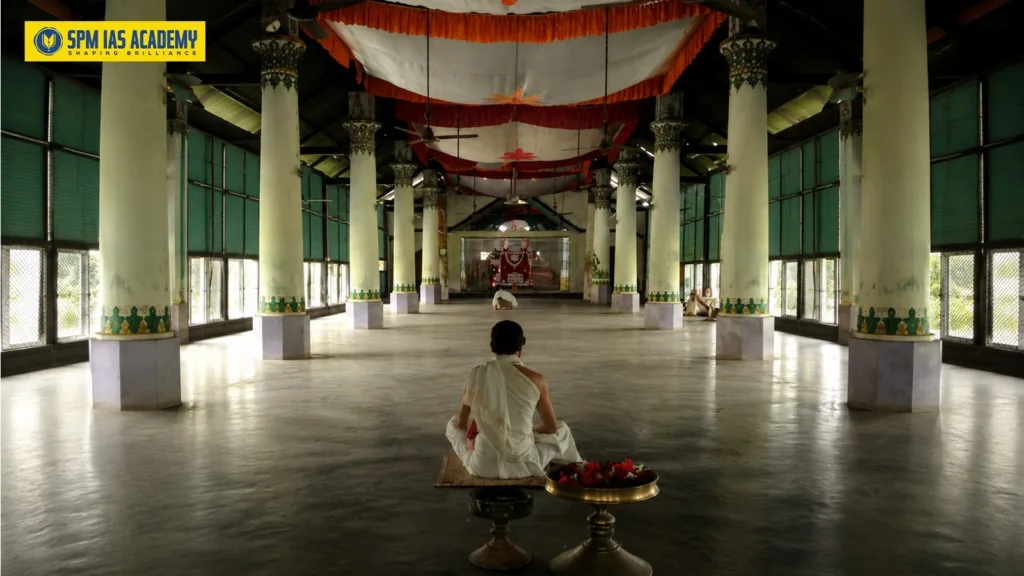
The Namghar — Central Congregational Hall: The Namghar is the physical and cultural nucleus of the entire campus. It serves simultaneously as the prayer house, theatre pavilion, and community court. Architecturally, it is a large, pillared rectangular hall with an open floor plan designed to maximize both visibility and acoustic resonance. The roof is traditionally built with a two-tiered or three-tiered gabled structure, the Do-chala or char-chala, made of thatch or corrugated iron sheets to shed heavy monsoon rainwater.
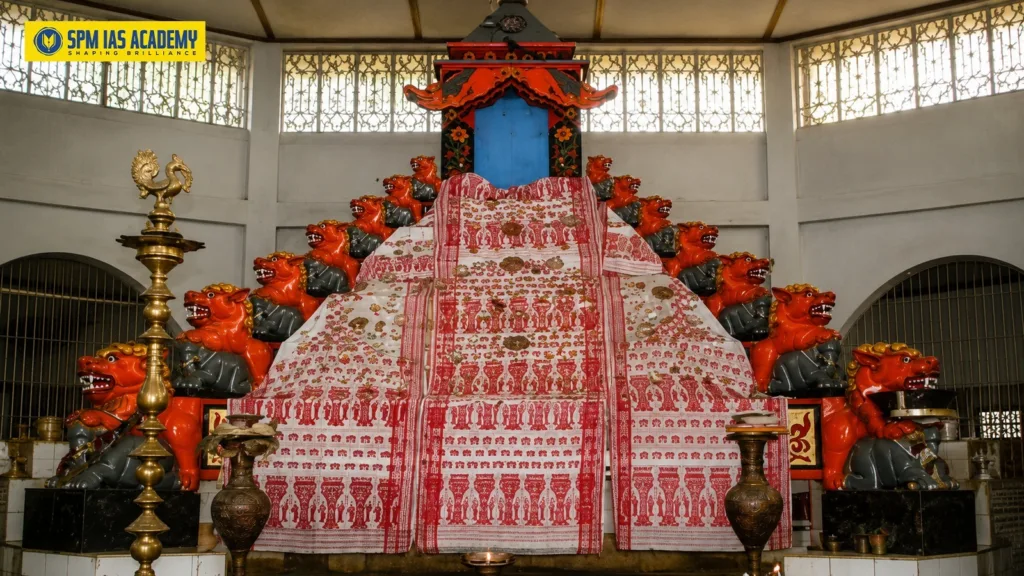
The Manikut—Sacred Sanctum: The Manikut is the jewel house, or “house of gems” where sacred texts, icons, and valuables are stored. It is a smaller square or rectangular structure attached directly to the eastern end of the Namghar and sits on a higher foundation. Inside sits the Guru Asana, a tiered wooden throne where holy manuscripts like the Bhagavat Purana rest. Importantly, the Manikut houses no idols, only texts and relics, reflecting the non-idol-worshipping nature of the Ekasarana faith.
The Hati—Residential Monastic Rows: The Hati are the living quarters for the celibate monks (Udasin Bhakats) and the head priest (Sattradhikari). These are long, continuous running rows of interconnected rooms surrounding the central Namghar-Manikut complex on all four sides. Each cell within the Hati is called a Boha, and it includes a small veranda, a living space, and a private kitchen at the back.
The Batchara or Karapat — Gateway: The Batchara is the formal entrance gate to the Sattra boundary. It is a simple, roofed gatehouse where visitors pause before entering the sacred grounds. It acts as a structural boundary marker that separates the secular world from the monastic space.
Traditional Engineering and Materials: Classical Satra construction relies on local, climate-resilient organic materials. Pillars, called “khuta,” are traditionally carved from massive logs of durable local timber like Azar or Sal wood. Wall construction uses the Ikra system, reed walls woven together and plastered with a mixture of mud, cow dung, and rice husk, which acts as a natural insulator and offers earthquake resilience. The main structures sit on elevated earthen or stone platforms called “Puta” to protect foundations from Assam’s severe seasonal flooding.
Symbolic Carvings on Namghar Pillars: The central pillars of the Namghar carry deeply symbolic carvings. The Simha-Vyala, a lion leaping over an elephant, represents spiritual wisdom conquering human ego and worldly desires. The Garuda carved in a praying posture symbolizes absolute surrender and humility before the divine. Lotus motifs around the pillar bases represent purity and non-attachment. Jai-Vijay guardian figures at the entrance pillars remind visitors to enter the sacred space with a pure mind.
Celibate vs Non-Celibate Sattras
The Sattras of Assam fall into two structural types based on the lifestyle of their residents. In celibate Sattras (Udasin), monks take lifelong vows of celibacy. The Hati forms a rigid, continuous, enclosed rectangular wall around the Namghar, and each room is identical in size, promoting egalitarianism. Auniati Satra and Kamalabari Satra follow this model. In non-celibate Sattras (Garihastha), the Sattradhikar and devotees may marry and raise families. The Hati rows are open, detached, and spread across a larger campus resembling individual village homes with courtyards and cattle sheds. Bardowa Satra and many Purusha and Kala sect sattras follow this model.
Why are the Sattras So Important — Culturally, Socially, and Historically?
The Sattras of Assam function as the foundational pillars of Assamese society across multiple dimensions. Their importance spans culture, social reform, literature, and political history simultaneously.
Cultural Importance
The Sattras of Assam are the primary custodians of Assam’s classical art, music, and dance traditions. They created and preserved Sattriya dance, which the Government of India officially recognized as one of India’s eight classical dance forms in 2000. Originally performed only by male monks as a form of worship, Sattriya has since traveled globally. Sattras also kept alive the Bhaona, the unique theatrical form of mythological plays created by Sankardeva, which blends acting, music, and spiritual discourse inside the Namghars. Furthermore, Borgeet (classical devotional songs) and unique percussion styles using the Khol and Taal are preserved almost exclusively within the Sattra system. Additionally, Sattras serve as living craft museums, keeping eco-friendly crafts alive, including the handmade theatrical masks of Samaguri Satra and the copying of ancient manuscripts onto Sanchi agarwood tree bark.
Social Importance
The Sattras of Assam introduced a revolutionary social system that reshaped the communal fabric of Northeast India. Before the 15th century, Assamese society was fractured by rigid caste hierarchies and animal sacrifices. The Ekasarana Dharma promoted absolute equality, people from all castes and communities sit, eat, and pray together on the same floor. Beyond spiritual egalitarianism, the Namghar functions as the village parliament and court. Villagers gather to debate local issues, plan community projects, and settle civil disputes without going to formal courts or police. This decentralized village democracy remains active in thousands of communities across Assam today. Furthermore, Sattras acted as bridges integrating indigenous tribal communities, Misings, Deoris, Kacharis, and Morans, into a broader unified Assamese social identity without erasing their unique cultural roots.
Literary and Historical Importance
Sankardeva and Madhavdeva composed thousands of literary works, poems, and plays within the Sattras. They created a literary language called Brajavali, which enriched the Assamese language and produced a body of devotional literature that remains central to Assamese literary history. Historically, the Sattras also served as political stabilizers, the powerful Ahom and Koch kings sought spiritual legitimacy from the heads of major Sattras. During periods of political crisis and foreign invasion, Sattras provided moral leadership and sanctuary to the public, fulfilling a role far beyond their religious function.
Conclusion
The Sattras of Assam represent one of the most extraordinary living heritage traditions anywhere in South Asia. Over five centuries, they have functioned simultaneously as monasteries, theaters, art schools, courthouses, craft workshops, and community centers, all grounded in the egalitarian spiritual vision of Srimanta Sankardeva. Understanding these institutions gives any student, researcher, or cultural enthusiast a direct window into what makes Assamese civilization distinctive, resilient, and deeply humane.
Frequently Asked Questions
A Satra is the entire monastic campus, which includes residential quarters for monks (Hati), storehouses, administrative offices, and the central prayer hall. A Namghar is specifically the central congregational prayer hall located within the Satra campus. Every Satra contains a Namghar, but independent Namghars also exist in almost every secular Assamese village, serving as community prayer and governance spaces without the full monastic structure of a Satra.
The Sattra system was initiated by the 15th- to 16th-century saint-reformer, playwright, and social architect Mahapurush Srimanta Sankardeva, along with his foremost disciple Shri Shri Madhavdeva. Together, they established the Ekasarana Dharma movement and built the institutional framework that the Sattras still follow today.
The very first Sattra of Assam was established by Srimanta Sankardeva in 1494 CE at Bardowa, also known as Bordowa, in the Nagaon district of Assam. He founded it at his own birthplace as a primary community prayer space, and it served as the birthplace of the entire Neo-Vaishnavite movement in the region.
There are approximately 862 to 900 active Sattras today, according to data from the Asam Satra Mahasabha. While Majuli Island holds the highest concentration, Sattras are also spread across Barpeta, Nagaon, Dibrugarh, Kamrup, and parts of West Bengal, continuing to function as living cultural and religious institutions.

Behind every article at SPM IAS Academy is a team of skilled content writers and subject experts committed to making preparation easier for aspirants. From answering common doubts to breaking down complex issues and current affairs, we create content that is accurate, easy to understand, and directly useful for UPSC, APSC, and other competitive exams.