
Clearing the APSC CCE preliminary exam feels like a milestone, but the real battle begins at the Mains stage. The Mains exam demands something fundamentally different from Prelims, not just factual recall, but structured thinking, analytical depth, and the ability to present ideas clearly under time pressure. Without a well-planned APSC CCE mains strategy, even well-prepared candidates leave marks on the table through poor answer structure, weak time management, or missing the Assam angle that examiners specifically look for.
This guide breaks down everything you need for effective Mains preparation—from understanding the exam pattern and developing a structured answer-writing framework to designing a practical study plan and mastering medium-specific speed strategies. It helps you build a Mains strategy based on clarity, consistency, and proven techniques rather than guesswork. Aspirants preparing through APSC coaching in Guwahati can use this guide to strengthen their answer-writing skills, improve time management, and enhance their overall performance in both APSC and UPSC Mains examinations.
What Is the APSC CCE Mains Exam Pattern for 2026?
Before building any preparation plan, understanding the exam structure is non-negotiable. The APSC CCE Mains is a descriptive exam that tests analytical ability and conceptual depth through written answers. It consists of 6 papers, each carrying 250 marks, for a total of 1500 marks.
There is no negative marking in the APSC Mains Examination. All six papers are conventional descriptive papers, where your performance depends entirely on the quality, structure, clarity, and analytical depth of your written answers. Success in the Mains requires strong conceptual understanding, effective answer writing, and efficient time management. Aspirants aiming to crack APSC exam online should focus on regular answer-writing practice, structured presentation, and incorporating relevant facts, examples, and current affairs to maximize their scores.
Here is the paper-wise breakdown:
- Paper I — Essay
- Paper II — General Studies I: History, Heritage, Society, and Culture of India and the World, plus Geography
- Paper III — General Studies II: Indian Constitution, Polity, Social Justice, Governance, and International Relations
- Paper IV — General Studies III: Technology, Economic Development, Biodiversity, Environment, Security, and Disaster Management
- Paper V — General Studies IV: Ethics, Integrity, and Aptitude
- Paper VI — General Studies V: History, Heritage, Economy, Polity, and Geography specific to Assam
Paper VI deserves special attention in your APSC CCE Mains strategy because it is entirely Assam-focused. Candidates who prepare this paper separately often gain a significant scoring advantage over those who treat it as an extension of the General Studies papers. A focused approach covering Assam’s history, geography, economy, polity, culture, and current affairs can substantially improve overall performance. Aspirants enrolled in civil service coaching in Guwahati should dedicate regular time to Paper VI, as strong preparation in this subject can play a decisive role in securing a high rank in the APSC examination.
How Is the APSC Mains Different From UPSC in Terms of Answer Writing?
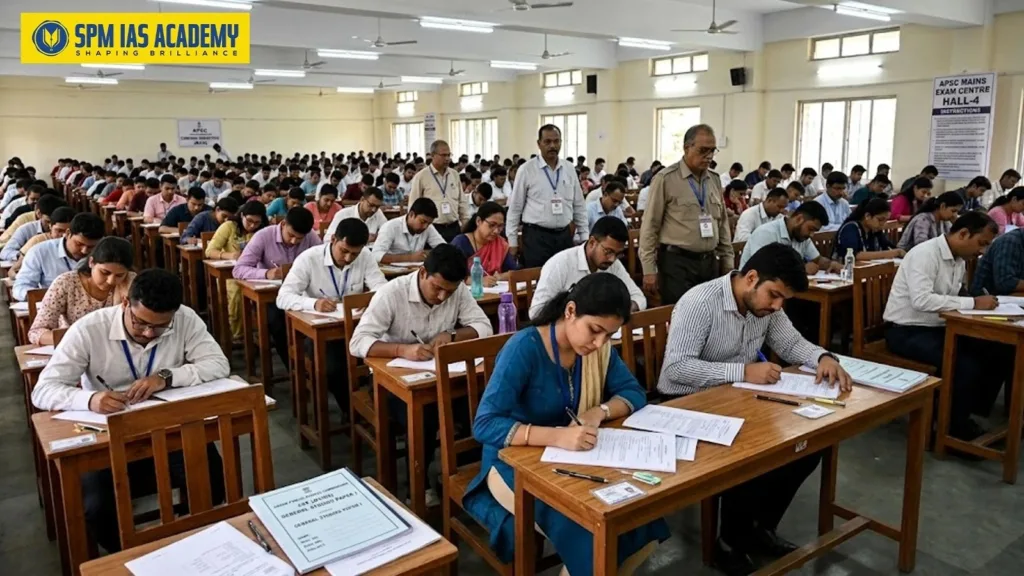
This is one of the most important distinctions your APSC CCE mains strategy must address. The APSC exam is not a condensed version of UPSC. The answer expectations, word limits, and time constraints differ in ways that affect how you structure every response.
Here is a clear comparison of what each question type demands:
| Question Type | Word Limit | Time Allocation | Structure |
| Short Answer (2–3 marks) | 50–75 words | 3–4 minutes | Direct statement + 1 supporting point |
| Medium Answer (5 marks) | 100–150 words | 7–8 minutes | Intro + 3 points + Conclusion |
| Long Answer (10 marks) | 200–250 words | 15–18 minutes | Intro + body with headings + Conclusion |
| Essay (15–20 marks) | 400–600 words | 25–30 minutes | Full essay format with argument arc |
Furthermore, APSC papers require a consistent Assam-specific angle in answers wherever applicable. This expectation is stronger in APSC than in UPSC, and candidates who write generic answers without local references consistently score lower than those who connect national policy discussions to Assam’s ground-level realities.
What Answer Framework Should You Use for APSC CCE Mains?
A reliable answer framework is the backbone of any strong mains strategy. Without one, candidates either write too much without direction or too little without enough support. The I-B-C-A model works as a default structure for every medium and long answer. Modify it as needed, but never abandon structure entirely, since unstructured answers are the single most common reason for avoidable mark loss.
I. Introduction
Write 1 to 2 sentences that define the topic or contextualize the question. Mention Assam where relevant. Avoid generic openings that say nothing, start with a precise definition or a current-context framing.
2. Body
Present your core arguments in clear paragraphs or bullet points. For 10-mark and above answers, use headings to organize the body. Include data, examples, and Assam-specific references that make your answer concrete rather than generic.
3. Critical Analysis
For analytical questions, especially those that ask you to “critically examine” or “evaluate”, present both sides or acknowledge limitations. One-sided answers to evaluative questions signal shallow thinking and lose marks at the upper end of the scoring range.
4. Assam Angle and Conclusion
Where applicable, connect your answer to Assam’s specific context. End with a forward-looking statement or a policy suggestion. Never end an answer abruptly, a conclusion signals that your answer is complete and well-thought-out.
How Do You Manage Speed and Accuracy Across the 3-Hour Papers?
Speed and accuracy together are what make or break your APSC CCE mains strategy on exam day. Writing the right content means very little if you run out of time before completing the paper.
Follow the 7-11 Minute Time Rule
For 10-mark questions, allocate exactly 7 minutes and cap your answer at 150 words. For 15-mark questions, allocate exactly 11 minutes and stay within 250 words. Following this strict timing across your paper leaves a vital 20-minute buffer across the 3-hour exam to read all questions, plan your structures, and handle any unexpected prompts calmly.
Switch From Dense Paragraphs to Structural Frameworks
Instead of writing long introductory paragraphs, use hub-and-spoke diagrams, a central circle for your main topic with 4 to 5 branches for key supporting points. Additionally, use bold boxed headings to guide the examiner’s eye through your answer instantly. for example, Causes of Assam Floods (অসমৰ বানপানীৰ কাৰণ), and shoot out 5 to 6 arrows for your supporting points. This takes approximately 30 seconds to draw but conveys the equivalent of half a page of text in a format the examiner can read at a glance.
Build a fact sheet for instant recall.
Pausing to remember a specific data point or a figure destroys your writing momentum. Therefore, maintain a small dedicated notebook of high-yield, versatile data points that apply across multiple topics. Prioritise memorising:
- For eg, literacy rate, population density, and sex ratio from the latest census data
- The current GSDP growth rate and sectoral contributions from the latest Economic Survey, both from Assam and overall India.
- Precise areas of national parks like Kaziranga and Manas, and annual flood damage statistics
Having these numbers ready without hesitation makes your answers data-backed and examiner-credible without costing you writing time.
Keep Paragraphs Short
Cap every paragraph at 3 to 4 sentences. Long, unbroken blocks of text are difficult to skim and grade. Shorter paragraphs with clear headings improve readability and make the structure of your argument immediately visible to the examiner.
Boxed Categorised Headings
Break the body of your answer into administrative blocks using bold, boxed headings:
For English medium—Economic Impact | Social Impact | Way Forward
For Assamese medium — অৰ্থনৈতিক প্ৰভাৱ | সামাজিক প্ৰভাৱ | ভৱিষ্যত কৰণীয়
These headings instantly guide the examiner’s eye through the structure of your answer without requiring them to read everything linearly. Furthermore, they signal that your thinking is organized and exam-aware, both of which positively influence scoring.
What Are the Language-Specific Strategies for English and Assamese Medium?
Your APSC CCE mains strategy must address your chosen medium specifically, since the challenges and techniques differ between English and Assamese.
English Medium — The Analytical Flow Approach
- Use precise administrative vocabulary instead of conversational English. For example, write “encroachment” instead of “illegal land occupation,” or “mitigation” instead of “stopping the problem.” Furthermore, maintain structural flow between paragraphs using specific connectors, furthermore, concurrently, in contrast, consequently, rather than vague transitions. Use bilingual data insertion anchored to specific sources: “According to the Assam Economic Survey, the agricultural sector contributes…”
- Use a lightweight, smooth ballpoint pen or a fast-drying 0.5 mm gel pen. Avoid heavy metal-capped pens since they cause fatigue in the final hour. Maintain a clean, looping cursive or semi-cursive script, do not write too small, as small letters reduce scanning readability for the examiner and slow down your own writing pace when you are tired.
Assamese Medium — The Academic Purity Approach (সাধু ভাষা)
- Several important techniques apply specifically to Assamese medium answers. First, avoid inventing literal translations for complex English terms. Instead, use established terminology, for example, “Sustainable Development” should be written as “বহনক্ষম উন্নয়ন,” “Local Self-Government” as “স্থানীয় স্বায়ত্ত্বশাসন,” and “Disaster Management” as “দুৰ্যোগ ব্যৱস্থাপনা.” Maintain a dedicated vocabulary notebook for administrative, economic, and scientific terms.
- Second, for complex English words with no natural Assamese translation, like biotechnology, artificial intelligence, GDP, or NITI Aayog, write them in Assamese script (বায়’টেকন’লজী, আৰ্টিফিচিয়েল ইণ্টেলিজেন্স, জিডিপি) rather than switching to English letters. This keeps your answer sheet visually consistent and clean.
- Third, keep your language strictly formal and academic, Sahu Bhasa. Avoid regional dialects or colloquial slang regardless of your home district.
- Use a 0.5mm needle-point gel pen with waterproof ink. This prevents Juktaksars from bleeding into unreadable ink blots if your hands sweat under exam pressure. Additionally, minimize lifting your pen mid-word. Draw the Matra (মাত্ৰা), the horizontal top line, across your words in single smooth strokes rather than stopping and starting for each letter. This single habit saves several minutes cumulatively across a full 3-hour paper. Keep Juktaksars (যুক্তাক্ষৰ) like ক্ষ, ষ্ণ, and ঞ্জ uniform and medium-sized, making them too large or artistically detailed wastes critical seconds without adding any content value.
Answer Sheet Space and Presentation
Regardless of your chosen medium, APSC Mains answer booklets feature blank, unruled A4 spaces. Managing these sheets well is a practical part of your APSC CCE mains strategy that directly affects readability and examiner impression. Keep every paragraph capped at 3 to 4 sentences. Long unbroken blocks of text are difficult for examiners to skim and tend to get lower scores than visually broken, structured answers of the same content quality.
Additionally, anchor every key point with verifiable bilingual data:
- English: “According to the Assam Economic Survey, the agricultural sector contributes…”
- Assamese: “অসমৰ অৰ্থনৈতিক সমীক্ষা অনুসৰি, কৃষি খণ্ডৰ অৱদান…”
Using source-attributed data in this format signals to the examiner that your answer is grounded in fact, not general opinion. That distinction consistently separates higher-scoring answers from lower-scoring ones at the same content level.
How Do You Build a Plug-and-Play Data Bank for APSC Mains?
Hesitation kills speed. If you pause for even 30 seconds to remember a specific statistic or figure, you fall behind your time budget and that deficit compounds across the paper. Therefore, building a small, focused database of Assam-specific figures is one of the most high-return investments in your APSC CCE mains strategy.
Memorise these versatile data points so you can insert them instantly into any relevant answer without slowing down:
Geography and Environment
English: Total forest cover of Assam is approximately 36%; Assam has 7 national parks, and the Brahmaputra River’s length within Assam covers a significant stretch of its total course.
Assamese: অসমৰ মুঠ বনাঞ্চলৰ পৰিমাণ (~৩৬%), ৭খন ৰাষ্ট্ৰীয় উদ্যানৰ নাম, ব্ৰহ্মপুত্ৰৰ দৈৰ্ঘ্য।
Economy (From Assam Economic Survey)
English: Current GSDP growth rate and the contribution percentage of the agricultural sector versus the services sector.
Assamese: সাম্প্ৰতিক GSDP বৃদ্ধিৰ হাৰ, কৃষি আৰু সেৱা খণ্ডৰ অৱদানৰ শতাংশ।
Demographics (Census Data)
English: Assam Literacy Rate, 72.19%; Population Density, 398 persons per square kilometer.
Assamese: অসমৰ সাক্ষৰতাৰ হাৰ (৭২.১৯%), জনসংখ্যাৰ ঘনত্ব (৩৯৮/বৰ্গ কিঃমিঃ)।
These data points apply across multiple GS papers, which means memorizing them once pays dividends in Paper II, Paper IV, Paper VI, and even ethics case studies. Dedicate a small notebook strictly to this data bank and revise it every morning throughout your preparation.
Conclusion
A winning APSC CCE mains strategy is not built on covering more content than everyone else. It is built on writing better answers, managing time more precisely, using the Assam angle consistently, and staying structured even when the clock is running out. Start with the exam pattern so you know exactly what each paper demands. Build your daily preparation around the I-B-C-A answer framework. Shift to timed answer writing practice as early as possible and use the 7-11 minute time rule to protect your buffer. Build your Assam fact sheet early and revise it daily. Choose your medium and master its specific vocabulary and speed techniques.
Every element of your mains strategy should point toward one outcome, writing answers that are clear, structured, data-backed, and Assam-relevant within the time available. That combination, sustained consistently over months of honest daily preparation, is what produces a competitive Mains score in 2026.
Frequently Asked Questions
No, there is no negative marking in the APSC CCE Mains exam. Negative marking applies only to the preliminary stage. The Mains consists entirely of conventional descriptive papers where your score depends on the quality, structure, and content depth of your written answers, so attempting every question is always the right call, even when you are uncertain.
No, you cannot mix mediums across different papers. You must select one medium, either English or Assamese, for all six merit-ranking General Studies papers. Switching mediums between papers is strictly prohibited, so your mains strategy must commit to one language medium from the beginning of preparation and develop fluency and speed within that chosen medium.
No, examiners specifically prefer clear, simple, and grammatically correct English over complex or flowery language. What matters is using precise administrative keywords, for example, “remediation” instead of “fixing” or “encroachment” instead of “illegal land occupation.” Correct grammar, clean structure, and specific terminology score higher than elaborate vocabulary in APSC Mains answer evaluation.

Behind every article at SPM IAS Academy is a team of skilled content writers and subject experts committed to making preparation easier for aspirants. From answering common doubts to breaking down complex issues and current affairs, we create content that is accurate, easy to understand, and directly useful for UPSC, APSC, and other competitive exams.