
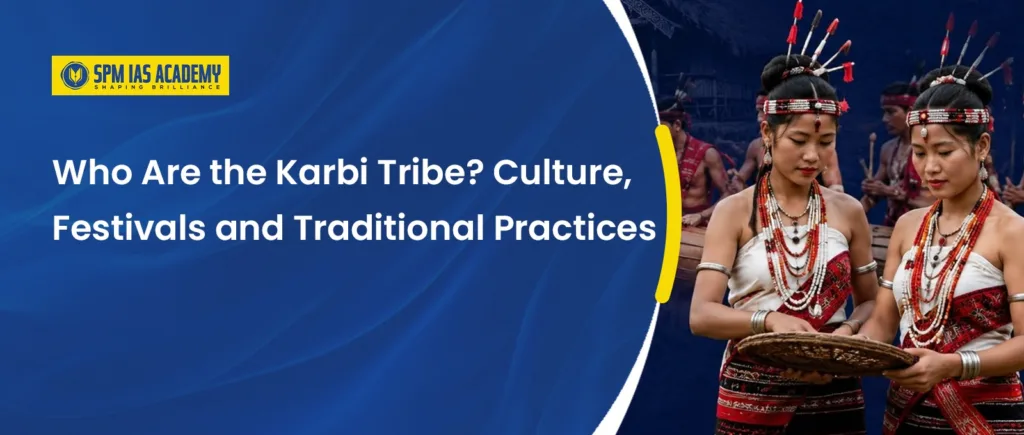
The Karbi Tribe of Assam is one of the state’s most prominent indigenous communities. They belong to the Tibeto-Burman ethnic group and are primarily concentrated in the two hill districts of Assam—Karbi Anglong and West Karbi Anglong. These districts are administered under the Sixth Schedule of the Indian Constitution through the Karbi Anglong Autonomous Council (KAAC), which provides a framework for tribal self-governance. The Karbis refer to themselves as ‘Arleng’, meaning “people” in the Karbi language, reflecting their distinct cultural identity and heritage. Aspirants preparing at an APSC coaching institute in Guwahati should study the Karbi community carefully, as topics related to Assam’s tribes, autonomous councils, and constitutional provisions are important for both the Preliminary and Main examinations.
Origin and History of the Karbi Tribe
Linguistically, the Karbis belong to the Tibeto-Burman language family and, racially, to the Mongoloid group. According to the official government sources, the ancestral homeland of many Tibeto-Burman-speaking groups is in Western China, near the Yang-Tee-Kiang and Howang-ho rivers. And from there, they migrated down the course of the Brahmaputra and entered India and the Indian Subcontinent. The Karbis are historically referred to as Mikir. It was used during the colonial administration.
Presently, the Karbi population is mainly concentrated in the two hill districts of Assam—Karbi Anglong and West Karbi Anglong. According to the 2011 Census, the Karbi population recorded as a Scheduled Tribe was 421,156, while the total number of Karbi-speaking people across India was 528,503. These figures highlight the community’s demographic significance and its important role in Assam’s tribal landscape. Aspirants preparing to crack APSC exam online should remember these facts, as questions related to Assam’s tribes, census data, and autonomous hill districts are frequently asked in competitive examinations.
Where Does the Karbi Tribe Live?
The Karbi people primarily inhabit the two hill districts of Karbi Anglong and West Karbi Anglong. Significant Karbi communities are also found in several other districts of Assam, including Dima Hasao, Hojai, Nagaon, Morigaon, Kamrup, Kamrup Metropolitan, Golaghat, Sonitpur, Biswanath, and Lakhimpur. Outside Assam, smaller Karbi populations reside in Ri-Bhoi, Jaintia Hills, and Khasi Hills in Meghalaya, the Papum Pare district of Arunachal Pradesh, and areas around Dimapur in Nagaland. Aspirants preparing through APSC online coaching should be familiar with the geographical distribution of the Karbi community, as Assam’s tribal population, regional geography, and cultural diversity are important topics in the APSC syllabus.
Karbi Language and Oral Traditions
The Karbi language is an important part of the community’s cultural identity. It belongs to the Tibeto-Burman language family and is spoken mainly in Assam, Meghalaya, and parts of Arunachal Pradesh. Two major varieties are generally recognised: Hills Karbi, spoken primarily in Karbi Anglong and West Karbi Anglong, and Plains Karbi (Amri Karbi), spoken mainly in Kamrup, Morigaon, and parts of Meghalaya. Despite regional variations, both forms play a vital role in preserving the traditions, folklore, and cultural heritage of the Karbi community. Aspirants preparing through online coaching in Assam should understand these linguistic aspects, as questions on Assam’s tribal languages and cultural diversity are frequently asked in competitive examinations.
Oral Literature and Folk Stories
The oral literature and folk stories of Karbi literature explain the origin, migration, and religious beliefs of the Karbi community. Moreover, folk stories often communicate moral values, community responsibilities, and practical knowledge about traditional life.
Among the most significant Karbi oral traditions is Mosera, which means “recalling the past”. It is a long narrative tradition that preserves accounts of the community’s origin, migration, and historical experiences. Mosera is traditionally performed during important ceremonies, particularly Chomangkan, the elaborate Karbi death ritual.
Traditional Songs and Performances
Karbi traditional songs are mainly connected with agriculture, religious rituals, marriage, death ceremonies, and community festivals. These may include descriptions of jhum cultivation, village life, love, separation, nature, or ancestral beliefs.
Furthermore, many ritual songs are performed by specific singers who understand their symbolic and spiritual meanings. These songs are not merely a form of entertainment; instead, they form part of the ceremonies through which cultural knowledge is passed and communicated.
Role of Oral Traditions in Cultural Memory
Most importantly, Karbi oral traditions function as a form of cultural symbol. They preserve information about ancestral migrations, clan relationships, customary laws, religious practices, and the natural environment.
However, social change and the declining use of traditional forms among younger generations have created challenges for their preservation. Therefore, documentation, community festivals, language education and intergenerational storytelling remain essential for protecting the Karbi language and its oral heritage.
Major Festivals of the Karbi Tribe
Karbi festivals play an important role in preserving the culture and identity of the community. They are closely connected with agriculture, religious beliefs, ancestral remembrance, and community life. Moreover, these occasions help transmit traditional songs, dances, and rituals to younger generations.
Rongker Festival
Rongker is one of the main festivals of the Karbi Tribe. It is a post-harvest festival and is generally celebrated in January or February. The festival is observed to seek blessings from the local deity for good cultivation, Peace and prosperity, protection from diseases and natural calamities, and the overall welfare of the village.
During Rongker, designated village elders and ritual specialists conduct prayers and make ceremonial offerings. Traditionally, villagers contribute money or materials for the rituals. Therefore, the festival also reflects collective responsibility and cooperation.
Chomangkan or Chomkan Festival
Chomangkan, also known as Chomkan, is a post-funeral ceremony of the Karbi tribe. It is not normally performed immediately after death. Instead, the family organises it months or even years later, depending on its readiness and resources.
The ceremony is conducted to honour the deceased and guide the departed soul towards the ancestral realm. Although it is associated with death, Chomangkan is not limited to mourning. Rather, it is also a community gathering that celebrates remembrance, continuity, and the liberation of the soul.
Hacha Kekan
Hacha Kekan is a traditional post-harvest celebration associated with the completion of paddy cultivation. It is also known for its lively harvest dance. Therefore, the term may refer both to the celebration and its principal cultural performance.
Unlike Rongker, Hacha Kekan is largely celebratory in character. It does not traditionally centre on the propitiation of village deities. Instead, it expresses happiness after the crops have been harvested and stored.
During the celebration, performers use rhythmic movements and traditional songs to represent agricultural activities. The songs may describe different stages of cultivation, from working in the fields to carrying harvested paddy to the granary.
Moreover, Hacha Kekan encourages community participation and celebrates the dignity of agricultural labour. It reflects the close relationship between Karbi cultural life and the farming cycle. The official Karbi Youth Festival resource also identifies Hacha Kekan as a traditional harvesting dance.
Karbi Youth Festival
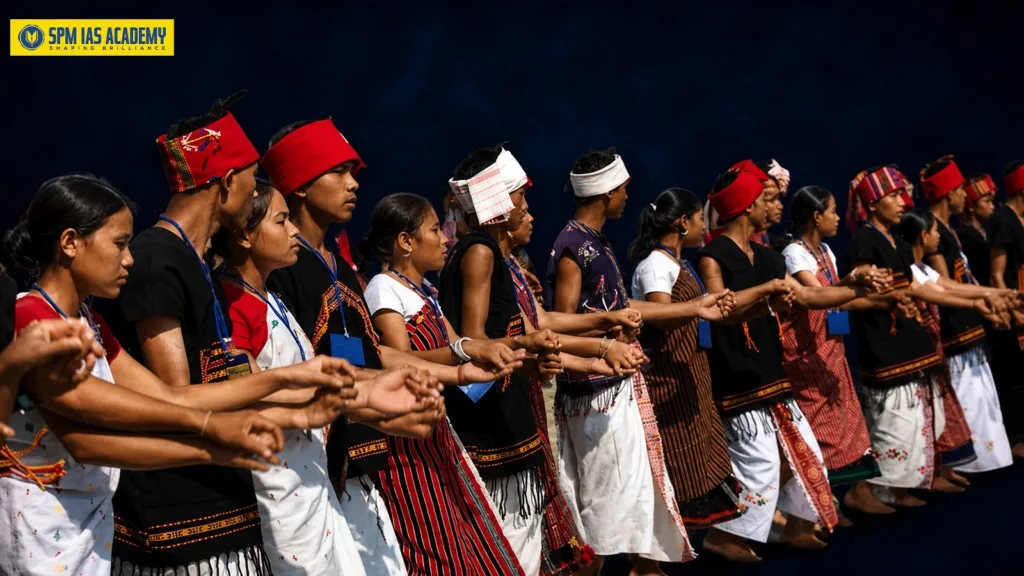
The Karbi Youth Festival, locally known as Karbi Riso-Nimso Rong Aje, is a major annual cultural event. It is organised by the Karbi Cultural Society at Taralangso near Diphu in Karbi Anglong. The main festival is generally held from 15 to 19 February. The festival plays an important role in preserving Karbi culture and tradition by showcasing traditional music, dance, clothing, handicrafts, and indigenous games.
The festival began in the 1970s as an initiative to preserve and promote Karbi cultural heritage. Over time, it has developed into a major platform for showcasing the community’s traditions.
Its principal attractions include: Traditional songs and dances, folk music and oral recitations, Indigenous games and competitions, Traditional clothing and ornaments, Handloom and handicraft exhibitions, Performances by different Karbi cultural zones.
Religious Beliefs and Traditional Practices of the Karbis
Traditional Karbi religious life is closely connected with nature, ancestors, the household, and the village community. Hills, forests, rivers, and agricultural land are often associated with spiritual powers or deities. Among the important traditional deities are Hemphu, Mukrang, and Rasinja. During Rongker Karkli, spirit deities are invoked to seek protection for families, crops, animals, and the wider community.
Ancestors also hold an important place in the Karbi worldview. Traditionally, the souls of the deceased are believed to reach Phu-phi Arong, where they reunite before being reborn into their respective clans. The elaborate Chomkan funeral ceremony is linked to this belief. It honours the deceased while bringing relatives and community members together. Therefore, ancestral rituals help preserve clan identity and relationships between generations.
Karbi household rituals are commonly known as Se-Karkli, meaning “voice worship.” During ceremonies such as Rong Arnam and Volok Asor, deities are invoked through prayers and offerings. These offerings are placed on a Dovan, an earthen altar usually constructed within the household boundary. The rituals are generally performed to seek protection, prosperity, and the well-being of the family.
Similarly, Chojun is an important ceremony in which household and guardian spirits are invoked for family welfare. Relatives are invited, and their blessings are sought. Traditional items such as Horpo, a particular rice beer, the Sih sieve, and the Horhak basket form part of the ceremony. Together, these practices preserve Karbi religious beliefs, kinship ties, and cultural memory
Karbi Traditional Dress and Ornaments
Karbi traditional dress is known for its handwoven fabric, distinctive colours, and geometric patterns, etc.
Traditional Dress of Karbi Women
- Pini: A rectangular lower garment wrapped around the waist like a skirt. Traditionally, it is commonly woven in black or dark shades with coloured borders.
- Pekok: A square or rectangular cloth worn over the upper body. It is usually tied or draped over the shoulder and features decorative woven patterns.
- Vamkok: An artistically woven waist belt used to secure the Pini. Besides its practical use, it adds colour and ornamentation to the attire.
Traditional Dress of Karbi Men
- Choi: A traditional sleeveless jacket or shirt worn by Karbi men. Different forms and designs may be used according to age and occasion.
- Poho: A traditional headcloth or turban worn by men. It forms an important part of male ceremonial attire.
- Sator: A white lower garment wrapped around the waist. Its form is similar to a dhoti and is generally worn with the Choi.
Traditional Karbi Ornaments
- Lek: A general term associated with traditional necklaces. Different varieties are made using coloured beads, coins, silver, or gold.
- Roi: A traditional bangle or bracelet worn on the wrist. It may be made of brass, silver or gold.
- Norik: An ear ornament traditionally worn by Karbi men. Depending on the design and the wearer, it may be made from silver or gold.
Karbi Weaving Tradition
Traditional Karbi garments are mainly woven by women on household looms using cotton and Eri silk. Red, black, indigo, and white are commonly seen in these textiles, although modern weavers now use a wider range of colours. The skills of weaving traditional patterns and motifs are passed from elders to younger generations. Therefore, Karbi textiles are more than everyday clothing; they represent the community’s identity, craftsmanship, and living cultural heritage.
Traditional Occupations, Weaving and Handicrafts
- Agriculture: Agriculture has traditionally been the main Karbi occupation. Paddy is the principal crop, while maize, ginger, turmeric, fruits, and vegetables are also cultivated. Jhum cultivation has been practised in the hills, although settled farming is now common.
- Bamboo and Cane Work: Karbi artisans use bamboo and cane to make baskets, mats, storage containers, agricultural tools, and household objects. These crafts are practical, lightweight, and well suited to village life.
- Woodcraft: Traditional woodcraft includes household utensils, agricultural objects, mortars, and ceremonial items. The Jambili Athon, associated with village chiefs and the Chomkan ceremony, is a notable example.
- Cotton and Eri Silk Weaving: Karbi women traditionally weave cotton and Eri silk on household looms. They produce garments, scarves, belts, and ceremonial textiles featuring distinctive colours and geometric patterns.
- Preservation of Traditional Skills: Farming, weaving, and craft-making knowledge is passed from elders to younger generations. Moreover, festivals and cultural exhibitions help preserve and promote these traditional skills.
Conclusion
The Karbi tribe carries a rich cultural legacy shaped by nature, community, ancestral beliefs, and generations of shared knowledge. From its language, festivals and religious customs to traditional dress, farming and craftsmanship, every practice reflects a distinct identity. Preserving these living traditions will help future generations remain connected to their roots while confidently embracing change.
Frequently Asked Questions
Q1. Where does the Karbi tribe mainly live?
The Karbi tribe is an indigenous community of Northeast India, concentrated mainly in Assam’s Karbi Anglong and West Karbi Anglong districts. Smaller Karbi communities also live in other parts of Assam, Meghalaya, Arunachal Pradesh, and Nagaland. Their language, customs, and festivals form an important part of Assam’s heritage.
Q2. What are the major festivals of the Karbi tribe?
Rongker and Chomangkan are two of the most important Karbi festivals. Rongker seeks protection, prosperity, and agricultural well-being for the village. Chomangkan is an elaborate post-funeral ceremony honouring the deceased. The Karbi Youth Festival also promotes traditional music, dance, dress, and crafts among younger generations.

Behind every article at SPM IAS Academy is a team of skilled content writers and subject experts committed to making preparation easier for aspirants. From answering common doubts to breaking down complex issues and current affairs, we create content that is accurate, easy to understand, and directly useful for UPSC, APSC, and other competitive exams.