
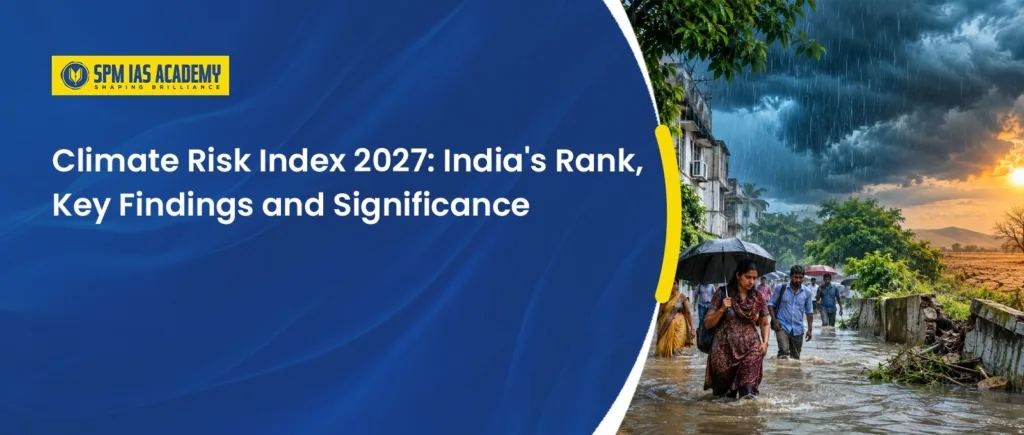
The Climate Risk Index 2027 (CRI 2027) is a global ranking published by the German environmental organisation Germanwatch. This index measures how severely countries have suffered from extreme weather events, including floods, cyclones, heatwaves and droughts. The index assesses human casualties, affected populations and economic losses.
According to the latest report, India ranked 10th globally for 1996–2025 and 12th for 2025. Germanwatch released the report during the COP31 Climate Conference in Antalya, Turkey, in November 2026. Understanding such climate-related rankings and international reports is important for current affairs preparation, making them relevant topics for aspirants enrolled in online coaching in Assam. .
This article explains the CRI 2027, India’s ranking, major findings, assessment methodology and its significance. This topic is important for UPSC, APSC Prelims and Mains under GS Paper 3.

Why Was the Climate Risk Index 2027 in the News?
Germanwatch released the Climate Risk Index 2027 on 17 November 2026, during the UN Climate Change Conference (COP31). The report highlighted India’s growing exposure to extreme weather. Between 1996 and 2025, India experienced 436 major extreme weather events. It resulted in more than 78,000 deaths and approximately US$170 billion in economic losses. Moreover, these events affected over 1.2 billion people cumulatively, including people affected repeatedly by different disasters. Understanding such reports is important for environment and disaster management preparation, making them relevant for aspirants attending UPSC coaching in the Northeast.
What Is the Climate Risk Index 2027?
The Climate Risk Index 2027 is a retrospective assessment of the impacts of extreme weather events. Germanwatch has published the index since 2006. It compares countries using six indicators covering absolute and relative human and economic losses.
Key Facts About CRI 2027
| Particular | Details |
| Published By | Germanwatch |
| Organisation’s Country | Germany |
| Release Date | 17 November 2026 |
| Released During | COP31, Antalya, Turkey |
| Assessment Periods | 2025 and 1996-2025 |
| India’s Long-Term Rank | 10th |
| India’s 2025 Rank | 12th |
Important Findings of Climate Risk Index 2027
The report highlights the increasing human and economic costs of extreme weather. Understanding these impacts, along with climate risks and disaster management measures, is important for APSC exam preparation, particularly for environment and geography-related topics.
- Global Deaths: Extreme weather events caused more than 916,000 deaths worldwide between 1996 and 2025.
- Economic Losses: Nearly 10,000 extreme weather events caused approximately US$4.7 trillion in direct economic losses.
- Affected Population: These disasters affected around 5.5 billion people cumulatively.
- Heatwaves: Moreover, heatwaves caused nearly 70% of reported disaster deaths in 2025.
- Storms: Storms accounted for 58% of economic losses during 1996-2025.
- Global Inequality: Nine of the ten most affected countries in the long-term ranking belonged to middle-income groups.
Top Countries in CRI 2027
| Rank | Long-Term Ranking (1996-2025) | Annual Ranking (2025) |
| 1 | Dominica | Jamaica |
| 2 | Myanmar | Sri Lanka |
| 3 | Honduras | Spain |
| 4 | Libya | Thailand |
| 5 | Haiti | Philippines |
India’s Rank in Climate Risk Index 2027
India ranked 10th in the long-term CRI 2027 and 12th in the 2025 ranking. Between 1996 and 2025, the country experienced 436 extreme weather events, which caused more than 78,000 deaths. Moreover, these disasters affected over 1.2 billion people cumulatively and resulted in economic losses exceeding US$170 billion. These figures highlight India’s growing vulnerability to extreme weather events. Understanding such environmental challenges is important for aspirants studying at an Assam Civil Service Academy, particularly for topics related to climate change, disaster management and current affairs.
India faces recurring climate-related disasters because of its geographical diversity and large exposed population. For example, the 1999 Odisha Super Cyclone, 2013 Uttarakhand floods, 2020 Cyclone Amphan. Furthermore, floods, cyclones and extreme rainfall regularly damage infrastructure, agriculture and livelihoods.
How Does the CRI 2027 Measure Climate Risk?
Germanwatch uses six indicators covering three dimensions:
- Human Fatalities: Total deaths and deaths relative to population.
- Affected Population: Total affected people and their share of the population.
- Economic Losses: Total financial losses and losses relative to economic output.
The index uses data from the EM-DAT International Disaster Database, World Bank and International Monetary Fund.
However, it measures past disaster impacts, not the probability of future disasters. Moreover, incomplete reporting may underestimate losses, especially in developing countries.
What Is the Significance of Climate Risk Index 2027 for India?
The CRI 2027 highlights India’s need for stronger climate adaptation and disaster preparedness.
- Disaster Management: Firstly, India must strengthen early warning systems and disaster-resilient infrastructure.
- Climate Adaptation: Secondly, states need better flood management, heat action plans and climate-resilient agriculture.
- Climate Finance: Moreover, the findings support discussions on international adaptation finance and loss-and-damage assistance.
- Sustainable Development: Climate-resilient infrastructure can protect livelihoods and reduce economic losses.
- Regional Planning: Furthermore, vulnerable states such as Assam require stronger flood preparedness and riverbank erosion management.
For Assam, recurring Brahmaputra floods, riverbank erosion and extreme rainfall make climate resilience particularly important.
Climate Risk Index vs Climate Change Performance Index
| Climate Risk Index (CRI) | Climate Change Performance Index (CCPI) |
| Measures impacts of extreme weather | Evaluates countries’ climate mitigation performance |
| Published by Germanwatch | Published by Germanwatch, NewClimate Institute and Climate Action Network International |
| India ranked 10th for 1996 to 2025 | India ranked 28th in CCPI 2027 |
| Focuses on deaths, affected people and economic losses | Focuses on emissions, renewable energy, energy use and climate policy |
Conclusion
The CRI 2027 highlights India’s significant exposure to extreme weather events. Its 10th position in the long-term ranking reflects the impact of recurring floods, cyclones and heatwaves.
Therefore, India must strengthen climate adaptation, disaster preparedness and resilient infrastructure. Moreover, international climate cooperation and adequate climate finance remain essential.
UPSC/APSC Prelims Practice Question
Q. With reference to the Climate Risk Index 2027 (CRI 2027), consider the following statements:
- The CRI 2027 was published by Germanwatch, a Germany-based environmental organisation.
- India ranked 10th in the long-term ranking for 1996 to 2025 and 12th in the 2025 annual ranking.
- The index measures climate risk using indicators related to human fatalities, affected populations and economic losses.
- The CRI primarily evaluates countries based on their greenhouse gas emissions and renewable energy performance.
Which of the statements given above are correct?
(a) 1 and 2 only
(b) 1, 2 and 3 only
(c) 2, 3 and 4 only
(d) 1, 2, 3 and 4
UPSC/APSC Mains Practice Question
Q. The Climate Risk Index 2027 ranks India among the ten countries most affected by extreme weather events during 1996-2025. Discuss the major findings of the Index. Also examine the need for climate adaptation, disaster preparedness and climate-resilient infrastructure in India.
Read More:
Source:
Frequently Asked Questions
1. What is the Climate Risk Index 2027, and who published it?
The CRI 2027 is a global report published by Germanwatch, a German environmental organisation. It measures the impact of extreme weather events, including floods, cyclones, droughts and heatwaves. Moreover, it assesses deaths, affected populations and economic losses.
2. What is India’s rank in the Climate Risk Index 2027?
India ranked 10th globally in the long-term CRI 2027 (1996-2025) and 12th in the 2025 ranking. During this period, India experienced 436 extreme weather events. Furthermore, these disasters caused over 78,000 deaths and economic losses exceeding US$170 billion.
3. What are the major findings of the CRI 2027?
The CRI 2027 recorded over 916,000 deaths and approximately US$4.7 trillion in economic losses worldwide during 1996-2025. Moreover, Dominica topped the long-term ranking, while Jamaica ranked first in the 2025 annual ranking.
4. Why is the CRI 2027 important for India?
The CRI 2027 highlights India’s vulnerability to extreme weather events. Therefore, it emphasises the need for stronger disaster management, early warning systems and climate-resilient infrastructure. Furthermore, it supports India’s efforts to secure climate adaptation finance and protect vulnerable regions like Assam.

Behind every article at SPM IAS Academy is a team of skilled content writers and subject experts committed to making preparation easier for aspirants. From answering common doubts to breaking down complex issues and current affairs, we create content that is accurate, easy to understand, and directly useful for UPSC, APSC, and other competitive exams.