

The Barak river system is one of the most important river systems of Northeast India and the lifeline of southern Assam. The Barak flows through the hills and plains of Northeast India before entering Bangladesh. It eventually becomes part of the larger Meghna river system and drains into the Bay of Bengal. Understanding important geographical features such as the Barak River can be useful for students looking to crack APSC exam online, particularly when preparing Assam and Northeast India-focused General Knowledge and geography topics.
In Assam, the river shapes the fertile Barak Valley and supports agriculture, settlements, fisheries and inland navigation. Moreover, its tributaries play an important role in the region’s recurring floods.
For UPSC, APSC, and other State PCS examinations, the Barak river system is important for Indian Geography, Assam Geography, water resources, floods, and India-Bangladesh relations. Students preparing for these examinations can also explore UPSC coaching in the Northeast for structured guidance on regional geography, current affairs, and broader civil services preparation.
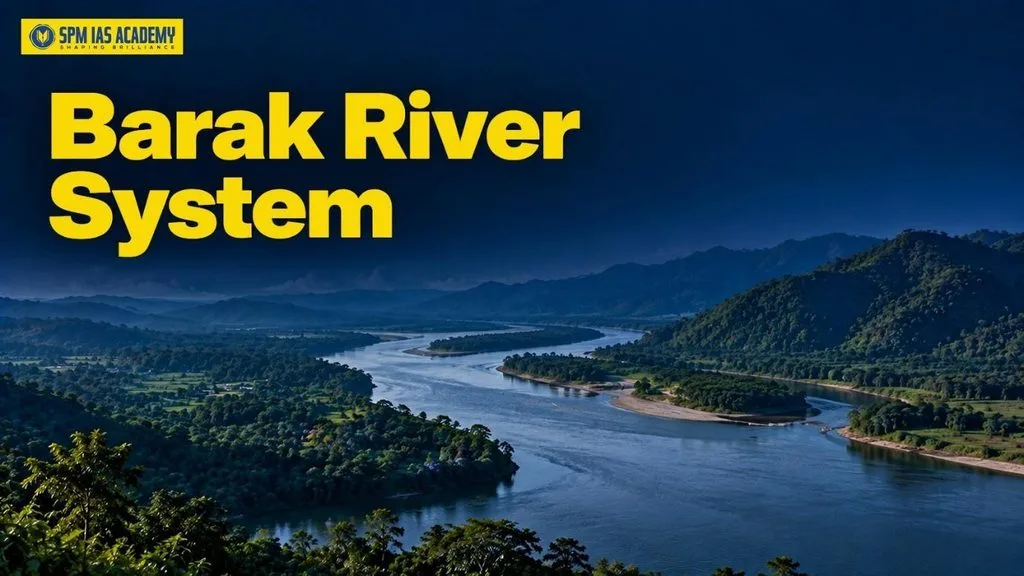
About Barak River System
- The Barak River system forms one of Assam’s two major river systems, the other being the Brahmaputra. Students preparing for APSC and other civil service examinations can also consider a Guwahati IAS academy for structured guidance in Assam-specific geography, General Knowledge, and broader competitive exam preparation.
- It is the second largest river system of North East India and Assam. The Barak sub-basin covers parts of India, Bangladesh and Myanmar.
- Within India, the sub-basin covers about 41,723 sq km. It extends across Assam, Manipur, Mizoram, Meghalaya, Tripura and Nagaland.
- The Barail Range separates it from the Brahmaputra basin in the north. Meanwhile, the Naga and Lushai hills lie towards its east, while Bangladesh borders the basin towards the south and west.
- The basin has two broad physiographic regions: hilly areas and plains. The plains support dense settlements and extensive cultivation. Students preparing for civil services examinations can use coaching classes for UPSC in Assam to strengthen their understanding of Indian and Assam-specific geography, including river systems, physiography, agriculture, and regional development.
Barak River Origin and Course
- The Barak River origin lies in the Manipur Hills, south of Mao in Senapati district, at an elevation of about 2,331 metres.
- From its source, the river flows through hilly terrain and along parts of the Manipur–Nagaland region before moving towards Mizoram and Assam.
- After entering Assam, it flows through the Barak Valley, one of the state’s most important geographical regions.
- Near the India-Bangladesh border, the Barak divides into two branches. One is the Surma and another one is Kushiyara. These rivers later reunited in Bangladesh to form the Meghna River.
- The Meghna eventually meets the Padma and drains into the Bay of Bengal.
What Are the Major Tributaries of the Barak River?
The extensive network of Barak River system tributaries drains the surrounding hills and valleys.
| North/Right Bank Tributaries | South/Left Bank Tributaries |
| Jiri | Sonai |
| Chiri | Rukni |
| Jatinga | Ghagra |
| Marang | Katakhal |
| Madhura | Dhaleshwari |
| Dalu | Singla |
| — | Longai |
Many tributaries are mainly rain-fed. Therefore, intense monsoon rainfall can quickly increase their discharge and create serious flood problems across the valley. This makes the tributary network important not only for physical geography but also for disaster management.
Importance of the Barak River System in Assam
- The Barak River system has major economic and geographical importance for southern Assam. Its plains support agriculture, while the river and its wetlands sustain fisheries and local livelihoods.
- Furthermore, the river has considerable transport potential. The 121-km Lakhipur-Bhanga stretch of the Barak River is National Waterway-16 (NW-16). This gives the river an important role in developing inland water transport and regional trade.
- The river also has international importance because its waters eventually enter Bangladesh and become part of the Meghna system. Thus, the river connects Northeast India’s geography with the wider Ganga-Brahmaputra-Meghna drainage system.
Conclusion
The Barak river system is central to the physical and economic geography of southern Assam and the wider Northeast. From its origin in the Manipur Hills to its transformation into the Surma-Kushiyara and Meghna system, the river links India with Bangladesh and the Bay of Bengal.
Therefore, its origin, tributaries, basin states, flood characteristics and inland-waterway importance make the Barak an essential river system to understand for Indian and Assam geography.
Read More:
Source:
Frequently Asked Questions
1. Where does the Barak River originate?
The Barak River originates from Liyai Kullen village, in Senapati district of Manipur.
2. What are the major tributaries of the Barak River?
The major tributaries of the Barak river system include Jiri, Jatinga, Madhura, Sonai, Rukni, Katakhal, Dhaleshwari, Singla and Longai. Moreover, these tributaries drain large parts of the surrounding hills and Barak Valley.
3. Where does the Barak River enter Bangladesh?
The Barak River flows towards Bangladesh after passing through southern Assam. Near the India-Bangladesh border, it divides into the Surma and Kushiyara branches. Later, these rivers become part of the Meghna river system.
4. Why is the Barak River System important for Assam?
The Barak river system supports agriculture, fisheries, settlements and livelihoods across southern Assam. Moreover, the Lakhipur-Bhanga stretch forms National Waterway-16.

Behind every article at SPM IAS Academy is a team of skilled content writers and subject experts committed to making preparation easier for aspirants. From answering common doubts to breaking down complex issues and current affairs, we create content that is accurate, easy to understand, and directly useful for UPSC, APSC, and other competitive exams.