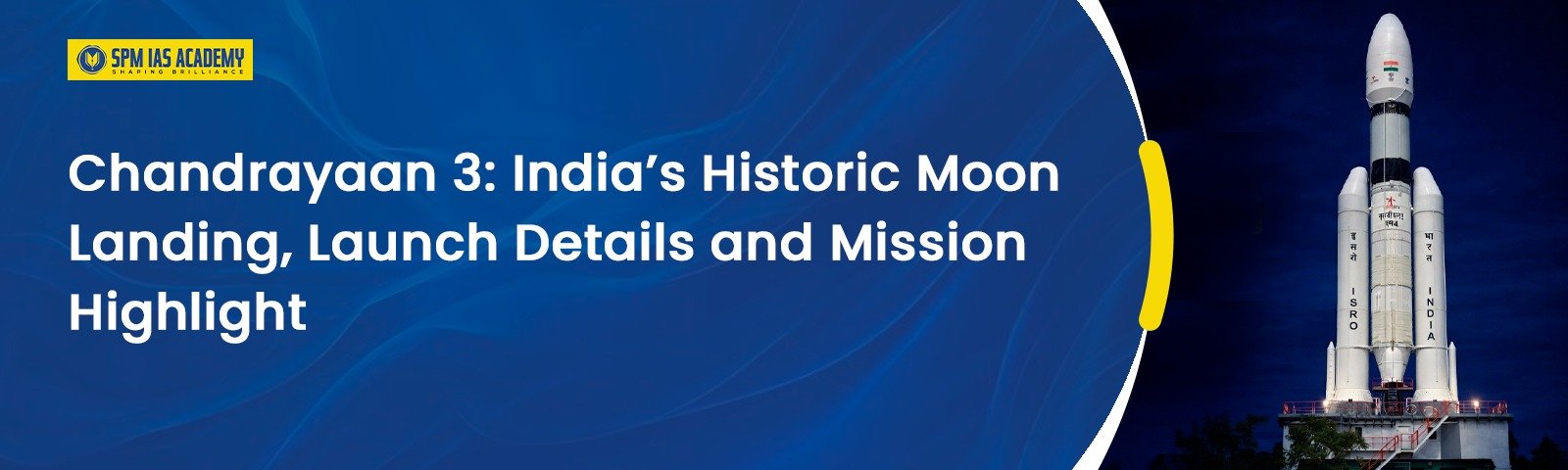
What is Chandrayaan 3?
Chandrayaan 3 is India’s third mission to the Moon, launched by the Indian Space Research Organisation (ISRO). It is a follow-on mission to Chandrayaan-2. Its main goal is to demonstrate end-to-end capability in safe landing and roving on the lunar surface.
The mission consists of three parts: a Lander Module, a Rover, and a Propulsion Module. Together, they formed an integrated spacecraft that travelled from Earth to the Moon. On 23 August 2023, it made history by achieving a successful soft landing near the Moon’s south pole.
India became the fourth country in the world after the United States, Russia, and China to achieve a soft landing on the Moon. Furthermore, India became the first country in the world to land a spacecraft near the lunar south pole.
ISRO Moon Mission Chandrayaan 3 – Background
The ISRO Moon Mission Chandrayaan 3 is part of India’s long journey to explore the Moon. ISRO launched Chandrayaan-1 on 22nd October, 2008. That mission orbited the Moon and discovered water molecules on its surface. Next, in July 2019, ISRO launched Chandrayaan-2. However, the lander Vikram crash-landed on the Moon due to a software issue. As a result, ISRO studied the failure carefully and spent four years preparing Chandrayaan 3 with improved technology.
Chandrayaan Series at a Glance
- Chandrayaan-1 (2008): Orbiter mission. Discovered water molecules on the Moon’s surface.
- Chandrayaan-2 (2019): Lander + Rover + Orbiter. The orbiter was successful but the lander crash-landed.
- Chandrayaan-3 (2023): Lander + Rover + Propulsion Module. Fully successful soft landing near the south pole.
Why the South Pole of the Moon Matters
Scientists believe that the shadowed craters near the Moon’s south pole contain water ice and other frozen materials. These materials have remained untouched for billions of years. Additionally, they provide clues about the early history of our solar system. Therefore, landing near the south pole gives India and the world access to valuable, never-before-explored resources.
Chandrayaan 3 Launch Date and Time
Aspirants must remember the exact Chandrayaan 3 launch date and time, as this often appears in preliminary and mains examinations.
| Event | Date and Time | Details |
| Launch | 14 July 2023, 2:35 PM IST | Satish Dhawan Space Centre, Sriharikota |
| Lunar Orbit Insertion | 5 August 2023 | Spacecraft entered Moon’s orbit successfully |
| Soft Landing | 23 August 2023, 6:04 PM IST | Near the lunar south pole |
| Rover Deployment | 24 August 2023 | Pragyan rover rolled out from lander Vikram |
| Mission Life | One lunar day | Approximately 14 Earth days of active operation |
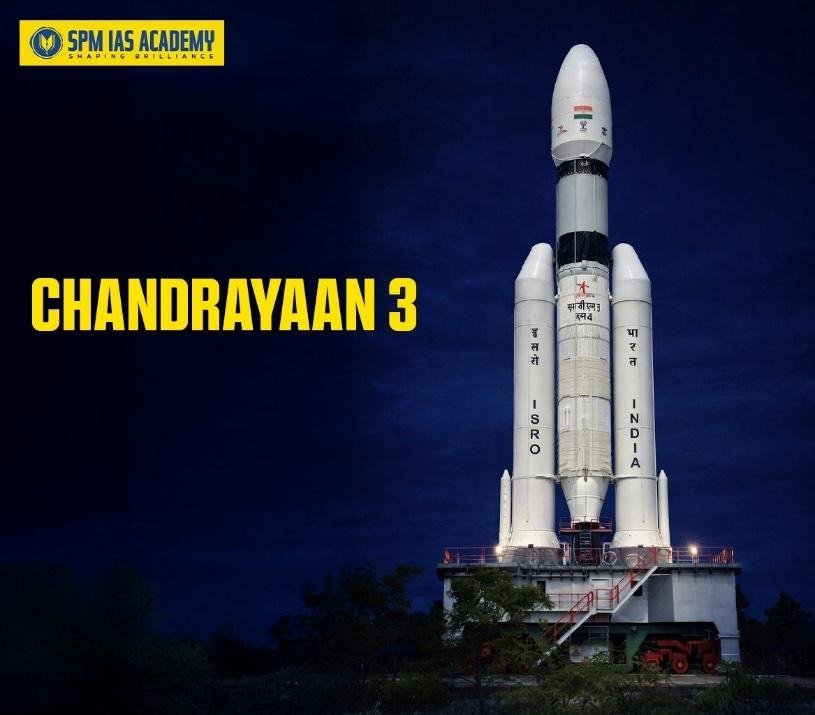
The launch vehicle used was the LVM3-M4 (Launch Vehicle Mark-3, Mission 4), which is ISRO’s largest and most powerful operational rocket. It placed the spacecraft into an Elliptic Parking Orbit (EPO) of approximately 170 x 36,500 km before the spacecraft began its journey to the Moon.
What is the Purpose of Chandrayaan 3?
ISRO defined three clear mission objectives for Chandrayaan 3:
- Safe and Soft Landing on the Lunar Surface: ISRO wanted to prove that India has the technology to land a spacecraft gently on the Moon. This capability is fundamental to all future planetary exploration missions.
- Rover Roving on the Moon: After landing, the rover Pragyan moved across the Moon’s surface. This demonstrated India’s ability to operate a mobile robotic vehicle on another celestial body.
- In-Situ Scientific Experiments: The lander and rover carried scientific instruments to study the Moon’s surface. They collected data on temperature, seismic activity, plasma, and chemical composition of lunar soil.
Furthermore, the purpose of Chandrayaan 3 extends to building India’s capacity for future interplanetary missions, including missions to Mars and beyond. The mission also demonstrates advanced technologies such as hazard detection, autonomous navigation, and throttleable engines.
Advanced Technologies Demonstrated
- Laser and Radio Frequency Altimeters for precise height measurement
- Laser Doppler Velocimeter for horizontal speed measurement during descent
- Hazard Detection and Avoidance Camera for autonomous navigation
- 800N Throttleable Liquid Engines for precise speed control
- Lander Leg Mechanism for safe touchdown
- Navigation, Guidance and Control (NGC) software for powered descent
Key Components of Chandrayaan 3
1. Propulsion Module (PM)
The Propulsion Module acts as the carrier vehicle. Its main job is to carry the Lander Module from Earth’s orbit to a 100 km circular polar orbit around the Moon. After separating the Lander, the Propulsion Module continues to orbit the Moon and operates its own scientific instrument called SHAPE (Spectro-polarimetry of Habitable Planet Earth).
2. Lander Module – Vikram
The Lander, named Vikram, carries the rover and performs the soft landing on the Moon’s surface. After landing, it deploys the rover through a ramp. Vikram is equipped with advanced sensors, cameras, throttleable engines, and landing leg mechanisms.
3. Rover – Pragyan
The Rover, named Pragyan (meaning ‘wisdom’ in Sanskrit), rolled out from Vikram after landing and moved across the lunar surface, conducting chemical analysis of the soil and rocks.
Scientific Payloads carried by Chandrayaan 3
The following instruments were carried by Chandrayaan 3.
| Module | Instrument | Full Name | Purpose |
| Lander | RAMBHA (LP) | Radio Anatomy of Moon Bound Hypersensitive ionosphere and Atmosphere | Measures near-surface plasma density and its changes over time |
| Lander | ChaSTE | Chandra’s Surface Thermo Physical Experiment | Measures thermal properties and temperature of lunar surface near polar region |
| Lander | ILSA | Instrument for Lunar Seismic Activity | Measures seismic activity (moonquakes) and studies lunar crust and mantle structure |
| Lander | LRA (NASA) | Laser Retroreflector Array | Passive experiment for lunar laser ranging studies – provided by NASA |
| Rover | LIBS | Laser Induced Breakdown Spectroscope | Identifies chemical and mineralogical composition of lunar soil |
| Rover | APXS | Alpha Particle X-ray Spectrometer | Determines elemental composition (Mg, Al, Si, K, Ca, Ti, Fe) of soil and rocks |
| Propulsion Module | SHAPE | Spectro-polarimetry of Habitable Planet Earth | Studies spectral and polarimetric properties of Earth from lunar orbit for exoplanet research |
Director of Chandrayaan 3 – Key Leadership
Knowing the director of Chandrayaan 3 and the key people behind the mission is important for competitive exams.
| Role | Name | Significance |
| ISRO Chairman | S. Somanath (S. Sreedhara Panicker Somanath) | Led ISRO during Chandrayaan 3 and declared ‘India is on the Moon’ after the successful landing |
| Project Director | P. Veeramuthuvel | The primary director of the Chandrayaan 3 project |
| Mission Director | S. Mohanakumar | Managed overall mission operations from launch to landing |
| Associate Mission Director | G. Narayanan | Played a key supporting role in mission operations |
| Vehicle Director (LVM3) | Biju C. Thomas | Directed the LVM3 launch vehicle operations |
Benefits of Chandrayaan 3
1. Scientific Benefits
Chandrayaan 3 provides direct data about the lunar south pole, a region never before explored by any country. The ChaSTE instrument found that temperature near the south pole drops steeply below the surface. The ILSA instrument recorded a moonquake, giving scientists data about the Moon’s interior structure. These findings advance human understanding of planetary science.
2. Technological Benefits
The mission required India to develop and master many cutting-edge technologies independently. Throttleable liquid engines allow the lander to reduce speed precisely during descent. The hazard detection system makes the lander autonomous. As a result, these technologies can find applications in robotics, defence, and aerospace manufacturing.
3. Economic and Strategic Benefits
A successful moon landing increases India’s credibility as a reliable space partner. This helps ISRO attract more commercial launch contracts from other countries. Additionally, it boosts India’s share in the global space economy, which is worth over USD 600 billion. The mission cost only around Rs. 615 crore, making it one of the most cost-effective Moon missions in history.
4. Benefits for Future Missions
Chandrayaan 3 lays the groundwork for India’s upcoming missions such as Chandrayaan-4, the Gaganyaan human spaceflight programme, and future Mars exploration. The south pole of the Moon contains water ice, which is crucial for future human settlements on the Moon.
5. National and Inspirational Benefits
The mission proved that India can accomplish world-class science with a lean budget. It inspires millions of young Indians to pursue careers in Science, Technology, Engineering, and Mathematics (STEM). The government’s declaration of 23 August as National Space Day further recognises this achievement.
Conclusion – Chandrayaan 3 and Its Significance
In conclusion, Chandrayaan 3 stands as one of the greatest achievements in the history of India’s space programme and in global lunar exploration. The ISRO Moon Mission Chandrayaan 3 succeeded where many others failed. It landed precisely near the unexplored lunar south pole, conducted valuable experiments, and returned critical scientific data to Earth.
For UPSC, APSC, and State PCS aspirants, knowing about the Chandrayaan 3 launch date, its purpose and wide benefits are absolutely essential.
Furthermore, this mission reflects India’s growing capability in Science and Technology, a core theme in UPSC Mains GS Paper-3. The story of perseverance after Chandrayaan-2’s failure, learning from mistakes, and ultimately succeeding is a model of resilience that aligns with values tested in the UPSC Interview and Essay paper.
Therefore, study the details of Chandrayaan 3 thoroughly — know the key facts, the people, and the significance and you will be well prepared for any question this historic mission brings in your competitive exam.
Source:
FAQ:
Chandrayaan 3 is India’s third Moon mission by ISRO. It successfully landed a spacecraft (Vikram lander) and a rover (Pragyan) near the Moon’s south pole on 23 August 2023. It proved that India has the technology to softly land on and explore the Moon.
Chandrayaan 3 was launched on 14 July 2023 at 2:35 PM (IST) from Satish Dhawan Space Centre in Sriharikota, Andhra Pradesh, using the LVM3-M4 rocket.
P. Veeramuthuvel is the Project Director of Chandrayaan 3. S. Mohanakumar is the Mission Director, and S. Somanath is the ISRO Chairman who led the overall programme.
The three main purposes of Chandrayaan 3 are: (1) to demonstrate safe and soft landing on the Moon, (2) to demonstrate rover mobility on the lunar surface, and (3) to conduct in-situ scientific experiments on the Moon’s surface.
The benefits of Chandrayaan 3 include new scientific data about the lunar south pole, development of advanced indigenous technologies, boost to India’s space economy, a foundation for future missions like Chandrayaan-4 and Gaganyaan, and national inspiration for students in STEM fields.
India became the first country in the world to successfully land a spacecraft near the lunar south pole through Chandrayaan 3 on 23 August 2023.

Behind every article at SPM IAS Academy is a team of skilled content writers and subject experts committed to making preparation easier for aspirants. From answering common doubts to breaking down complex issues and current affairs, we create content that is accurate, easy to understand, and directly useful for UPSC, APSC, and other competitive exams.