
What is Tropical Cyclone?
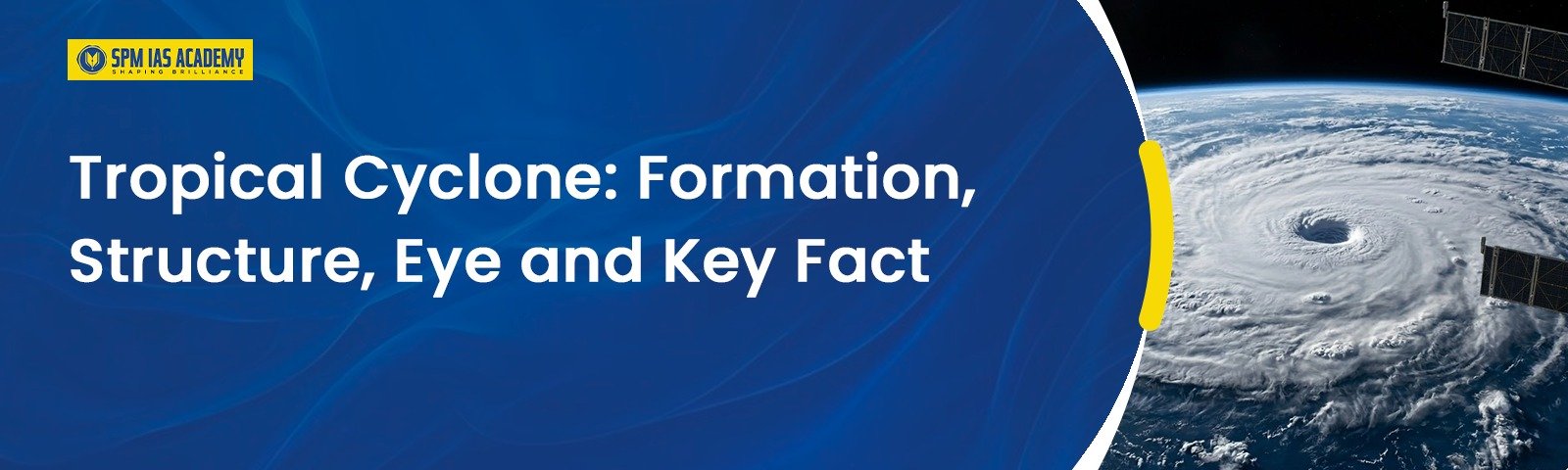
A Tropical Cyclone is an intense, rotating storm system that originates over warm tropical oceans between latitudes 5° and 30° on either side of the equator. It has a warm, low-pressure centre called the eye, surrounded by a violent eyewall of thunderstorms and strong spiralling winds. Tropical cyclones draw their energy from the latent heat released when warm, moist oceanic air rises and condenses. They are also called hurricanes in the North Atlantic, typhoons in the Western Pacific, and willy-willies in Australia.
Tropical Cyclone Formation – How Are Tropical Cyclones Formed?
Understanding tropical cyclone formation is essential for UPSC aspirants. A tropical cyclone forms through a step-by-step process that requires several conditions to occur simultaneously.
Step-by-Step: How a Tropical Cyclone Forms
- Step 1 – Warm Ocean Heating: Warm Ocean water (above 26.5°C) heats the air above it. This warm, moist air becomes less dense and begins to rise rapidly from the ocean surface.
- Step 2 – Low Pressure Formation: As warm air rises, it leaves behind a region of low pressure at the ocean surface. Surrounding cooler and denser air rushes in to fill this low-pressure zone.
- Step 3 – Condensation and Latent Heat Release: As the rising moist air cools at higher altitudes, water vapour condenses into clouds and releases latent heat. This latent heat further warms the surrounding air, causing it to rise faster and intensifying the upward motion.
- Step 4 – Coriolis Force Initiates Rotation: The Coriolis force, caused by Earth’s rotation, deflects the incoming air. This gives the system a spin – anti-clockwise in the Northern Hemisphere and clockwise in the Southern Hemisphere.
- Step 5 – Upper-Level Divergence: At the top of the troposphere (above 7 km), the rising air spreads out horizontally in an anticyclonic (outward) pattern. This outflow maintains the low pressure at the surface and allows the storm to sustain itself.
- Step 6 – Eye and Eyewall Formation: As the system intensifies, air spirals inward, rises steeply in the eyewall, and subsides in the centre, forming the calm eye. The eyewall contains the highest wind speeds and most intense rainfall.
- Step 7 – Mature Cyclone: The system reaches maturity with a well-defined eye, eyewall, and spiral rain bands. At this stage it is classified as a tropical cyclone.
Favourable Conditions for Tropical Cyclone Formation
| Condition | Required Value / Description |
| Sea Surface Temperature (SST) | Above 26.5°C to a depth of at least 46 m — provides heat and moisture |
| Warm Moist Air Supply | Continuous supply of warm, humid air for sustained convection and latent heat release |
| Coriolis Force | Must be sufficiently strong — absent between 0°–5° latitude; this is why cyclones do not form near the equator |
| Low Vertical Wind Shear | Wind speed and direction must not change much with height; high shear disrupts the cyclone’s vertical structure |
| Upper-Level Divergence | Strong divergence at 9-12 km altitude allows rising air to be pumped out, maintaining low pressure at the surface |
| Pre-existing Low Pressure | A weather disturbance (monsoon trough, easterly wave) to trigger initial rotation |
| High Mid-Troposphere Humidity | Around 50-60% humidity at 4-7 km altitude to prevent dry air from disrupting convection |
Structure of Tropical Cyclone – Parts and Layers
The structure of a tropical cyclone is complex and well-organised. Understanding it helps aspirants answer questions in both UPSC prelims and Mains.
Students preparing geography topics like cyclones can benefit from expert guidance offered by upsc coaching in assam.
Horizontal Structure
| Component | Description |
| Eye | Roughly circular calm area at the centre; diameter 30-60 km (range 8–200 km). Has light winds, clear or partly cloudy sky, low pressure, and warm temperatures aloft. No significant rainfall. Sometimes blue sky is visible. |
| Eyewall | The ring of deep convective clouds surrounding the eye. Contains the highest wind speeds and most intense rainfall. Temperature at eye level may be 10°C warmer than surroundings at 12 km altitude. |
| Spiral Rain Bands | Long, curved bands of thunderstorm clouds (cumulonimbus) that spiral inward toward the eyewall. Made of nimbostratus and cumulus clouds at the periphery and cumulonimbus near the centre. |
| Outer Circulation | The outermost region of the cyclone with lighter winds and scattered cloud cover. Isobars are spaced farther apart here. |
Vertical Structure – Three Layers
| Layer | Altitude | Key Features |
| Inflow Layer | Surface to 3 km | Air flows inward toward the low pressure centre; warm moist air drawn in from ocean surface; drives the storm. |
| Cyclonic Storm Layer | 3 km to 7 km | Main zone of cyclonic activity; intense convection, heavy rainfall, and violent wind speeds occur here. |
| Outflow Layer | Above 7 km (max at 12 km) | Rising air spreads outward anticyclonically; maximum outflow at 12 km; acts as exhaust system maintaining surface low pressure. |
Eye of Tropical Cyclone – The Calm Centre
The eye of a tropical cyclone is one of the most distinctive and frequently examined features in competitive examinations. It appears paradoxically peaceful amid the world’s most violent storms.
The eye is a roughly circular zone of light winds, clear or partly cloudy skies, and fair weather at the centre of a fully developed tropical cyclone. Despite being surrounded by the most violent part of the storm, the eye remains calm because of a process called subsidence – dry air descending from the upper troposphere, which suppresses cloud formation and rainfall within the eye.
Key Facts about the Eye of a Tropical Cyclone
| Feature | Details |
| Diameter | Average 30-60 km; can range from 8 km to over 200 km |
| Weather inside | Light winds; little or no precipitation; sometimes blue sky visible |
| Pressure | Lowest surface pressure in the entire cyclone system |
| Temperature | Warmest temperatures aloft – up to 10°C warmer than surroundings at 12 km altitude; but only 0-2°C warmer at surface |
| Formation cause | Dynamic centrifuging of air outward into eyewall + forced descent caused by moist convection of eyewall |
| Eyewall | Ring of tallest convective clouds surrounding the eye; contains highest wind speeds |
| Eye wall replacement | In intense cyclones, an outer eyewall can form and replace the inner one — temporarily weakening the storm |
| Danger | Passage of eye over land creates a false sense of safety; winds resume with even greater ferocity after eye passes |
Characteristics of Tropical Cyclone
The characteristics of a tropical cyclone distinguish it clearly from other atmospheric systems. These features are frequently tested in UPSC Prelims and Mains examinations.
| Characteristic | Description |
| Origin | Originates exclusively over warm tropical oceans (SST > 26.5°C); between 5°–30° N/S latitudes |
| Warm Core | The centre is warmer than the surrounding atmosphere — driven by latent heat release. This is its primary energy source |
| Isobars | Isobars are closely spaced, indicating steep pressure gradients; pressure may fall 14–17 mb per 100 km and sometimes up to 60 mb per 100 km |
| Wind speed | Highly destructive — wind gusts can exceed 200–300 km/h in severe cyclones |
| Wind direction | Anti-clockwise in Northern Hemisphere; Clockwise in Southern Hemisphere |
| No front | Unlike temperate cyclones, tropical cyclones do NOT have a frontal system (warm front or cold front) |
| Size | Horizontal extent: 500–1,000 km; Vertical extent: 12-14 km |
| Asymmetry on landfall | The right side of the track (in Northern Hemisphere) has stronger winds and more intense rainfall |
| Rainfall | Extremely heavy; most rainfall concentrated near the eyewall and in spiral rain bands |
| Storm Surge | Sea level rises 2–9 metres near the coast due to the combined effect of low pressure and strong onshore winds — deadliest aspect of cyclones |
| Movement | Eastward to westward in tropics (steered by trade winds); may recurve poleward |
| Decay | Weakens upon landfall or over cool waters (loses moisture and heat source); also decays in high wind shear environments |
Types of Tropical Cyclone – IMD Classification
The India Meteorological Department (IMD) classifies tropical cyclones based on wind speed. This classification is frequently asked in UPSC Prelims.
| IMD Category | Wind Speed (km/h) | Description |
| Low Pressure Area | < 31 km/h | Initial weather disturbance; isobars not closed |
| Depression | 31 – 49 km/h | Organised system with closed isobars; 1–2 isobars |
| Deep Depression | 50 – 61 km/h | Intensifying system; 2–3 closed isobars |
| Cyclonic Storm | 62 – 88 km/h | Named storm; at least 3 closed isobars |
| Severe Cyclonic Storm | 89 – 117 km/h | Intense system causing significant damage |
| Very Severe Cyclonic Storm | 118 – 167 km/h | Major cyclone; extensive damage |
| Extremely Severe Cyclonic Storm | 168 – 221 km/h | Very destructive; large-scale evacuation required |
| Super Cyclonic Storm | Above 221 km/h | Most intense category; catastrophic damage |
Difference Between Tropical Cyclone and Temperate Cyclone
The difference between tropical cyclone and temperate cyclone is a very frequently asked UPSC topic. Understanding both systems and their key contrasts is essential.
| Feature | Tropical Cyclone | Temperate (Extra Tropical) Cyclone |
| Also known as | Hurricane, Typhoon, Willy-Willy | Extratropical Cyclone, Mid-latitude Cyclone, Western Disturbance |
| Origin | Warm tropical oceans (5°–30° N/S) | Mid and high latitudes (35°–65° N/S), land or sea |
| Energy source | Latent heat from warm ocean evaporation | Temperature contrast between warm and cold air masses (baroclinicity) |
| Core temperature | Warm core (centre is warmer than surroundings) | Cold core (centre is colder than surroundings) |
| Frontal system | No fronts – non-frontal in nature | Well-developed warm front and cold front |
| Size | Smaller (500–1,000 km) | Much larger (2,000–3,000 km or more) |
| Wind speed | Very high; more destructive | Moderate; less destructive |
| Movement | East to West (trade winds); may recurve poleward | West to East (westerlies); more predictable |
| Season | Confined to specific season (summer/post-monsoon) | Can occur throughout the year |
| Rainfall | Very heavy; concentrated in eye region and rain bands | Widespread moderate rainfall across a large area |
| Over land | Weakens rapidly | Can persist and even intensify |
| Example | Cyclone Nivar, Tauktae, Biparjoy | Western Disturbances affecting northern India |
Extra Tropical Cyclone – Formation and Features
An extra tropical cyclone forms outside the tropics, in the mid and high latitudes. Unlike tropical cyclones, which draw energy from warm ocean water, extra tropical cyclones form due to the temperature contrast (baroclinicity) between warm tropical air and cold polar air.
Formation of Extra Tropical Cyclone (Norwegian Model)
- Polar Front Development: Warm tropical air and cold polar air meet along the polar front, a boundary between the two contrasting air masses.
- Wave Formation: A disturbance creates a wave along the polar front. The warm air begins to push northward (in the Northern Hemisphere) and the cold air pushes southward, forming a wave-like bulge.
- Warm and Cold Fronts: A warm front forms on the leading edge (warm air advancing) and a cold front on the trailing edge (cold air advancing). Low pressure develops at the apex of the wave.
- Deepening: The low pressure deepens; winds spiral inward; the cyclone intensifies. The cold front moves faster than the warm front.
- Occlusion: The faster-moving cold front catches up with the warm front, forming an occluded front. The warm air sector is lifted off the ground entirely.
- Decay: As the warm air is fully lifted, the temperature contrast diminishes, and the cyclone decays.
Key Features of Extra Tropical Cyclone
- Firstly, cold core system: The centre of an extra tropical cyclone remains colder than its surrounding areas. Therefore, it differs fundamentally from tropical cyclones, which are warm-core systems.
- Secondly, presence of frontal system: It develops along well-defined warm and cold fronts. Consequently, it shows clear temperature contrasts within the system.
- Moreover, larger spatial extent: It covers a much larger geographical area, often extending 2,000-3,000 km or more, thus affecting wide regions simultaneously.
- Additionally, west-to-east movement: It generally moves from west to east under the influence of prevailing westerlies. Hence, its path is comparatively more predictable.
- Furthermore, year-round occurrence: It can form during any season of the year, unlike tropical cyclones, which are season-specific.
- Finally, Western Disturbances: Extra tropical cyclones that originate over the Mediterranean Sea and bring winter rainfall to northwestern India are known as Western Disturbances.
Why Do Tropical Cyclones Occur Rarely in Brazil? (South Atlantic)
This is a direct UPSC Prelims 2015 question. In the South Atlantic and South-Eastern Pacific regions in tropical latitudes, tropical cyclones rarely originate. Understanding why is essential for UPSC aspirants.
Hurricane Catarina (2004) is the only recorded South Atlantic hurricane in history — a near once-in-a-lifetime event. Tropical Storm Akara (2024) was another rare recent example.
Reasons Why Tropical Cyclones Are Rare in Brazil / South Atlantic
| Reason | Explanation |
| 1. ITCZ Does Not Shift South | The Intertropical Convergence Zone (ITCZ) stays at or near the equator in the Atlantic. It does NOT shift sufficiently southward over the South Atlantic, unlike the Indian Ocean basin where the ITCZ and Monsoon Trough regularly shift far enough from the equator. Without the ITCZ, there is no large-scale vorticity (spin) and convergence to trigger cyclone formation. |
| 2. High Vertical Wind Shear | The South Atlantic experiences persistently high values of vertical wind shear throughout the year. Strong wind shear disrupts the vertical structure of a developing storm, preventing it from organising into a cyclone. |
| 3. Relatively Cool Sea Surface Temperatures | SSTs in the South Atlantic are generally slightly cooler than the threshold of 26.5°C, even during the southern summer. The cold Benguela Current further keeps coastal waters cool. |
| 4. Absence of Tropical Waves | In the North Atlantic, tropical waves generated over West Africa regularly trigger cyclone formation. No such organised wave train exists over the South Atlantic. |
| 5. Weak Coriolis Force at Low Latitudes | The ITCZ in the South Atlantic rarely shifts more than 1-2 degrees south of the equator. At such latitudes, the Coriolis force is too weak to initiate cyclonic rotation. |
| 6. No Official Warning System | Because cyclones are so rare, Brazil historically had no official tropical cyclone warning system – reflecting the region’s perceived immunity to such storms. |
Indian Tropical Cyclone – Cyclone Nivar, Tauktae, Burevi, Biparjoy, Gulab
India is one of the most cyclone-prone countries in the world, with about 10% of the world’s tropical cyclones affecting its coastline. The Bay of Bengal generates more cyclones than the Arabian Sea due to higher sea surface temperatures and a more favourable monsoon trough.
Stay updated with cyclone developments, climate events, and disaster updates through regularly updated Current news.
Cyclone Nivar – November 2020
| Parameter | Details |
| Origin | Bay of Bengal |
| Named by | Iran |
| Landfall | Near Puducherry (Karaikal), Tamil Nadu — 25–26 November 2020 |
| Classification | Very Severe Cyclonic Storm — wind speeds 100–120 km/h at landfall |
| States affected | Tamil Nadu, Puducherry, Andhra Pradesh, Telangana, southern Karnataka |
| Damage | Approximately Rs 5,000 crore; heavy floods in Chennai |
| Response | NDRF deployed 1,200+ personnel; large-scale evacuation; Army rescue teams deployed |
| UPSC relevance | Third name from the new 2020 IMD list; good example of IMD’s 48-hour advance warning system |
Cyclone Tauktae — May 2021
| Parameter | Details |
| Origin | Arabian Sea |
| Named by | Myanmar (means ‘gecko’ in Burmese) |
| Landfall | Near Diu-Una, Gujarat coast — 17 May 2021 |
| Classification | Extremely Severe Cyclonic Storm — wind speeds 185 km/h; among strongest to hit Gujarat in decades |
| States affected | Kerala, Karnataka, Goa, Maharashtra, Gujarat |
| Impact | 17 deaths on a barge off Mumbai coast; widespread damage in Gujarat; disrupted COVID-19 vaccination drives |
| Significance | One of the most intense cyclones ever recorded in the Arabian Sea; intensified rapidly due to unusually warm sea surface temperatures |
| UPSC relevance | Rapid intensification, climate change link, impact on COVID response — all important angles |
Cyclone Burevi — December 2020
| Parameter | Details |
| Origin | Bay of Bengal |
| Named by | Maldives |
| Landfall | Near Rameswaram, Tamil Nadu — 4 December 2020 |
| Classification | Cyclonic Storm — slightly weaker than Nivar |
| States affected | Tamil Nadu, Sri Lanka, Kerala |
| Significance | Unusual — followed closely after Cyclone Nivar (November 2020); two cyclones in quick succession in the same season |
| UPSC relevance | Named by Maldives; example of post-monsoon Bay of Bengal cyclones; close spacing of two cyclones in a single season |
Cyclone Biparjoy — June 2023
| Parameter | Details |
| Origin | Arabian Sea |
| Named by | Bangladesh — ‘Biparjoy’ means ‘disaster’ or ‘calamity’ in Bengali |
| Landfall | Near Jakhau Port, Saurashtra-Kutch coast, Gujarat — 15 June 2023 |
| Classification | Extremely Severe Cyclonic Storm — wind speeds up to 150 km/h |
| States affected | Gujarat, Rajasthan; also affected Pakistan’s coastal areas |
| Scale | One of the longest-lasting cyclones in the Arabian Sea; completed 13+ days over the sea before landfall |
| Significance | Fourth major cyclone to affect Gujarat in five years; massive evacuation of 37,700+ people from coastal districts |
| UPSC relevance | Long duration cyclone; Arabian Sea warming; disaster management; Gujarat’s increasing cyclone frequency |
Cyclone Gulab — September 2021
| Parameter | Details |
| Origin | Bay of Bengal |
| Named by | Pakistan (gulab means ‘rose’ in Urdu/Hindi) |
| Landfall | Near Kalingapatnam, Andhra Pradesh — 26 September 2021 |
| Classification | Cyclonic Storm |
| States affected | Odisha and Andhra Pradesh — heavy rainfall, flooding, crop damage |
| Unique feature | After crossing land, the remnants re-emerged into the Arabian Sea and intensified into Cyclone Shaheen |
| UPSC relevance | First cyclone to make landfall on the east coast during September in 15 years; the rare land-to-sea transition and re-intensification is a very important concept |
Naming of Tropical Cyclones – How Are Indian Cyclones Named?
The naming of tropical cyclones in the North Indian Ocean region is governed by the WMO/ESCAP Panel on Tropical Cyclones. The India Meteorological Department (IMD) is the designated Regional Specialised Meteorological Centre (RSMC) for the North Indian Ocean.
Key Facts about Cyclone Naming
- 13 member countries contribute names: Bangladesh, India, Iran, Maldives, Myanmar, Oman, Pakistan, Qatar, Saudi Arabia, Sri Lanka, Thailand, UAE, and Yemen.
- A new list of 169 names (13 names each from 13 countries) was issued by IMD in 2020.
- Names are used sequentially regardless of basin (Bay of Bengal or Arabian Sea).
- Once a name is used, it is retired and not repeated.
- Names must be culturally neutral, short (maximum 8 letters), easy to pronounce, and not offensive.
- India’s 13 names: Gati, Tej, Murasu, Aag, Vyom, Jhar, Probaho, Neer, Prabhanjan, Ghurni, Ambud, Jaladhi, Vega.
Impacts and Disaster Management – Tropical Cyclones in India
Tropical cyclones cause multiple types of damage to coastal and inland areas. Aspirants must understand these for Disaster Management (GS Paper III) answers.
Types of Impact
| Impact Type | Description |
| Strong Winds | Destroy buildings, infrastructure, uproot trees, damage power and communication lines; gusts above 200 km/h are catastrophic |
| Storm Surge | Most deadly impact — sea level rise of 2–9 m near coast due to low pressure + onshore winds; inundates coastal areas |
| Heavy Rainfall and Flooding | Extreme rainfall causes flash floods, river flooding, and waterlogging; affects large inland areas even after landfall |
| Tornadoes | Strong cyclones can spawn smaller tornadoes in their rain bands, causing localised extreme destruction |
| Landslides | Heavy rainfall on hilly coastal areas (Western Ghats, Odisha hills) triggers landslides |
| Economic Loss | Crop damage, fisheries loss, infrastructure damage — billions of rupees in losses per major cyclone |
| Disruption | Transportation, power supply, communication, healthcare, and supply chains are severely disrupted |
India’s Cyclone Management Systems:
- Firstly, Indian Meteorological Department (IMD): The IMD issues cyclone warnings 48-72 hours in advance. Moreover, it monitors cyclones using Doppler weather radars and advanced satellite systems to ensure timely alerts.
- Secondly, National Disaster Management Authority (NDMA): The NDMA formulates national guidelines for cyclone risk mitigation. Therefore, it strengthens preparedness and policy coordination across states.
- Additionally, National Disaster Response Force (NDRF): The NDRF deploys trained rescue and relief teams both before and after cyclone landfall. Consequently, it minimizes casualties and damage.
- Furthermore, Odisha Model: Odisha has developed an internationally recognized cyclone preparedness system. As a result, it reduced deaths from over 10,000 during the 1999 Super Cyclone to near zero in later cyclones.
- Finally, Cyclone Shelters: India has constructed thousands of cyclone shelters along the eastern coast, especially in Andhra Pradesh, Odisha, and West Bengal. Thus, it ensures safe evacuation and community protection during severe cyclonic events.
Conclusion:
In conclusion, tropical cyclones are one of the most powerful and destructive natural phenomena on Earth. A thorough understanding of tropical cyclone formation – from warm ocean heating and low pressure development to the role of the Coriolis force and upper-level divergence — is essential for UPSC, APSC, and State PCS aspirants.
Source:
World Meteorological Organization
Frequently Asked Questions:
A tropical cyclone is a powerful rotating storm that forms over warm tropical oceans. It has a calm centre called the eye, surrounded by violent winds and heavy rain. It draws its energy from the latent heat released when warm, moist ocean air rises and cools. Tropical cyclones are called hurricanes in the North Atlantic, typhoons in the Western Pacific, and cyclones in the Indian Ocean region.
Tropical cyclones form when warm ocean water heats the air above it, creating low pressure. Surrounding air rushes in and spirals upward due to the Coriolis force. The rising air releases latent heat, which powers the storm. Upper-level divergence removes the rising air, maintaining the low pressure. As the system intensifies, the eye and eyewall develop, and the tropical cyclone reaches maturity.
The eye is the calm, roughly circular centre of a mature tropical cyclone. It has the lowest pressure, light winds, little or no rainfall, and sometimes clear sky. The eye forms because dry air descends from the upper troposphere (subsidence), suppressing cloud formation. The eye is surrounded by the eyewall, which contains the highest wind speeds in the entire storm.
Tropical cyclones are rare in the South Atlantic because: (1) the ITCZ does not shift far enough south to provide the vorticity needed, (2) persistent high vertical wind shear disrupts cyclone development, (3) sea surface temperatures are slightly cooler than required, and (4) there are no tropical wave disturbances. Hurricane Catarina (2004) is the only recorded South Atlantic hurricane in history.
The key differences are: tropical cyclones are warm core, have no fronts, form over oceans (5°–30°), move east to west, and are more destructive with higher wind speeds. Temperate (extratropical) cyclones are cold core, have warm and cold fronts, form at mid-latitudes, move west to east, and cover a much larger area with moderate winds.

Behind every article at SPM IAS Academy is a team of skilled content writers and subject experts committed to making preparation easier for aspirants. From answering common doubts to breaking down complex issues and current affairs, we create content that is accurate, easy to understand, and directly useful for UPSC, APSC, and other competitive exams.