
Indian politics runs through the Parliament of India, which stands at the heart of democratic governance. The Parliament functions from the national capital and shapes every major law and policy of the country. The Indian Parliament works through three vital pillars, the President of India, the Lok Sabha, and the Rajya Sabha. Among these, Lok Sabha and Rajya Sabha play the most active role in law-making and governance. While the Lok Sabha works as the voice of the people, the Rajya Sabha safeguards the interests of the states. Together, Lok Sabha and Rajya Sabha ensure balance, debate, and accountability in Indian democracy.
This article explains the Difference Between Lok Sabha and Rajya Sabha and their structure, powers, and functions clearly and simply.
Difference Between Lok Sabha and Rajya Sabha
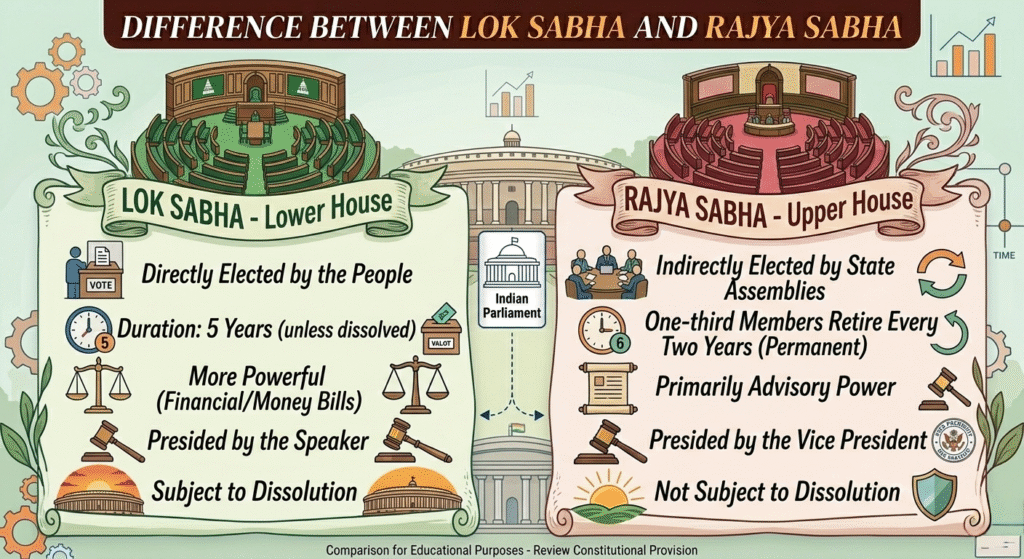
India follows a bicameral legislature, which means the Parliament has two houses. The names Lok Sabha and Rajya Sabha were officially adopted in 1954. The constitutional framework of the Indian Parliament finds its place from Article 79 to Article 122 of the Constitution of India. Although both houses work together, they differ in composition, powers, and roles.
Detailed Comparison: Lok Sabha and Rajya Sabha
| Basis of Comparison | Lok Sabha | Rajya Sabha |
| Definition | Lok Sabha works as the lower house, or House of the People, where elected representatives directly participate in lawmaking. | Rajya Sabha works as the upper house, or Council of States, that protects the interests of states. |
| Constitutional Provision | Article 81 explains the composition of Lok Sabha. | Article 80 explains the composition of the Rajya Sabha. |
| Tenure | Lok Sabha continues for five years unless dissolved earlier. | Rajya Sabha works as a permanent house and never dissolves. |
| Election Method | Citizens elect members directly through voting. | State legislative assembly members elect representatives. |
| Election Principle | Universal adult franchise applies. | Proportional representation with a single transferable vote applies. |
| Strength | Strength ranges from 500 to 552; currently, there are 543 members. | Strength ranges from 200 to 250; currently, 245 members. |
| Minimum Age | A member must complete 25 years. | A member must complete 30 years. |
| Presiding Officer | The Speaker of the Lok Sabha conducts proceedings. | The vice-president acts as chairman. |
| Role in Law-Making | Lok Sabha holds stronger powers, especially over Money Bills. | Rajya Sabha reviews, suggests, and safeguards state interests. |
Lok Sabha and Its Functions
Lok Sabha stands as the House of the People and represents the democratic will of Indian citizens. Voters directly elect its members through general elections held every five years. The seventeenth Lok Sabha election took place in 2019. Through debates, discussions, and decisions, Lok Sabha ensures transparency and accountability in governance. Financial control remains one of its strongest powers.
Functions of Lok Sabha
1. Legislative Role
Lok Sabha actively participates in making, amending, and repealing laws. It debates bills, discusses national issues, and approves legislation. When disagreements arise between Lok Sabha and Rajya Sabha, the President can call a joint sitting under Article 108, where Lok Sabha holds numerical strength and influence.
2. Financial Authority
Lok Sabha enjoys special powers over financial matters. Members introduce Money Bills only in Lok Sabha. After passing the bill, Lok Sabha sends it to Rajya Sabha for recommendations. Rajya Sabha must return the bill within 14 days. Lok Sabha can accept or reject those suggestions without obligation.
3. Composition and Elections
Article 81 sets the strength and composition of Lok Sabha. Members elect the Speaker, who maintains discipline and conducts proceedings. Lok Sabha directly reflects public opinion because citizens choose their representatives.
4. Public Accountability
Lok Sabha members raise questions, debate policies, and examine government actions. These discussions help maintain checks and balances. Lok Sabha keeps the executive answerable to the people.
Lok Sabha and Its Functions
Lok Sabha stands as the House of the People and represents the democratic will of Indian citizens. Voters directly elect its members through general elections held every five years. The seventeenth Lok Sabha election took place in 2019. Through debates, discussions, and decisions, Lok Sabha ensures transparency and accountability in governance. Financial control remains one of its strongest powers.
Functions of Lok Sabha
1. Legislative Role
Lok Sabha actively participates in making, amending, and repealing laws. It debates bills, discusses national issues, and approves legislation. When disagreements arise between Lok Sabha and Rajya Sabha, the President can call a joint sitting under Article 108, where Lok Sabha holds numerical strength and influence.
2. Financial Authority
Lok Sabha enjoys special powers over financial matters. Members introduce Money Bills only in Lok Sabha. After passing the bill, Lok Sabha sends it to Rajya Sabha for recommendations. Rajya Sabha must return the bill within 14 days. Lok Sabha can accept or reject those suggestions without obligation.
3. Composition and Elections
Article 81 sets the strength and composition of Lok Sabha. Members elect the Speaker, who maintains discipline and conducts proceedings. Lok Sabha directly reflects public opinion because citizens choose their representatives.
4. Public Accountability
Lok Sabha members raise questions, debate policies, and examine government actions. These discussions help maintain checks and balances. Lok Sabha keeps the executive answerable to the people.
Miscellaneous Functions of Lok Sabha and Rajya Sabha
Lok Sabha and Rajya Sabha jointly perform several constitutional duties. Both houses amend the Constitution. Both houses participate in removing judges of the Supreme Court and High Courts. Lok Sabha must approve actions related to the vice-president even when Rajya Sabha initiates them. Together, Lok Sabha and Rajya Sabha maintain democratic balance and constitutional stability.
Conclusion
The Difference Between Lok Sabha and the Rajya Sabha clearly shows how Indian democracy balances power. Lok Sabha represents people directly and controls finance and governance. Rajya Sabha protects states and ensures thoughtful lawmaking. While Lok Sabha drives governance, Rajya Sabha refines decisions. Together, Lok Sabha and Rajya Sabha strengthen Parliament and ensure that democracy works smoothly for the nation.
FAQs
Yes, the Rajya Sabha works as a permanent body of the Indian Parliament, and this feature clearly distinguishes Lok Sabha and Rajya Sabha from each other. Rajya Sabha never dissolves, even during political instability or a change of government. Instead, it follows a system of continuity where members serve a six-year term, and one-third of the members retire every two years. This rotation ensures that the house always has experienced members who understand parliamentary procedures deeply. Because of this permanent nature, the Rajya Sabha provides stability to the legislative process and prevents sudden or rushed lawmaking. In the overall structure of Lok Sabha and Rajya Sabha, this permanence allows Rajya Sabha to act as a reviewing and revising chamber that carefully examines bills passed by Lok Sabha.
Lok Sabha functions as a temporary house with a normal tenure of five years. After completing its term, the Lok Sabha dissolves, and fresh general elections take place so that people can elect new representatives. However, the Lok Sabha may also dissolve earlier if the government loses majority support or under exceptional political circumstances. This temporary nature keeps Lok Sabha closely connected to public opinion because citizens regularly get the chance to change their representatives. In the framework of Lok Sabha and Rajya Sabha, this feature ensures democratic accountability, as the Lok Sabha directly reflects the will of the people at a given time.
Lok Sabha holds exclusive and dominant power when it comes to money bills, which highlights an important difference. Only the Lok Sabha can introduce money bills, and the Rajya Sabha cannot reject or amend them. Rajya Sabha can only make recommendations and must return the bill within 14 days. Even then, the Lok Sabha can choose whether to accept or ignore those suggestions. If the Rajya Sabha fails to return the bill within the stipulated time, the bill automatically becomes law. This special power ensures that financial control remains with the directly elected house, reinforcing the principle that public money should be handled by representatives chosen by the people.
The head of Lok Sabha is the Speaker, who plays a crucial role in the smooth functioning of the house. The Speaker presides over debates, maintains discipline, decides who can speak, and ensures that parliamentary rules are followed. During joint sittings of Lok Sabha and Rajya Sabha, the Speaker of Lok Sabha presides over the session, which further highlights the stronger position of Lok Sabha in legislative matters. In the working relationship between Lok Sabha and the Rajya Sabha, the Speaker acts as a neutral authority who safeguards democratic procedures and protects the rights of all members, irrespective of party affiliation.

Behind every article at SPM IAS Academy is a team of skilled content writers and subject experts committed to making preparation easier for aspirants. From answering common doubts to breaking down complex issues and current affairs, we create content that is accurate, easy to understand, and directly useful for UPSC, APSC, and other competitive exams.