India’s Strategic Petroleum Reserves (SPRs) are currently only 64% full (data presented in Rajya Sabha on 23 March, 2026), holding 3.37 million metric tonnes out of a total capacity of 5.33 million metric tonnes. This means the country’s actual emergency oil buffer stands well below the maximum coverage of 9.5 days. With India importing over 88% of its crude oil needs, this development carries major implications for energy security, economic stability, and national security – all key themes for UPSC, APSC, and other State PCS examinations.
What Are Strategic Petroleum Reserves (SPRs)?
Strategic Petroleum Reserves, commonly known as SPRs, are government-owned emergency stockpiles of crude oil. Countries build these reserves to protect themselves from sudden supply disruptions, geopolitical shocks or sharp price spikes in the global oil market.
Think of SPRs as a country’s emergency fuel bank. When a war breaks out in an oil-producing region or when a supply route gets blocked, the government can draw from these reserves to keep the economy running smoothly.
For UPSC, APSC, and State PCS aspirants, SPRs are an important topic under the Indian Economy, Energy Security, and Internal Security sections of the General Studies syllabus.
If you are preparing for civil services, explore the best online upsc coaching for beginners for structured guidance and expert mentorship.
Where Does India Store Its Strategic Petroleum Reserves?
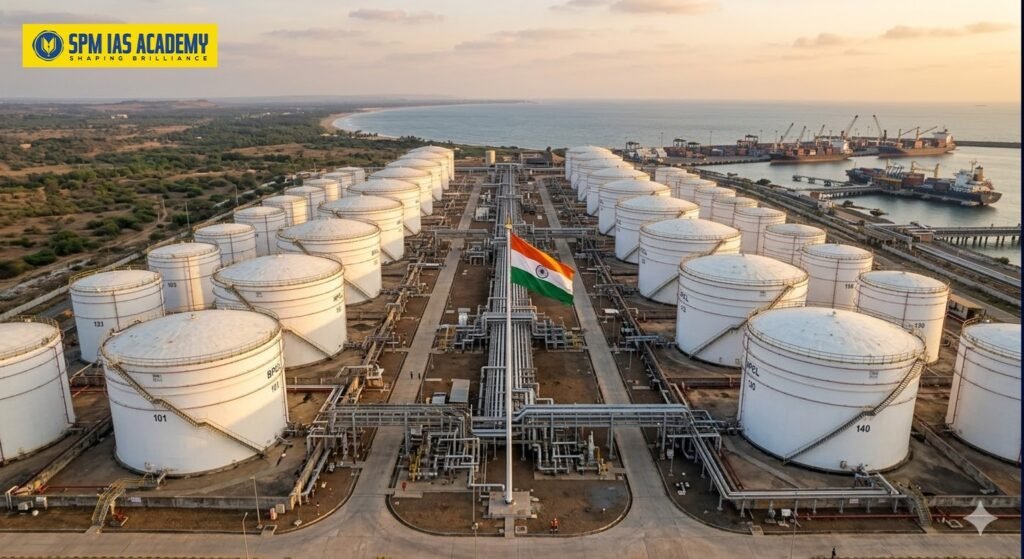
India stores its strategic crude oil in underground rock caverns. These facilities are located at three sites:
- Visakhapatnam, Andhra Pradesh – Capacity: 1.33 million metric tonnes
- Mangaluru, Karnataka – Capacity: 1.50 million metric tonnes
- Padur, Karnataka – Capacity: 2.50 million metric tonnes
The Indian Strategic Petroleum Reserves Limited (ISPRL), set up on June 16, 2004, manages these facilities. Moreover, the SPR programme itself received government approval on January 7, 2004.
India’s Oil Security Data: Key Facts
The following table presents the most important data points related to India’s oil security.
| Indicator | Data / Figure |
| Total SPR Storage Capacity | 5.33 million metric tonnes |
| Current Oil Stock in SPR | 3.37 million metric tonnes |
| Current Utilisation Rate | 64% |
| Coverage at Full SPR Capacity | 9.5 days |
| Total Oil Stock (including commercial) | 74 days |
| IEA Recommended Level | 90 days |
| India’s Import Dependency on Crude Oil | 88% |
| SPR Locations | Visakhapatnam, Mangaluru, Padur |
| Approved Expansion Capacity | 6.5 million metric tonnes |
Current Situation: Why Is One-Third of India’s SPR Empty?
According to data presented in the Rajya Sabha on March 23, 2026, India currently holds approximately 3.372 million metric tonnes of crude oil in its strategic reserves. This is only 64% of its total storage capacity of 5.33 million metric tonnes.
Therefore, the effective oil buffer is significantly less than the maximum of 9.5 days. In practical terms, India’s strategic reserves can cover even fewer days of demand at the current stock level.
Furthermore, India’s total oil stock including both strategic and commercial reserves stands at around 74 days. However, this figure is still below the International Energy Agency (IEA) recommended level of 90 days.
Stay updated with daily current affairs to better understand evolving issues related to India’s energy security.
Why Does This Gap Matter for India’s Energy Security?
This shortfall matters for several important reasons.
- First, India imports over 88% of its crude oil requirements. This high import dependency makes the country extremely vulnerable to external supply shocks.
- Second, a significant portion of India’s crude oil comes from West Asia — the Middle East region. The ongoing conflict in West Asia has already caused volatility in global crude oil prices.
- Third, and most critically, global oil trade passes through the Strait of Hormuz – a narrow waterway between Iran and Oman. Any blockade or disruption at this chokepoint could immediately affect India’s oil supply. Because India’s SPRs are only partially filled, the country has a smaller buffer to absorb such a shock.
West Asia Conflict and India’s Oil Import Risk
The escalating tensions in West Asia directly threaten India’s energy security. India depends heavily on countries such as Iraq, Saudi Arabia, the UAE, and Kuwait for its crude oil imports.
A disruption in this region could cause a rapid rise in oil prices. Moreover, if supply routes are blocked – particularly the Strait of Hormuz, India would need to rely immediately on its strategic reserves.
Given that these reserves currently cover fewer than 9.5 days at full capacity, and less than that at the current stock level, India’s vulnerability is considerable.
India’s Strategic Petroleum Reserves (SPR) Expansion Plan: What Has the Government Approved?
The Government of India took a forward-looking step in July 2021 by approving an expansion of the SPR network. Two new facilities are planned:
- Chandikhol, Odisha – Planned capacity: 4 million metric tonnes
- Additional capacity at Padur, Karnataka – Planned capacity: 2.5 million metric tonnes
Together, these two sites will add 6.5 million metric tonnes of additional storage capacity. The government proposes to develop these facilities under a Public-Private Partnership (PPP) model.
However, neither of these expansion projects has become operational yet. Until they do, India’s strategic oil buffer remains limited.
How Does India Compare with Global Standards?
The IEA recommends that countries maintain at least 90 days of oil import coverage. India’s total oil stock, including commercial reserves, currently provides about 74 days of coverage. This places India below the global benchmark by a margin of 16 days.
Countries like the United States, Japan, South Korea, and Germany maintain reserves that meet or exceed the 90-day IEA standard. India’s gap, therefore, reflects both an infrastructure challenge and a policy priority for the coming years.
What Should India Do? – Key Policy Recommendations
A well-rounded answer in UPSC Mains or State PCS requires you to suggest solutions, not just describe the problem. Here are the key policy directions:
- Fill existing SPR capacity urgently – The government should prioritise purchasing crude oil at current market rates to bring utilisation from 64% to 100%.
- Accelerate expansion projects – The Chandikhol and Padur expansion facilities should move toward implementation without further delay.
- Diversify oil import sources – India must reduce dependence on West Asian suppliers by importing more from the United States, Russia, and African nations.
- Invest in renewable energy – Reducing oil dependency through solar, wind, and green hydrogen can lower the strategic risk over the long term.
- Adopt the IEA standard – India should set a clear policy target to achieve 90 days of oil coverage, including both strategic and commercial stocks.
Conclusion:
India’s strategic petroleum reserves face a significant gap. With only 64% utilisation of its 5.33 million metric tonne capacity, the country holds fewer than 9.5 days of crude oil coverage. Combined with an 88% import dependency and ongoing tensions in West Asia – particularly around the Strait of Hormuz – India’s energy security vulnerabilities are real and pressing.
The government’s plan to expand SPR capacity by 6.5 million metric tonnes through new facilities at Chandikhol and Padur is a positive step. However, until these projects become operational, India must urgently fill its existing reserves and work toward meeting the IEA’s 90-day benchmark.
Source:
Frequently Asked Questions:
Strategic Petroleum Reserves (SPR) are emergency crude oil stockpiles maintained by the government to handle supply disruptions and price shocks. They act as a backup fuel system during crises. Therefore, SPRs play a key role in strengthening India’s energy security.
India’s total SPR capacity stands at 5.33 million metric tonnes, while current storage is about 3.37 million metric
tonnes, which is around 64% utilisation. As a result, the country’s emergency oil buffer remains below its full potential.
India stores its SPRs in underground rock caverns at Visakhapatnam (Andhra Pradesh), Mangaluru (Karnataka), and Padur (Karnataka). These locations ensure safe and secure storage of crude oil. Moreover, they are strategically placed near coastal areas for easy access.
India depends on imports for over 88% of its crude oil needs, which increases vulnerability to global supply disruptions. Therefore, SPRs help maintain economic stability during crises such as geopolitical conflicts or supply shocks.
The International Energy Agency recommends maintaining 90 days of oil reserves. However, India currently has about 74 days of total oil coverage, including commercial reserves. Hence, India still needs to expand its reserves to meet global standards.