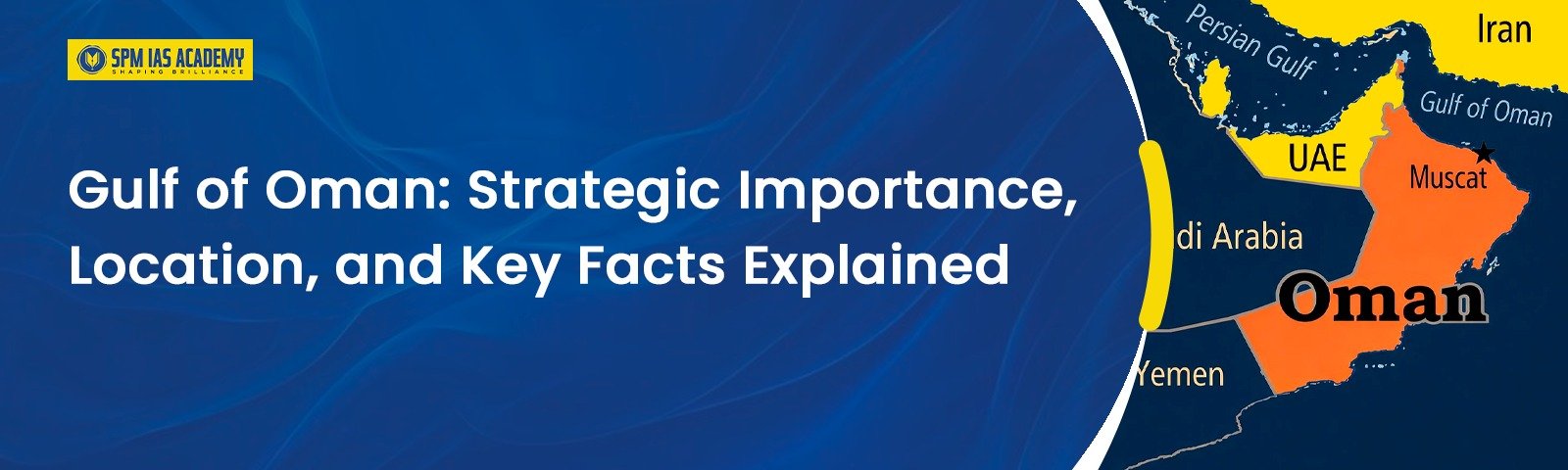
The Gulf of Oman is one of the most strategically important water bodies in the world. It connects the Arabian Sea to the Persian Gulf through the Strait of Hormuz – the world’s most critical oil chokepoint. For UPSC, APSC, Arunachal Pradesh PCS, and other State PCS exams, understanding this region is essential.
Serious aspirants can strengthen preparation with expert guidance through UPSC coaching in Assam at SPM IAS Academy.
What Is the Gulf of Oman?
The Gulf of Oman is a semi-enclosed sea located in the northwestern part of the Arabian Sea. It acts as the most important maritime gateway between the Middle East and the rest of the world. Simply put, it is the body of water that connects the Persian Gulf to the open ocean.
Furthermore, the Gulf of Oman plays a central role in global energy security. Almost 20% of the world’s oil passes through this body of water every single day. Therefore, any disruption here affects oil prices, global trade, and international relations directly.
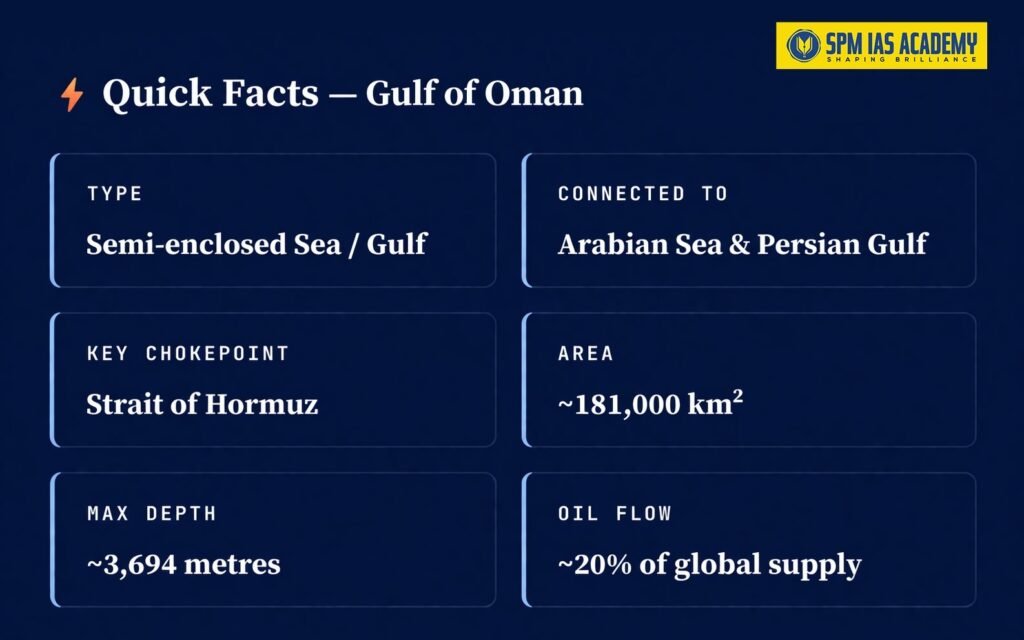
Location and Geography of the Gulf of Oman
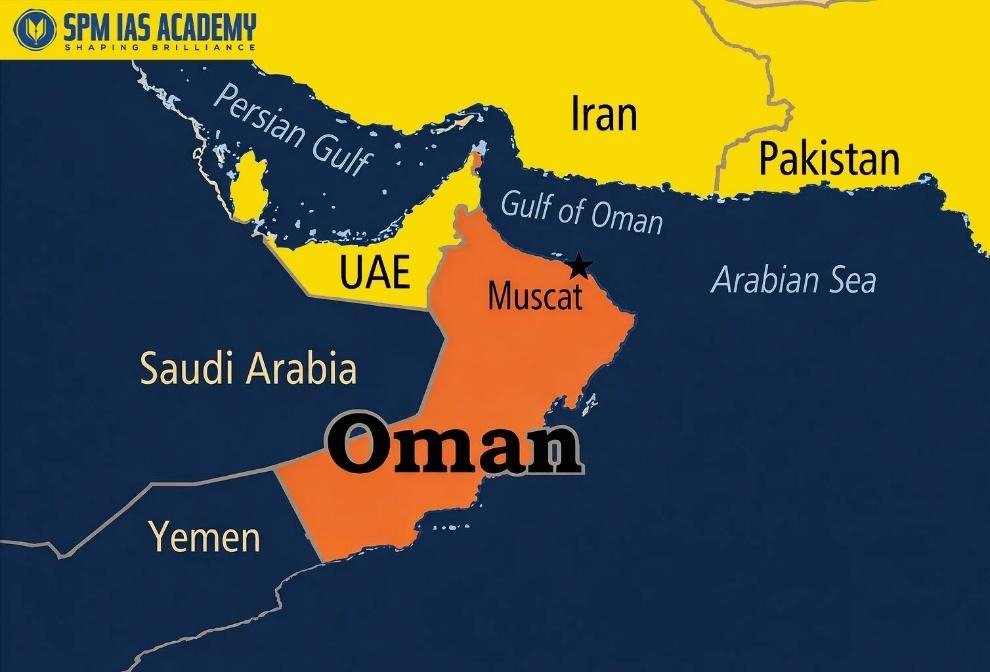
The Gulf of Oman lies to the northeast of the Arabian Peninsula and to the south of Iran. It extends from the Strait of Hormuz in the northwest to the Gulf of Masirah in the southeast, where it merges into the Arabian Sea.
Geographical Coordinates
The Gulf of Oman sits approximately between 22°N to 26°N latitude and 56°E to 65°E longitude. This position makes it a vital part of the Indian Ocean Region (IOR), which is a key focus area in UPSC Geography and International Relations.
Size and Dimensions
The gulf stretches about 560 kilometres in length and is roughly 320 kilometres wide. Its total surface area is approximately 181,000 square kilometres. Moreover, the maximum depth of the Gulf of Oman reaches about 3,694 metres, making it significantly deep compared to the Persian Gulf, which is relatively shallow.
The Gulf of Oman is much deeper than the Persian Gulf. The Persian Gulf has an average depth of only about 50 metres, while the Gulf of Oman can go as deep as 3,694 metres. This fact often appears in UPSC Prelims questions.
Bordering Countries and Coastlines
Three countries directly share a coastline with the Gulf of Oman. Each of them plays an important role in regional geopolitics and India’s foreign policy.
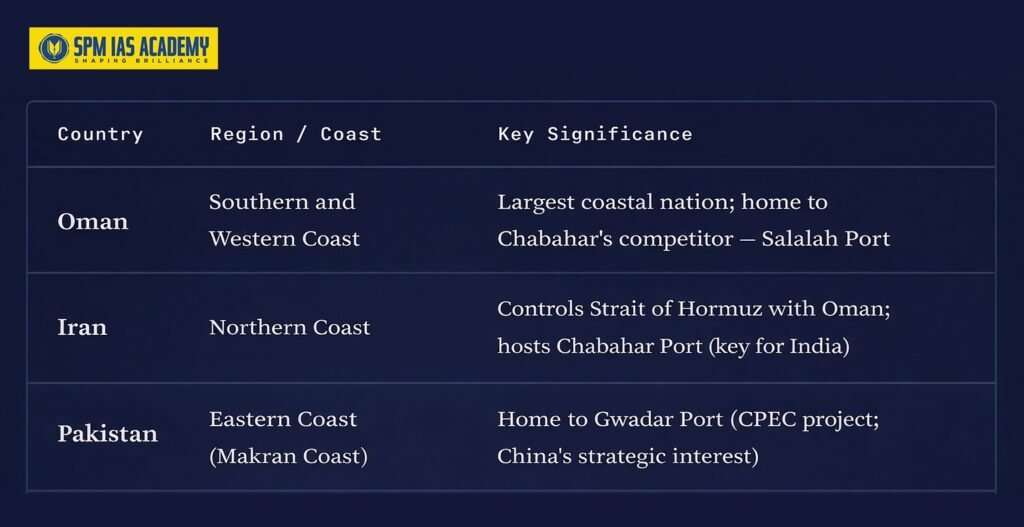
The Makran Coast – A Strategic Stretch
The Makran Coast runs along Pakistan’s southern border on the Gulf of Oman. This coastline is geopolitically sensitive because China has built the Gwadar Port here under the China-Pakistan Economic Corridor (CPEC). This gives China a potential naval presence close to the Gulf’s oil lanes – a major concern for both India and the United States.
Connection to the Strait of Hormuz
The Strait of Hormuz is the narrow passage that links the Gulf of Oman to the Persian Gulf. It is, without doubt, the most important oil chokepoint in the world. At its narrowest point, it is only about 33 kilometres wide.
Why Is the Strait of Hormuz So Important?
Every day, roughly 17-21 million barrels of crude oil pass through the Strait of Hormuz. This represents nearly one-fifth of global petroleum liquids consumption. As a result, both Iran and Oman jointly control this strategic waterway – a fact that gives Iran enormous leverage in global energy markets.
Iran’s Threat to Close the Strait
During periods of tension with the United States or Western nations, Iran has repeatedly threatened to close the Strait of Hormuz. If this happens, it would cause an immediate global oil price shock and widespread repercussions in the global economy.
Strategic and Geopolitical Importance of the Gulf of Oman
The Gulf of Oman is not just a geographical feature. It is a theatre of global power competition. Several major powers, including the USA, China, India, and Russia, have strategic interests in this region. Let us understand each one clearly.
Regularly following current affairs helps aspirants understand geopolitical developments like the Gulf of Oman and Strait of Hormuz.
USA and NATO Naval Presence
The United States maintains a strong naval presence in the Gulf of Oman through its Fifth Fleet, based in Bahrain. Additionally, NATO allies conduct regular patrols here to ensure the free flow of oil. However, tensions with Iran continue to test this presence.
China’s Growing Influence
China uses its Belt and Road Initiative (BRI) to expand influence along the Gulf of Oman coastline. The Gwadar Port in Pakistan is its most visible asset in this area. Consequently, China gains access to the Arabian Sea and Indian Ocean trade lanes, bypassing the Malacca Strait.
Iran’s Strategic Position
Iran controls the northern shore of the Gulf of Oman and one side of the Strait of Hormuz. Therefore, Iran uses this geographical advantage as a diplomatic and military tool. Whenever international sanctions tighten, Iran threatens to disrupt oil flows here.
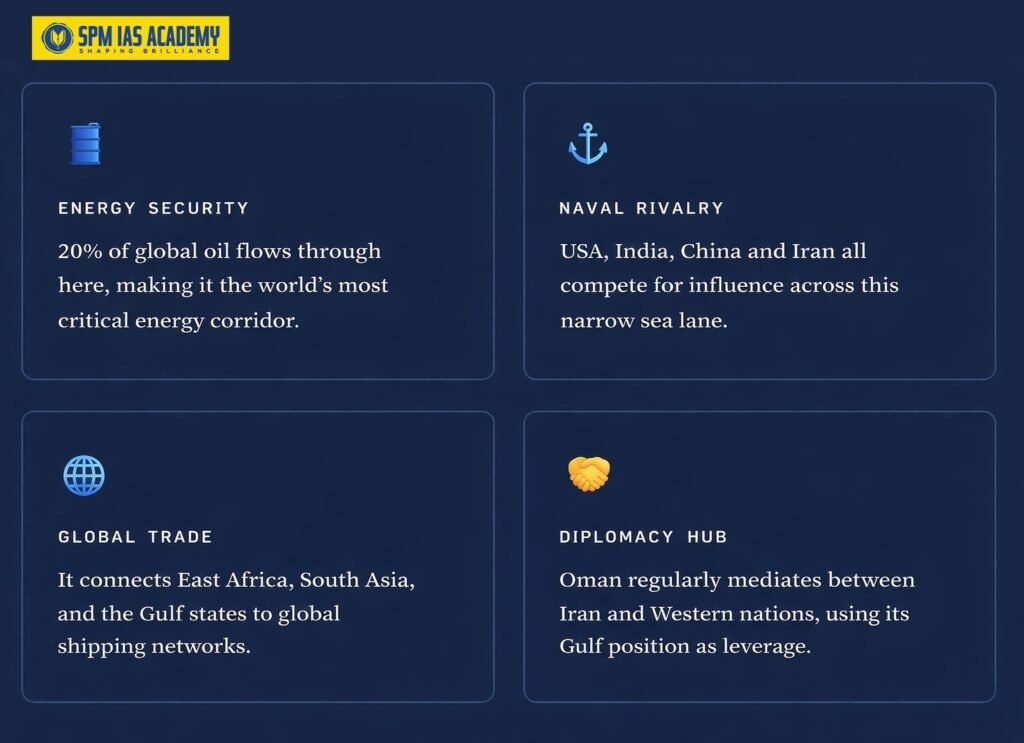
Trade Routes and Energy Significance
The Gulf of Oman forms a crucial part of the global maritime trade network. Both oil tankers and LNG (Liquefied Natural Gas) carriers use it daily. Understanding its trade role helps you answer UPSC Economy and Geography questions with confidence.
Major Ports on the Gulf of Oman
- Chabahar Port (Iran) – India’s gateway to Central Asia and Afghanistan, bypassing Pakistan. India has heavily invested in developing this port.
- Gwadar Port (Pakistan) – China’s strategic port under CPEC. It gives China a warm-water port and access to the Arabian Sea.
- Salalah Port (Oman) – One of the busiest transshipment hubs in the Middle East. It handles large volumes of container traffic.
- Muscat / Port Sultan Qaboos (Oman) – Oman’s main commercial port and a key hub for regional trade.
LNG Exports from Qatar:
Qatar, the world’s largest LNG exporter, exports its gas through the Persian Gulf and then through the Gulf of Oman to reach global markets. Therefore, the Gulf of Oman is not just about oil; it is equally important for natural gas trade.
India’s Interest in the Gulf of Oman:
India has deep economic, strategic, and cultural ties with the Gulf of Oman region. This topic is extremely important for UPSC Mains GS-II (International Relations) and also features in APSC and State PCS exams across Northeast India.
Chabahar Port – India’s Most Important Asset Here
India has invested significantly in developing Chabahar Port in Iran. The Chabahar Port sits on the Gulf of Oman coastline. This port gives India a direct sea route to Afghanistan and Central Asia without depending on Pakistan’s territory. Furthermore, it creates a competing trade route against China’s Gwadar Port, which is just 72 kilometres away.
India-Oman Strategic Partnership
India and Oman share a Comprehensive Strategic Partnership. The two countries conduct regular naval exercises. Additionally, India uses Oman’s ports for naval logistical support. Oman also serves as a neutral diplomatic channel between India and Iran.
Energy Imports Through the Gulf
India imports about 90% of its oil needs. A large share of this oil comes from Gulf countries such as Saudi Arabia, UAE, Iraq, and Kuwait. All of these countries export through the Gulf of Oman. Therefore, any instability in this region directly threatens India’s energy security.
Conclusion:
In conclusion, the Gulf of Oman is not only a vital geographical feature but also a key centre of global trade and energy security. It connects the Arabian Sea with the Persian Gulf through the Strait of Hormuz, making it one of the most important maritime routes in the world.
Moreover, its role in global oil transportation, international trade routes, and geopolitical tensions highlights its growing importance in international relations. At the same time, India’s strategic interests through projects like Chabahar Port further increase its relevance. Therefore, understanding the significance of the Gulf of Oman location is essential for competitive exams.
Source:
Frequently Asked Questions:
The Gulf of Oman is located between Iran, Oman, and Pakistan, connecting the Arabian Sea with the Persian Gulf.
It is important due to its role in global oil transportation, trade routes, and strategic military significance.
The Strait of Hormuz connects the two.
Iran, Pakistan, and Oman border the Gulf of Oman.
The Gulf of Oman is a strategic water body that connects the Arabian Sea to the Persian Gulf. Therefore, it plays a crucial role in global oil trade, energy security, and international shipping routes.
The importance of the Gulf of Oman for India lies in energy security and trade. Moreover, projects like Chabahar Port help India access Central Asia and strengthen strategic influence.

Behind every article at SPM IAS Academy is a team of skilled content writers and subject experts committed to making preparation easier for aspirants. From answering common doubts to breaking down complex issues and current affairs, we create content that is accurate, easy to understand, and directly useful for UPSC, APSC, and other competitive exams.