
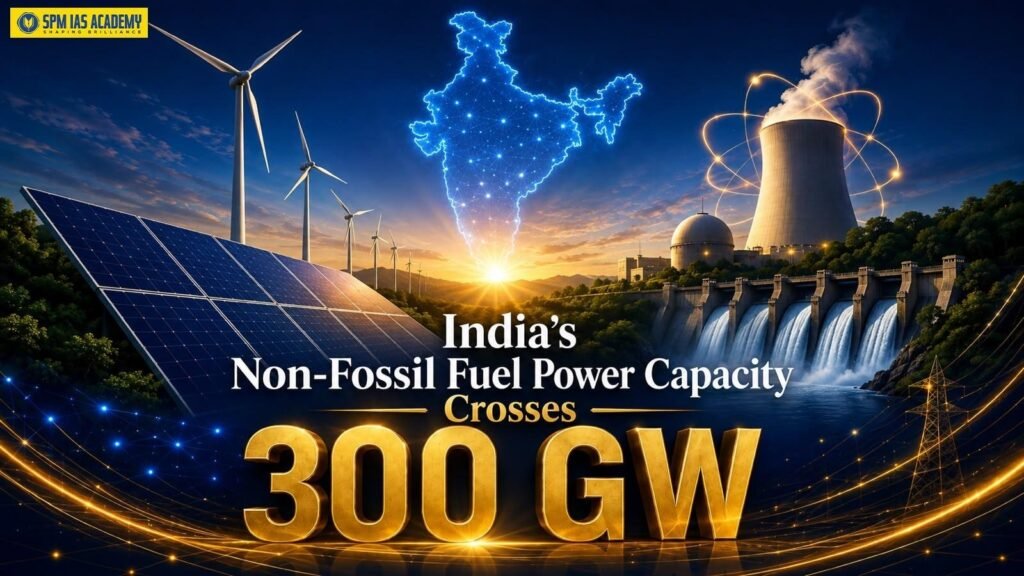
India’s Non-Fossil Fuel Power Capacity crossed the historic 300 GW mark as of 31 July 2026, marking a major milestone in the country’s clean energy transition. According to the Ministry of New and Renewable Energy, India reached 300.50 GW of non-fossil fuel-based installed electricity generation capacity.
For UPSC, APSC and other State PCS aspirants, this topic is important under GS III – Energy, Environment, Climate Change, Infrastructure, Green Economy, Renewable Energy and Sustainable Development.
India’s Non-Fossil Fuel Power Capacity: Why is it in News?
India’s Non-Fossil Fuel Power Capacity is in news because India has crossed 300 GW of non-fossil installed electricity capacity. This achievement shows India’s rapid progress towards its climate action goals and clean energy commitments. It also strengthens India’s vision of building an Aatmanirbhar energy ecosystem.
At present, India’s total installed electricity generation capacity is around 552 GW. Out of this, non-fossil fuel electricity capacity has reached over 54%. Therefore, India has already moved a major part of its power capacity away from fossil fuels.
India’s Non-Fossil Fuel Power Capacity: Latest Breakdown
The latest data shows that solar power leads India’s non-fossil energy basket. Wind, hydro, bio-power and nuclear energy also contribute significantly.
| Source | Installed Capacity as on 31 July 2026 |
| Solar Power | 164.59 GW |
| Wind Power | 58.14 GW |
| Hydro Power — Large and Small | 57.24 GW |
| Bio-power | 11.75 GW |
| Nuclear Power | 8.78 GW |
| Total Non-Fossil Capacity | 300.50 GW |
This data shows that India’s Non-Fossil Fuel Power Capacity now has a diversified base. However, solar power remains the strongest growth engine.
Solar and Wind Power Drive India’s Clean Energy Growth
- Solar energy has played the biggest role in expanding India’s Non-Fossil Fuel Power Capacity. India’s solar capacity has grown from just 2.8 GW in 2014 to around 165 GW in 2026. This sharp rise shows the impact of policy support, falling technology costs, solar parks, rooftop solar initiatives and domestic manufacturing.
- Moreover, wind power has also shown strong growth. India’s wind energy capacity increased from 21 GW in 2014 to over 58 GW in 2026. Together, solar and wind power have strengthened India’s renewable energy transition and reduced dependence on fossil-based electricity.
Record Addition in Non-Fossil Fuel Capacity During 2025–26
- India added a record 55.29 GW of non-fossil fuel-based electricity capacity during 2025–26.
- Solar power contributed 44.6 GW, while wind power added 6 GW. This record addition shows that India is not only setting targets but also building capacity at scale.
- In addition, renewable energy generation has increased sharply. It rose from 190.96 billion units in 2014–15 to 477.79 billion units in 2025–26.
Therefore, India’s clean energy transition reflects both capacity expansion and higher electricity generation from renewable sources.
India’s Non-Fossil Fuel Power Capacity and the 500 GW Target by 2030
- India has set a target of achieving 500 GW non-fossil fuel-based electricity capacity by 2030.
- By crossing 300 GW, India has already achieved more than 60% of this target. This progress matters because energy transition remains central to India’s climate commitments, economic resilience and energy security.
- However, India must maintain high annual capacity addition to reach the 2030 target. It must also expand grid infrastructure, storage systems, green corridors, battery manufacturing and transmission capacity. Without these supporting systems, installed capacity may not fully translate into reliable clean power supply.
Green Hydrogen and Industrial Decarbonisation
The Ministry of New and Renewable Energy is also pushing deep industrial decarbonisation through the National Green Hydrogen Mission. India aims to become a global hub for the production, use and export of Green Hydrogen and its derivatives.
This step is important because sectors such as steel, fertilisers, shipping and heavy transport are difficult to decarbonise through electricity alone. Green Hydrogen can help India reduce emissions in these hard-to-abate sectors.
Challenges Ahead for India’s Clean Energy Transition
Although India has made strong progress, it still faces some challenges.
- First, renewable energy needs better grid integration.
- Second, solar and wind power require storage because they depend on weather conditions.
- Third, India must improve domestic supply chains for solar cells, batteries and critical minerals.
- Moreover, distribution companies must become financially stronger to purchase and distribute clean electricity efficiently.
Therefore, India needs a balanced strategy that combines renewable capacity, storage, transmission, domestic manufacturing and policy stability.
Conclusion
India’s Non-Fossil Fuel Power Capacity crossing 300 GW marks a major step in India’s clean energy journey. It shows that India is moving steadily towards its 500 GW non-fossil capacity target by 2030. Moreover, the rise of solar power, wind energy, domestic solar manufacturing and Green Hydrogen reflects India’s broader vision of energy independence, industrial competitiveness and climate responsibility. For UPSC, APSC and other State PCS aspirants, India’s Non-Fossil Fuel Power Capacity is a high-value topic for energy security, environment, economy and governance-related answers.
Read More:
FAQs
India’s Non-Fossil Fuel Power Capacity reached 300.50 GW as of 31 July 2026. Solar power contributes the largest share, followed by wind, hydropower, bio-power and nuclear energy. Moreover, non-fossil sources now account for more than half of India’s total installed electricity generation capacity.
India has already achieved more than 60% of its 500 GW non-fossil fuel capacity target for 2030 by crossing the 300 GW mark. However, India must continue adding renewable capacity at a strong pace. In addition, it needs better energy storage, transmission networks and grid infrastructure to support further expansion.

Behind every article at SPM IAS Academy is a team of skilled content writers and subject experts committed to making preparation easier for aspirants. From answering common doubts to breaking down complex issues and current affairs, we create content that is accurate, easy to understand, and directly useful for UPSC, APSC, and other competitive exams.