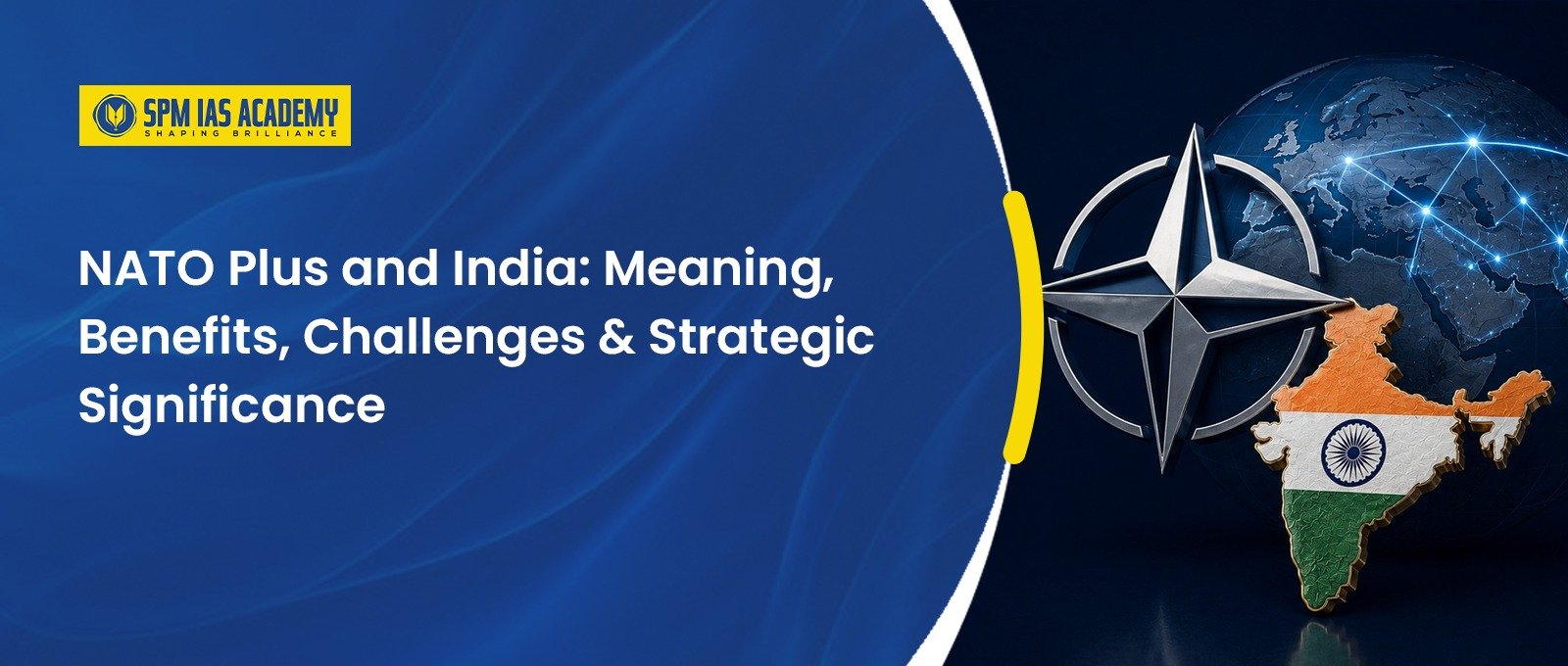
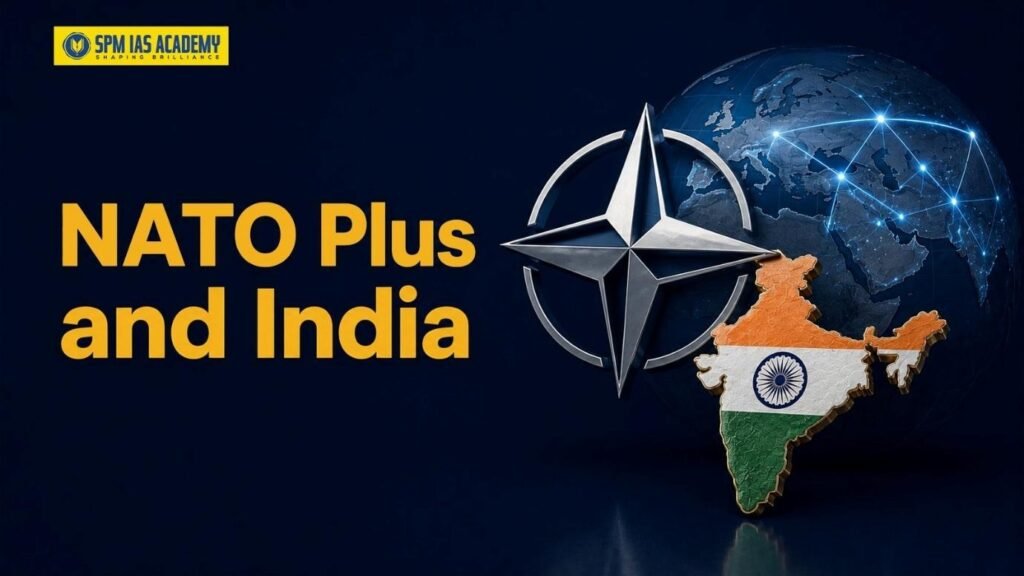
The debate around NATO Plus and India has gained attention as global security increasingly focuses on the Indo-Pacific, emerging technologies, cyber threats and strategic competition. However, aspirants must first understand an important distinction that is – NATO Plus is not the same as NATO membership.
What is NATO Plus?
- NATO Plus generally refers to a proposed framework that would expand security cooperation between NATO and selected non-member countries. The term has gained prominence particularly in discussions involving countries such as Australia, Japan, New Zealand and South Korea. These countries already have a close cooperation with NATO.
- NATO itself uses the broader concept of global partners and maintains structured cooperation through different mechanisms. Its Indo-Pacific partners currently include Australia, Japan, the Republic of Korea and New Zealand.
Therefore, NATO Plus and India should be understood primarily as a debate about deeper strategic engagement rather than an existing formal membership arrangement.
What is NATO?
Before we delve into the debate of NATO Plus and India, lets first know about NATO.
- NATO stands for the North Atlantic Treaty Organization. It is a political and military alliance.
- NATO was established in 1949 by the United States, Canada and 10 Western European countries.
- The alliance emerged during the early Cold War. It aimed to provide collective security against potential Soviet aggression.
- The North Atlantic Treaty established the principle of collective defence. Under Article 5, an armed attack against one member is treated as an attack against all.
- Initially, NATO focused on Europe and North America. Its collective defence commitment covered attacks against members in these regions.
Why Was NATO Created?
- After World War II, European countries faced major security challenges. They also struggled to rebuild their economies.
- Meanwhile, tensions with the Soviet Union increased. Events such as the Czechoslovak coup of 1948 and the Berlin Blockade deepened Western security concerns.
- The Marshall Plan also strengthened Western cooperation. It promoted European economic recovery and closer cooperation with the United States.
- Consequently, Western European countries sought collective security. The Brussels Treaty of March 1948 marked an important step towards this arrangement.
- The Vandenberg Resolution of 1948 further supported a US-European security treaty.
Formation of NATO
- Eventually, 12 countries signed the North Atlantic Treaty in 1949. They included the United States, Canada, Belgium, Denmark, France, Iceland, Italy, Luxembourg, the Netherlands, Norway, Portugal and the United Kingdom.
- The alliance later expanded its membership. Greece and Turkey joined in 1952, while West Germany joined in 1955.
- Following West Germany’s entry, the Soviet Union responded by establishing the Warsaw Treaty Organization in 1955.
Members of NATO
- NATO currently has 32 member countries. These members form a collective political and military alliance based on mutual defence.
- The United States and Canada are the two North American members. Meanwhile, the remaining members are European countries.
- The founding members joined NATO in 1949. They included the United States, Canada, Belgium, Denmark, France, Iceland, Italy, Luxembourg, the Netherlands, Norway, Portugal and the United Kingdom.
- Greece and Turkey joined in 1952. Subsequently, West Germany joined in 1955.
- NATO expanded significantly after the Cold War. Several Central and Eastern European countries joined the alliance.
- Sweden became NATO’s 32nd member in 2024. It joined after Finland became the 31st member in 2023.
- Today, NATO includes countries from both sides of the Atlantic. Therefore, the alliance combines European and North American security interests.
- Importantly, India is not a NATO member. However, NATO engages with India on selected regional and security issues.
NATO During the Cold War
- The Korean War accelerated NATO’s military integration. Members strengthened coordination through a centralised defence structure.
- Moreover, NATO developed nuclear deterrence strategies. The early doctrine of “massive retaliation” relied on the threat of a large-scale nuclear response.
- Therefore, NATO became a key pillar of Western security during the Cold War.
NATO After the Cold War
- NATO survived the end of the Cold War. It subsequently expanded its membership to include several former Soviet-aligned states.
- Today, NATO has 32 members. It remains one of the world’s largest political and military alliances.
- Furthermore, NATO maintains partnerships and consultations with non-member countries. These arrangements cover areas such as regional security and cooperation.
India and NATO
- India is not a NATO member. It also does not have a formal bilateral NATO partnership programme.
- However, NATO engages with India on regional security issues. Therefore, India-NATO relations remain relevant to discussions on the Indo-Pacific, maritime security, terrorism and emerging security challenges.
NATO Plus and India: What is India’s Current Relationship with NATO?
- India does not have a formal NATO partnership comparable to NATO’s Indo-Pacific partners. However, NATO states that it consults non-member countries including India, China, Brazil and Singapore on particular regional security dynamics.
- At the same time, India maintains extensive bilateral and multilateral defence relationships with several NATO members, particularly the United States, France, Germany and the United Kingdom.
Consequently, India can deepen cooperation with individual NATO members without becoming part of the alliance.
Why is NATO Plus and India Important?
The debate around NATO Plus and India has strategic relevance because India’s security environment increasingly extends beyond its immediate neighbourhood.
- Indo-Pacific Security: India plays an important role in the Indo-Pacific, particularly through initiatives such as the Quad and its maritime-security approach. NATO has also increased engagement with Indo-Pacific partners because developments in the region can affect Euro-Atlantic security.
- Maritime Security: Greater cooperation could potentially support information sharing, maritime domain awareness, counter-piracy operations and protection of critical sea lanes. This could complement India’s SAGAR (Security and Growth for All in the Region) vision.
- Cybersecurity and Emerging Technologies: NATO increasingly works with partners on cross-cutting challenges including cyber defence, counter-terrorism, resilience and emerging technologies. For India, cooperation in areas such as artificial intelligence, cybersecurity, space and critical technologies could strengthen national resilience.
- Defence Technology: Closer engagement could provide opportunities for technology cooperation, interoperability and defence-capability development. However, India would need to assess such cooperation against its strategic-autonomy objectives.
What Are the Challenges for India?
Despite potential benefits, NATO Plus and India also raise several concerns.
- Strategic Autonomy: India has traditionally followed a policy of strategic autonomy. Formal alignment with a military alliance could restrict India’s ability to independently respond to geopolitical crises.
- Relations with Russia: India maintains significant defence and strategic ties with Russia. A closer institutional association with NATO could complicate this relationship.
- China Factor: NATO’s growing Indo-Pacific engagement partly reflects concerns about changing global power dynamics and China’s rise. India, however, must balance its China-related security concerns with the need to maintain strategic space for independent diplomacy.
- Alliance Commitments: NATO membership involves collective-defence obligations under Article 5. India would need to carefully distinguish between cooperation, partnership and formal alliance commitments.
NATO Plus and India: Should India Join?
- India’s approach should focus on issue-based cooperation rather than automatic alignment.
- India can cooperate with NATO countries on areas such as maritime security, cyber defence, counter-terrorism, critical technologies, disaster resilience and defence interoperability while maintaining strategic autonomy.
- Moreover, India’s existing platforms such as the Quad, G20, BRICS, SCO and bilateral defence partnerships provide additional avenues for pursuing its national interests.
Therefore, the question is not simply whether India should “join NATO Plus”. Instead, India should evaluate where deeper cooperation advances its strategic interests without compromising independent foreign-policy choices.
Conclusion
The discussion on NATO Plus and India reflects the changing nature of global security cooperation. While deeper engagement could provide benefits in technology, maritime security and cybersecurity, India must carefully balance these opportunities with strategic autonomy, existing partnerships and national interests.
Rather than choosing between complete alignment and disengagement, India can pursue flexible, issue-based cooperation with NATO members while continuing to strengthen its independent role in the emerging multipolar world. India can cooperate more closely with NATO countries without necessarily becoming part of a formal NATO alliance structure.
Read More:
Source:
Frequently asked question
1. What is NATO Plus and how is it different from NATO membership?
NATO Plus refers to deeper security cooperation between NATO and selected non-member countries. However, it does not mean full NATO membership or automatic Article 5 commitments.
2. Why is NATO Plus and India important?
NATO Plus and India discussions matter because deeper cooperation could strengthen maritime security, cybersecurity, defence technology and counter-terrorism. Moreover, it could support India’s interests in the Indo-Pacific.
3. Should India join NATO Plus?
India can pursue issue-based cooperation with NATO countries while protecting its strategic autonomy. Therefore, India should assess cooperation based on its national interests rather than seek formal alliance commitments.

Behind every article at SPM IAS Academy is a team of skilled content writers and subject experts committed to making preparation easier for aspirants. From answering common doubts to breaking down complex issues and current affairs, we create content that is accurate, easy to understand, and directly useful for UPSC, APSC, and other competitive exams.