
A classical language of India is a language that the Government of India officially recognises for its ancient literary heritage, historical significance, and independent development. As of 2024, India had six officially recognised classical languages: Tamil, Sanskrit, Telugu, Kannada, Malayalam, and Odia. In October 2024, the Union Cabinet approved the addition of Marathi, Pali, Prakrit, Assamese, and Bengali as classical languages, taking the total to eleven. This topic is extremely important for UPSC, APSC, APPSC, and all state PCS exams, as questions on classical languages of India appear regularly in prelims and mains.
Explore the best online upsc coaching for beginners to build strong fundamentals and crack exams confidently.
This article explains the full list of classical languages of India, the criteria for recognition, the benefits given to classical languages, and all exam-relevant facts in simple and easy language.
What Is a Classical Language of India?
A classical language is a language with a very long recorded history, a rich and ancient body of literature, and an independent origin that is not borrowed from another language. The Government of India introduced the concept of granting classical language status in 2004, when Tamil became the first language to receive this recognition. Since then, the government has recognised several more languages under this category based on specific criteria.
Furthermore, a classical language is different from a scheduled language. The Eighth Schedule of the Indian Constitution lists the officially recognised languages of India. However, classical language status is a separate government recognition that highlights the ancient heritage of specific languages. Therefore, aspirants must not confuse classical languages with scheduled languages when answering exam questions.
Criteria for Classical Language Status in India
The Linguistic Experts Committee, set up under the Ministry of Culture, determines whether a language qualifies for classical status. The committee uses the following criteria to evaluate a language:
- High antiquity: The language must have a recorded history of at least 1,500 to 2,000 years. The language should have ancient texts and inscriptions that document its early use.
- Ancient body of literature: The language must have a rich and valuable body of ancient literature that scholars and speakers consider a heritage of great importance.
- Original and independent literary tradition: The literary tradition of the language must be original. It should not be borrowed from another language community.
- Distinct from modern form: The classical form of the language may be discontinuous from its present spoken or written form, meaning the ancient and modern versions of the language can be significantly different.
These criteria ensure that only languages with genuine ancient heritage and literary significance receive classical status. Consequently, this recognition carries both cultural prestige and practical benefits.
Full List of Classical Languages of India: How Many Are There?
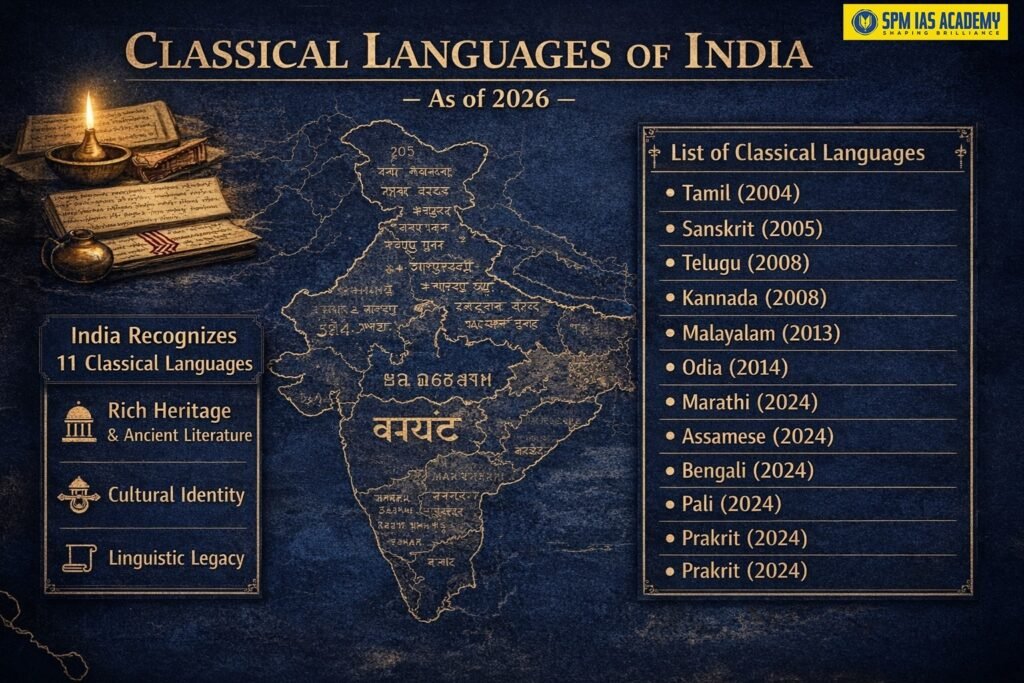
India now recognises eleven classical languages in total. The Union Cabinet approved the latest additions – Marathi, Pali, Prakrit, Assamese, and Bengali in October 2024. Here is the complete and updated list of classical languages of India with their year of recognition:
- Tamil – 2004 (first language to receive classical status)
- Sanskrit – 2005
- Telugu – 2008
- Kannada – 2008
- Malayalam – 2013
- Odia – 2014
- Marathi – 2024
- Pali – 2024
- Prakrit – 2024
- Assamese – 2024
- Bengali – 2024
It is important to note that Tamil holds the distinction of being the first classical language of India.
Brief Profile of Each Classical Language of India
Tamil: The Oldest Classical Language of India
Tamil is widely considered the oldest living classical language in the world. It has a literary tradition spanning over 2,000 years. The Sangam literature, composed between 300 BCE and 300 CE, forms the foundation of Tamil classical writing. Tamil is primarily spoken in Tamil Nadu and Sri Lanka. The Government of India recognised Tamil as the first classical language in 2004.
Sanskrit: The Sacred Classical Language of Ancient India
Sanskrit is one of the oldest languages in the world and the language of the Vedas, Upanishads, Mahabharata, Ramayana, and many classical texts. It has profoundly influenced most Indian languages and several Southeast Asian languages. The Constitution of India includes Sanskrit in the Eighth Schedule. The government recognised Sanskrit as a classical language in 2005.
Telugu and Kannada: Classical Languages of South India
Telugu and Kannada both received classical language status in 2008. Telugu, primarily spoken in Andhra Pradesh and Telangana, has a literary history of over 1,000 years. Nannaya, who lived in the 11th century, is considered the first poet of Telugu literature. Kannada, spoken mainly in Karnataka, also has a recorded literary history of over 1,500 years. The Kavirajamarga, composed in the 9th century CE, is one of the oldest known works in Kannada.
Malayalam and Odia: Later Additions to the Classical List
Malayalam, spoken in Kerala, received classical status in 2013. It has a literary tradition going back to the 13th century CE, with the Ramacharitam considered one of its oldest texts. Odia, spoken in Odisha, received classical language status in 2014. It became the sixth classical language of India. The Odia script is one of the oldest scripts in eastern India, and Sarala Das’s Odia Mahabharata is one of its most celebrated early works.
Marathi, Pali, Prakrit, Assamese and Bengali: The 2024 Additions
In October 2024, the Union Cabinet approved classical status for five more languages. Marathi has a literary tradition of over 1,000 years and is spoken primarily in Maharashtra. Pali is the sacred language of Theravada Buddhism and carries immense religious and historical importance. Prakrit is a group of ancient Middle Indo-Aryan languages closely linked to Jainism and early Buddhist literature. Assamese is the official language of Assam and has a rich literary tradition dating back to the 13th century CE. Bengali has one of the richest literary traditions in South Asia, with a history spanning over 1,000 years.
Benefits of Classical Language Status: What Does the Government Provide?
The Government of India provides several benefits to languages that receive classical status. These benefits help preserve, promote, and study the ancient heritage of these languages. The key benefits include:
- Two major annual international awards for scholars of eminence in classical Indian languages.
- A Centre of Excellence for Studies in Classical Languages is set up under the University Grants Commission (UGC).
- The government establishes a professional Chair for the classical language in central universities.
- Financial grants are provided to promote research, documentation, and publication of classical language texts.
These benefits ensure that the classical languages of India receive both academic attention and government support for their preservation and development.
Stay updated daily with reliable insights from best online upsc coaching for beginners for current affairs preparation.
Conclusion:
To summarise, the classical languages of India represent the country’s deepest linguistic and literary heritage. As of 2024, India officially recognises eleven classical languages: Tamil, Sanskrit, Telugu, Kannada, Malayalam, Odia, Marathi, Pali, Prakrit, Assamese, and Bengali. For aspirants, this topic covers art and culture, Indian polity, and current affairs. Remember the criteria for classical language status, the full list of classical languages of India with year of recognition, the benefits provided by the government.
In conclusion, the classical languages of India reflect the country’s deep-rooted cultural and linguistic heritage. Moreover, the clear criteria for recognition ensure that only languages with genuine antiquity and rich literature receive this status. Therefore, by granting benefits like research support and institutional backing, the government actively promotes preservation and academic study. Ultimately, protecting these classical languages not only strengthens India’s identity but also ensures that future generations continue to value and learn from this timeless legacy.
Source:
Frequently Asked Questions:
Tamil is the first classical language of India. The Government of India granted Tamil classical language status in 2004, making it the first language in the country to receive this recognition. Tamil also holds the distinction of being one of the oldest living classical languages in the world, with a literary tradition of more than 2,000 years.
The Linguistic Experts Committee under the Ministry of Culture evaluates a language based on four main criteria: a recorded history of at least 1,500 to 2,000 years; a rich ancient body of literature; an original and independent literary tradition not borrowed from another language; and a distinct classical form that may differ significantly from the modern spoken version of the language.
In October 2024, the Union Cabinet approved classical language status for five languages: Marathi, Pali, Prakrit, Assamese, and Bengali. This decision took the total number of classical languages in India from six to eleven. The approval came during the cabinet meeting chaired by Prime Minister Narendra Modi.
A classical language of India is a language with ancient origin, rich literary heritage, and independent development. Moreover, the Government of India grants this status to recognise its historical and cultural significance.
As of 2026, India has 11 classical languages, including Tamil, Sanskrit, Telugu, Kannada, Malayalam, Odia, Marathi, Pali, Prakrit, Assamese, and Bengali. Therefore, India ranks among countries with the richest linguistic heritage.

Behind every article at SPM IAS Academy is a team of skilled content writers and subject experts committed to making preparation easier for aspirants. From answering common doubts to breaking down complex issues and current affairs, we create content that is accurate, easy to understand, and directly useful for UPSC, APSC, and other competitive exams.