Pakistan Occupied Kashmir (PoK) – Background, Constitutional Status and India’s Stand
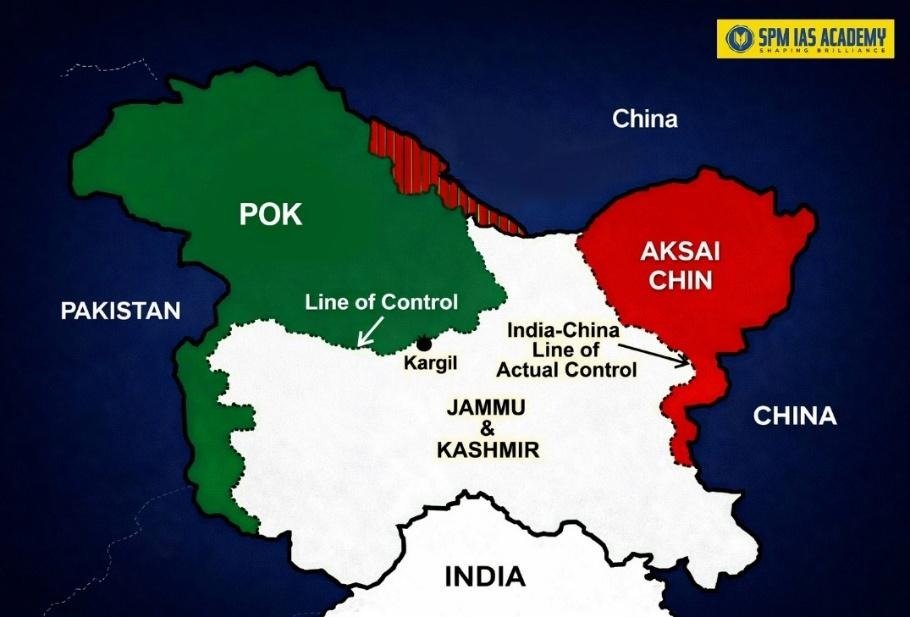
Pakistan Occupied Kashmir (PoK) refers to the part of the former princely state of Jammu and Kashmir that has been under Pakistan’s control since the 1947-48 war. India officially considers Pakistan Occupied Kashmir as an integral part of India. However, Pakistan administers this region as two separate territories – Azad Jammu and Kashmir (AJK) and Gilgit-Baltistan.
The topic Pakistan Occupied Kashmir (PoK) and issues related to it is highly important for UPSC, APSC, APPSC and other competitive exams under International Relations, Security Studies, and India-Pakistan relations.
Explore expert guidance through UPSC & APSC coaching in Assam for structured preparation and better exam success.
What is Pakistan Occupied Kashmir (PoK)?
- Firstly, Pakistan Occupied Kashmir (PoK) refers to the portion of the erstwhile princely state of Jammu and Kashmir which came under Pakistani control after the first India-Pakistan war of 1947-48.
- Historically, the conflict began following the accession of Jammu and Kashmir to India in October 1947, which led to military confrontation between India and Pakistan. Consequently, a ceasefire line was established in 1949 under United Nations supervision, dividing the region.
- As a result, the territories west of the ceasefire line remained under Pakistan’s administration and came to be known in India as Pakistan Occupied Kashmir (PoK).
Key Components of Pakistan Occupied Kashmir (PoK):
At present, Pakistan administers PoK in two main parts:
- Azad Jammu and Kashmir (AJK) – This region has its own administrative setup with a president and prime minister. However, it remains under significant control of the Pakistani federal government.
- Gilgit-Baltistan – This strategically important region lies in the northern part of PoK. Although it has a local legislative assembly, Pakistan governs it directly through constitutional arrangements different from its provinces.
- Moreover, Gilgit-Baltistan holds geopolitical significance because it connects Pakistan with China through the China-Pakistan Economic Corridor (CPEC).
India’s Position on PoK:
- Importantly, India claims both Azad Jammu and Kashmir and Gilgit-Baltistan as integral parts of the Union Territory of Jammu and Kashmir.
- Furthermore, India maintains that the entire region of Jammu and Kashmir legally acceded to India in 1947 under the Instrument of Accession signed by Maharaja Hari Singh.
- Therefore, from India’s constitutional and legal perspective, Pakistan Occupied Kashmir remains an integral part of India, though it is currently under Pakistan’s control.
Historical Background of Pakistan Occupied Kashmir (PoK):
1. Accession of Jammu and Kashmir (1947):
- Firstly, in October 1947, tribal militias backed by Pakistan invaded the princely state of Jammu and Kashmir. This invasion created instability and posed a serious security threat to the region.
- Consequently, Maharaja Hari Singh, the ruler of Jammu and Kashmir, sought military assistance from India to defend his territory.
- Thereafter, he signed the Instrument of Accession on 26 October 1947, legally acceding Jammu and Kashmir to the Dominion of India. This accession was similar to the process followed by other princely states during integration.
- Following the accession, India sent its troops to defend Kashmir and repel the invading forces.
- However, military operations continued, and the conflict between India and Pakistan escalated into the first India-Pakistan war, which lasted until 1948.
2. UN Ceasefire and Division (1948-49):
- Subsequently, in 1948, the issue was brought before the United Nations, which intervened to prevent further escalation of the conflict.
- As a result, a ceasefire was declared in January 1949 under UN supervision.
- Thereafter, a ceasefire line was established, dividing the territory into Indian-controlled and Pakistan-controlled areas.
- Over time, this ceasefire line evolved into the Line of Control (LoC) following the 1972 Shimla Agreement between India and Pakistan after the 1971 war.
- Thus, the territories west of the ceasefire line remained under Pakistan’s administration and came to be referred to in India as Pakistan Occupied Kashmir (PoK).
Legal and Constitutional Status of Pakistan Occupied Kashmir (PoK):
India’s Position:
- Firstly, India considers Pakistan Occupied Kashmir (PoK) as an integral and inseparable part of its sovereign territory. From India’s constitutional perspective, the entire region of the former princely state of Jammu and Kashmir legally acceded to India in October 1947 through the Instrument of Accession.
- Moreover, India maintains that this accession was final and legally valid under international and constitutional law, similar to the accession of other princely states during the process of national integration.
- Importantly, in 1994, the Indian Parliament unanimously passed a resolution. The resolution affirmed that the entire territory of Jammu and Kashmir including areas under Pakistan’s control is an integral part of India. The resolution also declared that Pakistan must vacate the areas under its occupation.
- Therefore, India’s official and consistent position is that PoK remains Indian territory under illegal occupation by Pakistan.
Pakistan’s Position:
- On the other hand, Pakistan administers PoK in two separate units: Azad Jammu and Kashmir (AJK) and Gilgit-Baltistan.
- Firstly, Pakistan describes Azad Jammu and Kashmir as a self-governing region with its own president, prime minister, and legislative assembly. However, significant powers remain with Pakistan’s federal authorities.
- Secondly, Gilgit-Baltistan has a separate administrative structure with a legislative assembly. But it does not enjoy the constitutional status of a full province of Pakistan.
- Moreover, despite exercising administrative control, Pakistan has not formally integrated PoK as a constitutional province, partly due to the broader Kashmir dispute and international sensitivities.
- Consequently, the constitutional arrangements in both AJK and Gilgit-Baltistan remain distinct from Pakistan’s four provinces.
International Perspective:
- Thus, the legal and constitutional status of Pakistan Occupied Kashmir remains disputed at the international level. While India asserts full sovereignty based on legal accession, Pakistan administers the region under separate political arrangements, keeping the larger Kashmir dispute unresolved.
Geographic and Strategic Importance of Pakistan Occupied Kashmir (PoK):
Pakistan Occupied Kashmir holds immense geographic and strategic importance in South Asia due to its location, terrain, and connectivity.
1. Border Significance:
- Firstly, PoK shares borders with India, China, and Afghanistan, making it a strategically sensitive tri-junction region in South Asia.
- Moreover, it is located near the Siachen Glacier and the Ladakh region, both of which are highly significant from a military and security perspective.
- In addition, the region lies close to important mountain passes in the Karakoram Range. These passes historically served as routes for trade and movement.
Therefore, its geographical location gives it immense importance in terms of border security and regional stability.
2. China-Pakistan Economic Corridor (CPEC):
- Significantly, the China-Pakistan Economic Corridor (CPEC) passes through Gilgit-Baltistan, a part of PoK.
- Furthermore, CPEC connects China’s Xinjiang province to Pakistan’s Gwadar Port on the Arabian Sea, providing China with strategic access to the Indian Ocean.
- At the same time, the corridor includes infrastructure projects such as highways, energy pipelines, and industrial zones, enhancing Pakistan’s economic connectivity.
- However, India strongly opposes CPEC. It passes through territory that India claims as part of the Union Territory of Jammu and Kashmir.
Consequently, CPEC has added a new dimension to the geopolitical and strategic relevance of PoK.
3. Military Importance:
- From a defence perspective, PoK provides strategic depth to Pakistan along the Line of Control (LoC).
- Moreover, the rugged mountainous terrain offers tactical advantages for military positioning and surveillance.
- In addition, the region plays a central role in India-Pakistan military dynamics, particularly in relation to cross-border infiltration and ceasefire violations.
- Furthermore, proximity to the Siachen Glacier and Ladakh enhances its importance in broader India-China–Pakistan strategic calculations.
Thus, due to its border location, connectivity under CPEC, and military significance, PoK remains a critical region in South Asian geopolitics and security architecture.
Demographic and Political Issues in Pakistan Occupied Kashmir (PoK)
Several political, economic, and governance-related concerns have been reported in Pakistan Occupied Kashmir (PoK). These issues are often discussed in the context of autonomy, development, and democratic functioning.
- Firstly, observers have pointed out concerns regarding limited political autonomy in the region. Although Azad Jammu and Kashmir (AJK) has its own elected government and legislative assembly, significant powers reportedly remain with Pakistan’s federal authorities, particularly in matters of defence, finance, and key administrative decisions.
- Moreover, the region faces issues of economic underdevelopment. Despite its strategic importance, industrial growth and large-scale economic diversification remain limited, leading to dependence on external financial assistance and remittances.
- In addition, there are reported infrastructure challenges, including inadequate road connectivity in remote mountainous areas, limited healthcare facilities, and uneven access to modern educational institutions. These constraints affect overall human development indicators.
- Furthermore, various international observers and human rights groups have reported restrictions on democratic freedoms, including limitations on political expression and participation in certain areas. Such reports have drawn attention to the functioning of governance structures in the region.
- However, Pakistan officially describes Azad Jammu and Kashmir as an autonomous, self-governing region with its own political framework, while Gilgit-Baltistan has a separate administrative setup with a legislative assembly.
- Therefore, the demographic and political issues in PoK remain subjects of debate and international observation, with differing perspectives presented by India, Pakistan, and independent observers.
H2: Difference Between PoK and Indian-Administered Kashmir:
| Feature | Pakistan Occupied Kashmir (PoK) | Indian-Administered Kashmir |
| Control | Administered by Pakistan | Administered by India |
| Legal Claim | Claimed by India | Recognized by India |
| Administrative Units | AJK & Gilgit-Baltistan | UT of Jammu & Kashmir & Ladakh |
Developments After 2019:
- Firstly, in August 2019, the Government of India revoked Article 370, which had granted special status to the former state of Jammu and Kashmir.
- Subsequently, the region was reorganized into two separate Union Territories – Jammu & Kashmir and Ladakh – through the Jammu and Kashmir Reorganisation Act, 2019.
- Moreover, India reiterated its official position that the entire territory of the erstwhile princely state of Jammu and Kashmir, including Pakistan Occupied Kashmir (PoK), remains an integral part of India.
- Meanwhile, Pakistan raised concerns at various international forums regarding India’s constitutional changes.
- At the same time, tensions increased along the Line of Control (LoC), leading to heightened military alertness and ceasefire violations in certain periods.
- However, in 2021, both India and Pakistan reaffirmed the ceasefire agreement along the Line of Control, which led to a relative reduction in hostilities.
- As of 2025, PoK continues to remain under Pakistani administration, while India maintains its legal and constitutional claim over the region.
Stay updated with reliable current affairs to strengthen your understanding of international relations and geopolitical developments.
Conclusion: Pakistan Occupied Kashmir (PoK) – A Core Issue in India–Pakistan Relations
Pakistan Occupied Kashmir (PoK) remains one of the most sensitive geopolitical issues in South Asia. The region came under Pakistan’s control after the 1947-48 war. India continues to claim PoK as an integral part of its territory. The strategic importance of Gilgit-Baltistan, the presence of CPEC, and proximity to Ladakh make PoK highly significant in India-Pakistan relations. A clear understanding of Pakistan Occupied Kashmir strengthens preparation in International Relations, Security Studies, and Indian Polity for UPSC, APSC, and APPSC examinations.
Source:
Frequently Asked Questions:
Pakistan Occupied Kashmir (PoK) refers to the part of the former princely state of Jammu and Kashmir that has been under Pakistan’s control since the 1947-48 India-Pakistan war. India considers PoK an integral part of its sovereign territory, while Pakistan administers it as Azad Jammu and Kashmir (AJK) and Gilgit-Baltistan.
Pakistan Occupied Kashmir holds major strategic importance due to its location near India, China, and Afghanistan. It includes Gilgit-Baltistan, through which the China-Pakistan Economic Corridor (CPEC) passes. The region is also close to Ladakh and the Siachen Glacier, making it critical for India-Pakistan security dynamics.
India maintains that the entire region of Jammu and Kashmir, including Pakistan Occupied Kashmir, legally acceded to India in 1947 through the Instrument of Accession. The Indian Parliament reaffirmed this position in a 1994 resolution, stating that PoK is under illegal occupation by Pakistan.
Pakistan Occupied Kashmir is administered by Pakistan as Azad Jammu and Kashmir and Gilgit-Baltistan, while Indian-administered Kashmir consists of the Union Territories of Jammu & Kashmir and Ladakh. However, both India and Pakistan claim the entire region of the former princely state.
The China-Pakistan Economic Corridor (CPEC) passes through Gilgit-Baltistan in PoK, connecting China’s Xinjiang region to Pakistan’s Gwadar Port. This corridor enhances China-Pakistan strategic cooperation and adds a major geopolitical dimension to the Kashmir dispute in South Asia.

Behind every article at SPM IAS Academy is a team of skilled content writers and subject experts committed to making preparation easier for aspirants. From answering common doubts to breaking down complex issues and current affairs, we create content that is accurate, easy to understand, and directly useful for UPSC, APSC, and other competitive exams.