
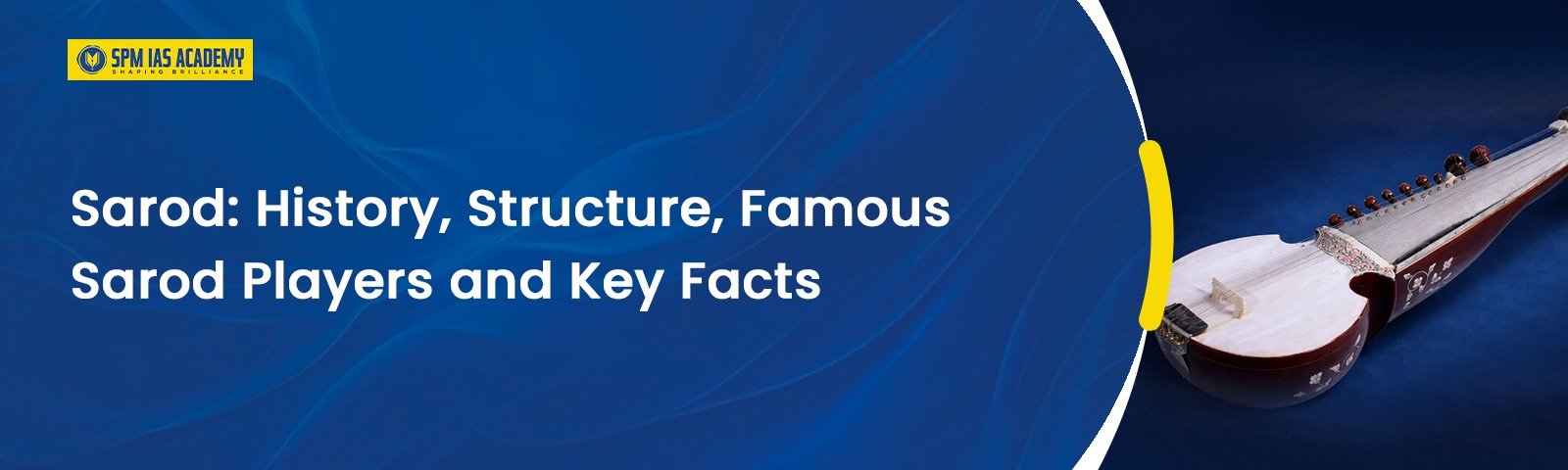
The sarod is one of the most important classical string instruments of India. It belongs to the Hindustani classical music tradition and produces a deep, resonant sound that distinguishes it from other Indian string instruments. The sarod is a plucked instrument with a metal fingerboard and no frets. It allows the player to produce smooth gliding notes called meend. For UPSC, APSC, APPSC, and other state PCS exam aspirants, the sarod is a key topic under Indian art and culture.
Explore the best APSC UPSC coaching centre in Guwahati for expert guidance and structured preparation.
This article covers everything you need to know about the sarod – its history, structure, playing technique, famous sarod players, and other exam-relevant facts.
About Sarod: What Kind of Instrument Is It?
The sarod is a chordophone – a musical instrument that produces sound through vibrating strings. It falls under the category of plucked lutes. It is an important instrument of Hindustani classical music, which is the classical music tradition of northern India. The sarod typically has 25 strings, though the exact number can vary slightly depending on the style of the player and the tradition followed.
Furthermore, the sarod belongs to the same family as the sitar, but it differs significantly in sound, structure, and playing style. While the sitar has frets and produces a bright, sharp tone, the sarod has a smooth metal fingerboard without any frets and produces a heavier, deeper, and more meditative tone. Therefore, the sarod is often described as the instrument that captures the soulful depth of Hindustani classical music.
History and Origin of the Sarod
The sarod has a rich and layered history. It evolved in India during the 18th and 19th centuries from an older Afghan instrument called the rabab (also spelled rubab). The rabab was a short-necked lute widely played in Afghanistan and Central Asia. When Afghan musicians and traders migrated to India, they brought the rabab with them. Over time, Indian musicians adapted and transformed the rabab to suit the demands of Hindustani classical music, and the modern sarod gradually emerged from this process.
The Bangash family of musicians, originally from Afghanistan and later settled in India, played a central role in developing the sarod. Niyamatullah Khan of the Bangash family is widely credited with transforming the rabab into what we recognise as the sarod today. Subsequently, the instrument evolved further through the contributions of the Senia Bangash gharana (school of music) and later through the innovations of the Shahjahanpur and Maihar gharanas.
Additionally, the word sarod is believed to derive from the Persian word meaning melody or music. This Persian connection reflects the historical influence of Central Asian and Persian musical traditions on Indian classical music during the Mughal period.
Structure and Design of the Sarod
Body and Resonator
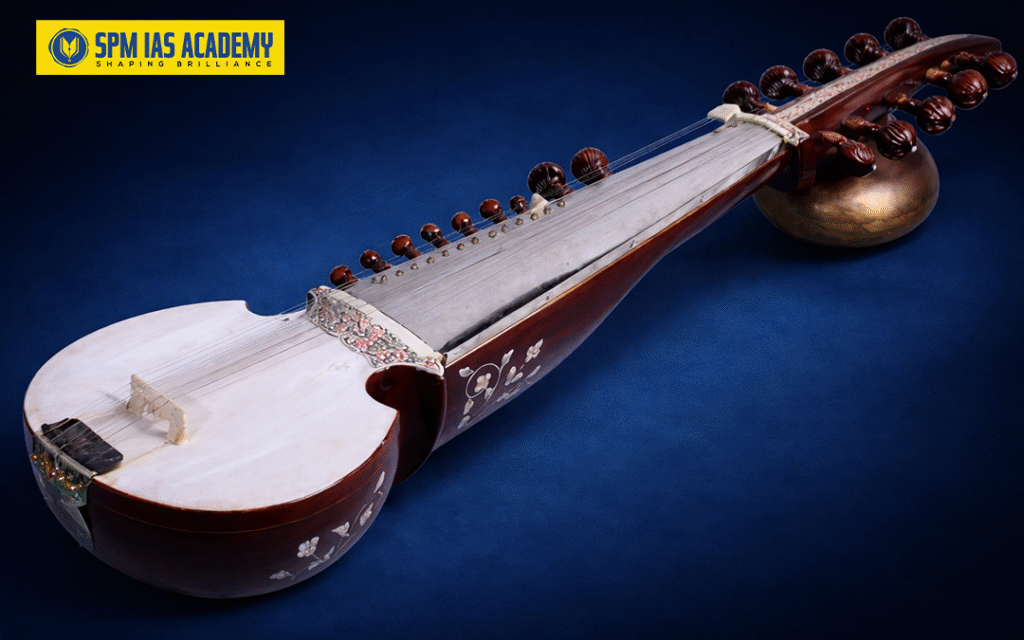
The body of the sarod consists of a hollow wooden resonator, usually made from teak or tun wood. A thin membrane of goatskin or calfskin covers the lower part of the resonator, similar to the covering on a tabla. This skin covering amplifies the vibrations of the strings and gives the sarod its distinctive tonal quality. The upper portion of the body has a wooden soundboard that further contributes to the instrument’s resonance.
Fingerboard, Strings, and Tuning Pegs
One of the most distinctive features of the sarod is its smooth, fretless metal fingerboard, usually made of polished steel. The absence of frets allows the player to slide the fingers across the strings and produce the characteristic gliding notes (meend) that define Hindustani classical music. The strings are made of steel or bronze.
The sarod generally has four main playing strings, two drone strings (called chikari strings), and multiple sympathetic strings (called tarab strings) that run beneath the main strings. These sympathetic strings vibrate in resonance when the main strings play, creating a rich, layered sound. The player uses a small triangular plectrum made from coconut shell, ebony, or wire to pluck the strings.
Famous Sarod Players in India: Who Are the Greatest Masters?
Several maestros have elevated the sarod to international fame. Knowing their names and contributions is essential for the art and culture section of competitive exams. Here are the most celebrated sarod players in India:
- Ustad Allauddin Khan: He is widely regarded as one of the greatest musicians of the 20th century. He founded the Maihar gharana and taught both Ravi Shankar and Ali Akbar Khan. The Government of India awarded him the Padma Vibhushan and the Padma Bhushan. He is also known as Baba Allauddin Khan.
- Ustad Ali Akbar Khan: Son and disciple of Allauddin Khan, Ali Akbar Khan became one of the greatest sarod players in history. He introduced the sarod to Western audiences and received the Padma Vibhushan from the Government of India. He also received a Grammy Lifetime Achievement Award nomination.
- Amjad Ali Khan: He is one of the most prominent living sarod maestros. Born into the Bangash tradition, he modernised the sarod while preserving its classical roots. The Government of India has honoured him with the Padma Vibhushan, Padma Bhushan, and Padma Shri.
- Ustad Hafiz Ali Khan: Father of Amjad Ali Khan and one of the foremost sarod players of his era. He received the Padma Bhushan in 1960.
- Buddhadev Das Gupta: He was one of the leading sarod players from the Senia Shahjahanpur gharana and received both the Padma Bhushan and the Sangeet Natak Akademi Award.
Additionally, the younger generation of sarod players includes Amaan Ali Bangash and Ayaan Ali Bangash, the twin sons of Amjad Ali Khan, who continue to carry the legacy of this instrument forward.
Awards and Institutional Recognition Related to Sarod
The Sangeet Natak Akademi, established by the Government of India, recognises outstanding contributions to classical music including sarod. Many sarod maestros have received the Sangeet Natak Akademi Award, which is one of the highest honours in the field of performing arts in India. Furthermore, the Padma awards – Padma Shri, Padma Bhushan, and Padma Vibhushan have been conferred on several sarod players for their contributions to Indian classical music.
The sarod also features in the curriculum of several prominent music institutions such as the Bhatkhande Music Institute (Deemed University) in Lucknow and the Indira Kala Sangit Vishwavidyalaya in Khairagarh, Chhattisgarh. Therefore, aspirants must note these institutions as they appear in questions related to music education and cultural heritage in India.
Stay updated with daily insights through current affairs to strengthen your UPSC and APSC exam preparation.
Conclusion:
In conclusion, the Sarod stands as one of the most significant instruments in Hindustani classical music, known for its deep, resonant tone and unique fretless design. It evolved from the Afghan rabab and gradually developed into a refined instrument that beautifully captures the emotional depth of Indian music traditions. Moreover, its distinctive structure, including the metal fingerboard and sympathetic strings, allows musicians to produce expressive techniques like meend, which define its rich musical character.
Furthermore, the contributions of legendary sarod players such as Ustad Allauddin Khan, Ali Akbar Khan, and Amjad Ali Khan have elevated the instrument to global recognition. Therefore, understanding the sarod history, structure, famous players, and key facts becomes essential for aspirants preparing for UPSC, APSC, and other State PCS exams.
Overall, the sarod not only represents India’s rich cultural heritage but also plays a vital role in the study of Indian art and music.
Source:
Frequently Asked Questions:
The Sarod is a fretless string instrument used in Hindustani classical music. Moreover, it produces a deep, resonant sound and allows smooth gliding notes called meend.
The origin of Sarod traces back to the Afghan rabab. Over time, Indian musicians transformed it during the 18th–19th centuries to suit Hindustani classical music. Therefore, the modern Sarod evolved in India.
The Sarod instrument usually has around 25 strings, including main, drone, and sympathetic strings. Consequently, these strings create a rich and layered musical sound.
Famous Sarod players in India include Ustad Allauddin Khan, Ali Akbar Khan, and Amjad Ali Khan. Moreover, they helped popularize the Sarod worldwide.
The sarod and sitar are both plucked string instruments used in Hindustani classical music. But they differ significantly. The sarod has a fretless smooth metal fingerboard, which allows the player to produce gliding notes (meend). The sitar, on the other hand, has movable metal frets. The sarod produces a deep, heavy, and resonant tone. On the other hand, the sitar produces a brighter and sharper sound. The sarod’s body is partially covered with animal skin, while the sitar has a gourd resonator. The player uses a plectrum (javva) for the sarod and a wire mizrab for the sitar.

Behind every article at SPM IAS Academy is a team of skilled content writers and subject experts committed to making preparation easier for aspirants. From answering common doubts to breaking down complex issues and current affairs, we create content that is accurate, easy to understand, and directly useful for UPSC, APSC, and other competitive exams.