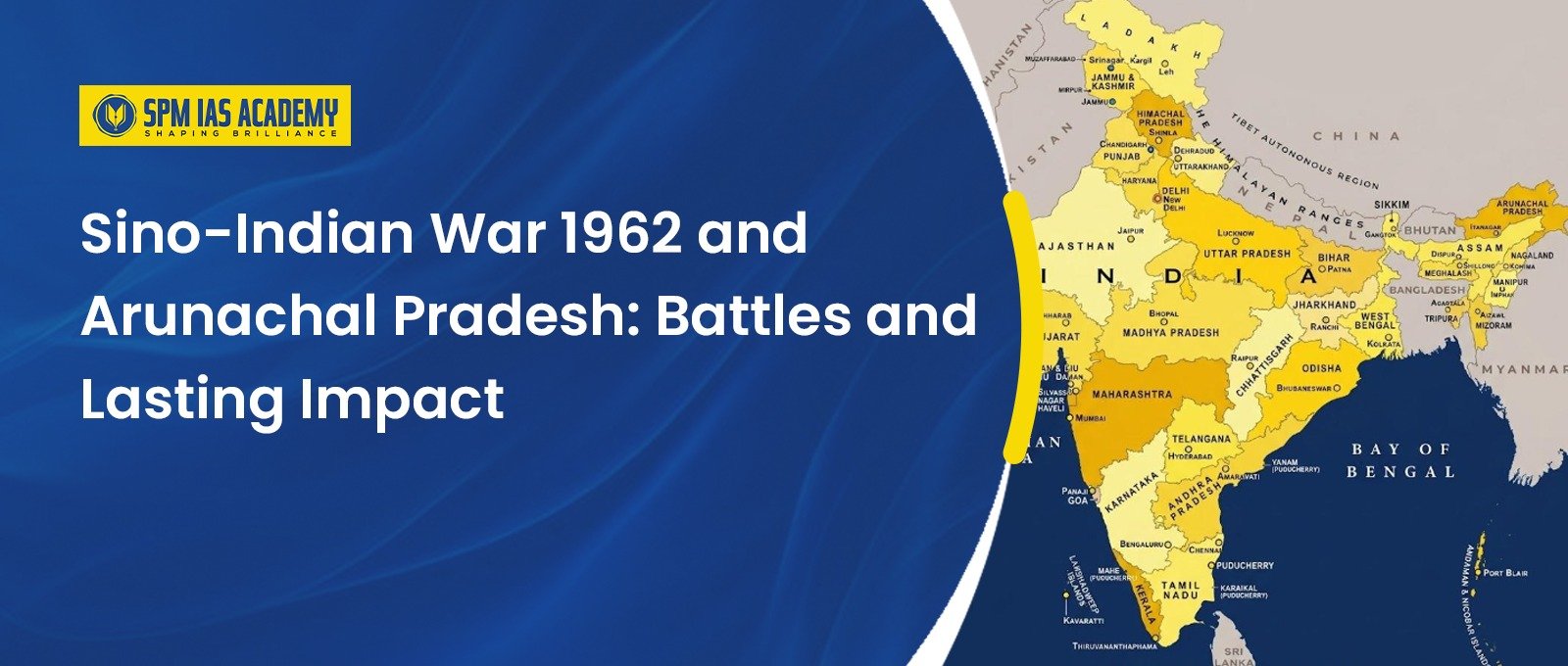
The Sino-Indian War of 1962 was an armed conflict between India and China that took place from October to November 1962. It is regarded as one of the most significant military conflicts in post-Independence India. The primary cause of the war was the long-standing border dispute in the Himalayan region, particularly over Aksai Chin and Arunachal Pradesh, along with several other strategic and political disagreements that eventually escalated into armed conflict. This topic is highly important for aspirants preparing for an IAS coaching in Assam, as it is frequently covered in UPSC and APSC examinations under Modern Indian History, International Relations, Security Issues, and Current Affairs.
Sino-Indian War 1962: A Brief Overview
The Sino-Indian War 1962 was fought between India and China from 20 October to 21 November. from 20 October to 21 November 1962. The war took place mainly in two regions—Aksai Chin in the western sector and the North-East Frontier Agency (NEFA) in the eastern sector. NEFA later became Arunachal Pradesh.
The conflict developed because India and China disagreed over their shared border. In the eastern sector, India recognised the McMahon Line as the boundary. However, China did not accept it. Moreover, tensions increased because of developments in Tibet and growing military activity of China along the border.
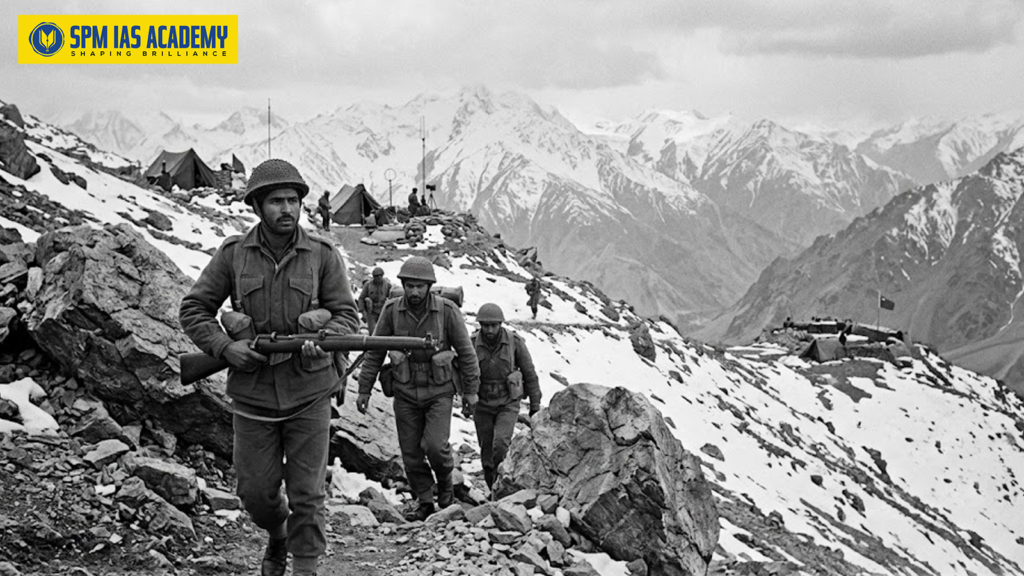
On 20 October 1962, Chinese forces launched coordinated attacks in both the western and eastern sectors. In the North-East Frontier Agency (NEFA), major battles took place at Namka Chu, Tawang, Nuranang, Se La, Bomdila, and Walong. Despite fighting with exceptional courage in challenging mountainous terrain, Indian soldiers faced significant difficulties, including inadequate road infrastructure, limited supplies, insufficient winter equipment, and poor communication systems. Understanding such historical events is essential for aspirants learning how to start preparing for APSC, as questions on the Sino-Indian War of 1962 frequently appear in APSC and UPSC examinations under Modern Indian History, International Relations, Defence, and Current Affairs.
What are the causes of the Sino-Indian War 1962?
The Sino-Indian War 1962 did not begin because of one event. Instead, several border disputes and political disagreements increased tension over many years. The following were its principal causes
Competing Interpretations of the Boundary
India and China did not agree on the location of their Himalayan boundary. Large parts of the border had never been clearly marked on the ground. India duly followed boundaries shown on its official maps. However, China claimed several areas under Indian administration. Therefore, conflict escalated.
The McMahon Line Dispute
The McMahon Line was formulated at the Simla Conference in 1914 as the boundary between British India and Tibet in the eastern sector. After independence, India accepted it as its official boundary. However, China rejected the Simla Convention and did not recognise the McMahon Line. This disagreement mainly affected present-day Arunachal Pradesh, which was then called the North-East Frontier Agency or NEFA.
China’s Control of Tibet
The Chinese People’s Liberation Army entered Tibet in 1950, and China strengthened its control over the region. As a result, India and China became direct neighbours along a long Himalayan frontier. India also lost Tibet as a geographical buffer between the two countries. Meanwhile, political developments in Tibet created mistrust between India and China.
India Granting Asylum to the Dalai Lama
A major uprising took place in Tibet in March 1959. Soon afterwards, the 14th Dalai Lama escaped from Tibet and entered India through the Tawang region. India granted him asylum on humanitarian grounds. However, China suspected that India was supporting the Tibetan resistance. India rejected this claim, but the issue further damaged relations between the two countries.
The Aksai Chin Dispute
India considered Aksai Chin as an integral part of Ladakh. However, China also claimed the region. During the 1950s, China built a road through Aksai Chin to connect Xinjiang with Tibet. India objected because the road passed through its territory and threatened its sovereignty. Thus, Aksai Chin became the main point of dispute in the western sector.
Breakdown of Diplomatic Relations
India and China tried to settle the border dispute through talks and negotiations. Chinese Premier Zhou Enlai visited India in 1960 and discussed the issue with Prime Minister Jawaharlal Nehru. However, the two sides could not reach an agreement. At the same time, border clashes and accusations increased mistrust. Therefore, the earlier friendship expressed through the slogan Hindi-Chini Bhai-Bhai completely broke down.
Why did Arunachal Pradesh Become a Major Battlefield?
During the 1962 war, present-day Arunachal Pradesh was known as the North-East Frontier Agency (NEFA). It became a major battlefield because of its disputed border, important mountain passes, and strategic routes.
- Dispute over the eastern border: India accepted the McMahon Line as the boundary between NEFA and Tibet, as agreed in the Shimla Conference in 1914. However, China did not recognise this line. Therefore, the eastern sector became one of the main areas of conflict.
- Strategic importance of Tawang: Tawang lies close to the border and has historical and religious links with Tibet. It also provides access towards the plains of Assam. As a result, controlling Tawang was important for military movement in the eastern sector.
- Routes through the Himalayan passes: The high mountains made troop movement difficult. However, passes such as Bum La and Se La provided important routes through the region. Therefore, both sides focused on controlling these passes and the roads connected to them
- Important communication routes: The Tawang–Se La–Bomdila route connected the border region with the foothills and Assam. It was needed to move soldiers, food, weapons and other supplies. However, NEFA had very few developed roads in 1962. This made communication and supply difficult for Indian forces.
- River valleys provided routes for movement: Valleys such as Namka Chu, Lohit and Subansiri offered possible routes through the difficult mountain landscape. Consequently, military operations developed around these valleys and nearby positions.
- Walong’s location in the eastern sector: Walong, in the Lohit Valley, was another important frontier area. Indian forces tried to stop the Chinese advance there and launched a counterattack in November 1962. Thus, fighting occurred in both the Tawang and Walong sectors.
Major Battles Fought in Arunachal Pradesh
During the Sino-Indian War 1962, present-day Arunachal Pradesh was called the North-East Frontier Agency (NEFA). Fighting took place mainly in the Tawang and Walong sectors.
Battle of Namka Chu
The Battle of Namka Chu began on 20 October 1962 near Thagla Ridge. Chinese troops attacked Indian positions along the Namka Chu River from higher ground. Indian soldiers fought under difficult conditions with limited supplies and weak communication. However, the military disadvantage forced them to withdraw towards Tawang.
Fighting at Bum La and Tongpen La
Fighting took place near Bum La and Tongpen La on 23 October 1962. Subedar Joginder Singh and his soldiers resisted repeated Chinese attacks despite being outnumbered. They continued fighting until their ammunition was nearly exhausted. For his courage and leadership, Subedar Joginder Singh received the Param Vir Chakra.
Fall of Tawang
After the setback at Namka Chu, Indian forces withdrew from Tawang to prepare defensive positions farther south. Chinese troops entered the town on 24 October 1962. Tawang was important because it connected the border with Se La, Bomdila, and routes towards Assam. However, no major battle took place inside the town.
Battle of Nuranang
The Battle of Nuranang was fought near Jang on 17 November 1962. Soldiers of 4 Garhwal Rifles offered strong resistance and slowed the Chinese advance. Rifleman Jaswant Singh Rawat displayed notable courage during the fighting. However, Indian troops later withdrew when the wider defence around Se La weakened
The Battle of Walong and India’s Resistance
The Battle of Walong was fought in the Lohit Valley of present-day Arunachal Pradesh. During the Sino-Indian War 1962, the Battle of Walong was fought in the Lohit Valley. Walong was important because it stood near the eastern border and provided access through the river valley. Therefore, Indian troops were sent to stop the Chinese advance.
Indian soldiers defended the area despite difficult mountains, weak road links and limited supplies. They held several positions around Walong and slowed the Chinese forces. Moreover, Indian troops launched a counterattack near a position known as “Yellow Pimple” between 14 and 16 November. It was one of India’s main counterattacks in the eastern sector during the war.
Role of Local Communities During the 1962 War
Guides and Porters
Local communities understood the mountains, forests and narrow paths of NEFA better than anyone else. Therefore, many local people worked as guides and porters for the Indian Army. They carried food, ammunition and other supplies through areas where vehicles could not travel.
Support for Indian Soldiers
Villagers also provided food, shelter and useful information to Indian troops whenever possible. Moreover, residents helped wounded soldiers and guided retreating units through difficult routes. Their knowledge of the weather and terrain became especially valuable when roads and communication lines failed.
Courage During a Difficult Time
As the fighting spread, many villages faced fear, displacement, and shortages. Government officials and other residents also left some frontier areas during the Chinese advance. However, several Indigenous communities remained in their ancestral villages and faced the crisis with courage. Their service is not always fully recorded in military accounts, yet their support formed an important part of India’s resistance
Impact of the 1962 War on Arunachal Pradesh
The Sino-Indian War 1962 had a lasting impact on Arunachal Pradesh and its people
- Loss of lives: Soldiers and civilians suffered during the fighting. Many families lost their loved ones, while several villages faced fear and uncertainty.
- Displacement of people: As Chinese troops advanced, many residents left their homes and moved towards safer places. However, some Indigenous communities remained in their villages.
- Administrative disruption: Government officials and other workers had to leave several frontier areas during the attack. As a result, local administration and public services were disrupted for a short period.
- Damage to daily life: The war disrupted transport, communication, and the supply of essential goods. People living in remote border areas faced serious difficulties.
- Greater military presence: After the war, India increased the deployment of soldiers along the eastern border. Moreover, the government gave greater attention to border security.
- Development of border infrastructure: India gradually improved roads, bridges, airfields, and communication systems in the region. These facilities supported both defence needs and civilian movement.
- Closer national attention: The war showed the strategic importance of NEFA, which later became Arunachal Pradesh. Therefore, the region received greater attention in India’s security planning.
- Lasting public memory: Stories of soldiers, local guides and villagers became part of Arunachal Pradesh’s history. The events of 1962 continue to shape the region’s identity and its awareness of border security.
Conclusion
The Sino-Indian War 1962 deeply affected Arunachal Pradesh and its people. It revealed the region’s strategic importance and the difficulties of defending a remote mountain border. However, the courage of Indian soldiers and local communities remains an important part of its history. Therefore, remembering the war helps us value their sacrifices and understand the continuing need for peace, preparedness and secure borders.
Frequently Asked Questions
Q1. Why was Arunachal Pradesh important during the Sino-Indian War of 1962?
Arunachal Pradesh, then called NEFA, shared a disputed border with Tibet. Tawang, important mountain passes, and routes towards Assam gave the region great strategic value. Therefore, major fighting occurred around Namka Chu, Bum La, Nuranang, Se La, Bomdila and Walong during the war.
Q2. What happened in Arunachal Pradesh after the 1962 war ended?
China announced a unilateral ceasefire on 21 November 1962 and later withdrew its forces from most of NEFA. Afterwards, India strengthened its military presence, roads and communication systems in the region. The war also brought greater national attention to Arunachal Pradesh’s people, security and strategic importance.

Behind every article at SPM IAS Academy is a team of skilled content writers and subject experts committed to making preparation easier for aspirants. From answering common doubts to breaking down complex issues and current affairs, we create content that is accurate, easy to understand, and directly useful for UPSC, APSC, and other competitive exams.