
The Strait of Hormuz has once again become a focal point of global tension after rising conflict involving Iran, the United States, and Israel. Reports of disruption in oil and gas movement through this narrow maritime passage have created anxiety in global energy markets. Since nearly one-fifth of the world’s petroleum trade passes through this route, even temporary disruption can raise oil prices and affect economies worldwide.
For UPSC, APSC and APPSC exam aspirants, the Strait of Hormuz is an important topic. It connects geography, international relations, maritime security, and economic stability. Understanding its significance helps in analysing current global developments in a structured way.
Strait of Hormuz: Location, Geography and Physical Features
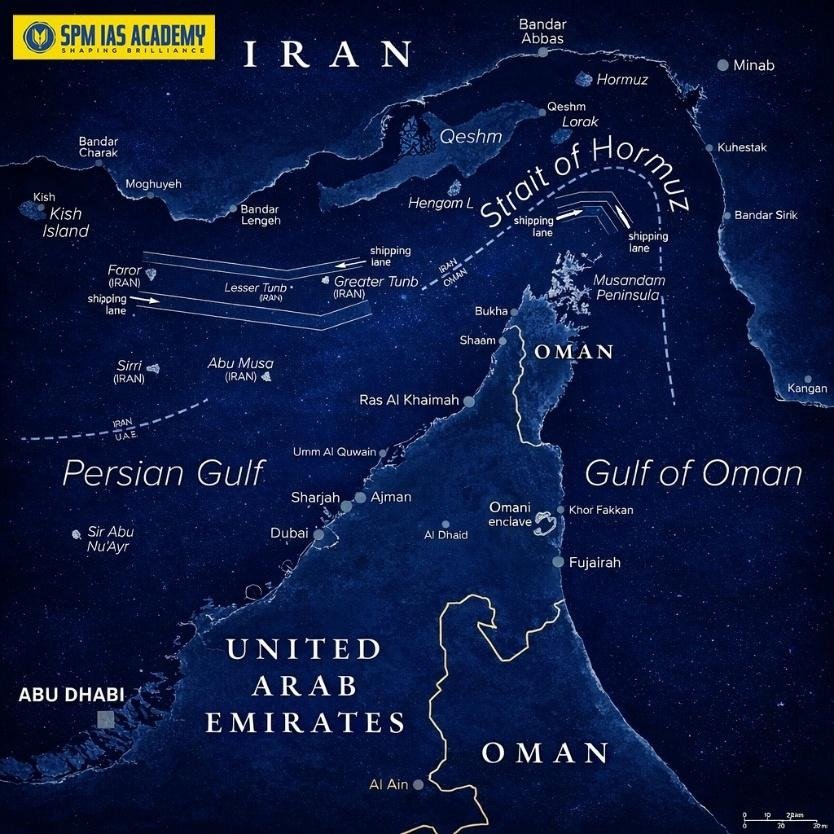
The Strait of Hormuz is a narrow waterway located between Iran (to the north) and Oman’s Musandam Peninsula (to the south). It connects:
- The Persian Gulf
- The Gulf of Oman
- The Arabian Sea
Key Geographical Features of Strait of Hormuz:
- Firstly, the Strait of Hormuz narrows to approximately 30 miles (48 km) at its narrowest point, making it a highly sensitive maritime passage.
- Secondly, it is one of the world’s most critical maritime chokepoints. A significant share of global oil and gas trade passes through it.
- Moreover, the strait has deep waters, which allow very large crude carriers (VLCCs) and other heavy oil tankers to navigate safely.
- In addition, ships move through a designated Traffic Separation Scheme (TSS), which ensures structured and safe maritime navigation.
- Furthermore, the strait contains eight major islands, most of which are under Iranian control.
- Consequently, Iran maintains military installations in the region, thereby enhancing its strategic influence over maritime movement and regional security.
Therefore, this unique geographical and strategic positioning gives the Strait of Hormuz immense global importance in terms of energy security and geopolitics.
Why is the Strait of Hormuz in News?
The recent US-Israel joint military action against Iran has significantly heightened global concerns over the stability of energy supplies. As tensions escalated, reports emerged that Iran’s Islamic Revolutionary Guards Corps transmitted messages suggesting a possible closure of the Strait of Hormuz. Although Tehran did not issue any formal declaration confirming such a move, the uncertainty alone prompted many shipping companies and insurance firms to suspend operations in the region. Meanwhile, former US President Donald Trump described the operation as “massive and ongoing,” and the US Department of Defense officially named it Operation Epic Fury. Consequently, the situation has intensified fears of disruption in global oil and gas flows, leading to increased volatility in energy markets.
As a result of the escalating tensions, several immediate disruptions became visible in global energy markets. Oil tankers began dropping anchor in open waters, while LNG shipments slowed considerably. At the same time, insurance premiums for vessels operating in the region increased due to heightened risk perceptions. Consequently, global oil prices surged, with Brent crude already rising sharply. Markets now fear that prices could climb further if the disruption continues or intensifies.
Strategic Importance of the Strait of Hormuz:
- To begin with, the Strait of Hormuz is widely regarded as the world’s most important oil transit chokepoint, due to the massive volume of energy resources that pass through it.
- Specifically, it handles:
- Around 20% of global liquid petroleum consumption.
- Nearly one-fifth of global LNG trade.
- Approximately 15 million barrels of oil per day.
- Although some Gulf countries have developed pipelines to bypass the strait, their overall capacity remains limited.
- Consequently, even at full utilization of these alternative routes, a significant share of global oil exports would still depend on this narrow passage.
- Therefore, the strait functions as a powerful geopolitical pressure point, as any country exercising influence over this route gains substantial strategic leverage in international politics.
- Furthermore, the strait is crucial for global oil trade, with nearly 20% of worldwide oil flows moving through it.
- In India’s context, the importance is even greater, as the country imports nearly 90% of its crude oil requirements, and about 50% of these imports transit through the Strait of Hormuz.
Impact on India: Energy Security and Economic Concerns:
- To begin with, India is one of the largest consumers of crude oil in the world. However, it imports more than 88% of its crude oil requirement, which makes it heavily dependent on external energy supplies.
- Notably, around half of India’s total oil imports transit through the Strait of Hormuz, with major supplies coming from Iraq, Saudi Arabia, the UAE, and Kuwait.
- In volume terms, this dependence translates to roughly 2.5 to 2.7 million barrels per day moving through this narrow passage.
- Given this structural dependency, any prolonged disruption in the strait could significantly increase fuel prices within the country.
- Consequently, transportation and logistics costs would rise, thereby putting additional pressure on businesses and consumers.
- Furthermore, higher import bills could widen the trade deficit and weaken macroeconomic stability.
- Ultimately, sustained disruption may fuel inflationary pressures across multiple sectors of the economy.
Therefore, energy security remains a central pillar of India’s long-term economic stability and policy planning.
What are India’s Immediate Options in Case of Disruption?
India possesses certain strategic buffers that help manage short-term energy supply shocks.
- Firstly, the country can draw upon its strategic petroleum reserves to stabilize immediate supply gaps.
- In addition, refiners can utilize existing crude inventories, which typically cover around 10 days of consumption.
- Moreover, India can increase spot market purchases from alternative regions to offset disruptions.
- Furthermore, India can expand its imports from diverse suppliers such as Russia, the United States, West Africa, and Latin America, thereby reducing overdependence on a single transit route.
- Importantly, there are floating Russian cargoes available in the Indian Ocean region, which can be accessed relatively quickly if required.
- Consequently, this diversification strategy significantly lowers the risk of an immediate supply crisis.
LPG and LNG: Greater Vulnerabilities:
While crude oil imports are supported by certain strategic buffers, LPG and LNG supplies face comparatively higher risks in the event of prolonged disruption.
LPG Situation:
To begin with, India imports nearly 80-85% of its LPG requirements, which makes the country significantly dependent on overseas suppliers. Moreover, the majority of these imports are sourced from Gulf countries, and most shipments transit through the Strait of Hormuz. In addition, India has limited strategic storage capacity for LPG when compared to crude oil. Furthermore, the global spot market for LPG remains relatively thin, which reduces flexibility during emergencies. Consequently, any sustained disruption in the strait could create logistical and pricing challenges for domestic cooking gas supplies.
LNG Situation:
Similarly, around 60% of India’s LNG imports pass through the Strait of Hormuz, thereby increasing exposure to regional instability. Although LNG plays a crucial role in power generation and industrial usage, structural supply buffers remain limited. Additionally, spot cargo availability in the global LNG market is tight, which restricts quick alternative procurement. Therefore, if disruption continues for an extended period, both electricity generation and industrial output could come under significant pressure.
Global Economic Consequences:
- To begin with, energy markets respond rapidly to geopolitical tensions, often reacting even to perceived threats of disruption.
- If the situation worsens, oil prices may exceed $100 per barrel, thereby increasing global energy costs.
- Consequently, higher fuel prices could trigger a rise in global inflation, as transportation and production expenses increase.
- Moreover, shipping and insurance costs are likely to rise due to heightened security risks in affected maritime routes.
- In addition, currency volatility may intensify, particularly in countries with high energy import bills.
- As a result, developing nations that depend heavily on imported energy may face greater economic pressure.
- Ultimately, sustained increases in production and transportation costs could slow economic growth across both emerging and advanced economies.
Why Has the Strait Never Been Fully Closed?
Although Iran has repeatedly threatened to close the Strait of Hormuz in the past, it has never fully implemented such a blockade.
- Firstly, Iran itself exports a significant portion of its oil through the same route. Therefore, complete closure would directly harm its own economy.
- Secondly, Gulf economies heavily depend on uninterrupted energy exports, and prolonged disruption would severely impact regional stability.
- Moreover, a full closure could trigger a strong international military response, thereby escalating the conflict further.
- In addition, such an action could intensify diplomatic isolation and increase economic sanctions against Iran.
- Consequently, the Strait of Hormuz functions more as a strategic warning or pressure mechanism rather than a permanently blocked waterway.
Long-Term Strategic Lessons for India:
- To begin with, the Strait of Hormuz crisis clearly exposes the structural vulnerabilities present in global energy supply chains.
- Therefore, India must further diversify its oil import sources to reduce excessive dependence on any single region.
- In addition, the country should expand its strategic petroleum reserves to enhance its ability to manage future supply shocks.
- Moreover, India needs to develop larger LPG and LNG storage capacities, thereby strengthening resilience in critical energy segments.
- Furthermore, increased investment in renewable energy and green hydrogen can gradually reduce reliance on imported fossil fuels.
- At the same time, India should strengthen maritime security cooperation to ensure safe and uninterrupted sea-lane communication.
- Ultimately, reducing long-term dependence on imported fossil fuels remains the most sustainable and strategic solution for energy security.
Conclusion: Strait of Hormuz and the Future of Global Energy Stability
The Strait of Hormuz is more than just a narrow waterway. It is a critical artery of the global energy system. Any disruption affects oil prices, inflation, trade flows, and economic stability across continents.
For India, the challenge lies in balancing immediate supply security with long-term diversification. Although short-term buffers exist, prolonged disruption could increase crude prices, strain LPG and LNG supplies, and create fiscal pressure.
Understanding the Strait of Hormuz crisis is essential for analyzing global geopolitics, maritime security, energy trade routes, oil price volatility, and India’s energy security strategy. These interconnected themes make it one of the most important contemporary international issues for serious examination preparation.
Source:
https://www.bbc.com/news/articles/c75evve6l63o
The Strait of Hormuz is considered the world’s most critical oil transit chokepoint because nearly 20% of global liquid petroleum consumption and a major share of LNG trade pass through it. It connects the Persian Gulf with the Gulf of Oman and the Arabian Sea, making it essential for global oil supply chains and international trade stability.
If the Strait of Hormuz is closed, global oil and gas supplies would face serious disruption. Oil prices could rise sharply, possibly crossing $100 per barrel. Shipping and insurance costs would increase, inflation may rise globally, and energy-importing countries could experience economic stress.
India imports nearly 90% of its crude oil, and about half of these imports pass through the Strait of Hormuz. Any disruption could increase fuel prices, widen the trade deficit, raise inflation, and create pressure on LPG and LNG supplies. Therefore, the crisis directly impacts India’s energy security and overall economic stability.
Although Iran has repeatedly threatened to close the strait, it has never fully implemented such a move because it also exports oil through the same route. A complete closure would harm its own economy, risk international military response, and increase diplomatic isolation.
India aims to diversify its oil import sources, expand strategic petroleum reserves, increase LPG and LNG storage capacity, invest in renewable energy and green hydrogen, and strengthen maritime security cooperation. These steps help reduce long-term dependence on imported fossil fuels and enhance energy security.