Primary word – South China Sea
The South China Sea is one of the most important seas in the world. It lies between countries like China, Vietnam, the Philippines, and Malaysia. It is very important because it has busy trade routes, rich fish resources, and possible oil and gas reserves. Moreover, many countries depend on it for trade and livelihood. However, several nations claim parts of this sea, which has led to serious disputes. As a result, tensions often rise in the region. Therefore, understanding the South China Sea dispute, its importance, and key issues is very important for global politics and exams.
South China Sea: An Overview
The South China Sea is a marginal sea of the Pacific Ocean. It stretches across a vast area of approximately 3.5 million square kilometres. Furthermore, it connects several major economies in Southeast and East Asia.
This sea has become a global flashpoint in recent decades. Multiple countries claim overlapping territories here. As a result, it remains at the centre of international attention and diplomatic tension.
Where Is the South China Sea Located?
The South China Sea lies in Southeast Asia. It sits south of China and Taiwan. Moreover, it lies east of Vietnam, north of the Philippines, and west of Borneo and Malaysia.
It connects with the East China Sea through the Taiwan Strait. Additionally, it links with the Philippine Sea to the east. In the west, it connects to the Gulf of Thailand and the Gulf of Tonkin.
South China Sea Map: Key Geographic Features
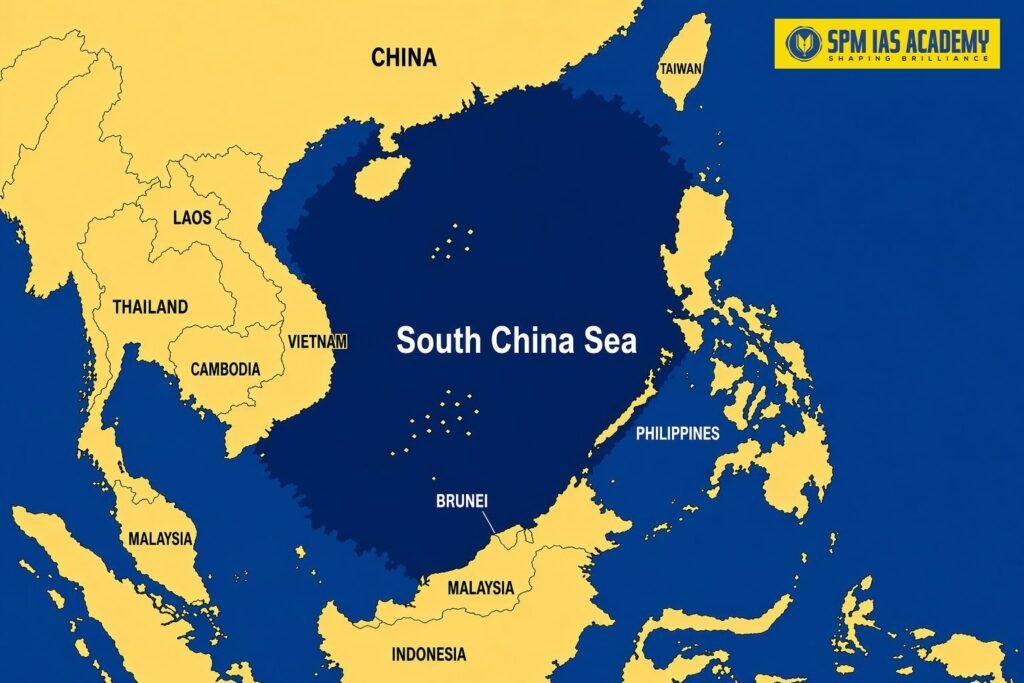
The South China Sea map shows several important island groups, reefs, and shoals. These features are at the heart of the ongoing territorial dispute. Understanding the map is essential for UPSC and state PCS exams.
Major Island Groups in the South China Sea
- Paracel Islands: Located in the northern part. China controls them. Vietnam and Taiwan also claim them.
- Spratly Islands: Located in the southern part. Multiple countries claim them, including China, the Philippines, Vietnam, Malaysia, Brunei, and Taiwan.
- Pratas Islands (Dongsha): Controlled by Taiwan. China also claims them.
- Scarborough Shoal: A triangular chain of reefs. China, the Philippines, and Taiwan claim this area.
- Macclesfield Bank: A submerged atoll. China and Taiwan claim it.
South China Sea Bordering Countries
Several countries share their coastlines with the South China Sea. These South China Sea bordering countries play a key role in the ongoing dispute. Here is a list of the major ones:
- China (People’s Republic of China)
- Taiwan
- Vietnam
- Philippines
- Malaysia
- Brunei
- Indonesia
- Singapore (at the southern tip, via the Strait of Malacca)
Each of these countries has strategic, economic, or territorial interests in this sea. Therefore, the dispute involves multiple stakeholders with competing claims.
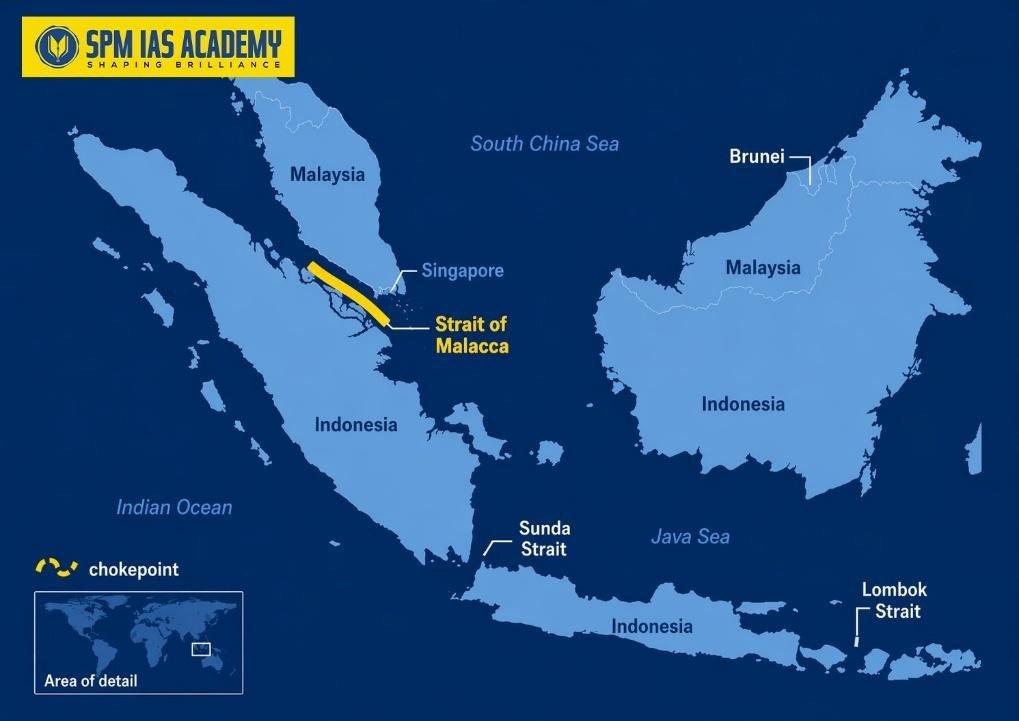
Which Waterway Connects the Andaman Sea with the South China Sea?
The Strait of Malacca connects the Andaman Sea with the South China Sea. This strait runs between the Malay Peninsula and the Indonesian island of Sumatra. It is one of the busiest and most important shipping lanes in the world.
Over 80,000 ships pass through the Strait of Malacca every year. Additionally, it carries about 25 percent of global trade. As a result, it holds enormous strategic value for world economies.
India also has a strategic interest in this strait. The Andaman and Nicobar Islands give India a key geographic advantage near this waterway.
South China Sea Dispute: Causes and Current Status
The South China Sea dispute is one of the most complex territorial conflicts in Asia. It involves competing claims over islands, reefs, and exclusive economic zones. Moreover, it involves rich natural resources and key shipping routes.
Why Is the South China Sea Disputed?
Several factors make the South China Sea a disputed zone. These include:
- Natural Resources: The seabed holds an estimated 11 billion barrels of oil and 190 trillion cubic feet of natural gas.
- Fisheries: The sea accounts for about 10 percent of global fish catch. Many coastal communities depend on it.
- Strategic Shipping Lanes: Nearly one-third of global maritime trade passes through this sea. This makes it vital for global supply chains.
- Military Importance: Controlling the sea means projecting military power across Asia and the Pacific.
- Historical Claims: China uses historical maps to assert its nine-dash line claim over most of the sea.
China’s Nine-Dash Line Claim
China claims about 90 percent of the South China Sea. It uses a boundary known as the nine-dash line. This line appears on Chinese maps and overlaps with the exclusive economic zones of several neighbouring countries.
In 2016, the Permanent Court of Arbitration (PCA) at The Hague ruled against China’s nine-dash line. The court said the claim had no legal basis under international law. However, China rejected the ruling and continues to assert its claim.
Disputed Islands in the South China Sea
The disputed islands in the South China Sea include the Spratly Islands, the Paracel Islands, and the Scarborough Shoal. These are the main flashpoints in the dispute. Each of these areas has seen military build-up and diplomatic tensions in recent years.
China has built artificial islands in the Spratly Islands. It has installed military equipment and infrastructure on these islands. This has increased tensions with the Philippines, Vietnam, and other claimants.
Stay updated with daily insights and analysis through reliable currentaffairs for UPSC and competitive exams.
Role of UNCLOS in the South China Sea Dispute
The United Nations Convention on the Law of the Sea (UNCLOS) governs maritime boundaries. It gives each coastal nation an Exclusive Economic Zone (EEZ) of 200 nautical miles. Countries can exploit resources within this zone.
Most claimants use UNCLOS to back their territorial claims. In contrast, China interprets UNCLOS differently. It argues that its historical rights take precedence over the convention. This remains a key legal and diplomatic challenge.
India’s Interest in the South China Sea
India follows an Act East Policy. As a result, the South China Sea is important to India’s foreign policy. India supports freedom of navigation and overflight in international waters.
Moreover, India has oil exploration projects in the South China Sea in partnership with Vietnam. China has repeatedly objected to these projects. This has added another dimension to India-China tensions.
India also participates in joint naval exercises with ASEAN nations and the United States. These exercises aim to uphold freedom of navigation in international waters. Hence, the South China Sea directly affects India’s strategic interests.
United States and the South China Sea
The United States does not claim any territory in the South China Sea. However, it actively opposes China’s expanding control. The US Navy regularly conducts freedom of navigation operations in the region.
The US supports its allies like the Philippines and Japan. It also works with the QUAD grouping, which includes India, Australia, and Japan. Together, these nations aim to maintain a free and open Indo-Pacific region.
ASEAN and the South China Sea Dispute
The Association of Southeast Asian Nations (ASEAN) plays a central role in managing the dispute. Several ASEAN members are direct claimants. These include Vietnam, the Philippines, Malaysia, and Brunei.
ASEAN has been pushing for a Code of Conduct (COC) in the South China Sea. This code aims to set rules for behaviour in disputed waters. However, negotiations with China have been slow and complex.
Conclusion:
In conclusion, the South China Sea is very important for the world. It supports global trade, fishing, and energy resources. Moreover, many countries depend on this sea for their economy and security.
However, the South China Sea dispute continues to create tension between countries. Different nations claim the same areas, which leads to conflicts and military activities. Therefore, peaceful solutions and strong international rules are very important.
Furthermore, laws like UNCLOS and efforts by ASEAN and global powers can help manage the situation. As a result, cooperation can reduce conflicts in the region.
Explore expert guidance and structured preparation with UPSC coaching in Assam for serious civil services aspirants.
Overall, understanding the South China Sea, its importance, and ongoing disputes is very important for global politics and exams. Hence, it will continue to remain a key issue in international relations.
Source:
Frequently Asked Questions:
The South China Sea is a large sea in Southeast Asia. Moreover, it connects many countries and supports global trade.
The South China Sea location is between countries like China, Vietnam, the Philippines, and Malaysia. Therefore, it lies in an important part of Asia.
The South China Sea is important because it has busy trade routes, rich fish resources, and oil and gas reserves. As a result, many countries depend on it.
The South China Sea dispute happens because many countries claim the same islands and sea areas. Therefore, this creates tension and conflicts.
Several South China Sea countries are involved, such as China, Vietnam, the Philippines, Malaysia, and Brunei. Moreover, other countries like the United States also take interest in the region.

Behind every article at SPM IAS Academy is a team of skilled content writers and subject experts committed to making preparation easier for aspirants. From answering common doubts to breaking down complex issues and current affairs, we create content that is accurate, easy to understand, and directly useful for UPSC, APSC, and other competitive exams.