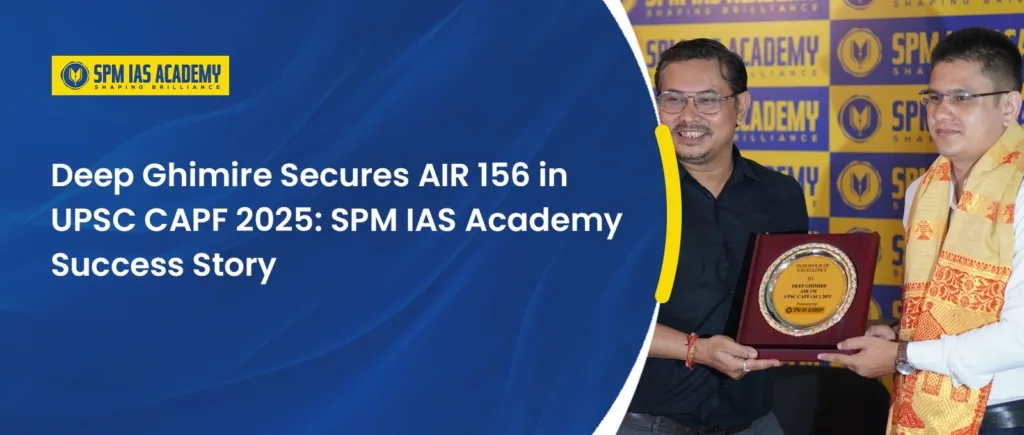
Cracking a pan-India examination conducted by the Union Public Service Commission (UPSC) demands intellectual rigor, strategic syllabus alignment, and unshakable mental grit. In an in-depth session of SPM Spotlight, Abhishek Lahkar Sir sat down with Deep Ghimire, a dedicated foundation student of SPM IAS Academy, who secured All India Rank (AIR) 156 in the UPSC Central Armed Police Forces (CAPF) Assistant Commandant Examination 2025.
Deep Ghimire’s journey directly challenges the misconception that central UPSC selections are out of reach for aspirants from Assam and the Northeast. From navigating the physical and mental demands of Sainik School Goalpara to overcoming six consecutive SSB rejections before earning his recommendation, his story offers a comprehensive, practical roadmap for defense and civil services aspirants alike.
Life Philosophy, Self-Belief, and Breaking the Northeast Myth
A recurring obstacle discussed during the conversation is the psychological hesitation among aspirants from the Northeast when targeting national-level examinations like UPSC CSE or CAPF. Host Abhishek Lahkar Sir pointed out that many candidates operate under the assumption of an inherent regional disadvantage.
Deep Ghimire dismissed this mindset directly, emphasizing that access to digital education and quality mentorship has equalized the playing field:
“Pehle bharosa rakhna padega ki hum bhi clear kar sakte hain bol ke. Chahe hum Assam se ho ya kahin se bhi ho, we are part of the larger nation, so we are equally eligible for that.”
He explained that with modern resources, geographical boundaries no longer dictate preparation quality:
- Universal Access: High-quality lectures, mock tests, and standard reference materials are available equally across India, whether studying from Tezpur, Guwahati, or New Delhi.
- Internal Motivation Over External Pressure: When a career choice is driven by personal ambition rather than societal expectations, multiple failures do not break your spirit:
“Kisi ne mere upar forces force nahi kiya tha. Jo apna goal hai, toh khud ke liye toh karna padega na, sir? Agar aapka interest aur motivation internally aaye, then 7 kya, 70 attempts bhi lag sakte hain.”
- Clarity of Destination: Deep highlighted that defining your objective early eliminates nearly half the battle:
“Sabse pehle zaroorat hai clarity of mind. Agar kisi ko yeh pata hai ki unko kya karna hai life mein, wahi sabse bada obstacle hai. Once you get clarity of mind, 30 to 40% obstacle aise hi paar ho jata hai.”
Formative Years of Deep Ghimire : Missamari Cantonment & Sainik School Discipline
Deep Ghimire’s passion for uniform services began in Missamari (near Tezpur, Assam), an active military cantonment. Studying at Kendriya Vidyalaya Missamari from Class 5 to Class 8, he watched high-ranking defense officials and airborne paratroopers drill daily next to his school grounds. This early exposure inspired him to clear the entrance test for Sainik School Goalpara in Class 9.
The Crucible of Goalpara Sainik School
Transitioning from a civilian household into a regimented military boarding school created an immediate shock factor that forged lifelong discipline:
- The 5:00 AM Routine: Days began at dawn with rigorous physical training (PT), cross-country runs, and inspections, seven days a week.
- Building Mental Toughness: As a member of Udaygiri House, long-distance running traditions pushed endurance limits:
“Hum log ka cross-country route hota tha 9 km ka. Lekin juniors ko seniors kabhi-kabhi do baar bhi dauda dete the—9 km into 2 (18 km)… Woh sab karke ek tough mentality ban gaya.”
Physical Fitness as a Cognitive Multiplier
Addressing whether heavy physical training interfered with academic studies, Deep noted that physical exertion actually heightened his study efficiency:
- Time Compression: With only 3 hours available for self-study compared to 5–6 hours in civilian life, focus sharpened dramatically.
- Cognitive Focus: Regular physical training (running, swimming, or gym workouts) eliminated lethargy, keeping the mind alert for demanding General Studies subjects.
Deep carried this routine into Jorhat Engineering College (JEC), completing his B.Tech in Mechanical Engineering in 2023 while concurrently preparing for competitive exams.
The 7-Attempt SSB Journey: Handling Rejections with Composure
Deep Ghimire’s path to recommendation was tested through a prolonged series of rejections across seven Service Selection Board (SSB) attempts:
- Initial Rejection (2019): In his first NDA SSB interview, he reached the final day but was conferenced out.
- The Screening-Out Phase: Subsequent attempts across NDA and Technical Entries resulted in recurring Stage-1 (PPDT/Screening) eliminations.
- Incubation During College: Deep used his undergraduate years at JEC to deliberately build the qualities required of an officer. He actively participated in campus clubs to refine public speaking, logical structuring, and interpersonal skills.
- The Recommendation: On his very first Combined Defence Services (CDS) attempt after completing his degree, he secured a direct recommendation from 24 SSB Bangalore.
Reflecting on staying focused through six rejections, Deep remarked:
“Chhathe baar tak doubtful rehta hai ki hoga ya nahi hoga, lekin mann mein hamesha yeh tha ki main yeh kar sakta hoon. I knew that I could do it. Self-confidence rehna hi padega.”
Family and Peer Support
Deep Ghimire acknowledged the vital backing of his family, who provided financial and emotional support without questioning his choices when he had to travel repeatedly to Allahabad, Bangalore, and Gandhinagar:
“Parents ne financial backing aur emotional support poora diya. Unhone bola: ‘Jab tak umar hai, karo.’ Meri family aur doston ko mujh par mere se zyada bharosa tha.“
Career Choices and Job Preferences: Why ITBP Over CISF?
In the UPSC CAPF (AC) examination—which recruits Group-A Gazetted Officers for BSF, CRPF, CISF, ITBP, and SSB under the Ministry of Home Affairs—nearly 90% to 99% of top rankers opt for CISF due to urban postings and industrial security profiles.
Deep Ghimire made an unconventional choice by selecting the Indo-Tibetan Border Police (ITBP) as his first preference, scoring 119 out of 150 marks in the UPSC interview:
- Passion for Mountain Warfare: Deep sought an adventurous military life specialized in extreme-altitude operations.
- Thriving Above 15,000 Feet: Operating in hostile Himalayan terrain offered the unique professional challenge he wanted:
“ITBP ka specialization mountain warfare mein bohot unique hai. 15,000 feet ke upar operate karna sadharan baat nahi hai. Wahan ka experience kahin aur nahi milega… 10–12 saal baad bolne ke liye 15,000–18,000 feet aur Siachen ki kahaniyan honi chahiye.”
Preparation Strategy with SPM IAS Academy
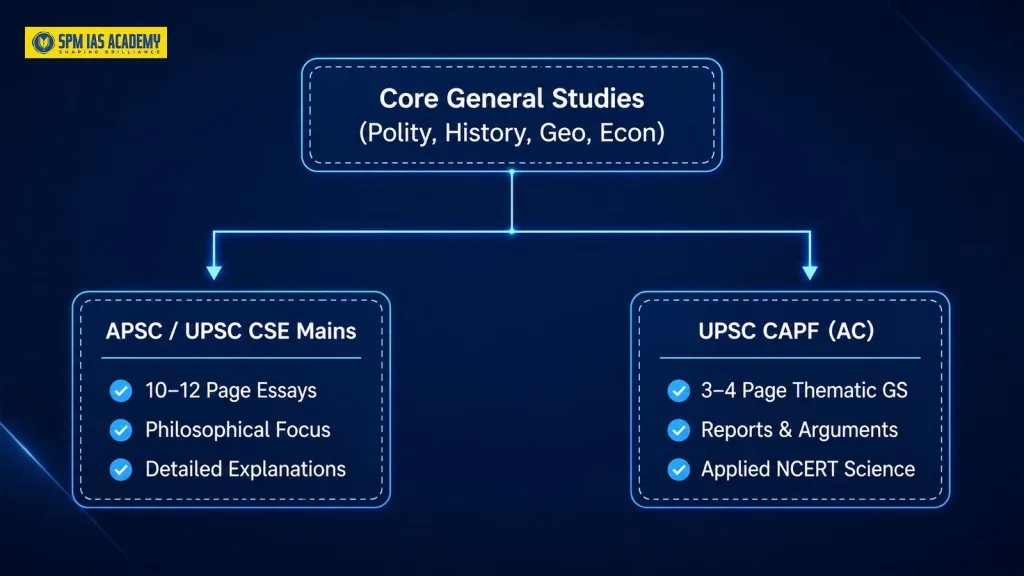
As a foundation student at SPM IAS Academy, Deep Ghimire leveraged the massive 85% to 90% syllabus overlap between State Civil Services (APSC), UPSC CSE, and UPSC CAPF:
Paper 1: General Ability & Intelligence (250 Marks)
- General Studies Core: Daily newspaper analysis from Satyajit Sir at SPM IAS Academy formed his baseline for Economy, Polity, and Ethics.
- Applied General Science: Unlike broad civil services prelims questions, CAPF tests deeper conceptual science from NCERT Class 9–10 with selective 11–12 topics.
- Quantitative Aptitude: Regular practice of CSAT-level math and logical reasoning (10–15 questions per test).
Paper 2: General Studies, Essay, and Comprehension (200 Marks)
- Thematic Conciseness: While Civil Services essays span 10–12 pages with philosophical themes, CAPF requires 4 thematic essays (out of 6 options) within 3 to 4 pages each.
- High Information Density: With strict page limits, essays must avoid narrative padding and deliver dense factual points, constitutional references, and committee data.
- The “GS Masala” for Arguments & Reports: Deep utilized his daily current affairs notes to structure balanced counter-arguments and formal reports for Paper 2.
Hybrid Mentorship Model at SPM IAS Academy
Deep utilized a structured hybrid learning model:
- Digital Lectures: Consistent online viewing of Satyajit Sir’s daily analyses and specialized modules from faculty members like Chinmoy Sir and Mrithul Sir.
- In-Person Mains Mock Tests: Attending Sunday mock test sessions at the SPM IAS Academy center in Guwahati to simulate exam pressure and refine time management.
Physical Standards & Efficiency Test (PET/PST)
Deep Ghimire noted that clearing the physical stage requires basic, regular conditioning rather than extreme athletic training:
- Physical Standard Test (PST): Height and chest measurements meet standard commission norms.
- Physical Efficiency Test (PET): Encompasses an 800-meter run, a 100-meter sprint, long jump, and shot put.
- Consistency at Home: Maintaining routine morning runs and bodyweight workouts at home is sufficient to pass the physical benchmarks comfortably.
Phased Roadmap for College Students
For students aiming to balance university degrees with competitive examinations, Deep recommended a clear, three-phase approach:
| College Stage | Strategic Focus | Practical Action Items |
| 1st Year | Exploration & Habit Building | Settle into campus life, join speaking clubs, and establish daily newspaper reading habits. |
| 2nd & 3rd Year | Core Foundation | Master Class 6–12 NCERTs across Polity, History, Geography, and Economy; practice basic CSAT. |
| Final Year & Beyond | Application & Test Series | Join a dedicated test series (such as SPM IAS Academy Mains Test Series), write timed mocks, and brush up on current affairs. |
Summary Comparison: Civil Services vs. UPSC CAPF
| Parameter | Civil Services (APSC / UPSC CSE) | UPSC CAPF (Assistant Commandant) |
| Recruitment Role | Administrative, Police & Revenue Cadres | Armed Border Security & Internal Operations |
| Rank Status | Group-A / Group-B Gazetted Officer | Group-A Gazetted Officer (Ministry of Home Affairs) |
| Written Format | In-depth, analytical GS papers & long essays | Objective GS/Science + 3-4 page concise thematic essays & reports |
| Interview Weightage | 275 Marks (UPSC CSE) / 180 Marks (APSC) | 150 Marks (Deep secured 119/150) |
| Physical Requirement | Medical clearance | Mandatory Physical Efficiency Test (800m, 100m, Long Jump, Shot Put) |
Final Takeaway
Deep Ghimire’s journey from Missamari to securing AIR 156 and entering the ITBP as an Assistant Commandant illustrates that setbacks are merely stepping stones when paired with structured guidance, early foundation building, and internal drive.
His parting message to all competitive exam aspirants remains clear:
“Bharosa rakhiye apne upar aur karte jaiye. Ek na ek din hona hi hai. Samay lag sakta hai—ek saal na ho, do saal na ho—lekin kitna koi rok sakta hai? Agar aapke andar woh junoon hai, toh safalta milni hi hai.”
For the complete conversation, watch the full interview on SPM IAS Academy’s Official YouTube Channel.

Written by SPM IAS Academy Content Team
We don’t create content to fill pages; we create content that fills the gaps in your preparation. Every article is researched, refined, and designed with one goal — to make your journey towards success a little sharper.
No unnecessary noise. No recycled information. Just focused insights, exam-oriented guidance, and content that actually helps aspirants move forward.
Because when the competition is tough, average preparation doesn’t make the cut.