
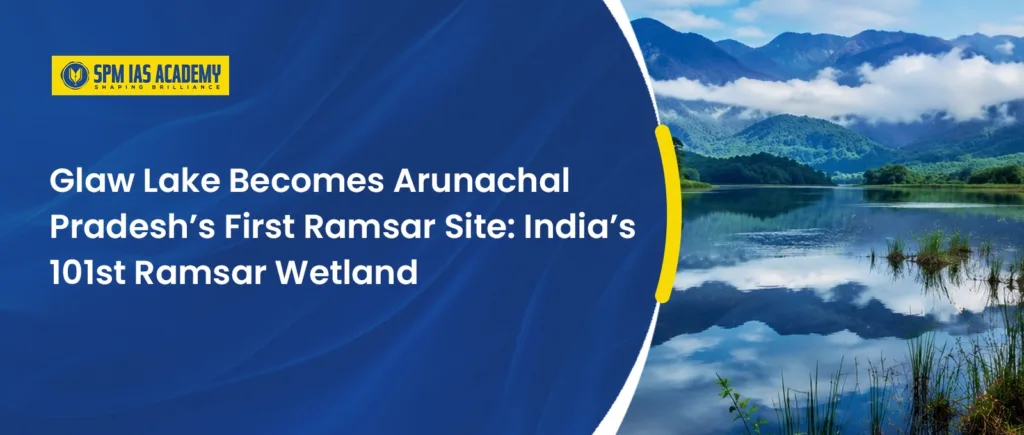
Glaw lake becomes Arunachal Pradesh’s first Ramsar site and marks a major milestone for India’s wetland conservation journey. The lake was designated as India’s 101st Ramsar site on 3 August 2026. It is located inside the Kamlang Tiger Reserve and Wildlife Sanctuary in Lohit district of Arunachal Pradesh, in the Eastern Himalayas.
For UPSC, APPSC, APSC, and other State PCS aspirants, this topic is important under Environment, Biodiversity, Wetlands, the Ramsar Convention, Protected Areas, and Northeast India Current Affairs. Candidates enrolled in the best APSC online coaching programs should prepare this topic thoroughly, as it is highly relevant for both Prelims and Mains and is frequently linked with environmental conservation, international conventions, and Assam and Northeast India current affairs.
Why was Glaw Lake in the News?
Glaw lake becomes Arunachal Pradesh’s first Ramsar site after Environment, Forest and Climate Change Minister announced its designation as India’s 101st Ramsar Site. He described the development as an important step for biodiversity conservation, water security, climate security and sustainable livelihoods.
This recognition is significant because Arunachal Pradesh, despite being one of India’s richest biodiversity zones, had no Ramsar wetland earlier. Therefore, the designation gives national and international attention to the ecological value of Glaw Lake. This development is highly relevant for aspirants attending APSC online classes, as it strengthens preparation for Environment, Ecology, Biodiversity, and Current Affairs sections in both APSC and UPSC examinations.
Where is Glaw Lake Located?
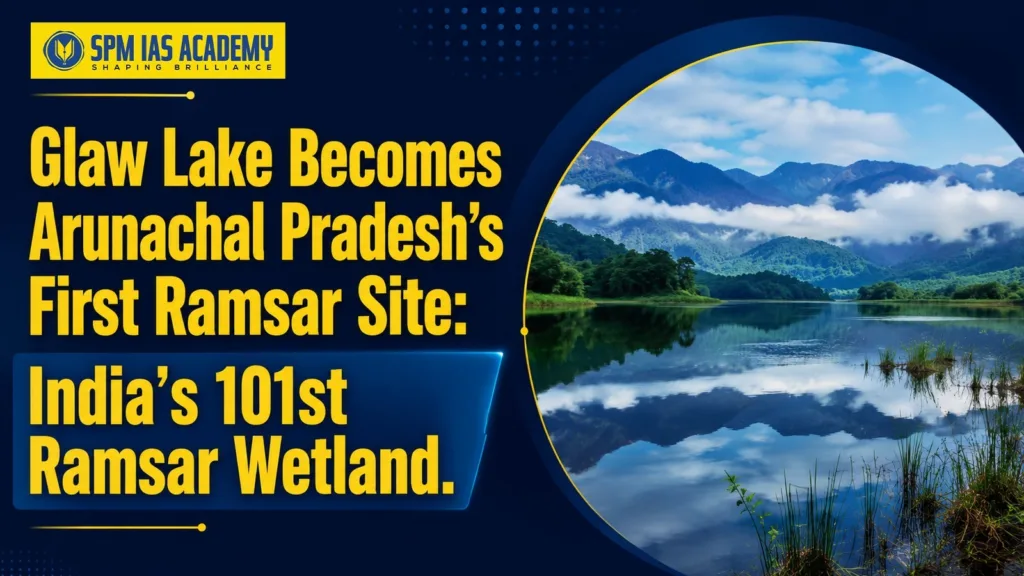
Glaw Lake is a pristine freshwater lake situated within the Kamlang Tiger Reserve and Wildlife Sanctuary. The site lies in Lohit district of Arunachal Pradesh, in the Eastern Himalayan region.
The Eastern Himalayas are one of the world’s most important biodiversity regions. Moreover, Glaw Lake’s location inside a tiger reserve adds further ecological importance because it forms part of a larger protected forest landscape. This topic is especially important for students seeking the best online coaching for APSC, as it is highly relevant for Environment, Biodiversity, Protected Areas, and Northeast India Current Affairs in APSC, UPSC, and other State PCS examinations.
What is a Ramsar Site?
- A Ramsar site is a wetland of international importance designated under the Ramsar Convention. The convention was adopted in 1971 in Ramsar, Iran, to promote conservation and wise use of wetlands. India became a party to the Ramsar Convention in 1982.
- Wetlands include lakes, marshes, peatlands, mangroves, floodplains and even some artificial wetlands. They provide multiple ecosystem services such as groundwater recharge, flood control, fish breeding, carbon storage and habitat support for birds and aquatic species.
Ecological Features of Glaw Lake
Glaw lake became Arunachal Pradesh’s first Ramsar site because of its high ecological value. It is a freshwater lake surrounded by rich vegetation and mountain ecosystems. According to official information, the site and its catchment support more than 150 tree species and 49 orchid species.
This biodiversity makes Glaw Lake important for conservation. Orchids often indicate the ecological quality of mountain habitats, while diverse tree cover supports birds, insects, mammals, and other species. In addition, the lake’s freshwater system helps maintain local hydrology and climate resilience. For aspirants studying at an IAS academy in Guwahati, this topic is highly relevant for Environment, Ecology, Biodiversity, and Current Affairs, particularly in the context of UPSC, APSC, and other competitive examinations.
Why is Glaw Lake Ramsar Designation Important?
The designation has several important benefits:
- First, it recognises Arunachal Pradesh’s wetland wealth. The state now has its first internationally recognised Ramsar site.
- Secondly, it strengthens biodiversity conservation. The lake lies in a biodiversity hotspot and supports rich vegetation, orchids and freshwater ecosystems.
- Moreover, it improves wetland governance. Ramsar recognition encourages better monitoring, conservation planning and community participation.
- In addition, it supports sustainable livelihoods. Healthy wetlands provide water, fisheries, ecological stability and nature-based livelihood opportunities.
- Finally, it boosts India’s global conservation image. India’s Ramsar site count has increased from 26 in 2014 to 101 in 2026.
Glaw Lake and India’s Wetland Conservation Journey
The fact that Glaw lake becomes Arunachal Pradesh’s first Ramsar site also reflects India’s expanding wetland conservation network. India now has 101 Ramsar sites, which demonstrates rapid growth in recognition of wetlands across states and union territories.
This expansion matters because wetlands face several threats, including pollution, encroachment, invasive species, climate change, unregulated tourism and land-use change. Therefore, Ramsar recognition must translate into active conservation on the ground.
Conclusion
Glaw lake’s designation as Arunachal Pradesh’s first Ramsar site, makes it a historic achievement for the state and India’s wetland conservation movement. Its location inside Kamlang Tiger Reserve, rich biodiversity, freshwater ecosystem and Eastern Himalayan setting make it ecologically significant. However, Ramsar status must lead to long-term protection, scientific monitoring and community-led conservation.
Source:
Frequently asked questions
Glaw Lake becomes Arunachal Pradesh’s first Ramsar site and India’s 101st Ramsar wetland, making it important for Environment, Biodiversity, Ramsar Convention, Protected Areas and Northeast India current affairs.
Glaw Lake is located inside the Kamlang Tiger Reserve and Wildlife Sanctuary in Lohit district of Arunachal Pradesh. It lies in the Eastern Himalayan region and supports rich freshwater biodiversity.
Glaw Lake became a Ramsar site because of its high ecological value. The lake and its catchment support rich vegetation, more than 150 tree species, 49 orchid species, freshwater biodiversity and climate-resilient wetland functions.

Behind every article at SPM IAS Academy is a team of skilled content writers and subject experts committed to making preparation easier for aspirants. From answering common doubts to breaking down complex issues and current affairs, we create content that is accurate, easy to understand, and directly useful for UPSC, APSC, and other competitive exams.