
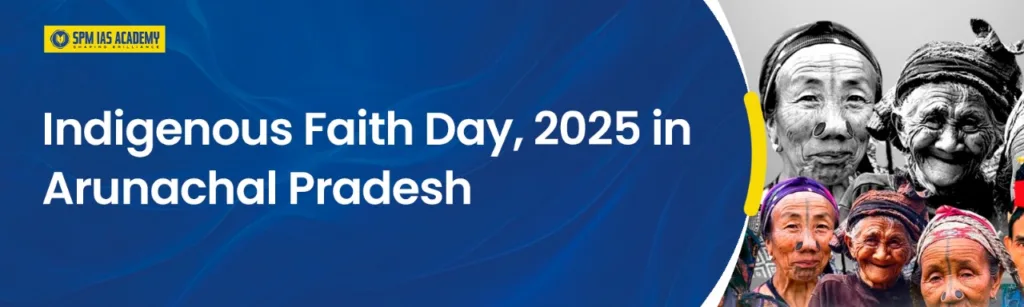
Source: Arunachal Times
Date: 02/12/2025
Syllabus: GS 1
What is Indigeneity?
- Anthropological perspective:
- Marshall Sahlins and Clifford Geertz – Indigeneity is rooted in shared memory, kinship networks, ecological relationships, and cultural continuity, not merely territorial occupation.
- Sociological Perspective:
- Anthony Giddens notes that indigenous identity persists despite modernization because it is anchored in embedded traditions rather than transactional social relations.
- Political Science / Post-colonial Studies:
- Benedict Anderson and James Scott view indigeneity as a political category shaped by resistance to assimilation and state expansion.
- Legal and Constitutional Scholarship:
- In global jurisprudence (UNDRIP 2007), indigeneity is defined by:
- Historical continuity with pre-settler societies
- Distinct cultural practices
- Self-identification and community acceptance
- Indian constitutional scholars emphasise that indigenous status (as Scheduled Tribes) is derived from ancestry, social distinctiveness, and geographical isolation, not religion.
- P.S. Krishnan and Virginius Xaxa – Indigeneity as a framework for affirmative action, cultural protection, and political representation.
- In global jurisprudence (UNDRIP 2007), indigeneity is defined by:
What is Indigenous Faith Day?
- Observed every year on 1 December in Arunachal Pradesh.
- Celebrates ancient belief systems, rituals, and traditions of indigenous communities.
- Aims to honour the identity, culture, and worldview of tribal groups.
Nature of Indigenous Faiths:
- Not founded by a single prophet or leader.
- Evolved naturally through oral traditions, stories, rituals, and practices.
- Originated from forests, rivers, mountains, and natural elements.
- Teachings promote respect, balance, harmony, and coexistence with nature.
Constitutional Context:
- India recognises indigenous communities under Scheduled Tribes (ST) (article 342).
- Recognition is based on ancestry, ethnicity, traditions, and historical continuity, not religion.
- Protecting indigenous heritage aligns with Constitutional safeguards (Articles 29, 371H, Fifth & Sixth Schedule principles, NCST (Art 338)).
What are the Significances?
- Tribal Diversity in Arunachal Pradesh:
- Home to 25 major tribes and 100+ sub-tribes (Nyishi, Adi, Apatani, Monpa, Galo, Wancho, Nocte, etc).
- Each community has distinct rituals, animistic traditions, and nature-based faith systems.
- Importance of Indigenous Knowledge:
- Vital for biodiversity conservation.
- Helps maintain sustainable agricultural systems (jhum, terrace farming).
- Preserves sacred groves and traditional forest management.
- Significance for Arunachal Pradesh:
- Strengthens cultural pride and unity among tribes.
- Reinforces the value of ancestral wisdom and traditional ecological knowledge.
- Encourages preservation of languages, rituals, festivals, and customary laws.
- Helps counter cultural erosion due to rapid modernization.
Challenges:
- Loss of languages.
- Influence of global religions and urban lifestyles.
- Decline in traditional festivals among youth and increasing celebration of western festivals.
- Need for documentation and community-led preservation.
Mains Practice Question:
Regular answer writing through Civil Services Mains Practice Question improves analytical depth and GS-I score.
Q. “Indigenous Faith Day in Arunachal Pradesh highlights the importance of preserving tribal faiths and ecological knowledge.” Discuss the significance of indigenous faiths in India and the challenges faced in their preservation.
Pointers for Answer:
Introduction:
- Indigenous Faith Day: Observed 1 December in Arunachal Pradesh.
- Celebrates ancient belief systems, rituals, and traditions of tribal communities.
- Focuses on identity, culture, and worldview of indigenous peoples.
Significance of Indigenous Faiths:
- Cultural Significance:
- Reflect shared memory, kinship, oral traditions, rituals, and nature-based practices.
- Promote community bonding, cultural pride, and continuity.
- Environmental & Ecological Importance:
- Traditional knowledge supports biodiversity conservation.
- Maintains sustainable agricultural systems (jhum cultivation, terrace farming).
- Preserves sacred groves and forest management practices.
- Constitutional & Legal Relevance:
- Indigenous communities recognized as Scheduled Tribes (Article 342).
- Safeguarded under Articles 29, 371H, Fifth & Sixth Schedule, and NCST (Art 338).
- Societal Relevance:
- Upholds ancestral wisdom, customs, languages, and festivals.
- Encourages inter-generational knowledge transfer and resilience against cultural erosion.
Challenges to Preservation:
- Cultural erosion: Influence of global religions and urban lifestyles.
- Language loss: Decline in traditional languages among younger generations.
- Declining traditional practices: Reduced participation in festivals and rituals.
- Documentation gap: Limited written records; oral traditions at risk.
- Modernization pressures: Adoption of western lifestyles and festivals.
Way Forward:
- Promote community-led documentation and awareness programs.
- Encourage youth participation in festivals and rituals.
- Integrate indigenous ecological knowledge into state biodiversity and agriculture policies.
- Strengthen legal and policy frameworks to protect tribal heritage and languages.
Aspirants can deepen GS-I understanding through expert guidance at UPSC & APSC Coaching in Guwahati.