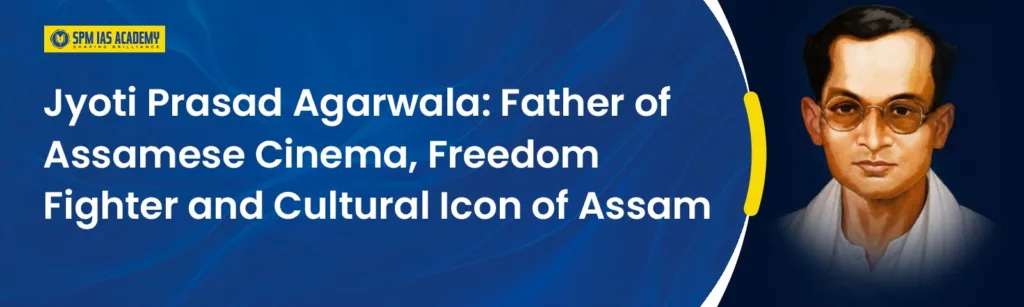
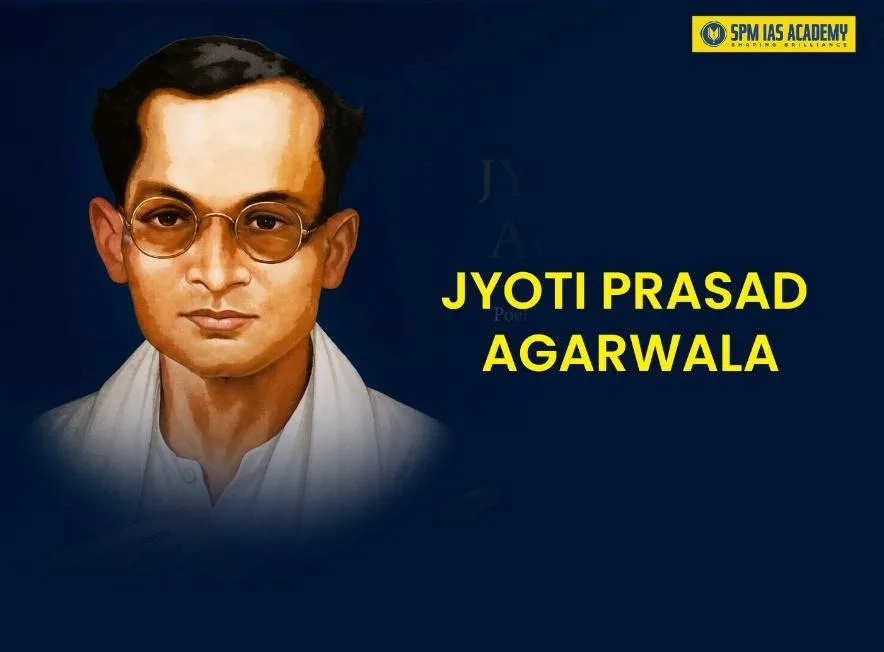
Jyoti Prasad Agarwala was an Assamese filmmaker, playwright, freedom fighter, and the father of Assamese cinema. He directed Joymoti, the first Assamese film, in 1935. He is widely known as Rupkonwar, which means ‘Prince of Beauty’. He gave Assam its first film, its first cinema hall, and over 300 immortal songs. Every APSC aspirant must know about this extraordinary personality of Assam.
Who Was Jyoti Prasad Agarwala?
Jyoti Prasad Agarwala was born on 17 June 1903 in Tamulbari Tea Estate, Dibrugarh, Assam. His father was Paramananda Agarwala and his mother was Kiranmayee Devi. His family originally came from the Marwar region of Rajasthan. However, Jyoti Prasad Agarwala considered himself fully Assamese by heart and soul.
His uncles, Chandra Kumar Agarwala and Ananda Chandra Agarwala, were famous Assamese poets. Growing up in such a creative family shaped Jyoti Prasad Agarwala deeply. He showed great talent in music, writing, and acting from a very young age.
Quick Facts About Jyoti Prasad Agarwala:
| Born | 17 June 1903, Tamulbari Tea Estate, Dibrugarh |
| Died | 17 January 1951, Poki, Tezpur |
| Popular Name | Rupkonwar (Prince of Beauty) |
| Known For | Father of Assamese Cinema |
| First Film | Joymoti (1935) |
| Death Anniversary | Observed as Silpi Divas (Artist’s Day) across Assam |
| Total Songs Composed | Over 300 songs, popularly known as Jyoti Sangeet |
Education, Freedom Struggle, and Early Life of Jyoti Prasad Agarwala
- Jyoti Prasad Agarwala studied in schools in Dibrugarh and Tezpur. In 1918, he attended the Ahmedabad Congress with his father. There, he heard Mahatma Gandhi speak. That speech left a deep impression on him. He became a committed nationalist from that day.
- In 1926, Jyoti Prasad Agarwala went to Edinburgh, Scotland to study Economics at the University of Edinburgh. However, his creative mind could not be limited to Economics alone. He composed melodies that later became famous songs in Assam. These compositions are now celebrated as Jyoti Sangeet.
- In 1930, Jyoti Prasad Agarwala left his studies and returned to Assam. On his way back, he spent seven months at UFA Studio in Berlin, Germany. There, he learned the art and technique of filmmaking. This decision changed the history of Assamese cinema forever.
- After his return, Jyoti Prasad Agarwala actively joined India’s independence movement. In 1932, he was imprisoned by the British for fifteen months. In 1941 and 1942, he participated in the Quit India Movement. He also went underground to escape British repression in 1942.
Why is Jyoti Prasad Agarwala famous?
- Jyoti Prasad Agarwala is best known as the Father of Assamese Cinema because he directed Joymoti in 1935, the first Assamese film in history.
- Moreover, he established Chitraban Studio in Tezpur and laid the foundation of modern Assamese cinema.
- He also composed more than 300 songs, which are collectively known as Jyoti Sangeet. Moreover, famous Jyoti Sangeet songs such as ‘Luitor Paarore Ami Deka Lora’ remain highly popular across Assam and continue to inspire generations with themes of patriotism and Assamese identity. These songs remain a major part of Assamese music and culture.
- Furthermore, Jyoti Prasad Agarwala was a talented playwright, poet, filmmaker, songwriter, actor, and cultural reformer who transformed Assamese art and literature.
- He wrote several famous plays such as Sonit Kunwori, Karengar Ligiri, and Lobhita, which highlighted social awareness and nationalism.
- In addition, he actively participated in India’s freedom struggle and faced imprisonment by the British government for his nationalist activities.
- Jyoti Prasad Agarwala also opened Junaki Cinema Hall in 1937, which became an important cultural landmark in Assam.
- Due to his extraordinary contribution to Assamese culture, literature, music, theatre, and cinema, people lovingly gave him the title “Rupkonwar,” meaning “Prince of Beauty.”
- Every year, Assam observes his death anniversary as Silpi Divas to honour his contribution to Assamese society and culture.
Students preparing Assam history topics can join a trusted apsc coaching centre in assam for expert guidance.
Why is Jyoti Prasad Agarwala called Rupkonwar?
- Jyoti Prasad Agarwala received the title “Rupkonwar,” which means “Prince of Beauty,” because of his extraordinary contribution to Assamese art, culture, literature, music, and cinema.
- Moreover, his creative works beautifully reflected the beauty of Assam, human emotions, patriotism, and social awareness. Therefore, people deeply admired his artistic vision and personality.
- He introduced modern Assamese cinema through ‘Joymoti’, the first Assamese film, and transformed the cultural identity of Assam.
- Furthermore, he composed more than 300 songs known as ‘Jyoti Sangeet’, which remain an important part of Assamese music and cultural heritage.
- Jyoti Prasad Agarwala also wrote famous plays, poems, and short stories that inspired people with messages of nationalism, freedom, and social justice.
- In addition, his artistic talent extended to filmmaking, acting, music composition, drama, and literature, making him one of the greatest cultural icons of Assam.
- The people of Assam lovingly gave him the title “Rupkonwar” to honour his creativity, cultural leadership, and timeless contribution to Assamese society.
Which was the first Assamese film?
- Joymoti was the first Assamese film in history. Moreover, the film was released on 10 March 1935 and marked the beginning of Assamese cinema.
- Jyoti Prasad Agarwala directed, produced, and composed the music for Joymoti. Therefore, he is widely known as the Father of Assamese Cinema.
- The story of ‘Joymoti’ was written by Lakshminath Bezbaruah. The story of Joymoti is based on the life of Sati Joymoti, an Ahom princess who sacrificed her life to protect her husband and the Ahom kingdom. The movie was starred by Aideu Handique and Phani Sarma.
- Furthermore, the film highlighted themes of courage, sacrifice, patriotism, and resistance against oppression.
- To produce the film, Jyoti Prasad Agarwala established the Chitraban Studio, the first film studio in Assam. It was established at Bholaguri Tea Estate near Gohpur in 1934.
- At that time, filmmaking technology and financial resources were very limited in Assam. However, Jyoti Prasad Agarwala successfully completed the project through determination and creativity.
- Although Joymoti did not achieve commercial success initially, the film later became a historic cultural milestone in Assamese cinema and Indian regional cinema.
What is Jyoti Sangeet?
- Jyoti Sangeet refers to the collection of songs composed and written by Jyoti Prasad Agarwala. Moreover, these songs form one of the most important musical traditions in Assamese culture and Assamese music.
- Jyoti Prasad Agarwala composed more than 300 songs during his lifetime. Most of these songs beautifully combine Assamese folk music, Indian classical music, and Western musical influences.
- Furthermore, Jyoti Sangeet focus on themes such as love, patriotism, nature, humanism, freedom, and social awareness. Therefore, these songs continue to inspire generations across Assam.
- He composed many of these melodies while studying at the University of Edinburgh in Scotland. Later, these compositions became timeless classics in Assamese music.
- Moreover, Jyoti Sangeet played a major role in modernising Assamese music and shaping the cultural identity of Assam during the 20th century.
- Even today, schools, colleges, cultural events, and music programmes across Assam regularly perform Jyoti Sangeet songs with great respect and pride.
- Due to their emotional depth and literary beauty, Jyoti Sangeet songs remain an important part of Assamese literature, music, and cultural heritage.
Major Contributions of Jyoti Prasad Agarwala
- Jyoti Prasad Agarwala directed Joymoti in 1935, which became the first Assamese film and marked the beginning of Assamese cinema.
- Moreover, he established Chitraban Studio in Tezpur in 1934, which became the first film studio in Assam.
- He also directed Indramalati in 1939, the second Assamese film in history.
- Furthermore, Jyoti Prasad Agarwala composed more than 300 songs known as ‘Jyoti Sangeet’, which laid the foundation of modern Assamese music.
- He wrote several important plays such as Sonit Kunwori (1925), Karengar Ligiri (1930), Rupalim (1938) and Lobhita (1945). These plays promoted nationalism, social awareness, and Assamese culture.
- In addition, he contributed significantly to Assamese literature through poems, short stories, children’s literature, and cultural writings.
- Jyoti Prasad Agarwala also opened Junaki Cinema Hall in 1937, which became an important cultural centre in Assam.
- Moreover, he actively participated in India’s freedom struggle and faced imprisonment by the British government for his nationalist activities.
- He played a major role in modernising Assamese theatre through his work at Ban Theatre in Tezpur.
Due to his immense contribution to Assamese cinema, music, literature, theatre, and culture, people lovingly honoured him with the title “Rupkonwar,” meaning “Prince of Beauty.”
Choose reliable apsc upsc coaching in guwahati to strengthen Assam culture and history preparation for competitive exams.
Why Is Silpi Divas Celebrated?
Assam celebrates Silpi Divas every year on 17 January to honour the death anniversary of Jyoti Prasad Agarwala. On Silpi Divas, schools, colleges, cultural organisations, and artists across Assam organise cultural programmes including Jyoti Sangeet performances. Moreover, drama shows, literary discussions and tribute ceremonies are also organized.
Moreover, people remember his contribution to India’s freedom struggle and his role in shaping modern Assamese cultural identity.
Therefore, Silpi Divas is celebrated to pay tribute to Jyoti Prasad Agarwala and to honour the artists, musicians, writers, and cultural heritage of Assam.
Poki: The Historic Home of Jyoti Prasad Agarwala
The ancestral home of Jyoti Prasad Agarwala in Tezpur is called ‘Poki’. This name comes from the Assamese word for a permanent or concrete house. Poki was the first concrete house in Tezpur. It was not just a family home. It was also an important cultural and political meeting place.
At Poki, Jyoti Prasad Agarwala met artists, musicians, social workers, and political leaders. These interactions shaped his thinking and his vision for Assam. In 1921, Mahatma Gandhi visited Assam for the first time. During that visit, Gandhi stayed at Poki. Great national leaders like Madan Mohan Malavya and Motilal Nehru also visited Poki. Therefore, Poki became an important landmark in the history of India’s freedom movement.
Jyoti Prasad Agarwala died at Poki on 17 January 1951 after suffering from cancer. Today, Poki stands as a symbol of Assamese culture and the freedom struggle.
Ban Theatre: Where Jyoti Prasad Agarwala Found His Stage
The Ban Theatre in Tezpur played a key role in the artistic growth of Jyoti Prasad Agarwala. It was a space where he developed his skills in music, art, and literature. Ban Theatre gave him a platform to showcase his talent to the people of Assam.
At Ban Theatre, Jyoti Prasad Agarwala staged his first play, Sonit Kunwari, in 1924. The audience received the play with great enthusiasm and encouragement. This success gave him confidence to pursue the arts more seriously. Later, in the mid-1940s, Jyoti Prasad Agarwala took charge of the music section of Ban Theatre.
Plays Written by Jyoti Prasad Agarwala
Jyoti Prasad Agarwala was a gifted playwright. He wrote his first play, Sonit Kunwari, at the age of just 14. This play was based on the mythological love story of Usha and Aniruddha. Gauhati University later included this play in its curriculum. His plays combined mythology, nationalism, and social awareness in a powerful way.
List of Important Plays by Jyoti Prasad Agarwala
| List of Important Plays by Jyoti Prasad Agarwala | Year |
| Sonit Kunwori | 1925 |
| Karengar Ligiri | 1930 |
| Rupalim | 1938 |
| Nimati Konya | 1964 |
| Khanikar | 1977 |
| Lobhita | 1945 |
Incomplete Plays by Jyoti Prasad Agarwala:
| Incomplete Plays | Status |
| Kanaklata | Incomplete |
| Sundarkonwar | Incomplete |
| Son Pakhilee | Incomplete |
His plays addressed the social and political issues of his time. Furthermore, they inspired audiences to think about freedom, justice, and identity.
Movies Directed by Jyoti Prasad Agarwala: The Birth of Assamese Cinema
Jyoti Prasad Agarwala is the father of Assamese cinema. He brought Assam into the world of filmmaking at a time when Indian cinema was just beginning. His contribution to Assamese movies is historic and unparalleled.
Joymoti (1935): Assam’s First Film
In 1934, Jyoti Prasad Agarwala established Chitraban Studio at Bholaguri Tea Estate in Tezpur. He then made Joymoti, the first-ever Assamese film. The film was released on 10 March 1935. Moreover, he directed, produced, and composed the music for this film himself. The story was based on a play written by Laxminath Bezbarua. It told the heroic story of Sati Joymoti, an Ahom princess who was tortured and imprisoned by a cruel Ahom swargadeo. The film boldly criticised oppression and celebrated courage.
Indramalati (1939): The Second Assamese Film
Jyoti Prasad Agarwala directed his second film, Indramalati, in 1939. Like Joymoti, this film also made strong political and social statements. Both movies showed that cinema could be a powerful tool for social change. In 1937, he also opened the Junaki Cinema Hall in Tezpur, which was a landmark in the cultural history of Assam.
Short Stories, Poems, and Other Literary Works of Jyoti Prasad Agarwala
Jyoti Prasad Agarwala was not only a filmmaker and songwriter. He was also a skilled writer of short stories, poems, and other literary works. His writing reflected a deep love for Assam, nature, and the ordinary people of society.
Poetry Collections by Jyoti Prasad Agarwala
- Jyoti Raamaayan – Poetry Collection
- Luitor Paaror Agnixur – Poetry Collection (1971)
- He also wrote about thirteen children’s poems, including the notable Kumpur Xopon
Short Stories and Other Works
Jyoti Prasad Agarwala wrote several short stories that captured the social realities of Assam. One of his well-known short stories is Amar Gaon (Our Village). His works moved from romantic themes in his early years to more radical and political ideas toward the end of his life. This shift clearly showed his growing concern for social justice and equality.
Understanding the APSC CCE syllabus prelims mains helps candidates prepare Assam-specific cultural topics more effectively.
Conclusion
In conclusion, Jyoti Prasad Agarwala remains one of the greatest cultural icons in Assam and a pioneer of Assamese cinema, Assamese music, and Assamese literature. Through Joymoti, Jyoti Sangeet, famous plays, and his contribution to India’s freedom struggle, he transformed the cultural identity of Assam. Moreover, his title “Rupkonwar” reflects the deep respect people still hold for his creativity and patriotism. Therefore, the life, films, songs, literary works, and contributions of Jyoti Prasad Agarwala are highly important for APSC and other competitive examinations.
Source:
Frequently Asked Questions:
Jyoti Prasad Agarwala was an Assamese filmmaker, playwright, poet, freedom fighter, songwriter, and cultural reformer. Moreover, he directed Joymoti, the first Assamese film, in 1935. Therefore, people widely remember him as the Father of Assamese Cinema.
Jyoti Prasad Agarwala is called the Father of Assamese Cinema because he made Joymoti, the first Assamese movie in history. Furthermore, he established Chitraban Studio and introduced modern filmmaking techniques to Assam.
Jyoti Sangeet refers to the collection of songs composed and written by Jyoti Prasad Agarwala. Moreover, these songs combine Assamese folk music, Indian classical music, and Western musical styles. Therefore, Jyoti Sangeet remains one of the most important musical traditions in Assamese culture.
Assam celebrates Silpi Divas every year on 17 January to honour the death anniversary of Jyoti Prasad Agarwala. Moreover, schools, colleges, and cultural organisations organise Jyoti Sangeet performances, drama shows, and tribute ceremonies on this day. Therefore, Silpi Divas recognises his immense contribution to Assamese culture, music, literature, and cinema.
Joymoti was the first Assamese film directed by Jyoti Prasad Agarwala. The film was released on 10 March 1935and marked the beginning of Assamese cinema. Moreover, the movie highlighted themes of courage, sacrifice, and patriotism in Assamese society.

Behind every article at SPM IAS Academy is a team of skilled content writers and subject experts committed to making preparation easier for aspirants. From answering common doubts to breaking down complex issues and current affairs, we create content that is accurate, easy to understand, and directly useful for UPSC, APSC, and other competitive exams.