
Myanmar and China are two major external factors shaping India’s internal and external security in the North-East. Myanmar has historically provided geographical depth to insurgent groups of North-East India, while China’s Belt and Road Initiative has created strategic pressure around India’s borders and the Indian Ocean. Therefore, both issues directly affect India’s national security, border management and Act East Policy.
Why did Myanmar become a sanctuary for North-East insurgent groups?
Myanmar became a safe space for many insurgent groups because of geography, weak state control and ethnic linkages.
- Porous India-Myanmar border: India and Myanmar share a long 1,643 km border across Arunachal Pradesh, Nagaland, Manipur and Mizoram. Dense forests, hills and difficult terrain make surveillance difficult.
- Ethnic continuity across borders: Communities such as Nagas, Kukis, Mizos and Chins live on both sides of the border. Insurgent groups used these ethnic and kinship links for shelter, movement, recruitment and supplies.
- Weak governance in Myanmar’s borderlands: Myanmar’s peripheral areas have long been controlled by ethnic armed organisations and not fully by the central government. After the 2021 military coup, civil war further weakened state control and increased cross-border insecurity.
- Training camps and logistics: Groups such as NSCN-K, ULFA-I, PLA and other Manipur-based outfits have used Myanmar’s Sagaing region and nearby areas for camps, arms movement and regrouping.
- Arms and drug trafficking networks: The proximity to the Golden Triangle helped insurgents access weapons, narcotics and illegal finance. This strengthened the insurgency-crime nexus.
India has responded through security cooperation with Myanmar, border fencing, suspension/review of the Free Movement Regime, intelligence operations and development projects like the India-Myanmar-Thailand Trilateral Highway and Kaladan project.
How does China’s BRI affect Indian security?
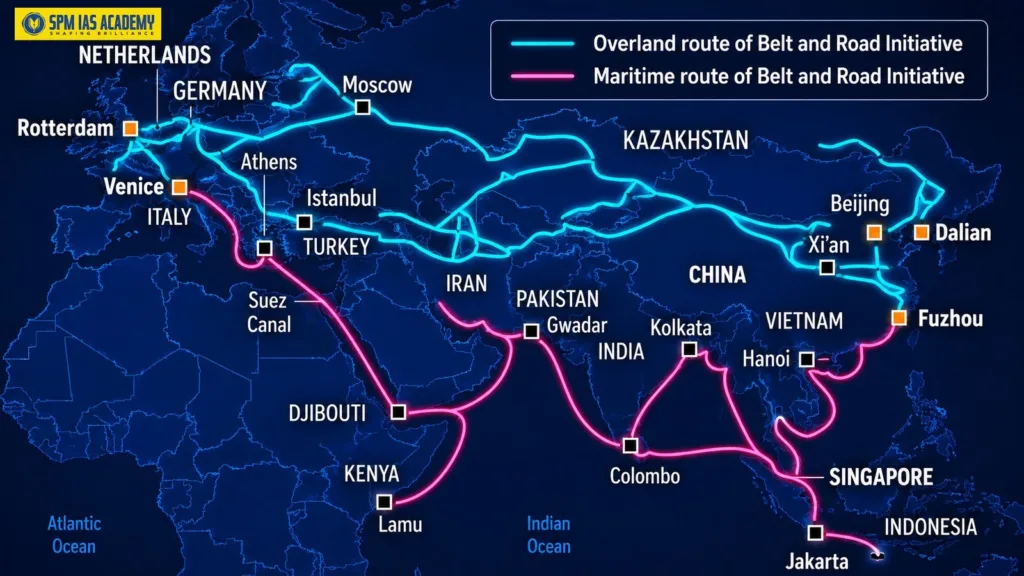
China’s Belt and Road Initiative affects India’s security because it combines infrastructure, finance, ports, energy corridors and geopolitical influence.
- Violation of sovereignty through CPEC: The China-Pakistan Economic Corridor passes through Pakistan-occupied Kashmir. India sees this as a direct violation of its sovereignty.
- Strategic encirclement: BRI-linked ports such as Gwadar in Pakistan, Hambantota in Sri Lanka and Kyaukphyu in Myanmar increase China’s presence around India’s maritime neighbourhood.
- Indian Ocean security concerns: Chinese-funded ports may initially appear commercial, but they can support naval access, surveillance and logistics in future.
- Pressure on North-East and Act East Policy: The China-Myanmar Economic Corridor gives China access to the Bay of Bengal through Myanmar. This can reduce India’s strategic space in its eastern neighbourhood.
- Debt and political influence: BRI projects may create debt dependence among smaller countries, allowing China to gain political and strategic leverage. For example, Sri Lanka leased Hambantota Port to a Chinese company for 99 years in 2017 after struggling with debt repayment, raising concerns over China’s growing strategic influence in the Indian Ocean.
Way Forward
- Strengthen border management: India should improve fencing, surveillance, border roads, drones, sensors and Assam Rifles’ operational capacity along the India-Myanmar border.
- Regulate cross-border movement carefully: The Free Movement Regime should be reviewed in a balanced manner so that security concerns are addressed without hurting genuine ethnic and livelihood linkages.
- Enhance intelligence cooperation: India must strengthen intelligence sharing among Assam Rifles, Army, state police, intelligence agencies and friendly actors in Myanmar’s border areas.
- Target insurgency-crime networks: Security agencies should act against arms smuggling, drug trafficking, extortion and illegal finance networks linked to insurgent groups.
- Accelerate North-East development: Better roads, jobs, education, health services and digital connectivity can reduce alienation and weaken the recruitment base of insurgent outfits.
- Complete Act East connectivity projects: Projects like the Kaladan Multimodal Transit Transport Project and India-Myanmar-Thailand Trilateral Highway should be completed faster to provide an Indian alternative to Chinese connectivity.
- Counter BRI through alternative partnerships: India should work with Japan, ASEAN, BIMSTEC, QUAD and EU through transparent, sustainable and sovereignty-respecting connectivity models.
- Strengthen maritime security: India must improve surveillance and naval presence in the Indian Ocean, especially around the Bay of Bengal, Andaman and Nicobar Islands and key sea lanes.
- Deepen neighbourhood diplomacy: India should support capacity building, democratic stability and economic development in Myanmar, Bangladesh, Sri Lanka, Nepal and Bhutan to reduce China’s strategic leverage.
- Promote peace talks and rehabilitation: Insurgent groups willing to join the mainstream should be encouraged through dialogue, surrender-cum-rehabilitation packages and political accommodation.
Conclusion
Thus, Myanmar-based insurgent sanctuaries and China’s BRI create multi-dimensional security challenges for India. The way forward lies in smart border management, strong intelligence, faster North-East development, Act East connectivity, maritime vigilance and neighbourhood diplomacy. A secure and developed North-East will strengthen India’s internal security as well as its strategic position in the Indo-Pacific.