
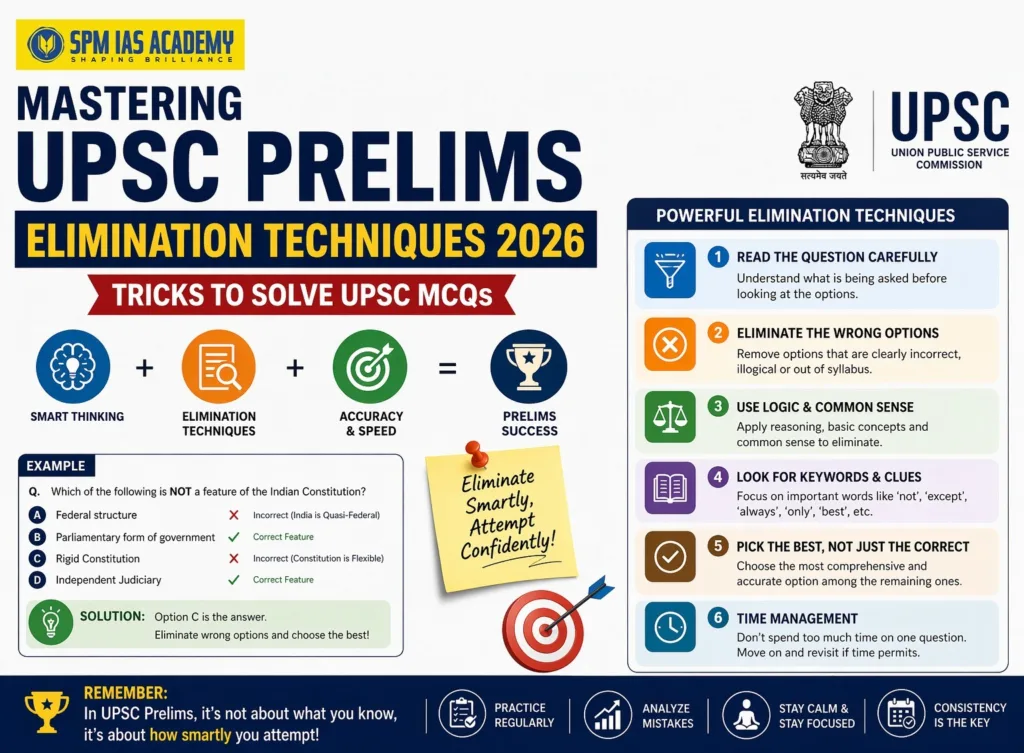
The UPSC Prelims Elimination Techniques 2026 landscape has shifted dramatically. Between 2023 and 2025, UPSC introduced a new question pattern. Questions now carry subtle traps, layered statements, and paired-answer formats. Aspirants who rely on old shortcut tricks are losing marks, not saving them.
The classic advice was simple: spot an extreme word, eliminate that option, and move on. That approach worked for the 2015-2020 era. It does not work today. In 2026, cracking Prelims requires logical reduction, a sharper, analytical form of elimination.
In this article, we will look into the updated technique, backed by UPSC pattern changes and real exam logic.
The Shift in 2026: Logical Reduction, Not Simple Tricks
UPSC has evolved. The exam setters are aware of popular coaching tricks, leading them to construct questions that punish blind pattern-matching. To navigate these changes, understanding UPSC Prelims Elimination Techniques 2026 has become important for aspirants. Mastering these techniques can help candidates effectively eliminate incorrect options and enhance their chances of success in this competitive exam.
What Changed After 2023?
- Statement-based MCQs now use ‘Only one of the above is correct’ and ‘Only two of the above are correct’ formats.
- Paired questions test whether you can match cause-and-effect, scheme-ministry, or data-fact pairs.
- Distractors are now planted inside correct-looking statements, not in obviously wrong options.
- Science & Technology questions test application, not just recall.
Logical reduction means: eliminate what you can definitively disprove, then reason your way to the most defensible answer. It is a thinking process, not a shortcut.
For structured guidance, consider coaching classes for upsc in assam to strengthen your logical elimination and exam strategy.
UPSC MCQ Tricks: Updated Strategies for 2026
1. The ‘Extreme Word’ Strategy: Now With Nuance
Words like “All,” “None,” “Always,” “Never,” “Drastic,” and “Only” are still useful signals. But UPSC has started embedding them inside correct statements too. Here is how to handle them in 2026:
- Extreme words in factual, scientific, or legal contexts are sometimes correct. Example: ‘All mammals are warm-blooded’ This is factually true.
- Extreme words in policy, governance, or historical statements are usually traps. Governance rarely operates in absolutes.
- Do not eliminate based on extreme words alone. First ask: Does this domain allow for absolute statements?
Key Rule: Use extreme words as a yellow flag, not a red one. They signal caution, not automatic elimination.
Aspirants can benefit from UPSC coaching in north east India to master evolving prelims patterns and analytical reasoning techniques.
2. The Science-Tech ‘Can’ Rule
In Science & Technology questions, statements using words like “can,” “may,” “is possible,” or “has the potential to” are almost always correct.
Why? Because science communicates possibility and potential. A statement that says a technology ‘can be used for X’ is almost never wrong because ‘can’ does not claim certainty.
Examples from recent patterns:
- “Quantum encryption can be used to prevent data breaches.” – Very likely correct.
- “Gene editing may allow treatment of hereditary diseases.” – Almost certainly correct.
- “Solar panels always produce maximum output at noon.” – Likely a trap (extreme word + factual claim).
Apply this rule in UPSC 2026 preparation strategy: During mock tests, mark every Science & Tech statement with ‘can/may’ as a provisional ‘correct.’ Revisit only if another statement is stronger.
3. The Ministry and Data Swap Technique
UPSC frequently swaps two elements in factual statements to create false options. The two most common swaps are:
- Ministry Swap: A scheme is attributed to the wrong ministry. Example: ‘Pradhan Mantri Fasal Bima Yojana is managed by the Ministry of Finance’, it is actually under the Ministry of Agriculture.
- Numerical Data Swap: Percentages, targets, years, or statistics are altered slightly. Example: ‘30% of India’s GDP’ instead of the correct figure.
How to handle this:
- Do not try to memorise every data point. Instead, learn the correct ministry-scheme-year triplets for flagship programmes.
- When a number feels slightly off, flag it. Trust your preparation over an unfamiliar figure.
- In pairs-based questions, verify both elements of the pair independently.
4. Intelligent Guessing in Prelims: When and How
Intelligent guessing in Prelims is not random guessing. It is structured decision-making under uncertainty.
Follow this three-step protocol:
- Step 1: Eliminate definitively wrong options. Even if you can rule out just one, your probability improves from 25% to 33%.
- Step 2: Apply domain signals. Use the ‘Can Rule’ for Science & Tech. Use caution with extreme words in policy questions.
- Step 3: Choose the most general, moderate, defensible answer. UPSC rarely rewards the most dramatic option.
Only attempt intelligent guessing when you can eliminate at least one option. Blind guessing on all unknowns is a score-killer.
5. Logical Reasoning for IAS Prelims: Psychological Stability
Logical reasoning for IAS Prelims is as much a mental skill as it is an academic one. Anxiety distorts judgment.
Here is what happens under stress:
- You second-guess statements you already know are correct.
- You spot ‘tricks’ that are not there.
- You changed the correct answers at the last moment.
How to build psychological stability:
- Practice timed mock tests under exam-like conditions no phone, no breaks.
- After each mock, review why you changed answers. Track your ‘correct-to-wrong’ changes.
- Develop a fixed decision rule: if you can eliminate one option and apply a domain signal, attempt it. Otherwise, leave it.
Old Elimination vs New Logical Reasoning: A UPSC Pattern Changes Comparison
The evolving landscape of competitive examinations has led to significant changes in the way candidates approach the UPSC Prelims. With the introduction of new logical reasoning methods, there is a distinct shift from the traditional elimination techniques used in previous years. As we prepare for the UPSC Prelims Elimination Techniques 2026, understanding these updated strategies becomes important for aspirants aiming to crack this prestigious exam.
This comparison sheds light on the key differences and how they can impact preparation and performance:
| Aspect | Old Elimination (Pre-2023) | New Logical Reasoning (2024-26) |
| Approach | Rule-based (surface tricks) | Logic-based (analytical reduction) |
| Extreme Words | Always wrong – eliminate instantly | Often misleading, but check context first |
| Statement Matching | Pick ‘Only one’ or ‘Only two’ by pattern | Verify each statement independently |
| Science & Tech | Guess by elimination alone | Use ‘Can/May’ language as a positive signal |
| Ministry/Data Qs | Recall or skip | Cross-verify department and number pairs |
| Negative Marking Risk | High (over-reliance on tricks) | Lower (logic reduces false confidence) |
| Ideal Score Outcome | 60-70 range | 90–110+ range possible |
Conclusion: Your UPSC 2026 Preparation Strategy Starts Here
The best UPSC Prelims Elimination Techniques 2026 are not mere tricks; they are strategic thinking frameworks. The UPSC rewards aspirants who read carefully, reason systematically, and maintain composure under pressure. To effectively apply these techniques, start by revising core concepts, as elimination is only effective when built on a solid foundation of real knowledge. It’s also important to practice with the previous years’ question papers from 2023 to 2025 to identify new patterns firsthand.
Additionally, utilise domain signals, such as the ‘Can Rule,’ ministry-data checks, and an awareness of extreme word caution. Tracking your decisions during mock tests will help you develop discipline regarding when to attempt questions and when to leave them. By applying these UPSC Prelims Elimination Techniques 2026 in your next mock test, you can expect to see a significant improvement in your score.
A balanced UPSC 2026 preparation strategy ensures strong performance in both prelims elimination and mains answer-writing skills.
Frequently Asked Questions (FAQs):
Yes, but it works differently now. In the older format, you could guess the answer by counting correct statements. In the new paired format, you must verify each statement independently and then assess the pair as a unit. Elimination still applies within each statement. Eliminate statements you know are false. Then assess which pairing survives. The process is more rigorous, but elimination remains a core tool. The key difference is that you cannot shortcut the process by counting; you must reason through each statement on its own merit.
There is no fixed number. As a guiding principle: attempt any question where you can eliminate at least one option AND apply a domain-specific signal (like the ‘Can Rule’ or an extreme word flag). Based on a well-prepared candidate’s profile, this typically applies to 15–25 questions per paper. Never attempt elimination-based guessing on questions where you have zero information. The negative marking penalty of 0.66 marks makes random attempts mathematically counterproductive. Quality of elimination matters far more than quantity of attempts.
They are a useful signal but no longer a reliable rule. UPSC has started using factually correct statements that contain extreme words, especially in Science, the Constitution, and Geography. The right approach in 2026 is: treat extreme words as a caution flag, not an elimination trigger. Ask yourself whether this domain logically allows for absolute statements. If you are reading a biology fact (‘All mammals breathe air’), an extreme word does not make it wrong. If you are reading a governance or policy statement (‘The government always prioritises X’), the extreme word is almost certainly a trap. Domain context must guide your judgment.
Treat mock test reviews as seriously as the test itself. After every mock, do a focused review:
List every question where you used elimination. Did it lead to the right answer?
Note every question where you were fooled by an extreme word. What was the domain?
Track every question where you changed a correct answer under stress.
Build a personal error log. After 10 mocks, patterns will emerge in certain question types where your elimination logic is weak. Focus your revision there.
Also, practice with UPSC PYQs from 2021–2025 specifically. Analyse the setters’ intent: where did they place the trap? Was it a ministry swap, a data change, an extreme word, or a ‘can’ statement? Pattern recognition through deliberate practice is the fastest way to sharpen elimination logic.
No, and this is critical to understand. UPSC Prelims Elimination techniques 2026 are a supplement to subject knowledge, not a replacement for it. They help you make better decisions at the margin on questions where you have partial information. If you have not studied the NCERT syllabus, static GS content, and current affairs thoroughly, elimination will not save your score. In fact, without foundational knowledge, elimination becomes guessing in disguise.

Behind every article at SPM IAS Academy is a team of skilled content writers and subject experts committed to making preparation easier for aspirants. From answering common doubts to breaking down complex issues and current affairs, we create content that is accurate, easy to understand, and directly useful for UPSC, APSC, and other competitive exams.